MCQ 11 Mark
The use of one of the following will pollute the environment. This one is :
AnswerNylon cloth is non $-$ biodegradable and pollutes the environment.
View full question & answer→MCQ 21 Mark
Organisms of a higher trophic level which feed on several types of organisms belonging to a number of lower trophic levels constitute the:
AnswerOrganisms of a higher trophic level that feed on several types of organisms belonging to a number of lower trophic levels constitute a food web.
View full question & answer→MCQ 31 Mark
The flow of energy in an ecosystem is always:
AnswerEnergy always flows in one direction in an ecosystem, from a lower trophic level to a higher trophic level.
View full question & answer→MCQ 41 Mark
Which of the following is the best method to dispose of biological wastes from hospitals?
AnswerIncineration, which means burning harmful wastes into ashes, is the best method to dispose of biological wastes from hospitals.
View full question & answer→MCQ 51 Mark
In addition to wheat plants, a crop field ecosystem has organisms such as snake, peacock, eagle and mice. If the wheat plants are sprayed with pesticides periodically, which of the following will have the minimum concentration of pesticides in the body?
AnswerAs mice are in the lowest trophic level, they will have the minimum concentration of pesticides in their body.
View full question & answer→MCQ 61 Mark
AnswerCorrect option: C. Both living organisms and non $-$ living objects.
Both living organisms and non $-$ living objects are components of an ecosystem.
View full question & answer→MCQ 71 Mark
If a grasshopper is eaten by a frog, then the energy transfer will be from :
- A
- B
Producer to primary consumer.
- ✓
Primary consumer to secondary consumer.
- D
Secondary consumer to tertiary consumer.
AnswerCorrect option: C. Primary consumer to secondary consumer.
A grasshopper eats grass; hence, the grasshopper is the primary consumer.
A frog eats the grasshopper, so the frog becomes the secondary consumer.
The energy transfer is from the primary consumer to the secondary consumer,
i.e., from the grasshopper to the frog.
View full question & answer→MCQ 81 Mark
In the following groups of materials, which group/ groups contain only non $-$ biodegradable materials?
$(i)$ Wood, paper, leather.
$(ii)$ Polythene, detergent, $\text{PVC}$.
$(iii$) Plastic, detergent, grass.
$(iv)$ Plastic, bakelite, $\text{DDT}$.
- A
$(iii)$
- B
$(iv)$
- C
$(i)$ and $(iii)$
- ✓
$(ii)$ and $(iv)$
AnswerCorrect option: D. $(ii)$ and $(iv)$
These materials cannot be degraded by micro $-$ organisms and hence are non $-$ biodegradable.
View full question & answer→MCQ 91 Mark
Which of the following constitutes a food chain?
AnswerGrass is eaten by goats, and goats are eaten by humans.
View full question & answer→MCQ 101 Mark
What will happen if deer is missing in the food chain given below? Grass $\rightarrow$ Deer $\rightarrow$ Tiger
- A
The population of tigers increases.
- B
The population of grass decreases.
- C
Tigers will start eating grass.
- ✓
The population of tigers decreases and the population of grass increases.
AnswerCorrect option: D. The population of tigers decreases and the population of grass increases.
If deer are removed from the given food chain, the population of tigers will decrease as they will not have deer for their food and will starve to death. The density of grass will increase as there is no organism to consume it as food.
View full question & answer→MCQ 111 Mark
Which of the following gets the minimum energy through the food chain in an ecosystem?
AnswerAs large carnivores are at the upper trophic levels, they get the minimum energy through the food chain, according to the $10$ per cent law.
View full question & answer→MCQ 121 Mark
What percentage of sun's energy falling on the leaves of green plants is utilised by the plants in the process of photosynthesis and stored as chemical energy of food?
- A
$99$ per cent.
- B
$10$ per cent.
- ✓
$1$ per cent.
- D
$20$ per cent.
AnswerCorrect option: C. $1$ per cent.
Only one per cent of the sun's energy falling on the leaves of green plants is utilised by the plants in the process of photosynthesis and stored as the chemical energy of food.
View full question & answer→MCQ 131 Mark
Most of the water surface of a lake is covered with algae. This algae is part of the food chain which also includes small fish, bird, larvae and big fish. Which of the following will obtain the maximum energy?
AnswerLarvae feed on algae for their nutrition, so they get the energy they require directly from the producers. Thus, they get the maximum energy among all the consumers.
View full question & answer→MCQ 141 Mark
Which pollutant released into the air during refrigeration and airconditioning is the greatest contributor to the depletion of ozone layer?
- A
$\ce{BHC}.$
- B
$\ce{DDT}.$
- ✓
$\ce{CFC}.$
- D
$\ce{UNEP}.$
AnswerCorrect option: C. $\ce{CFC}.$
Chlorofluorocarbons $\ce{(CFCs)}$ are released into the air during refrigeration and air conditioning and are the greatest contributor to the depletion of the ozone layer.
View full question & answer→MCQ 151 Mark
If the energy transferred to a tertiary consumer in a food chain is $10J,$ how much energy was available to the primary consumer?
- A
$100J.$
- B
$500J.$
- ✓
$1000J.$
- D
$5000J.$
AnswerCorrect option: C. $1000J.$
According to the $10$ per cent law, only $10$ per cent of the energy available in one trophic level is transferred to the next trophic level.
View full question & answer→MCQ 161 Mark
One of the following is not a consumer. This one is:
AnswerAlgae are producers, which prepare their food themselves through photosynthesis. They are not consumers.
View full question & answer→MCQ 171 Mark
The harmful chemical which is accumulating in human beings through food chain is:
- A
- ✓
Dichlorodiphenyltrichloroethane.
- C
- D
AnswerCorrect option: B. Dichlorodiphenyltrichloroethane.
The harmful pesticide that accumulates in the bodies of human beings through the food chain, through a process known as biomagnification, is dichlorodiphenyltrichloroethane $\ce{(DDT)}.$
View full question & answer→MCQ 181 Mark
Which of the following represents a possible food chain found in a pond:
| |
Primary producers |
Primary consumers |
Secondary consumers |
| $a.$ |
green algae |
fish |
mosquito larvae |
| $b.$ |
fish |
green algae |
mosquito larvae |
| $c.$ |
mosquito larvae |
fish |
green algae |
| $d.$ |
green algae |
mosquito larvae |
fish |
- A
| Primary producers |
Primary consumers |
Secondary consumers |
| green algae |
fish |
mosquito larvae |
- B
| fish |
green algae |
mosquito larvae |
- C
| mosquito larvae |
fish |
green algae |
- ✓
| green algae |
mosquito larvae |
fish |
AnswerCorrect option: D.
| green algae |
mosquito larvae |
fish |
In a pond, green algae are the primary producers. Green algae are consumed by mosquito larvae, which therefore become the primary consumers. Mosquito larvae are consumed by fish, which then become the secondary consumers.
View full question & answer→MCQ 191 Mark
An aquatic food chain comprises of the organisms like tadpoles, weeds, fish and water beetles. The organism which gets the minimum energy through this food chain is:
AnswerAs fish are in the top trophic level in an aquatic food chain, they get the minimum energy, according to the $10$ per cent law.
View full question & answer→MCQ 201 Mark
The decomposers in an ecosystem:
- A
Convert inorganic material to simpler forms.
- ✓
Convert organic material to inorganic forms.
- C
Convert inorganic material into organic compounds.
- D
Do not break down organic compounds.
AnswerCorrect option: B. Convert organic material to inorganic forms.
Decomposers convert the organic matter present in the bodies of dead organisms into inorganic forms and mix them with the soil.
View full question & answer→MCQ 211 Mark
In a food chain, the initial organism is usually:
AnswerThe initial organism of a food chain is the producer, which produces food through photosynthesis.
View full question & answer→MCQ 221 Mark
In the figure given alongside, the various trophic levels are shown in the form of a pyramid. At which trophic level the maximum energy is available?
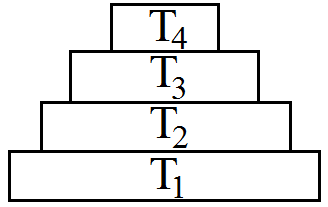
AnswerAt $T_1$, producers, which make food, are present, and hence they are at the bottom of the trophic levels.
As they get energy directly from the sun, they have the maximum energy.
This energy keeps on reducing as it is passed on to the next trophic levels.
View full question & answer→MCQ 231 Mark
If the energy available at the producer level in a food chain is $150J,$ how much energy will be transferred to: tertiary consumer?
- A
$15J.$
- B
$10J.$
- C
$1.50J.$
- ✓
$0.15J.$
AnswerCorrect option: D. $0.15J.$
According to the $10$ per cent law, only $10$ per cent of the energy available in one trophic level is transferred to the next trophic level.
View full question & answer→MCQ 241 Mark
One of the following is not a biodegradable material. This one is:
AnswerAluminium foil cannot be degraded by the action of micro$-$organisms and hence is non$-$biodegradable.
View full question & answer→MCQ 251 Mark
One of the following is a micro$-$consumer. This one is:
AnswerFungi are micro$-$consumers, which consume micro$-$producers.
View full question & answer→MCQ 261 Mark
Which of the following group of organisms are not constituents of a food chain?
$(i).$ Grass, lion, rabbit, wolf.
$(ii).$ Plankton, man, fish, grasshopper.
$(iii).$ Wolf, grass, snake, tiger.
$(iv).$ Frog, snake, eagle, grass, grasshopper.
- A
$(i)$ and $(iii)$
- B
$(iii)$ and $(iv)$
- ✓
$(ii)$ and $(iii)$
- D
$(i)$ and $(iv)$
AnswerCorrect option: C. $(ii)$ and $(iii)$
A food chain is a sequence of living organisms in a community or ecosystem, in which one organism is consumed the other. The organisms given in options $(i)$ and $(iii)$ cannot comprise a food chain.
View full question & answer→MCQ 271 Mark
Organisms which synthesise carbohydrates from inorganic compounds by using radiant energy are called:
AnswerGreen plants are producers that prepare carbohydrates as food from inorganic compounds, such as carbon dioxide and water, by using sunlight as the radiant energy.
View full question & answer→MCQ 281 Mark
A food chain comprises of cat, seed$-$eating bird, plants, and dog. The organism which will have the maximum concentration of harmful pesticides coming through the food chain is most likely to be:
AnswerThe concentration of harmful pesticides in the bodies of birds and animals increases at each trophic level, and hence the dog in the given food chain will have the maximum concentration of harmful pesticides.
View full question & answer→MCQ 291 Mark
$O_2$ is converted into $O_3$ by the action of:
AnswerOxygen is converted into ozone by ultraviolet radiations.
View full question & answer→MCQ 301 Mark
The ten per cent law is associated with:
AnswerCorrect option: C. Transfer of chemical energy from one organism to another.
The $10$ per cent law is associated with the transfer of chemical energy from one organism to another.
View full question & answer→MCQ 311 Mark
Which of the following is not a non$-$biodegradable material?
AnswerA jute carry bag is made from jute, which is a plant fibre. Hence, it is biodegradable.
View full question & answer→MCQ 321 Mark
Which of the following is an artificial ecosystem?
AnswerA crop field is an artificial ecosystem, because it is made by man.
View full question & answer→MCQ 331 Mark
Which of the following act as decomposers in an ecosystem?
AnswerPutrefying bacteria decompose dead organisms, and hence act as decomposers in an ecosystem.
View full question & answer→MCQ 341 Mark
In an ecosystem, the ten per cent energy available for transfer from one trophic level to the next is in the form of:
AnswerThe food prepared by plants is in the form of chemical energy, which is passed on to the next trophic level in an ecosystem.
View full question & answer→MCQ 351 Mark
The excessive exposure of humans to ultraviolet rays results in:
$(i).$ Damage to immune system.
$(ii).$ Damage to lungs.
$(iii).$ Skin cancer.
$(iv).$ Peptic ulcers.
- A
$(i)$ and $(ii)$
- B
$(ii)$ and $(iv)$
- ✓
$(i)$ and $(iii)$
- D
$(iii)$ and $(iv)$
AnswerCorrect option: C. $(i)$ and $(iii)$
Excessive exposure of humans to ultraviolet rays results in skin cancer and damage to the immune system.
View full question & answer→MCQ 361 Mark
Which of the following statement is incorrect?
- A
All green plants and blue green algae are producers.
- ✓
Green plants get their food from readymade organic compounds.
- C
Producers prepare their own food from inorganic compounds.
- D
Plants convert solar energy into chemical energy.
AnswerCorrect option: B. Green plants get their food from readymade organic compounds.
This is an incorrect statement as green plants prepare their food themselves; they do not get readymade organic compounds as their food.
View full question & answer→MCQ 371 Mark
In the food chain given below, if the amount of energy available at fourth trophic level is $5\ kJ,$ what was the energy available at the producer level? Grass $\rightarrow$ Grasshopper $\rightarrow$ Frog $\rightarrow$ Snake $\rightarrow$ Hawk
- A
$500\ kJ.$
- B
$50\ kJ.$
- ✓
$5000\ kJ.$
- D
$5\ kJ.$
AnswerCorrect option: C. $5000\ kJ.$
According to the $10$ per cent law, only $10$ per cent of the energy available in a trophic level is passed on to the next level. Hence, if the amount of energy available at the fourth trophic level is $5\ kJ,$ the energy available at the producer level will be $5,000\ kJ: 5 \rightarrow 50 \rightarrow 500 \rightarrow 5,000.$
View full question & answer→MCQ 381 Mark
Which of the following limits the number of trophic levels in a food chain?
- A
Insufficient food supply from producer level.
- ✓
Decrease in energy at higher trophic levels.
- C
Increase in the number of organisms at higher trophic levels.
- D
Accumulation of harmful chemicals at higher trophic levels.
AnswerCorrect option: B. Decrease in energy at higher trophic levels.
According to the $10$ per cent law, the amount of energy decreases in each trophic level, and hence the number of trophic levels in a food chain is limited.
View full question & answer→MCQ 391 Mark
One of the following helps in the recycling of materials in an ecosystem. This one is:
AnswerSaprotrophs such as bacteria and fungi recycle the organic matter present in the bodies of dead organisms by mixing it with the soil.
View full question & answer→MCQ 401 Mark
The depletion of ozone layer in the upper atmosphere is mainly due to the emission of:
AnswerChlorofluorocarbons emitted by air$-$conditioners, refrigerators and jet planes cause the depletion of the ozone layer.
View full question & answer→MCQ 411 Mark
What provides the energy which then flows through a food chain?
AnswerSunlight provides energy to plants for preparing food, and this energy is then passed on to the next trophic levels through a food chain.
View full question & answer→MCQ 421 Mark
Which of the following is not a producer?
AnswerZooplanktons are herbivorous micro$-$organisms such as protozoa that are found in water bodies. They depend upon producers for food and hence are not producers.
View full question & answer→MCQ 431 Mark
Which of the following cannot be added in a composting pit to prepare compost?
- A
- B
Fruit and vegetable peels.
- ✓
- D
AnswerPlastic is a non$-$biodegradable substance, and hence it cannot be decomposed by composting.
View full question & answer→MCQ 441 Mark
Sahara Desert was formed over a period of time due to one of the following uncontrolled activities of man:
- A
Excessive cutting down of forest plants and trees.
- B
Excessive killing of large herbivores.
- ✓
Excessive killing of large carnivores.
- D
Excessive use of poisonous chemicals herbicides.
AnswerCorrect option: C. Excessive killing of large carnivores.
Excessive killing of lions resulted in an increase in the number of herbivores, which in turn consumed all the vegetation.
Hence, the Sahara Desert was formed.
View full question & answer→Question 451 Mark
Which of the following are decomposers of dead organisms?
|
|
Bacteria
|
Fungi
|
Viruses
|
|
(a)
|
no
|
yes
|
yes
|
|
(b)
|
yes
|
no
|
yes
|
|
(c)
|
yes
|
yes
|
no
|
|
(d)
|
yes
|
yes
|
yes
|
Answer
| |
Bactaria |
Fungi |
Viruses |
| (C) |
Yes |
Yes |
No |
Explanation:
Bacteria and fungi are decomposers of dead organisms.
View full question & answer→MCQ 461 Mark
Disposable plastic plates should not be used because:
AnswerCorrect option: D. They are made of non $-$ biodegradable materials.
Disposable plastic plates cannot be degraded by micro$-$organisms and hence should not be used. They will remain as such in the environment and pollute it.
View full question & answer→MCQ 471 Mark
In the food chain comprising of a snake, grass, insect, and frog, the secondary consumer is:
AnswerThe grass is eaten by the insect, which is eaten by the frog, which is eaten by the snake. Hence, the grass is the producer, the insect is the primary consumer, the frog is the secondary consumer and the snake is the tertiary consumer.
View full question & answer→MCQ 481 Mark
In a food chain, the third trophic level is always occupied by:
AnswerThe third trophic level is always occupied by carnivores. The first trophic level is occupied by producers, the second by herbivores and the fourth by decomposers.
View full question & answer→MCQ 491 Mark
In an ecosystem:
$(i).$ The flow of energy is unidirectional.
$(ii).$ The flow of materials is unidirectional.
$(iii).$ The flow of materials is cyclic.
$(iv).$ The flow of energy is cyclic.
- A
$(i)$ and $(ii)$
- B
$(ii)$ and $(iii)$
- C
$(i)$ and $(iv)$
- ✓
$(i)$ and $(iii)$
AnswerCorrect option: D. $(i)$ and $(iii)$
In an ecosystem, the flow of energy is unidirectional and the flow of materials is cyclic.
View full question & answer→MCQ 501 Mark
Accumulation of non $-$ biodegradable pesticides in the food chain in increasing amount at each higher trophic level is known as:
AnswerThe accumulation of non-biodegradable pesticides in the food chain in an increasing amount at each higher trophic level is known as biomagnifications.
View full question & answer→