Questions

Write True or False

🎯

Test yourself on this topic

12 questions · timed · auto-graded

Question 11 Mark
If the height of the orbit of a satellite increases, its velocity must also increase.
Answer
False.
Explanation:
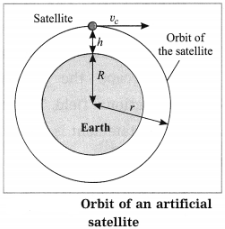
Centripetal force on the satellite $\frac{m v_c^2}{R+h}=$ gravitational force exerted by the earth on the satellite $\frac{G M m}{(R+h)^2}$
where,
m : mass of the satellite
$u_c$ : critical velocity of the satellite
$h$ : height of the satellite from the surface of the earth
$M$ : mass of the earth
$R$ : radius of the earth
$G$: gravitational constant
$\therefore v_c^2=\frac{G M}{R+h}$
$\therefore v_c=\sqrt{\frac{G M}{R+h}}$
Thus, if the value of $h$ changes, the value of $v_c$ also changes. It means a satellite needs to be given a specific velocity (in the tangential direction) to keep it revolving in a specific orbit.
Image

As per the formula $v_c=\sqrt{\frac{G M}{R+h}}$, if the value of $h$ increases, the value of $U_c$ decreases. Hence, if the height of the satellite from the surface of the earth increases, its velocity decreases.
View full question & answer
Question 21 Mark
A satellite needs a specific velocity to revolve in a specific orbit.
Answer
True.
Explanation:
Centripetal force on the satellite $\frac{m v_c^2}{R+h}$ = gravitational force exerted by the earth on the satellite $\frac{G M m}{(R+h)^2}$where,
$m$: mass of the satellite
$υ_c$: critical velocity of the satellite
$h$: height of the satellite from the surface of the earth
$M$: mass of the earth
$R$: radius of the earth
$G$: gravitational constant
$\begin{aligned} & \therefore v_{ c }^2=\frac{G M}{R+h} \\ & \therefore v_{ c }=\sqrt{\frac{G M}{R+h}}\end{aligned}$
Thus, if the value of h changes, the value of υc also changes. It means a satellite needs to be given a specific velocity (in the tangential direction) to keep it revolving in a specific orbit.
Image
View full question & answer
Question 31 Mark
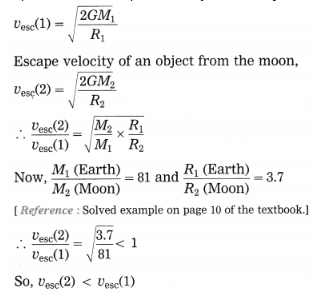
The escape velocity on the moon is less than that on the earth.
Answer
True.
Explanation: Escape velocity of an object from the earth,

Image

View full question & answer
Question 41 Mark
If a spacecraft has to be sent away from the influence of the earth’s gravitational field, its velocity must be less than the escape velocity.
Answer
False.
Explanation: The escape velocity of a body is the minimum velocity with which it should be projected from the earth’s surface, so that it can escape the influence of the earth’s gravitational field. This clearly shows that the given statement is false.
View full question & answer
Question 61 Mark
Polar satellites revolve in an orbit parallel to the equator.
Answer
False. Polar satellites revolve in an orbit along the north and south pole
View full question & answer
Question 71 Mark
All artificial satellites revolve in similar orbits around earth.
Answer
False. All artificial satellites do not revolve in similar orbits around earth.
View full question & answer
Question 81 Mark
If the height of the orbit of a satellite increases, its velocity must also increase.
Answer
False. If height increases, the velocity decreases.
View full question & answer
Question 101 Mark
The escape velocity on the Moon is less than that on the Earth.
Answer
True. As the gravitational force of attraction on the moon is 1/6th of the Earth. Hence, less escape velocity is required to overcome the gravitational force.
View full question & answer
Question 121 Mark
If a spacecraft has to be sent away from the influence of earth's gravitational field; its velocity must be less than the escape velocity
Answer
False. The escape velocity is responsible to launch a rocket in space which can overcome the earth's gravitational force. Hence, its velocity should be more than the escape velocity.
View full question & answer