Question types

P-2 Towards Green Energy question types

165 questions across 7 question groups — pick any mix to generate a Science paper with step-by-step answer keys.

165
Questions
7
Question groups
5
Question types
Sample Questions

P-2 Towards Green Energy questions

One sample from each question group in this chapter. Select any group above to see the full set with answer keys.

Q 2M.C.Q1 Mark
Which of the following is not the source of green energy?
  • A
    Wind
  • B
    Natural gas
  • C
    Sunlight
  • Fossil fuel

Answer: D.

View full solution
Q 3M.C.Q1 Mark
Which of the following is used in solar cooker to harvest the solar energy?
  • A
    Solar panels
  • B
    Silicon cell
  • Mirrors
  • D
    Glass lid

Answer: C.

View full solution
Q 4M.C.Q1 Mark
What are the two technologies for harnessing solar energy?
  • Solar photovoltaics and solar thermal
  • B
    Solar cooker and solar lamp
  • C
    Heat capturing and Heat conversation
  • D
    Active and passive technologies

Answer: A.

View full solution
Q 5M.C.Q1 Mark
Which is the most abundant and renewable energy?
  • A
    Thermal power
  • Solar energy
  • C
    Fossil fuels
  • D
    Atomic power

Answer: B.

View full solution
Remake the table taking into account relation between entries in three columns.
IIIIII
CoalPotential energyWind electricity plant
UraniumKinetic energyHydroelectric plant
Water reservoirNuclear energyThermal plant
WindThermal energyNuclear power plant
View full solution
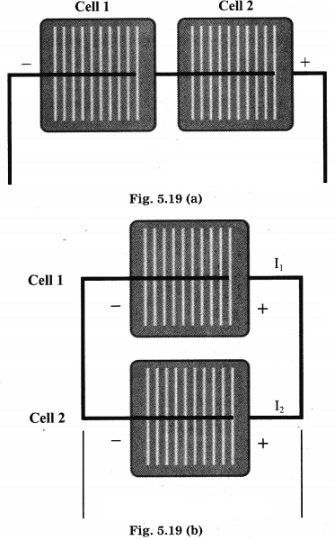
Draw a neat labelled diagrams: One solar panel produces a potential difference of 18 V and current of 3A. Describe how you can obtain a potential difference of 72 Volts and current of 9 A with a solar array using solar panels. You can use sign of a battery for a solar panel.
View full solution
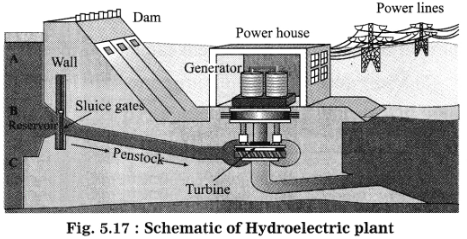
The schematic of hydroelectric plant is shown in Figure. Water from about middle of the total height of the dam is taken to the turbine, as shown by point B in the diagram.
Image
(i) With reference to point B, potential energy of how much water reservoir in the dam will be converted into kinetic energy?
(ii) What will be the effect on electricity generation, if the channel taking water to turbine starts at point A?
(iii) What will be the effect on electricity generation, if the channel taking water to turbine starts at point C?
View full solution
Read the information given below and solve the questions based on it.
Electric energy is produced in various ways like hydroelectric, wind power, solar energy, bio-fuel, etc. These energy sources are inexhaustible, sustainable. Besides, it does not cause any environmental problem.
Questions and Answers:
(1) Above information is about which type of energy?
(2) Whether the fossil fuel is an example of this energy?
(3) Draw the flow chart of production of electric energy.
View full solution
Renewable energy is, energy produced from sources that do not deplete or can be replenished within a human’s life time. The most common examples include wind, solar, geothermal, biorhass, and hydroelectric power. This is in contrast to non-renewable sources such as fossil fuels. Most renewable energy is derived directly or indirectly from the sun. Sunlight can be captured directly using solar technologies. The sun’s heat drives winds, whose energy is captured with turbines. Plants also rely on the sun to grow and their stored energy can be utilized for bioenergy. Not all renewable energy sources rely on the sun. For example, geothermal energy utilizes the Earth’s internal heat, tidal energy relies on the gravitational pull of the moon, and hydroelectric power relies on the flow of water.
Questions and Answers :
(1) What is renewable energy?
(2) Give the examples of renewable energy.
(3) Why will energy from fossil fuel be over soon?
(4) Name the renewable sources of energy which are not dependent on sun. What are they dependent upon?
(5) Which type of energy do we mostly use in India?
View full solution

Generate a P-2 Towards Green Energy paper free

Pick question groups from the list above, set marks and difficulty, and export a branded PDF with step-by-step answer keys. First 3 chapters free — no signup.

Download App