Demographic dividend occurs when the proportion of ____________
Question types
Population in India question types
78 questions across 13 question groups — pick any mix to generate a Economics paper with step-by-step answer keys.
78
Questions
13
Question groups
5
Question types
01
Complete the following statements
15 Q→02Choose the correct option
12 Q→03Complete the correlation
5 Q→04Find the odd word out
2 Q→05Choose the wrong pair
2 Q→06Give economic terms
10 Q→07Choose The Correct Pair.
3 Q→08Identify and explain the concept .
4 Q→09Distinguish between
1 Q→10Answer the following
11 Q→11State with reason, whether you agree or disagree with the following statement
10 Q→12Answer the following questions in detail
1 Q→13Observe the following table and answer the questions
2 Q→Sample Questions
Population in India questions
One sample from each question group in this chapter. Select any group above to see the full set with answer keys.
View full solution →
Under the situation of optimum population, there is a balance between ____________
To continue having children in hope of son is known as ____________
In India marriage is considered as ____________
The situation where the growth of population is faster than the growth of the economy is called ____________Q
Arrange in proper order:
Population Policy in India
(a) Family welfare programme
(b) National population policy
(c) Family planning programme
Population Policy in India
(a) Family welfare programme
(b) National population policy
(c) Family planning programme
- Aa, b, c
- Bb, c, a
- ✓c, a, b
- Dnone of above
Answer: C.
View full solution →Arrange in proper order:
Stages of Demographic Transition
(a) Decline in birth rate and death rate
(b) Low growth of population
(c) Rapid fall in death rate
Stages of Demographic Transition
(a) Decline in birth rate and death rate
(b) Low growth of population
(c) Rapid fall in death rate
- Aa, b, c
- ✓b, c, a
- Cc, a, b
- Dnone of above
Answer: B.
View full solution →Arrange in proper order:
Growth of population in India
(a) Year of Great Divide
(b) Population explosion
(c) Marginal decline in population
(d) Increase in population
Growth of population in India
(a) Year of Great Divide
(b) Population explosion
(c) Marginal decline in population
(d) Increase in population
- Aa, b, c, d
- Ba, c, b, d
- ✓c, a, d, b
- Db, a, c, d
Answer: C.
View full solution →Features of National Population Policy, 2000
(a) Delay marriage age of girls
(b) Free and compulsory education up to age of 20
(c) Achieve a stable population by 2050
(d) Prevention and control of the communicable disease.
(a) Delay marriage age of girls
(b) Free and compulsory education up to age of 20
(c) Achieve a stable population by 2050
(d) Prevention and control of the communicable disease.
- Aa, b, c
- Bb, c, d
- ✓a,c,d
- Db, d
Answer: C.
View full solution →Population Policy of India
(a) Family planning programme
(b) Mid-day meal programme
(c) Family welfare programme
(d) National population policy
(a) Family planning programme
(b) Mid-day meal programme
(c) Family welfare programme
(d) National population policy
- Aa, d
- Bb, c
- ✓a, c, d
- Da, b, c
Answer: C.
View full solution →Theory of Population Growth : ____________ : : Theory of Demographic Transition : Coale and Hoover.
Economic measure to check population : Removal of poverty : : ____________ : Social measure to check population.
Family Planning Programme : 1979 : : National Population Policy : ____________
____________ : Cause of high birth rate : : Use of Nutritious food : Cause of low death rate.
1st Transition stage : Low growth of population : : 2nd Transition stage : ____________
Causes of high birth rate : Illiteracy, Preference, for male child, Expansion of industrial sector, Joint family system.
Concepts related to population growth : Birth rate, Death rate, Survival rate, Interest rate.
| Group ‘A’ | Group ‘B’ |
| (i) Population Policy | (a) Family Welfare Programme |
| (ii) Effects of population explosion | (b) Increased pressure on land |
| (iii) Overpopulation | (c) Population growth < Natural Resources |
| (iv) Theory of Demographic Transition | (d) Coale and Hoover |
| Group ‘A’ | Group ‘B’ |
| (i) Malthusian Theory | (a) Thomas Robert Malthus |
| (ii) Kautilya | (b) Samajshashtra |
| (iii) World Population Day | (c) 11th July |
| (iv) 1921 | (d) Year of Great Divide |
Preference for male children.
The proportion of working people to the total population is high.
The policy was introduced to reduce the birth rate in 2000.
Programme introduced (renamed) to reduce the birth rate in 1979.
Population growth exceeds the availability of natural resources.
| Group ‘A’ | Group ‘B’ |
| (1) Family Welfare Programme | (a) 2000 |
| (2) National Population Policy | (b) 1952 |
| (3) Infant Mortality Rate in 2011 | (c) 1979 |
| (4) Family Planning Programme | (d) 47 per 1000 |
- A1-d, 2-c, 3-a, 4-b
- B1-b, 2-c, 3-d, 4-a
- C1-b, 2-a, 3-c, 4-d
- ✓1-c, 2-a, 3-d, 4-b
Answer: D.
View full solution →| Group ‘A’ | Group ‘B’ |
| (1) 1921 | (a) 121.02 crores |
| (2) 2011 Census | (b) The year of great divide |
| (3) Family Planning | (c) Mortality rate |
| (4) Death rate | (d) Planned parenthood |
- A1-d, 2-c, 3-a, 4-b
- B1-b, 2-c, 3-d, 4-a
- ✓1-b, 2-a, 3-d, 4-c
- D1-c, 2-d, 3-a, 4-b
Answer: C.
View full solution →| Group ‘A’ | Group ‘B’ |
| (1) Census | (a) Survival rate |
| (2) High birth rate | (b) Population per sq. km. |
| (3) Density of population | (c) Universal marriage |
| (4) Difference between birth rate and death rate | (d) Method of computing population |
- ✓1-d, 2-c, 3-b, 4-a
- B1-b, 2-c, 3-d, 4-a
- C1-b, 2-a, 3-c, 4-d
- D1-c, 2-d, 3-a, 4-b
Answer: A.
View full solution →For a certain period of time, China had adopted the policy of ‘One child per family.
In-country ‘B’ there are 15 deaths taking place per 1000 during a year.
In Mumbai city, public transport service is largely affected due to the growing population.
There were 40 births per 1000 in-country ‘A’ during a year.
Birth Rate and Death Rate.
Explain the concepts related to population growth.
Explain the Theory of Demographic Transition.
Explain about Population Policy of India.
What social measures do you suggest to check population growth?
What economic measures do you suggest to check population growth?
The birth rate in India is controlled.
India is not going through a population explosion.
India is in the second stage of demographic transition.
The family planning programme has been very successful in India.
The year 1921 is known as the “Year of Great Divide”.
Explain the measure to check population explosion.
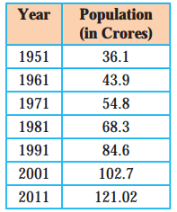
Draw a population growth curve from the given data.
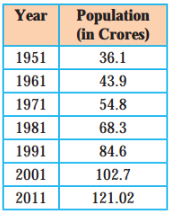
Find out Q3 from the given data
Generate a Population in India paper free
Pick question groups from the list above, set marks and difficulty, and export a branded PDF with step-by-step answer keys. First 3 chapters free — no signup.