Questions

Write short notes in 50 to 60 words

Take a timed test

5 questions · self-marked practice — reveal the answer and mark yourself.

Question 13 Marks
Hermann Ebbinghaus’s experiment
Answer
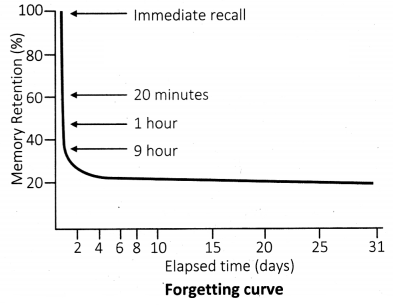
  • The pioneer of experiments on forgetting was Hermann Ebbinghaus.
  • He created several lists of nonsense syllables and learned them. A nonsense syllable is a set of three alphabets where two on both the sides are consonants and the middle one is a vowel, e.g. NOM, GEX.
  • He checked his own recall at various periods of time.
  • He found out that he forgot 40% of whatever he had learned in the first 20 minutes.
  • After one hour, he forgot 60% while after nine hours he forgot a total of 70% of what he had learned.
  • After one day, he could recall only around 30% of the material he learned. After that, his recall was steady for a long period of time.
  • This experiment proved that we forget most of the things we learn in a short span.
Image
View full question & answer
Question 23 Marks
Recall
Answer
  • The recall is the retrieval of information from LTM with few or no cues. Recall can be in the written form or it can be oral.
  • The recall involves remembering a fact, event, or object that is not currently physically present and requires the direct uncovering of information from memory.
  • The recall is of two types, viz. free recall and serial recall.
  • Free recall is a recollection of the items in the list without their serial order, e.g. we may listen to a lecture and later recall few important points irrespective of the order in which they were presented.
  • In serial recall, the material is recalled in the exact order in which it was presented, e.g. when you solve a mathematical problem, you are doing steps one after the other; so, it is serial recall.
  • The recall is greatly affected by emotions and motivation at the time of learning and retrieval.
  • Also, memory for the free recall is always better than if the subjects are asked to recall in a serial order.
View full question & answer
Question 33 Marks
visuospatial Sketch Pad (VSSP)
Answer
  • VSSP handles visual and spatial information. It is responsible for storing speech-based information.
  • It has two components, viz. Phonological memory store and Articulatory Subvocal Rehearsal.
  • Phonological memory stores can hold traces of acoustic or speech-based information.
  • Articulatory Subvocal Rehearsal maintains material in short-term store. Prevention of articulatory rehearsal leads to rapid forgetting.
View full question & answer
Question 43 Marks
Retroactive interference and Proactive interference
Answer
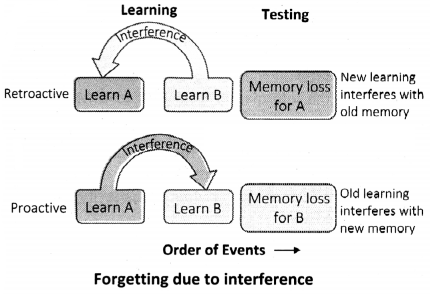
  • Retroactive interference is the partial or complete forgetfulness of the previously learned material due to new memories that get mixed up with the older ones. On the other hand, proactive interference is the partial or complete forgetfulness of newly learned material due to the old material.
  • e.g. You studied Psychology yesterday and you studied Sociology today. If you forget Psychology due to the study of Sociology, it is due to retroactive interference while if you forget Sociology due to the study of Psychology, it is due to proactive interference.
Image
View full question & answer
Question 53 Marks
Primacy effect and Recency effect
Answer
  • The primacy effect occurs when the subject is able to recall items that are presented at the starting point of the list while the recency effect occurs when the subject is able to recall the items which are presented at the end. Free recall is effective in studying both these effects.
  • Both primary and recency effect was witnessed in Murdock’s experiment where subjects could prominently recall the first few and last few words from the list.
  • The primacy effect is the tendency to remember the first piece of information that we encounter in a better manner than the information presented later on. Conversely, the recency effect is the tendency to remember the most recent information in a better way.
View full question & answer