Questions

Write short notes

Take a timed test

9 questions · self-marked practice — reveal the answer and mark yourself.

Question 13 Marks
tendon.
Answer
1. Tendons are a type of dense regular connective tissue.
2. Tendons connect skeletal muscles to bones.
3. They contain bundles of white fibres which give tensile strength to the tissue, e.g. Achilles tendon, Hamstring tendon.
View full question & answer
Question 23 Marks
the structure and location of cartilage.
Answer
Cartilage is a type of supporting connective tissue. It is a pliable yet tough tissue.
Structure:
1. Abundant matrix is delimited by a sheath of collagenous fibres called perichondrium.
2. The matrix is called chondrin.
3. Below the perichondrium, immature cartilage forming cells called chondroblasts are present.
4. Chondroblasts mature and get converted into chondrocytes.Chondrocytes are scattered in the matrix and are enclosed in the lacunae Each lacuna contains 2 to 8 chondrocytes.
5. It forms the endoskeleton of cartilaginous fishes like shark.
6. It is widely distributed in vertebrate animals
View full question & answer
Question 33 Marks
mammalian bone.
Answer
Explain histological structure of mammalian bone.
$a.$ The bone is characterised by hard matrix called ossein which is made up of mineral salt hydroxy apatite $(Ca_{10} (P0_4)_6 (OH)_2).$
$b.$ An outer tough membrane called periosteum encloses the matrix.
$c.$ Blood vessels and nerves pierce through the periosteum.
$d.$ The matrix is arranged in the form of concentric layers called lamellae.
$e.$ Each lamella contains fluid filled cavities called lacunae from which fine canals called canaliculi radiate.
$f.$ The canaliculi of adjacent lamellae connect with each other as they traverse through the matrix.
$g.$ Active bone cells called osteoblasts and inactive bone cells called osteocytes are present in the
lacunae.
$h.$ The mammalian bone shows the peculiar haversian system.
$i.$ The haversian canal encloses an artery, vein and
View full question & answer
Question 43 Marks
hyaline cartilage.
Answer
Hyaline cartilage: The hyaline cartilage is elastic and compressible in nature.
a. Perichondrium is present in this cartilage.
b. Its matrix is bluish white and gel like.
c. Very fine collage fibres and chondrocytes are present in this cartilage.
Function: It acts as a good shock absorber as well as provides flexibility. It reduces friction.
Location: It is found at the end of long bones, epiglottis, trachea, ribs, larynx and hyoid.
View full question & answer
Question 53 Marks
types of glandular epithelium.
Answer
Types: Depending on the mode of secretion, multicellular glands can be further classified as duct bearing glands (exocrine glands) ad ductless glands (endocrine glands).
a. Exocrine glands: These glands pour their secretions at a specific site. e.g. salivary gland, sweat gland, etc.
b. Endocrine glands: These glands release their secretions directly into the blood stream, e.g. thyroid gland, pituitary gland, etc.
View full question & answer
Question 63 Marks
cartilage.
Answer
Cartilage is a type of supporting connective tissue. It is a pliable yet tough tissue.
Structure:
  1. Abundant matrix is delimited by a sheath of collagenous fibres called perichondrium.
  2. The matrix is called chondrin.
  3. Below the perichondrium, immature cartilage forming cells called chondroblasts are present.
  4. Chondroblasts mature and get converted into chondrocytes.
View full question & answer
Question 73 Marks
tendon.
Answer
1. Tendons are a type of dense regular connective tissue.
2. Tendons connect skeletal muscles to bones.
3. They contain bundles of white fibres which give tensile strength to the tissue, e.g. Achilles tendon, Hamstring tendon.
View full question & answer
Question 83 Marks
ciliated epithelium.
Answer
Location: It is found in inner lining of buccal cavity of frog, nasal cavity, trachea, oviduct of vertebrates, etc.
Structure:
1. Cells of this tissue are cuboidal or columnar.
2. Free ends of cells are broad while narrow ends rest on a basement membrane.
3. The free ends of the cell show hair-like cilia.
4. The nucleus is oval and placed at basal end of the cell.
Function: To create a movement of materials that comes in contact with the epithelium, in a specific direction. This aids in functions like prevention of entry of foreign particles in the trachea, pushing of the ovum through the oviduct, etc.
View full question & answer
Question 93 Marks
squamous epithelium
Answer
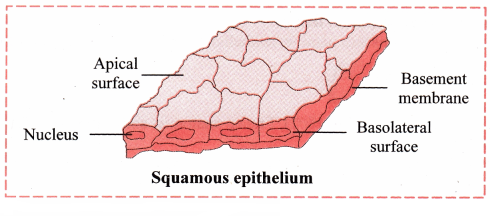
Squamous epithelium or pavement epithelium:
Location: It is present in blood vessels, alveoli, coelom, etc.
Structure:
  1. The squamous epithelium is composed of single layer of cells.
  2. The cells are polygonal in shape, thin and flat, with serrated margin.
  3. They have centrally placed spherical or oval nucleus.
  4. They appear like flat tiles when viewed from above, thus, are also called as pavement epithelium.
  5. Functions: Protection, absorption, transport, filtration and secretion.
Image
View full question & answer