Questions

Write short notes

Take a timed test

18 questions · self-marked practice — reveal the answer and mark yourself.

Question 13 Marks
Write a note on control unit of a cell.
Answer
a. Nucleus contains the genetic material of an organism.
b. This genetic material is present in the form of Deoxyribonucleic Acid (DNA) which is responsible for synthesis of various proteins and enzymes.
c. These proteins and enzymes in turn regulate metabolic activities of the cells.
Therefore, nucleus is considered as control unit of a cell.
View full question & answer
Question 23 Marks
Write short note on lysosomes.
Answer
Lysosomes:
  1. Lysosomes are considered as dismantling and restructuring units of a cell.
  2. These are membrane bound vesicles containing hydrolytic enzymes. The enzymes in lysosomes are used by most eukaryotic cells to digest (hydrolyse) macromolecules.
  3. The lysosomal enzymes show optimal activity in acidic pH.
  4. Lysosomes arise from Golgi associated endoplasmic reticulum.
  5. Lysosomes are polymorphic in nature and are classified as primary lysosomes, secondary or hybrid lysosomes, residual body and autophagic vesicle.
  6. The list of lysosomal enzymes includes:
    All types of hydrolases viz, amylases, proteases and lipases.
View full question & answer
Question 33 Marks
Write a short note on totipotency.
Answer
  1. Totipotency (totus – entire, potential – power) is the capacity or the potential of living nucleated cell, to differentiate into any other type of cell and thus, can form a complete new organism.
  2. A cell is totipotent as it has the entire genetic information of the organism stored in its nucleus.
  3. Embryonic animal cells are totipotent and are termed as stem cells.
  4. Stem cells are used in curing many diseases. Therefore, they have great potential for medical applications.
View full question & answer
Question 43 Marks
Write a note on microscope.
Answer
Cell is defined as a structural and functional unit of life of all living organisms capable of independent existence and can perform all functions of life.
View full question & answer
Question 63 Marks
Explain in detail the structures of components that help in locomotion of unicellular organisms.
Answer
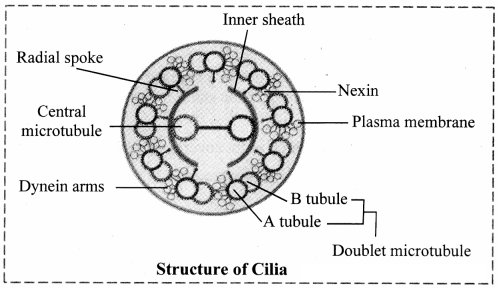
  1. Cilium or flagellum helps in locomotion of unicellular organisms.
  2. They consist of basal body, basal plate and shaft.
  3. Basal body is placed in outer part of cytoplasm. It is derived from centriole. It has nine peripheral triplets of fibrils.
  4. Shaft is exposed part of cilia or flagella. It consists of two parts- sheath and axoneme.
  5. Sheath is covering membrane of cilium or flagellum.
  6. Core called axoneme possesses 11 fibrils (microtubules) running parallel to long axis.
  7. It shows 9 peripheral doublet microtubules and two single central microtubules (9+2).
  8. The central tubules are enclosed by central sheath.
  9. This sheath is connected to one of the tubules of peripheral doublets by a radial spoke.
  10. Central tubules are connected to each other by bridges.
  11. The peripheral doublet microtubules are connected to each other through linkers or inter-doublet bridge.
View full question & answer
Question 83 Marks
Explain the cytoskeletal system of a cell.
Answer
  1. The cytoskeleton is a supportive structure built from microtubules, intermediate filaments, and
    microfilaments.
  2. Microtubules are made up of protein- tubulin.
  3. Microfilaments are made up of actin.
  4. Intermediate filaments are composed of fibrous proteins.
View full question & answer
Question 93 Marks
Write a note on chromatin material.
Answer
  1. Nucleus contains genetic information in the form of chromosomes which are DNA molecules associated with proteins.
  2. In a non-dividing cell, the chromosomes appear as thread like network and cannot be identified individually. This network is called chromatin material.
  3. The chromatin material contains DNA, histone and non-histone proteins and RNA.
  4. In some regions of chromatin, DNA is more and is genetically active called euchromatin.
  5. Some regions that contain more of proteins and less DNA and are genetically inert, are called
    heterochromatin.
View full question & answer
Question 103 Marks
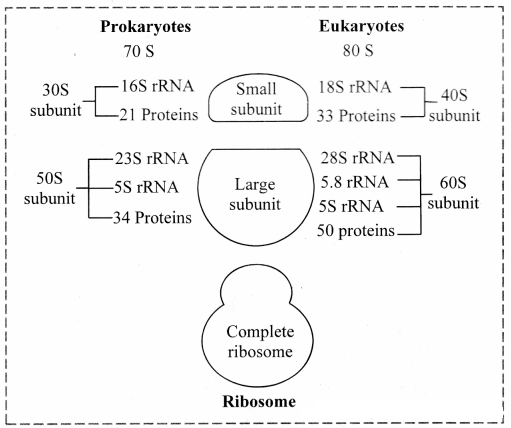
Insulin is the protein hormone synthesized by pancreatic cells. Name the component that performs the role of protein factory and draw their labelled structure as seen in prokaryotes and eukaryotes.
Answer
Ribosomes are the protein factories that synthesize proteins using genetic information.Image
View full question & answer
Question 113 Marks
Draw a labelled diagram of the organelle which plays a significant role in synthesis of starch in plants. Write a note on its structure.
Answer
Chloroplast plays a significant role in synthesis of starch in plants.
Structure of chloroplast:
  1. In plants, chloroplast is found mainly in mesophyll of leaf.
  2. Chloroplast is lens shaped but it can also be oval, spherical, discoid or ribbon like.
  3. A cell may contain single large chloroplast as in Chlamydomonas or there can be 20 to 40 chloroplasts per cell as seen in mesophyll cells.
  4. Chloroplasts contain green pigment called chlorophyll along with other enzymes that help in production of sugar by photosynthesis.
  5. Inner membrane of double membraned chloroplast is comparatively less permeable.
  6. Inside the cavity of inner membrane, there is another set of membranous sacs called thylakoids.
  7. Thylakoids are arranged in the form of stacks called grana (singular: granum).
  8. The grana are connected to each other by means of membranous tubules called stroma lamellae.
  9. Space outside thylakoids is filled with stroma.
  10. The stroma and the space inside thylakoids contain various enzymes essential for photosynthesis.
  11. Stroma of chloroplast contains DNA and ribosomes (70S).
View full question & answer
Question 123 Marks
What are plastids?
Answer
Plastids are double membraned organelles containing DNA, RNA and 70S ribosomes.
View full question & answer
Question 133 Marks
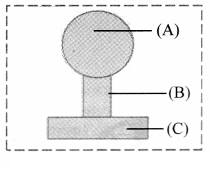
Identify and label the following structure. Write a note on it.
Image
Answer
$1.$ The given structure is of Oxysome/$ F_1$ Particle.
$2. A:$ Head $(F_1)$
$B:$ Pedicel
$C:$ Foot $($Base $/ F_0)$
$3.$ Structure of Oxysome:
$a.$ Inner membrane of mitochondria bears numerous particles called as Oxysomes $(F_1 – F_o /$ Fernandez
Moran Elementary particles / Mitochondrial particles$)$.
$b.$ Each particle consists of head, stalk (Pedicel) and base.
$c.$ Head $(F_1)$ / lollipop head faces towards matrix and foot $(F0)$ is embedded in inner membrane.
$d.$ Head acts as an enzyme $\text{ATP}$ synthase and foot $($base$)$ as proton channel. Oxysomes are involved in
proton pumping and $\text{ATP}$ synthesis.
View full question & answer
Question 143 Marks
Write a note on vacuoles.
Answer
The organelle which helps in maintaining turgidity of the cell and a proper internal balance of cellular contents is known as vacuole.
  1. The vacuoles are bound by semipermeable membrane, called tonoplast membrane. This membrane helps in maintaining the composition of vacuolar fluid (cell sap), different from that of the cytosol.
  2. Composition of cell sap differs in different types of cells.
  3. In vacuoles along with excretory products other compounds are stored that are harmful or unpalatable to herbivores, thereby protecting the plants.
  4. Attractive colours of the petals are due to storage of such pigments in vacuoles.
  5. Generally, there are two or three permanent vacuoles in a plant cell.
  6. In some large plant cells, a single large vacuole occupies the central part of the cell. It is called central vacuole. In such cells, vacuole can occupy about 90% of the total volume of the cell.
  7. The cell sap of central vacuole is a store house of various ions and thus is hypertonic to cytosol.
  8. Small vacuoles in seeds of certain plants store organic materials like proteins.
  9. In animal cells, they are few in number and smaller in size.
  10. Intake of food or foreign particle by phagocytosis involves formation of food vacuole.
View full question & answer
Question 153 Marks
Write a note on lysosomes and make a list of lysosomal enzymes.
Answer
Lysosomes:
  1. Lysosomes are considered as dismantling and restructuring units of a cell.
  2. These are membrane bound vesicles containing hydrolytic enzymes. The enzymes in lysosomes are used by most eukaryotic cells to digest (hydrolyse) macromolecules.
  3. The lysosomal enzymes show optimal activity in acidic pH.
  4. Lysosomes arise from Golgi associated endoplasmic reticulum.
  5. Lysosomes are polymorphic in nature and are classified as primary lysosomes, secondary or hybrid lysosomes, residual body and autophagic vesicle.
  6. The list of lysosomal enzymes includes:
    All types of hydrolases viz, amylases, proteases and lipases.
View full question & answer
Question 163 Marks
Write a note on cytoplasm in Eukaryotic cell.
Answer
Cytoplasm in Eukaryotic cell:
  1. The cell contains ground substance called cytoplasmic matrix or cytosol.
  2. This colloidal jelly like material shows streaming movements called cyclosis.
  3. The cytoplasm contains water as major component along with organic and inorganic molecules like sugars, amino acids, vitamins, enzymes, nucleotides, minerals and waste products.
  4. It also contains various membrane-bound cell organelles like endoplasmic reticulum, Golgi complex, mitochondria, plastids, nucleus, microbodies and cytoskeletal elements like microtubules.
  5. Cytoplasm acts as a source of raw materials as well as seat for various metabolic activities taking place in the cell.
  6. It helps in distribution and exchange of materials between various cell organelles.
View full question & answer
Question 173 Marks
Explain the structure of plant cell wall.
Answer
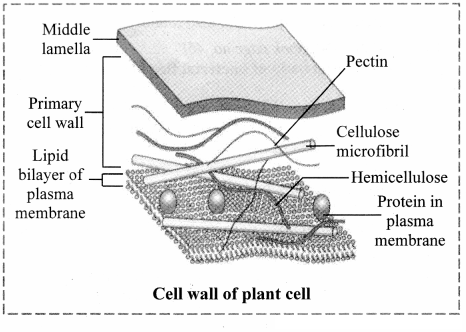
In plants, cell wall shows middle lamella, primary wall and secondary wallImage
1. Middle lamella:
It is thin and present between two adjacent r cells. It is the first structure formed from cell plate during cytokinesis. It is mainly made up of pectin, calcium and magnesium pectate. Softening of ripe fruit is due to solubilization of pectin.
2. Primary wall:
In young plant cell, it is capable of growth. It is laid inside to middle lamella.
It is the only wall seen in meristematic tissue, mesophyll, pith, etc.
3. Secondary wall:
It is present inner to primary wall. Once the growth of primary wall stops, secondary wall is laid. At some places thickening is absent which leads to formation of pits.
View full question & answer
Question 183 Marks
Write a note on cell wall in Eukaryotic cells.
Answer
  • The rigid, protective and supportive covering, outside the cell membrane is called cell wall. It is present in plant cells, fungi and some protists.
  • Algae show presence of cellulose, galactans, mannans and minerals like calcium carbonate in cell wall.
  • In other plants, it is made up of hemicelluloses, pectin, lipids and protein.
  • Microfibrils of plant cell wall show presence of cellulose which is responsible for rigidity.
  • Some of the depositions of cell wall are silica (grass stem), cutin (epidermal walls of land plants), suberin (endodermal cells of root), wax, lignin.
  • Function:
    • Provides support, rigidity and shape to the cell.
    • Protects the protoplasm against mechanical injury and infections.
View full question & answer