Questions

Answer the following questions in detail

Take a timed test

11 questions · self-marked practice — reveal the answer and mark yourself.

Question 13 Marks
With the help of labelled diagram explain Kranz anatomy.
Answer
$1.$ Anatomy of leaves of $C_4$ plants is different from leaves of $C_3$ plants.
$2. \ C_4$ plants show Kranz anatomy.
$3.$ In the leaves of such plants, there is a bundle sheath around the vascular bundles.
$4.$ The chloroplasts in the bundle – sheath cells are large and without or less developed grana, where as in the mesophyll cells the chloroplasts are small but with well$-$developed grana.
View full question & answer
Question 23 Marks
Give graphic representation of cyclic photophosphorylation.
Answer
Cyclic photophosphorylation:
a. Illumination of photosystem-I causes electrons to move continuously out of the reaction center of photosystem-I and back to it.
b. The cyclic electron-flow is accompanied by the photophosphorylation of ADP to yield ATP. This is termed as Cyclic photophosphorylation.
c. Since this process involves only pigment system I, photolysis of water and consequent evolution of oxygen does not take place.
View full question & answer
Question 33 Marks
Explain the nature of light.
Answer
  1. Light is a form of energy.
  2. It travels as stream of tiny particles called photons.
  3. A photon contains a quantum of light.
  4. Light has different wavelengths having different colors.
  5. One can see electromagnetic radiation with wavelengths ranging from 390nm to 730nm. This part of the spectrum is called the Visible light.
  6. It lies between wavelengths of ultraviolet and infra-red.
View full question & answer
Question 43 Marks
What is the main function of accessory pigment?
Answer
1. Accessory pigments are light absorbing molecules which are found in photosynthetic organisms.
2. They transfer the absorbed light to chlorophyll-a and thus increasing the photosynthetic rate.
3. In absence of accessory pigments less amount of light will be absorbed and also there would be no protection provided to chlorophyll molecule from photo-oxidation.
View full question & answer
Question 53 Marks
Sketch and label ‘Ultrastructure of Chloroplast’.
Answer
  1. The chloroplasts are discoid and lens shaped in higher plants. Chloroplast is bounded by a double membrane.
  2. System of chlorophyll bearing a double-membrane sac is present inside the stroma.
  3. These are stacked one above the other to form grana.
  4. Individual sacs in each granum is are known as thylakoid.
  5. All the pigments chlorophylls, carotenes and xanthophylls are located in thylakoid membranes.
  6. These pigments are fat soluble and are present in lipid part of membrane also they absorb light of specific spectrum in the visible regions.
View full question & answer
Question 63 Marks
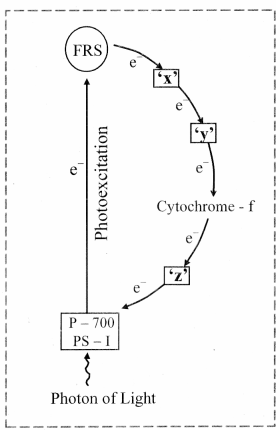
1. Identify ‘x’, ‘y’ and ‘z’ in the given diagrammatic representation of cyclic photophosphorylation.
2. During which steps ATP molecules are formed?
Answer
Image
1. ‘x’ is ferredoxin, ‘y’ is cytochrome-b6 and ‘z’ is plastocyanin.
2. During conversion of ferredoxin to cytochrome-b6 and from cytochrome-b6 to cytochrome-f ATP molecules are formed.
View full question & answer
Question 73 Marks
Give the significance of Photosynthesis.
Answer
$1.$ Photosynthesis is anabolic process which uses inorganic substances and produces food for all life directly or indirectly.
$2.$ This process transforms solar energy into chemical energy.
$3.$ The released by product $O_2$ is necessary not only for aerobic respiration in living organisms but also used in forming protective ozone layer around earth.
$4.$ It also helps us in providing fossil fuels, coals, petroleum and natural gas.
View full question & answer
Question 83 Marks
When does photorespiration occur?
Answer
1. Photorespiration occurs under the conditions like high temperature, bright light, high oxygen and low $CO _2$ concentration. It is a wasteful process linked with $C _3$-Cycle, where instead of fixation of $CO _2$, it is given out.
2. Photorespiration is a respiratory process in many higher plants by which they take up oxygen in the light and give outiearbon dioxide.
View full question & answer
Question 93 Marks
Who discovered the Carbon fixation pathway? How was the pathway studied?
Answer
  1. The path of carbon fixation in dark reaction through intermediate compounds leading to the formation of sugar and starch was discovered by Calvin, Benson and their co-workers discovered the carbon fixation pathway.
  2. Path of carbon was studied with the help of radioactive tracer technique using Chlorella, a unicellular green alga and radioactive${ }^{14} CO _2$.
  3. With the help of radioactive carbon, it becomes possible to trace the intermediate steps of fixation of ${ }^{14} CO _2$.
View full question & answer
Question 103 Marks
The oxidized P-680 regains its electrons by the photolysis of water. Mention the reactions related to the same.
Answer
The oxidized P-680 regains its electrons by the photolysis of water as follows:
1. $4 H _2 O \rightarrow 4 H ^{+}+40 H ^{-}$
2. $4 OH ^{-} \rightarrow 4( OH )+4 e ^{-}$
3. $4 OH ^{-} \rightarrow 2 H _2 O + O _2$
4. $4 H _2 O \rightarrow 2 H _2 O +0_2 \uparrow+4 H ^{+} 4 e ^{-}$Overall reaction
View full question & answer
Question 113 Marks
Which are the two reactions involved in the process of photosynthesis.
Answer
$1.$ The process of photosynthesis is an oxidation and reduction process in which water is oxidized $($to release $O_2)$ and $CO_2$ is reduced to form sugar. It consists of two successive series of reactions.
$2.$ The first reaction requires light and is called Light reaction.
$3.$ Second reaction does not require light and is called Dark or Blackman reaction.
$4.$ Of the two reactions, the former is a photochemical reaction, while the latter is a biochemical reaction.
View full question & answer