Questions

Answer the following questions in detail.

Take a timed test

11 questions · self-marked practice — reveal the answer and mark yourself.

Question 16 Marks
In a chemical laboratory, Priyal was asked to isolate an organic compound from its aqueous solution. She added ethyl acetate to the given sample, separated the organic layer and kept it for evaporation. At the end of her practical, Priyal found few crystals in the beaker which she kept for evaporation. Answer the following questions:
i. In the above passage, which method was used by Priyal for separation? State its principle.
ii. Why do you think the organic compound dissolved in ethyl acetate?
iii. Illustrate the method of separation used in the passage with an example.
Answer
i. Method used: Solvent extraction method.
Principle: Extraction of compound takes place based on the difference in solubility of compound in two liquids,
  • In this process, the solute distributes itself between two immiscible liquids. From the aqueous phase the solute gets extracted in the organic phase.
  • On shaking for a few times with small volumes of organic phase, most of the solute gets extracted into the organic phase.
  • Then solute is then recovered from organic solvent either by evaporation of organic solvent or distillation.
ii. An organic compound (non-polar) dissolves in organic solvents (non-polar) because of the dipole-dipole interactions in between them (like dissolves like). Water is a polar solvent and it is unlikely that the covalent constituents of the organic substance is strong enough to break the ionic bonds. Any substance dissolves in other because it is able to break the bonds between the solvent molecules and form weak bonds with the solvent molecules. Hence, the organic compound will be more soluble in ethyl acetate as compared to water and this helps in its isolation from aqueous solution.

iii. An example for the separation of organic compound using solvents extraction method is: Benzoic acid in water can be extracted from its aqueous solution by using benzene.
View full question & answer
Question 26 Marks
Describe the process of thin layer chromatography (TLC) and separation of components in it.
Answer
i. Process:
  • A thin layer (about 0.2 mm thick) of an adsorbent like silica gel or alumina is spread over a thin glass plate (called chromplate or TLC plate). This plate acts as a stationary phase.
  • With the help of a capillary tube, the solution of the mixture to be separated is spotted at above 2 cm (on base line) from one end of the TLC plate.
  • The TLC plate is then placed in a closed jar containing a suitable solvent (mobile phase or eluant).
  • As the mobile phase rises up the plate, the components of the mixture move up along with the mobile phase to different distances depending upon their degree of adsorption, thus resulting in complete separation.
ii. Separation of components:
  • If the components are coloured, they appear as separated coloured spots on the plate.
  • If the components are not coloured but have property of fluorescence, they can be visualised under UV light, or the plate can be kept in a chamber containing a few iodine crystals. The Iodine vapours are adsorbed by the components and the spots appear brown.
  • Amino acids are visualised by spraying the plate with a solution of ninhydrin. This is known as spraying agent.
View full question & answer
Question 36 Marks
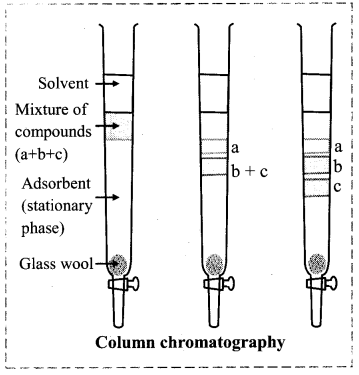
Give a brief description of column chromatography with an illustration.
Answer
Column chromatography involves the separation of components over a column of stationary phase. The stationary phase material can be alumina, silica gel.
Procedure:

Image
  • A slurry of the stationary phase material is filled in a long glass tube provided with a stopcock at the bottom and a glass wool plug at the lower end.
  • The mixture to be separated is dissolved in a suitable solvent and then it is loaded on top of adsorbent column.
  • A suitable mobile phase which could be a single solvent or a mixture of solvents is then poured over the adsorbent column.
  • The mixture along with the mobile phase slowly moves down the column.
  • The solutes get adsorbed on the stationary phase and depending on the degree to which they are adsorbed, they get separated from each other.
  • The component which is readily adsorbed are retained on the column and others move down the column to various distances forming distinct bands.
  • The component which is less strongly adsorbed is desorbed first and leaves the column first, while the strongly adsorbed component is eluted later.
  • The solutions of these components are collected separately.
  • These different components can be recovered by evaporating the solvent.
View full question & answer
Question 46 Marks
What is chromatography? Explain the principle behind it.
Answer
Chromatography is a technique used to separate components of a mixture, and also purify compounds.
Principle: The principle of separation of substances in chromatography is based on the distribution of the solutes in two phases, i.e., stationary phase and mobile phase.
  • Chromatography uses two phases for separation.
  • This technique is based on the difference in rates at which components in the mixture move through the stationary phase under the influence of the mobile phase.
  • In this technique, first the mixture of components is loaded at one end of the stationary phase and then the mobile phase is allowed to move over the stationary phase. The mobile phase can be a pure solvent or a mixture of solvents.
  • Depending on the relative affinity of the components toward the stationary phase and mobile phase, they remain on the surface of the stationary phase or move along with the mobile phase, and gradually get separated.
View full question & answer
Question 56 Marks
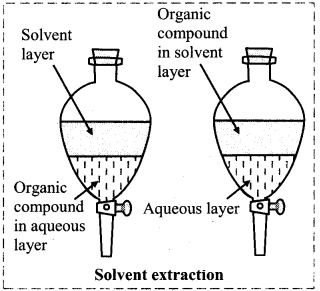
Write the principle of solvent extraction and explain the process with labelled diagram.
Answer
Principle: Extraction of compound takes place based on the difference in solubility of compound in two liquids.
  • In this process, the solute distributes itself between two immiscible liquids. From the aqueous phase the solute gets extracted in the organic phase.
  • On shaking for a few times with small volumes of organic phase, most of the solute gets extracted into the organic phase.
  • Then solute is then recovered from organic solvent either by evaporation of organic solvent or distillation.
Diagram:

Image
View full question & answer
Question 66 Marks
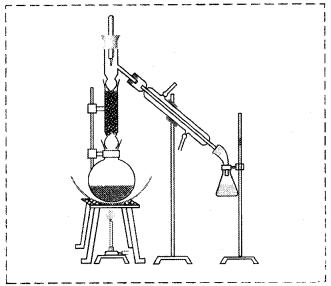
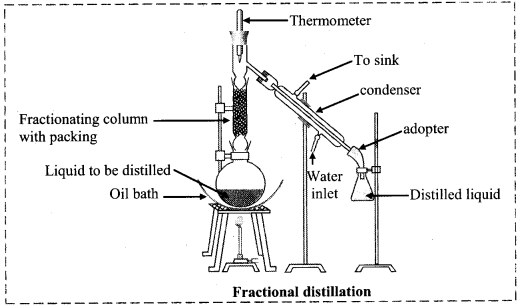
Label the following diagram and explain the process by giving example.

Image
View full question & answer
Question 76 Marks
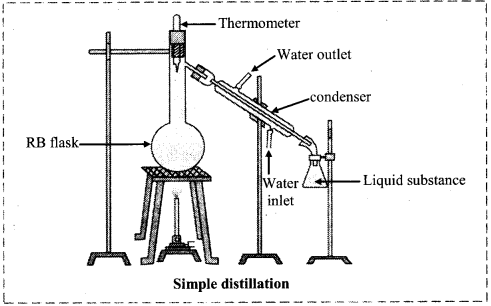
Explain the construction of simple distillation unit using neat labelled diagram.
Answer
i. The apparatus used for simple distillation is shown in the figure below:

Image
ii. It consists of round bottom flask fitted with a cork having a thermometer.
iii. The flask has a sidearm through which it is connected to a condenser.
iv. The condenser has a jacket with two outlets through which water is circulated.
v. The liquid to be distilled is taken in the round bottom flask fixed by clamp.
vi. The flask is placed in a water bath or oil bath or sometimes wire gauze is kept on a stand as shown in the figure.
View full question & answer
Question 86 Marks
Give a brief description of the principle of fractional crystallization.
Answer
Fractional crystallization is based on the differences in solubilities of two or more compounds in the same solvent at the same temperature. That is, the substance which is least soluble crystallizes out first and the most soluble substance crystallizes out last.
e.g. Mixture of two solutes A and B can be purified by fractional crystallization as follows:
  • Preparation of a saturated solution: Mixture of two solutes A and B are dissolved in a suitable hot solvent to prepare a saturated solution.
  • Hot filtration: The hot saturated solution is filtered to remove insoluble impurities.
  • Cooling of the filtrate: Hot filtrate is allowed to cool. On cooling, the solute which is least soluble crystallizes out first leaving behind the most soluble substance in the mother liquor.
  • Filtration: The crystals formed are filtered, washed with solvent and dried. Crystals obtained will be of a solute which is least soluble in a given solvent.
  • Concentration of a mother liquor: The mother liquor is concentrated by evaporating the solvent. These crystals are filtered and dried to obtain the second purified component (which was more soluble in given solvent).
View full question & answer
Question 96 Marks
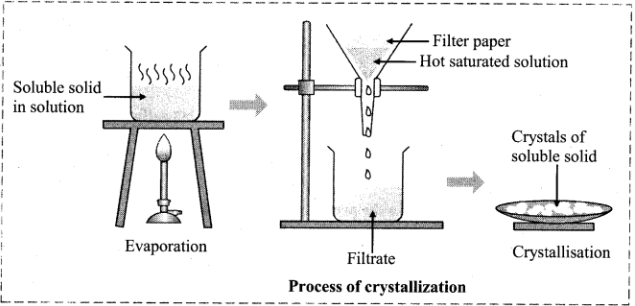
Describe the process of crystallization of common salt from impure sample with the help of a diagram.
Answer
  • Impure sample of a common salt is added to the required quantity of water and stirred with a glass rod.
  • More amount of salt is added and the solution is heated till no more salt dissolves.
  • The hot saturated solution is filtered off to remove insoluble impurities while the filtrate is collected in an evaporating dish.
  • The filtrate is allowed to cool which results in the formation crystals of pure salt (NaCl) leaving behind the soluble impurities.
  • The crystals are filtered and dried.
The diagram is as follows:

Image
View full question & answer
Question 106 Marks
Explain the following steps with respect to the process of crystallization.
i. Preparation of a saturated solution
ii. Hot filtration
iii. Cooling of the filtrate
iv. Filtration
Answer
i. Preparation of a saturated solution:
  • A saturated solution of the crude solid is prepared by boiling it in a small but sufficient quantity of a suitable solvent.
  • On doing so the main solute forms an almost saturated solution, but the solution is not saturated with respect to the soluble impurities, as they are in small proportion.
ii. Hot filtration: The hot saturated solution is quickly filtered to remove undissolved impurities as residue. Filtration under suction can be employed for rapid filtration.
iii. Cooling of the filtrate:
  • The hot filtrate is allowed to cool.
  • On cooling, the filtrate becomes supersaturated with respect to the main dissolved solute because solubility of a substance decreases with lowering of temperature.
  • The excess quantity of the dissolved solute comes out of the solution in the form of crystals.
  • The dissolved impurities, however, do not supersaturate the solution, as their quantity is small.
  • These continue to stay in the solution in dissolved state even on cooling. Therefore, the separated crystals are free from soluble impurities.
iv. Filtration:
  • The crystals obtained on cooling are further purified by filtration to remove insoluble impurities.
  • The filtrate obtained is called as mother liquor.
  • The crystals obtained after filtration are free from soluble as well as insoluble impurities.
View full question & answer
Question 116 Marks
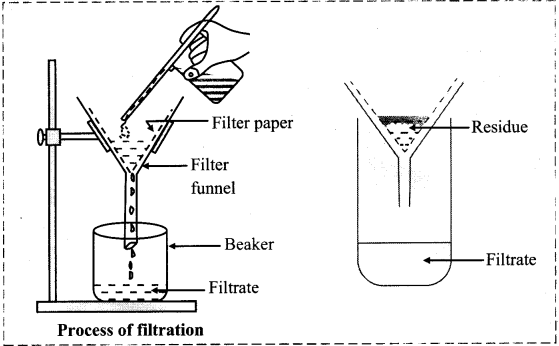
Describe the process of filtration with a neat and labelled diagram.
View full question & answer