Questions

MCQ

Take a timed test

58 questions · 57 auto-graded MCQ + 1 self-marked written.

MCQ 11 Mark
 Identify the molecule in which central atom undergoes sp3 hybridisation?
  • A
    $\mathrm{BeCl}_2$
  • $\mathrm{H}_2 \mathrm{O}$
  • C
    $\mathrm{BF}_3$
  • D
    $\mathrm{C}_2 \mathrm{H}_4$
Answer
Correct option: B.
$\mathrm{H}_2 \mathrm{O}$
B
View full question & answer
MCQ 41 Mark
Which among the following molecules is NOT linear in shape? 
  • $\mathrm{H}_2 \mathrm{~S}$
  • B
    $\mathrm{HBr}$
  • C
    $\mathrm{CO}_2$
  • D
    $\mathrm{BeBr}_2$
Answer
Correct option: A.
$\mathrm{H}_2 \mathrm{~S}$
A
View full question & answer
MCQ 51 Mark
What is the bond length between carbon and bromine in $CH _3- Br$ molecule?
  • 193 pm
  • B
    214 pm
  • C
    139 pm
  • D
    178 pm
Answer
Correct option: A.
193 pm
A
View full question & answer
MCQ 61 Mark
The molecule in which central atom does NOT undergo $sp ^3$ hybridisation is
  • A
    $\mathrm{NH}_3$
  • B
    $\mathrm{CH}_4$
  • C
    $\mathrm{H}_2 \mathrm{O}$
  • $\mathrm{BF}_3$
Answer
Correct option: D.
$\mathrm{BF}_3$
D
View full question & answer
MCQ 71 Mark
Which of the following molecules have bond order greater than one?
  • A
    $F_2$
  • $\mathrm{N}_2$
  • C
    $\mathrm{Li}_2$
  • D
    $\mathrm{H}_2$
Answer
Correct option: B.
$\mathrm{N}_2$
View full question & answer
MCQ 81 Mark
Identify a molecule having bent shape from following.
  • A
    $\mathrm{CO}_2$
  • $\mathrm{SO}_2$
  • C
    $\mathrm{BeBr}_2$
  • D
    $\mathrm{BF}_3$
Answer
Correct option: B.
$\mathrm{SO}_2$
View full question & answer
MCQ 91 Mark
Which of the following compounds is octahedral?
  • $\mathrm{SF}_6$
  • B
    $\mathrm{TeF}_4$
  • C
    $\mathrm{SeCl}_2$
  • D
    $\mathrm{SeF}_4$
Answer
Correct option: A.
$\mathrm{SF}_6$
View full question & answer
MCQ 101 Mark
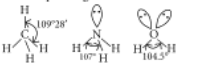
The decreasing order of bond angle in the following molecules is
  • A
    $\mathrm{NH}_3>\mathrm{CH}_4>\mathrm{H}_2 \mathrm{O}$
  • B
    $\mathrm{CH}_4>\mathrm{H}_2 \mathrm{O}>\mathrm{NH}_3$
  • C
    $\mathrm{H}_2 \mathrm{O}>\mathrm{NH}_3>\mathrm{CH}_4$
  • $\mathrm{CH}_4>\mathrm{NH}_3>\mathrm{H}_2 \mathrm{O}$
Answer
Correct option: D.
$\mathrm{CH}_4>\mathrm{NH}_3>\mathrm{H}_2 \mathrm{O}$
View full question & answer
MCQ 111 Mark
Which among the following is electron deficient compound?
  • A
    $\mathrm{CCl}_4$
  • B
    $\mathrm{SiF}_4$
  • C
    $\mathrm{PCl}_5$
  • $\mathrm{BCl}_3$
Answer
Correct option: D.
$\mathrm{BCl}_3$
View full question & answer
MCQ 131 Mark
Which of the following molecules has maximum value of dipole moment?
  • A
    $\mathrm{CH}_3-\mathrm{O}-\mathrm{CH}_3$
  • B
    $\mathrm{CH}_3-\mathrm{Cl}$
  • $\mathrm{CH}_3-\mathrm{CN}$
  • D
    $\mathrm{CH}_3-\mathrm{CH}_2-\mathrm{CH}_3$
Answer
Correct option: C.
$\mathrm{CH}_3-\mathrm{CN}$
View full question & answer
MCQ 151 Mark
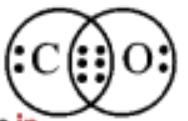
Which among the following is NOT odd electron molecule ?
  • A
    $\mathrm{ClO}_2$
  • B
    $\mathrm{NO}_2 $
  • $\mathrm{CO}$
  • D
    $\mathrm{NO}$
Answer
Correct option: C.
$\mathrm{CO}$
C
View full question & answer
MCQ 161 Mark
Which among the following concepts is NOT introduced by V. B. theory?
  • A
    Delocalization of electron over the two nuclei.
  • Number of lone pair and bonded pair of electrons decide the shape of the molecules.
  • C
    Partial ionic character of a covalent bond.
  • D
    Shielding effect of electrons.
Answer
Correct option: B.
Number of lone pair and bonded pair of electrons decide the shape of the molecules.
B
View full question & answer
MCQ 171 Mark
The bond length of $C - F$ in $CH _3- F$ molecule is
  • 139 pm
  • B
    193 pm
  • C
    178 pm
  • D
    214 pm
Answer
Correct option: A.
139 pm
A
View full question & answer
MCQ 181 Mark
What is $\angle HOH$ in $H _2 O$ molecule?
  • A
    107°
  • 109° 28'
  • C
    104° 28'
  • D
    120°
Answer
Correct option: B.
109° 28'
B
View full question & answer
MCQ 191 Mark
Two lone pairs of electrons and two bond pairs of electrons are present in
  • $\mathrm{H}_2 \mathrm{O}$
  • B
    $\mathrm{NH}_3$
  • C
    $\mathrm{BF}_3$
  • D
    $\mathrm{CO}_2$
Answer
Correct option: A.
$\mathrm{H}_2 \mathrm{O}$
View full question & answer
MCQ 201 Mark
Which among the following statements is NOT correct about dipole moment of $\mathrm{NH}_3$ and $\mathrm{NF}_3$ ?
  • A
    The dipole moment of $\mathrm{NH}_3$ is more than that of $\mathrm{NF}_3$.
  • B
    In $\mathrm{NH}_3$ orbital dipole is in the same direction as that of resultant dipole moment of $\mathrm{N}-\mathrm{H}$ bonds.
  • C
    In $\mathrm{NF}_3$ orbital dipole is in the opposite direction of the resultant dipole moment of three $\mathrm{N}-\mathrm{F}$ bonds.
  • Fluorine is less electronegative than nitrogen.
Answer
Correct option: D.
Fluorine is less electronegative than nitrogen.
D
View full question & answer
MCQ 211 Mark
The angle between two covalent bonds is minimum in:
  • A
    $CH _4$
  • B
    $C _2 H _2$
  • C
    $NH _3$
  • $H _2 O$
Answer
Correct option: D.
$H _2 O$
View full question & answer
MCQ 221 Mark
Which O2 molecule is pargmagnetic. It is explained on the basis of :
  • A
    Hybridisation
  • B
    VBT
  • MOT
  • D
    VSEPR
Answer
Correct option: C.
MOT
MOT
View full question & answer
MCQ 231 Mark
Valence Shell Electron Pair repulsion (VSEPR) theory is used to predict which of the following :
  • A
    Energy levels in an atom
  • the shapes of molecules and ions.
  • C
    the electrone getivities of elements.
  • D
    the type of bonding in compounds.
Answer
Correct option: B.
the shapes of molecules and ions.
View full question & answer
MCQ 241 Mark
When the following bond types are listed in decreasing order of strength (strongest first). Which is the correct order?
  • covalent > hydrogen > van der waals
  • B
    covalent > vander waal’s > hydrogen
  • C
    hydrogen > covalent > vander waal’s
  • D
    vander waal’s > hydrogen > covalent.
Answer
Correct option: A.
covalent > hydrogen > van der waals
View full question & answer
Question 261 Mark
Which of the following is true for $CO_2$?
  $C=O$ bond $CO_2$ molecule
$A$ polar non$-$polar
$B$ non$-$polar polar
$C$ polar polar
$D$ non$-$polar non$-$polar
Answer
  $C=O$ bond $CO_2$ molecule
$A$ polar non$-$polar
View full question & answer
MCQ 271 Mark
Which of the following molecules has no lone pair of electrons on central atom?
  • A
    $SO _2$
  • $SF _6$
  • C
    $NH _3$
  • D
    $SF _4$
Answer
Correct option: B.
$SF _6$
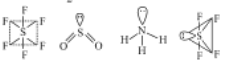
(b):
Image
View full question & answer
MCQ 281 Mark
What is formal charge on carbon in the following Lewis structure? $\ddot{\phi}= c =\ddot{\phi}$
  • 0
  • B
    1
  • C
    -1
  • D
    2
Answer
Correct option: A.
0
(a): The formal charge on $C$ in $CO _2=0$ (Zero)
$
\begin{aligned}
\text { Formal charge } & =\text { Valencee } e^{-}-\text {Non-bondinge } e^{-}-\frac{\text { Bonding } e^{-}}{2} \\
& =4-0-\frac{8}{2}=4-0-4=0
\end{aligned}
$

View full question & answer
MCQ 291 Mark
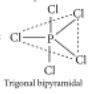
What is the geometry of $PCl _5$ molecule as per VSEPR?
  • Trigonal bipyramidal
  • B
    Octahedral
  • C
    Tetrahedral
  • D
    Square pyramidal
Answer
Correct option: A.
Trigonal bipyramidal
(a):
Image
View full question & answer
MCQ 301 Mark
Which among the following concepts is not introduced by V.B. theory?
  • A
    Partial ionic character of a covalent bond.
  • Number of lone pairs and bond pairs of electrons decide the shape of the molecules.
  • C
    Delocalisation of electrons over two nuclei.
  • D
    Shielding effect of electrons.
Answer
Correct option: B.
Number of lone pairs and bond pairs of electrons decide the shape of the molecules.
(b): Number of lone pairs and bond pairs of electrons decide the shape of the molecules is explained by VSEPR theory.
View full question & answer
MCQ 311 Mark
What is the bond onder of $O _2$ molecule?
  • 2,0
  • B
    1.5
  • C
    1
  • D
    3.5
Answer
Correct option: A.
2,0
(a) : The electronic configuration of $O _2$ is $\sigma 1 s^2 \sigma^* 1 s^2 \sigma 2 s^2 \sigma^2 2 s^2 \sigma 2 p_z^2 \pi 2 p_x^2=\pi 2 p_y^2 \pi^* 2 p_x^1=\pi^* 2 p_y^1$ Bond order $=\frac{10-6}{2}=2$
View full question & answer
MCQ 321 Mark
Which among the following molecules is non polar?
  • A
    $NH _3$
  • B
    $1 Cl$
  • C
    $HCl$
  • $C _6 H _6$
Answer
Correct option: D.
$C _6 H _6$
(d): Benzene, $C _6 H _6$ is a non-polar molecule.
View full question & answer
MCQ 331 Mark
The decreasing order of bond angle in the following molecules is
  • A
    $CH _4> H _2 O > NH _3$
  • B
    $NH _3> CH _4> H _2 O$
  • $CH _4> NH _3> H _2 O$
  • D
    $H _2 O > NH _3> CH _4$
Answer
Correct option: C.
$CH _4> NH _3> H _2 O$
(c):
Image
$CH _4, NH _3$ and $H _2 O$ involve $s p^3$ hybridisation. The number of lone pair of electrons present on $C , N$ and $O$
in $CH _4, NH _3$ and $H _2 O$ are 0,1 and 2 respectively. Greater the number of lone pairs, greater is the repulsion with the bond pairs and hence, smaller is the bond angle.
View full question & answer
MCQ 341 Mark
Which among the following molecules/ions is diamagnetic in nature?
  • A
    Superoxide ion
  • B
    Oxygen molecule
  • Carbon molecule
  • D
    Unipositive ion of nitrogen molecule
Answer
Correct option: C.
Carbon molecule
(c) : The electronic configuration of $C _2$ molecule is $\sigma 1 s^2 \sigma^* 1 s^2 \sigma 2 s^2 \sigma^* 2 s^2 \pi 2 p_x^2=\pi 2 p_y^2$.
Hence, it is diamagnetic in nature. Remaining given
View full question & answer
MCQ 351 Mark
Which of following bonds has maximum bond length?
  • A
    $C - O$
  • B
    $C - H$
  • $C - C$
  • D
    $C - N$
Answer
Correct option: C.
$C - C$
(c) : Bond & Bond length (pm) \\$C - O$ & 143 \\$C - H$ & 107 \\$C - C$ & 154 \\$C - N$ & 143\end{tabular}
View full question & answer
MCQ 361 Mark
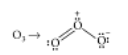
In ozone molecule, the formal charge on the central oxygen atom is
  • A
    $-1$
  • B
    $2$
  • C
    $0$
  • $1$
Answer
Correct option: D.
$1$
$=\left[\begin{array}{l}\text { Total no. of } \\ \text { valence dectrons } \\ \text { in the free atom }\end{array}\right]-\left[\begin{array}{l}\text { Total no. of } \\ \text { non-bonding } \\ \text { electrons }\end{array}\right]-\frac{1}{2}\left[\begin{array}{l}\text { Total no. } \\ \text { of bonding } \\ \text { electrons }\end{array}\right]$
The formal charge on the central oxygen atom
$=6-2-(1 / 2) \times 6$
$=+1$
Image
View full question & answer
MCQ 371 Mark
Formation of $PCl _3$ is explained on the basis of what hybridisation of phosphorus atom?
  • A
    $s p^2$
  • $s p^3$
  • C
    $s p^3 d$
  • D
    $s p^3 d^2$
Answer
Correct option: B.
$s p^3$
(b):
Image
View full question & answer
MCQ 381 Mark
What is the geometry of water molecule?
  • Distorted tetrahedral
  • B
    Tetrahedral
  • C
    Trigonal planar
  • D
    Diagonal
Answer
Correct option: A.
Distorted tetrahedral
(a):
Image
View full question & answer
MCQ 391 Mark
The dipole moment of
  • A
    $NF_3$ is higher than that of $NH_2$​​​​​​​
  • B
    $BF_3$ is higher than that of $NH_3$​​​​​​​
  • C
    $H_2S$ is higher than that of $H_2O$
  • $HCl$ is higher than that of $HBr$
Answer
Correct option: D.
$HCl$ is higher than that of $HBr$
View full question & answer
MCQ 401 Mark
Which of the following compounds is non$-$polar?
  • A
    $HCl$
  • B
    $CH_2Cl_2$
  • C
    $CHCl_3$
  • $CCl_4$
Answer
Correct option: D.
$CCl_4$
$CCl_4$
View full question & answer
MCQ 411 Mark
Each of the following molecules has a non$-$zero dipole moment $\text{EXCEPT}$:
  • A
    $NF_3$
  • $BF_3$
  • C
    $SO_2$
  • D
    $LiH$
Answer
Correct option: B.
$BF_3$
$BF_3$
View full question & answer
MCQ 421 Mark
The common features among the species $CO$ and $NO ^{+}$are:_____________
  • isoelectronic species and bond order 3
  • B
    isoelectronic species and bond order 2
  • C
    odd electron species and unstable
  • D
    odd electron species and bond order 1
Answer
Correct option: A.
isoelectronic species and bond order 3
View full question & answer
MCQ 431 Mark
The bond energies of $F_2, Cl_2, Br_2$ and $ I_2$ are $ 37, 58, 46,$ and $ 36 \ kcal/mol$ respectively. The strongest bond is present in
  • A
    $Br_2$
  • B
    $I_2$
  • $Cl_2$
  • D
    $F_2$
Answer
Correct option: C.
$Cl_2$
$Cl_2$
View full question & answer
MCQ 461 Mark
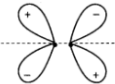
The molecular orbital shown in the diagram can be described as
Image
  • A
    σ
  • B
    σ*
  • π*
  • D
    π
Answer
Correct option: C.
π*
π*
View full question & answer
MCQ 471 Mark
The formation of $O-H$ bonds in a water molecule involves $.............$ overlap.
  • $sp^3-s$
  • B
    $sp^1-s$
  • C
    $sp-p$
  • D
    $sp^3-p$
Answer
Correct option: A.
$sp^3-s$
$sp^3-s$
View full question & answer
MCQ 481 Mark
In acetylene, $C-C \ \sigma$ bond is formed by $..........$ overlap.
  • A
    $sp^2-sp^2$
  • $sp-sp$
  • C
    $sp-s$
  • D
    $p-p$
Answer
Correct option: B.
$sp-sp$
$sp-sp$
View full question & answer
MCQ 491 Mark
In the potential energy curve for hydrogen molecule, the maximum stability is achieved when ………………..
  • A
    potential energy of the system is maximum
  • potential energy of the system is minimum
  • C
    force of repulsion become greater than force of attraction
  • D
    no bond formation takes place
Answer
Correct option: B.
potential energy of the system is minimum
View full question & answer
MCQ 501 Mark
Which of the following is INCORRECT?
  • A
    The strength of the bond depends on the extent of overlap of the atomic orbitals.
  • B
    The extent of overlap depends on the shape and size of the atomic orbitals.
  • The energy of the bonded atoms is more than that of the free atoms.
  • D
    During overlap of atomic orbitals, the electron density increases in between the two nuclei.
Answer
Correct option: C.
The energy of the bonded atoms is more than that of the free atoms.
View full question & answer
MCQ 511 Mark
Which of the following molecule has bent shape?
  • A
    $PCl_3$
  • $OF_2$
  • C
    $BH_3$
  • D
    $BeBr_2$
Answer
Correct option: B.
$OF_2$
$OF_2$
View full question & answer
MCQ 521 Mark
Pair of molecules having identical geometry is
  • A
    $BF_3, NH_3$
  • $BF_3, AlF_3$
  • C
    $BeF_2, H_2O$
  • D
    $BCl_3, PCl_3$
Answer
Correct option: B.
$BF_3, AlF_3$
$BF_3, AlF_3$
View full question & answer
MCQ 531 Mark
What will be the shape of molecule whose central atom is associated with 3 bonds and one lone pair?
  • Trigonal pyramidal
  • B
    Tetrahedral
  • C
    Square planar
  • D
    Triangular planar
Answer
Correct option: A.
Trigonal pyramidal
Trigonal pyramidal
View full question & answer
MCQ 541 Mark
The geometry of $H_2S$ is $…………$
  • A
    tetrahedral
  • angular
  • C
    linear
  • D
    trigonal planar
Answer
Correct option: B.
angular
angular
View full question & answer
MCQ 551 Mark
Identify the geometry represented by the following diagram.
Image
  • A
    Trigonal bipyramidal
  • B
    T-shape
  • C
    square planar
  • square pyramidal
Answer
Correct option: D.
square pyramidal
square pyramidal
View full question & answer
MCQ 561 Mark
In $BF_3,$ bond angle is .
  • A
    $90^\circ$
  • B
    $109^\circ$
  • $120^\circ$
  • D
    $180^\circ$
Answer
Correct option: C.
$120^\circ$
$120^\circ$
View full question & answer
MCQ 571 Mark
Which of the following molecule does not obey octet rule?
  • $BF_3$
  • B
    $CO_2$
  • C
    $H_2O$
  • D
    $N_2$
Answer
Correct option: A.
$BF_3$
$BF_3$
View full question & answer