For the reaction $\mathrm{N}_{2(\mathrm{~g})}+3 \mathrm{H}_{2(\mathrm{~g})} \rightarrow 2 \mathrm{NH}_{3(\mathrm{~g})}$, rate of disappearance of $\mathrm{N}_{2(\mathrm{~g})}$ is $2.22 \times 10^{-3} \mathrm{~mol} \mathrm{dm}^{-3}$. What is the rate of appearance of $\mathrm{NH}_{3(\mathrm{~g})}$ ?
For the reaction $\mathrm{N}_{2(\mathrm{~g})}+3 \mathrm{H}_{2(\mathrm{~g})} \rightarrow 2 \mathrm{NH}_{3(\mathrm{~g})}$, rate of disappearance of $\mathrm{N}_{2(\mathrm{~g})}$ is $2.22 \times 10^{-3} \mathrm{~mol} \mathrm{dm}^{-3}$. What is the rate of appearance of $\mathrm{NH}_{3(\mathrm{~g})}?$
Which of the following is not obtained when a mixture of methyl chloride and $n-$propyl chloride is treated with sodium metal in dry ether?
A
Ethane
✓
Propane
C
Butane
D
Hexane
Answer
Correct option: B.
Propane
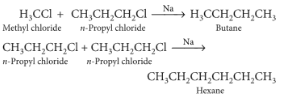
When two alkyl halides react in the presence of sodium metal, alkane is formed. When a mixture of methyl chloride and $n-$propyl chloride react in presence of $Na$ metal, ethane, butane and hexane are formed.
$ H _3 CCl + CH _3 Cl \xrightarrow{ Na } H _3 C - CH _3$
$\text { Methyl Methyl Ethane }$
$\text { chloride chloride }$
Which of the following reactions is used to prepare toluene from bromobenzene?
A
Wurtz reaction
B
Fittig reaction
✓
Wurtz-Fittig reaction
D
Swartz reaction
Answer
Correct option: C.
Wurtz-Fittig reaction
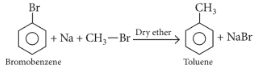
(c): When a mixture of an alkyl halide and aryl halide is treated with sodium in dry ether, an alkyl arene is obtained. This reaction is known as Wurtz-Fittig reaction.