MCQ 11 Mark
Mass of one molecule of oxygen in amu and in gram respectively is
- A
$53 \cdot 13 \times 10^{-24} \mathrm{u}, 32 \mathrm{~g}$
- B
$42 \mathrm{u}, 5 \cdot 313 \times 10^{-24} \mathrm{~g}$
- C
$16 \mathrm{u}, 6.0 \times 10^{-24} \mathrm{~g}$
- ✓
$32 \mathrm{u}, 53 \cdot 13 \times 10^{-24} \mathrm{~g}$
AnswerCorrect option: D. $32 \mathrm{u}, 53 \cdot 13 \times 10^{-24} \mathrm{~g}$
View full question & answer→MCQ 21 Mark
How many mole of oxygen gas at STP are equivalent to 5.6 litre?
- A
$\frac{1}{8}$ mole
- B
$\frac{1}{2}$ mole
- C
- ✓
$\frac{1}{4}$ mole
AnswerCorrect option: D. $\frac{1}{4}$ mole
View full question & answer→MCQ 31 Mark
What quantity of oxygen is required for complete burning of 15.6 g benzene?
MCQ 41 Mark
Find the quantity of dihydrogen required to prepare $2 \mathrm{~L}$ ammonia gas from $1 \mathrm{~L}$ dinitrogen.
AnswerCorrect option: C. $3 \mathrm{~L}$
View full question & answer→MCQ 51 Mark
What is the volume occupied by $2 \mathrm{~g}$ of helium gas (molar mass $=4 \mathrm{~g} \mathrm{~mol}^{-1}$ ) at STP ?
- A
$2.0 \mathrm{dm}^3$
- ✓
$11.2 \mathrm{dm}^3$
- C
$22.4 \mathrm{dm}^3$
- D
$5.6 \mathrm{dm}^3$
AnswerCorrect option: B. $11.2 \mathrm{dm}^3$
View full question & answer→MCQ 61 Mark
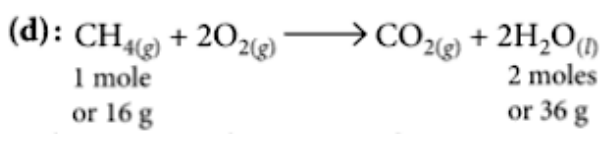
What is the volume occupied by $32 \mathrm{~g}$ methane gas at STP ?
- A
$56 \cdot 0 \mathrm{dm}^3$
- B
$22 \cdot 4 \mathrm{dm}^3$
- C
$33 \cdot 6 \mathrm{dm}^3$
- ✓
$44 \cdot 8 \mathrm{dm}^3$
AnswerCorrect option: D. $44 \cdot 8 \mathrm{dm}^3$
View full question & answer→MCQ 71 Mark
What quantity of carbon dioxide is produced when 2 mole of carbon is burnt in 16 g of dioxygen?
MCQ 81 Mark
What is the number of $\mathrm{CO}_2$ molecules in 45.42 litre at STP? (consider molar volume of gas at STP $=22 \cdot 71 \mathrm{~L} \mathrm{~mol}^{-1}$ )
- A
$1.806 \times 10^{24}$
- B
$1.501 \times 10^{24}$
- C
$0.913 \times 10^{24}$
- ✓
$1.204 \times 10^{24}$
AnswerCorrect option: D. $1.204 \times 10^{24}$
View full question & answer→MCQ 91 Mark
- A
$3.01 \times 10^{23} $
- ✓
$4.06 \times 10^{23}$
- C
$2.4 \times 10^{23}$
- D
$2.16 \times 10^{23}$
AnswerCorrect option: B. $4.06 \times 10^{23}$
View full question & answer→MCQ 101 Mark
What is the amount of water formed by combustion of 1.6 g methane?
MCQ 111 Mark
Which of the following species has highest mass?
- A
$\frac{1}{2}$ mole of $\mathrm{CH}_4$
- B
$10 \mathrm{~mL}$ of water at room temperature
- C
$3.011 \times 10^{23}$ atoms of oxygen
- ✓
$1 \mathrm{~g}$ atom of carbon
AnswerCorrect option: D. $1 \mathrm{~g}$ atom of carbon
View full question & answer→MCQ 121 Mark
Which of the following has the largest number of atoms ?
- A
$1 g Au _{( s )}$
- B
$1 g Na _{( s )}$
- ✓
$1 g Li _{( s )}$
- D
$1 g Cl _{2( g )}$
AnswerCorrect option: C. $1 g Li _{( s )}$
View full question & answer→MCQ 131 Mark
The number of molecules in 22.4 cm3 of nitrogen gas at STP is
- ✓
$6.022 \times 10^{20}$
- B
$6.022 \times 10^{23}$
- C
$22.4 \times 10^{20}$
- D
$22.4 \times 10^{23}$
AnswerCorrect option: A. $6.022 \times 10^{20}$
$6.022 \times 10^{20}$
View full question & answer→MCQ 141 Mark
How many g of H2O are present in 0.25 mol of it ?
MCQ 151 Mark
Which of the following has maximum number of molecules ?
- A
$7 g N _2$
- ✓
$2 g H _2$
- C
$8 g O _2$
- D
$20 g NO _2$
AnswerCorrect option: B. $2 g H _2$
View full question & answer→MCQ 161 Mark
In the reaction N2 + 3H2 → 2NH3, the ratio by volume of N2, H2 and NH3 is 1 : 3 : 2 This illustrates the law of
MCQ 171 Mark
$SI$ unit of the quantity electric current is
View full question & answer→MCQ 181 Mark
Which of the following temperature will read the same value on celsius and Fahrenheit scales.
MCQ 191 Mark
Which of the following compounds can NOT demonstrate the law of multiple proportions?
MCQ 201 Mark
A sample of pure water, whatever the source always contains …………. by mass of oxygen and 11.1 % by mass of hydrogen.
MCQ 211 Mark
Which of the following concentration terms depends on temperature?
Answer(b): Molarity depends on temperature.
Molality, mole fraction and percent by mass are independent of temperature.
View full question & answer→MCQ 221 Mark
What is the number of moles of water molecules required in prepare n moles of methane from n moles of methyl magnesium iodide?
Answer(a) : Methyl magnesium iodide reacts with water to produce methane as per the given reaction,
$
\underset{1 \text { mol }}{ CH _3 MgI }+\underset{1 \text { mole}}{ H _2 O } \rightarrow \underset{1 \text { mole }}{ CH _4}
$
Thus, $n$ mole of methyl magnesium iodide will react with $n$ mole of water to produce $n$ mole of methane.
View full question & answer→MCQ 231 Mark
Which of the following pair of compounds demonstrates the law of multiple proportions?
Answer(c) : Carboan and oxygen combine in a fixed ratio by mass to form $CO (3: 4)$ and $CO _2(3: 8)$.
View full question & answer→MCQ 241 Mark
What is number of atoms present in $2.24 dm ^3$ $NH _{ 3(g) }$ at $STP$ ?
Answer(b) : Number of atoms in $22.4 dm ^3=4 \times N_A$
Number of atoms in $2.24 dm ^3=\frac{4 \times N_A \times 2.24}{22.4}$
$
=\frac{4 \times 6.022 \times 10^{23}}{10}=2.4088 \times 10^{23}
$
View full question & answer→MCQ 251 Mark
calculate the percent atom economy when a product of formula weight $175 u$ is obtained in a chemical reaction using 225 u formula weight reactant.
Answer(b): Percent atom economy
$
=\frac{\text { Formula weight of product }}{\text { Formula weight of reactant }} \times 100=\frac{175 \times 100}{225}=77.7 \%
$
View full question & answer→MCQ 261 Mark
What is the amount of water formed by combustion of $1.6 g$ methane?
View full question & answer→MCQ 271 Mark
Find the formula weight of reactants if the formula weight of prodact is $54 u$ and the percent atom economy is 75 .
AnswerCorrect option: C. $72 u$
(c): Given, percent atom economy is $75 \%$ and formula weight of product is $54 u$.
Hence, formula weight of reactants $=\frac{100 \times 54}{75}=72 u$
View full question & answer→MCQ 281 Mark
What volume of ammonia is formed when $10 dm ^3$ dinitrogen reacts with $30 dm ^3$ dihydrogen at same termperature and preserure?
- A
$30 dm ^3$
- ✓
$20 dm ^3$
- C
$15 dm ^3$
- D
$10 dm ^3$
AnswerCorrect option: B. $20 dm ^3$
(b): $N _2+3 H _2 \rightleftharpoons 2 NH _3$
From the balanced chemical equation, it can be concluded that 1 volume of nitrogen produces 2 volume of ammonia i.e. $10 dm ^3$ of nitrogen produces $20 dm ^3$ of ammonia. Or, 3 volume of hydrogen produces 2 volume of ammonia i.e., $30 dm ^3$ of hydrogen prodices $20 dm ^2$ of ammonia.
View full question & answer→MCQ 291 Mark
Suppose the elements $X$ and $Y$ combine to form two compounds $X Y_2$ and $X_3 Y_2$ when $0.1$ mole of $X Y_2$ weighs $10 g$ and $0.05$ mole of $X_3 Y_4$ weighs $9 g$, the atomic weights of $X$ and $Y$ are respectively
- ✓
$40$ and $30$
- B
$50$ and $20$
- C
$30$ and $80$
- D
$40$ and $20$
AnswerCorrect option: A. $40$ and $30$
Let $x$ and $y$ be the atomic weights of $X$ and $Y$.
Given, $0.1$ mole of $X Y_2$ weighs $10 g$.
$\Rightarrow x+2 y=\frac{10}{0.1}=100 ....(i)$
$0.05$ mole of $X_3 Y_2$ weighs $9 g$.
$\Rightarrow 3 x+2 y=\frac{9}{0.05}=180 ....(ii)$
From $(i), x=100-2 y$
Substituting the value of $x$ in eq. $(ii),$
$3(100-2 y)+2 y=180$
$\Rightarrow 300-6 y+2 y=180$
$\Rightarrow y=30, x=100-2(30)=40$
Hence, the atonic weights of $X$ and $Y$ are $40$ and $30$ respectively.
View full question & answer→MCQ 301 Mark
What is the percentage of carbon in urea? (At. mass; $C =12, H =1, N =14, O =16$ )
- ✓
$20 \%$
- B
$26.6 \%$
- C
$6.67 \%$
- D
$46.0 \%$
AnswerCorrect option: A. $20 \%$
(a): Urea $\left( NH _2 CONH _2\right)$,
Molar mass $=28+12+16+4=60$
Mass of $C$ in urea $=12$ % of carbon $=(12 / 60) \times 100=20 \%$
View full question & answer→MCQ 311 Mark
Which of the following sets of componets form homogeneous mixture?
Answer(d) Ethyl alcohol + Water
View full question & answer→MCQ 321 Mark
What is the atomicity of aluminium phosphate?
Answer(b): The atomicity of aluminium phosphate $\left( AIPO _4\right)$ is 6 .
View full question & answer→MCQ 331 Mark
How many gram of sodium (atomic mass $23 u$ ) is required to prepare one mole of ethane from methyl chloride by Wurtz reaction?
Answer(d): Wurtz reaction :
$\underset{\text { Methyl chloride }}{2 CH _3 Cl }+2 Na \xrightarrow[-2 NaCl ]{\text { dry ether }} \underset{\text { Ethane }}{ CH _3 CH _3}$
One mole of ethane requires 2 moles of sodium.
$\therefore \quad 46 g$ of $Na$ is required to prepare one mole of ethane.
View full question & answer→MCQ 341 Mark
The volume of 1 mole of any pure gas at standard temperature and pressure is always equal to
- ✓
- B
$22.414 m ^3$
- C
$2.2414 m ^3$
- D
Answer(a) $0.022414 m ^3$
View full question & answer→MCQ 351 Mark
Which symbol replaces the unit of atomic mass, amu?
MCQ 361 Mark
What is the quantity of hydrogen gas liberated when $46 g$ sodium reacts with excess ethanol? (Given At mass of $Na =23$ ]
- A
$2.4 \times 10^{-3} kg$
- B
- C
- D
Answer(b) : $\underset{\text { Ethanol }}{2 CH _3 CH _2 OH }+\underset{\text { Sodium }}{2 Na } \longrightarrow \underset{\substack{\text { Sodium } \\ \text { ethoxide }}}{2 CH _3 CH _2 ONa + H _2}$
Molar mass of $Na =23 g mol ^{-1}$
$46 g$ of $Na$ or 2 moles of Na react with 2 moles of ethanol to produce one mole of hydrogen.
Mass of 1 mole of $H _2=2 g =2 \times 10^{-3} kg$
View full question & answer→MCQ 371 Mark
What is the SI unit of density?
MCQ 381 Mark
$4.4 \ g$ of an unknown gas occupies $2.24 \ L$ of volume under $STP$ conditions.
The gas may be ___________
- ✓
$CO_2$
- B
$CO$
- C
$O_2$
- D
$SO_2$
AnswerCorrect option: A. $CO_2$
$CO_2$
View full question & answer→MCQ 391 Mark
The mass of 224 mL of hydrogen gas at STP is
MCQ 401 Mark
$11.2 \ cm^3$ of hydrogen gas at $STP,$ contains ______________ moles.
- ✓
$0.0005$
- B
$0.01$
- C
$0.029$
- D
$0.5$
AnswerCorrect option: A. $0.0005$
$0.0005$
View full question & answer→MCQ 411 Mark
The number of molecules in $22.4 \ cm^3$ of ozone gas at $STP$ is ____________
- ✓
$6.022 \times 10^{20}$
- B
$6.022 \times 10^{23}$
- C
$22.4 \times 10^{20}$
- D
$22.4 \times 10^{23}$
AnswerCorrect option: A. $6.022 \times 10^{20}$
$6.022 \times 10^{20}$
View full question & answer→MCQ 421 Mark
The number of molecules present in $8 \ g$ of oxygen gas is ____________
- A
$6.022 \times 10^{23}$
- B
$3.011 \times 10^{23}$
- C
$12.044 \times 1023$
- ✓
$1.505 \times 10^{23}$
AnswerCorrect option: D. $1.505 \times 10^{23}$
$1.505 \times 10^{23}$
View full question & answer→MCQ 431 Mark
$180 \ g$ of glucose $(C_6H_{12}O_6)$ contains ____________ carbon atoms.
- A
$1.8 \times 10^{23}$
- B
$1.8 \times 10^{24}$
- ✓
$3.6 \times 10^{23}$
- D
$3.6 \times 10^{24}$
AnswerCorrect option: C. $3.6 \times 10^{23}$
$3.6 \times 10^{23}$
View full question & answer→MCQ 441 Mark
Which of the following is correct?
- A
$1 \ mole$ of oxygen atoms contains $6.0221367 \times 10^{23}$ atoms of oxygen.
- B
$1 \ mole$ of water molecules contains $6.0221367 \times 10^{23}$ molecules of water.
- C
$1 \ mole$ of sodium chloride contains $6.0221367 \times 10^{23}$ formula units of $NaCl.$
- ✓
View full question & answer→MCQ 451 Mark
The mass of $0.002 \ mole$ of glucose $(C_6H_{12}O_6)$ is _____________
- A
$0.20 \ g$
- ✓
$0.36 \ g$
- C
$0.50 \ g$
- D
$1.80 \ g$
AnswerCorrect option: B. $0.36 \ g$
$0.36 \ g$
View full question & answer→MCQ 461 Mark
One mole of oxygen molecule weighs ____________
AnswerCorrect option: B. $32 \ g$
$32 \ g$
View full question & answer→MCQ 471 Mark
At constant temperature and pressure, two litres of hydrogen gas react with one litre of oxygen gas to produce two litres of water vapour. This is in accordance with _____________
- A
law of multiple proportion
- B
law of definite composition
- C
law of conservation of mass
- ✓
View full question & answer→MCQ 481 Mark
Two elements, $A$ and $B,$ combine to form two compounds in which $‘a \ ’ g$ of $A$ combines with $‘b_1 \ ’$ and $‘b_2 \ ’g$ of $B$ respectively. According to law of multiple proportion __________________
- A
$b_1 = b_2$
- ✓
$b_1$ and $b_2$ bear a simple whole number ratio
- C
$a$ and $b_1$ bear a whole number ratio
- D
no relation exists between $b_1$ and $b_2$
AnswerCorrect option: B. $b_1$ and $b_2$ bear a simple whole number ratio
$b_1$ and $b_2$ bear a simple whole number ratio
View full question & answer→MCQ 491 Mark
A sample of calcium carbonate $(CaCO_3)$ has the following percentage composition $: Ca = 40 \%; C = 12 \%; O = 48 \%.$ If the law of definite proportions is true, then the weight of calcium in $4 \ g$ of a sample of calcium carbonate from another source will be ______________
- A
$0.016 \ g$
- B
$0.16 \ g$
- ✓
$1.6 \ g$
- D
$16 \ g$
AnswerCorrect option: C. $1.6 \ g$
$1.6 \ g$
View full question & answer→MCQ 501 Mark
The sum of the masses of reactants and products is equal in any physical or chemical reaction. This is in accordance with _______________
- A
law of multiple proportion
- B
law of definite composition
- ✓
law of conservation of mass
- D
law of reciprocal proportion
AnswerCorrect option: C. law of conservation of mass
law of conservation of mass
View full question & answer→MCQ 511 Mark
Which one of the following is NOT a mixture?
- A
- B
- C
Liquefied Petroleum Gas (LPG)
- ✓
View full question & answer→MCQ 521 Mark
A/an is a simple combination of two or more substances in which the constituent substances retain their separate identities.
MCQ 531 Mark
The branch of chemistry which deals with carbon compounds is called _________________ chemistry.