Questions

Answer the following in one or two sentences.

Take a timed test

27 questions · self-marked practice — reveal the answer and mark yourself.

Question 12 Marks
Which atom in $NH _4^{+}$will have formal charge +1 ?
Answer
In $NH _4^{+}$, nitrogen atom ( $N$ ) will have formal charge of +1 .
View full question & answer
Question 22 Marks
Which electrons are involved in the formation of chemical bonds?
Answer
The electrons present in the outermost shell of an atom are involved in the formation of a chemical bond.
View full question & answer
Question 32 Marks
Why are atoms held together in chemical compounds?
Answer
Atoms are held together in chemical compounds due to chemical bonds.
View full question & answer
Question 42 Marks
Which part of an atom was discovered by Ernest Rutherford from the experiment of scattering of α-particles by gold foil?
Answer
Nucleus of an atom was discovered by Ernest Rutherford from the experiment of scattering of α-particles by gold foil.
View full question & answer
Question 52 Marks
Which particle was identified by J. J. Thomson in the cathode ray tube experiment?
Answer
Electron was identified by J.J. Thomson in the cathode ray tube experiment.
View full question & answer
Question 62 Marks
Does an atom have any internal structure or is it indivisible?
Answer
Yes, an atom has internal structure. Different subatomic particles such as protons, electrons and neutrons constitute an atom. So, it is divisible.
View full question & answer
Question 72 Marks
What is the difference between molecules of an element and those of a compound?
Answer
The molecules of an element are made of atoms of same element while the molecules of a compound are made of atoms of different elements.
View full question & answer
Question 92 Marks
Give the names of quantum numbers.
Answer
The four quantum numbers are: principal quantum number $( n )$, azimuthal or subsidiary quantum number ( 1 ), magnetic quantum number $\left( m _1\right)$ and electron spin quantum number $\left( m _{ g }\right)$.
View full question & answer
Question 102 Marks
State Heisenberg uncertainty principle.
Answer
Heisenberg uncertainty principle states that “It is impossible to determine simultaneously, the exact position and exact momentum (or velocity) of an electron”.
View full question & answer
Question 112 Marks
Name the element that shows simplest emission spectrum.
Answer
The element that shows simplest emission spectrum is hydrogen.
View full question & answer
Question 122 Marks
If an element ‘X’ has mass number 11 and it has 6 neutrons, then write its representation.
Answer
The representation of the given element is ${ }_5^{11} X$.
View full question & answer
Question 132 Marks
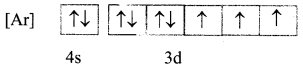
A student pictorially represented the electronic configuration of cobalt (Z = 27) in ground state as shown in the following figure.
Image

i. Is this the correct representation?
ii. Identify the rules of electron filling that are violated (if any) in the above answer and give the correct representation.
View full question & answer
Question 142 Marks
Write condensed orbital notation of electronic configuration of the following elements:
$i.$ Fluorine $(Z = 9)$   $ii.$ Scandium $(Z = 21)$  $iii.$ Cobalt $(Z = 27)$  $iv.$ Zinc $(Z = 30)$
Answer
No. Element Condensed orbital notation
$i.$ Fluorine $(Z = 9)$ $[He] 2s^2 2p^5$
$ii.$ Scandium $(Z = 21)$ $[Ar] 4s^2 3d^1$
$iii.$ Cobalt $(Z = 27)$ $[Ar] 4s^2 3d^7$
$iv.$ Zinc $(Z = 30)$ $[Ar] 4s^2 3d^{10}$
View full question & answer
Question 152 Marks
What is meant by the term ‘boundary surface diagram’?
Answer
A boundary surface is drawn in space for an orbital such that the value of probability density $\left(\psi^2\right)$ is constant and encloses a region where the probability of finding electron is typically more than $90 \%$. Such a boundary surface diagram is a good representation of shape of an orbital.
e.g. Boundary surface diagram of $\mathrm{Is}$ and $2 \mathrm{~s}$ orbitals are spherical in shape.
View full question & answer
Question 172 Marks
Calculate the energy of a photon of radiation having wavelength $300 \ nm. [h = 6.63 \times 10^{-34} J s]$
Answer
Given: Wavelength $(\lambda)=300 \mathrm{~nm}$
To find: Energy of a photon $(E)$
Formulae: $\mathrm{E}=\frac{\mathrm{hc}}{\lambda}$
Calculation: From formula,$E=\frac{6.63 \times 10^{-34} \mathrm{~J} \mathrm{~s} \times 3 \times 10^8 \mathrm{~m} \mathrm{~s}^{-1}}{300 \times 10^{-9} \mathrm{~m}}=6.63 \times 10^{-19} \mathrm{~J}$
Energy of a photon is $6.63 \times 10^{-19} \mathrm{~J}$.
View full question & answer
Question 182 Marks
What is an emission spectrum?
Answer
  • When a substance is irradiated with electromagnetic radiation, it absorbs energy. Atoms, molecules or ions, which have absorbed radiation are said to be ‘excited’. Heating can also result in an excited state.
  • The excited species emits the absorbed energy in the form of radiation. This process is called emission of radiation and the recorded spectrum of this emitted radiation is called ‘emission spectrum’.
View full question & answer
Question 192 Marks
Certain results were obtained when scientists studied the interactions of radiation with matter. What were the two results, utilized by Neils Bohr to overcome the drawbacks of Rutherford model?
Answer
The two results utilized by Neils Bohr to overcome the drawbacks of Rutherford model were:
  • Wave particle duality of electromagnetic radiation
  • Line emission spectra of hydrogen
View full question & answer
Question 202 Marks
Find out the average atomic mass of lithium (Li) from the following data:
IsotopeAtomic mass (u)Abundance
${ }^6 \mathrm{Li}$6.0157.59%
${ }^7 \mathrm{Li}$7.01692.41%
Answer
Given: Three isotopes of lithium along with respective atomic mass and % abundance.
To find: Average atomic mass of lithium
Calculation:
\begin{aligned}
\text { Average atomic mass of lithium } & =\frac{\left(\text { Atomic mass of }{ }^6 \mathrm{Li} \times \% \text { Abundance }\right)+\left(\text { Atomic mass of }{ }^7 \mathrm{Li} \times \% \text { Abundance }\right)}{100} \\
& =\frac{(6.015 \mathrm{u})(7.59)+(7.016 \mathrm{u})(92.41)}{100} \\
& =\mathbf{6 . 9 4 0} \mathbf{u}
\end{aligned}
Ans: Average atomic mass of lithium is 6.940 u.
View full question & answer
Question 212 Marks
Complete the following table:
IsobarsAtomic No.(Z)Mass No.(A)Number of Protons(Z)No. of Neutrons(N)
${ }_6^{14} \mathrm{C}$6146
${ }_7^{14} \mathrm{C}$7147
Answer
IsobarsAtomic No.(Z)Mass No.(A)Number of Protons(Z)No. of Neutrons(N)
${ }_6^{14} \mathrm{C}$61468
${ }_7^{14} \mathrm{C}$71477
View full question & answer
Question 222 Marks
Complete the information about the isotopes of carbon in the following table:
SymbolAtomic Number(Z)Atomic Mass Number(A)Neutron Number,
N =A-Z
% AbundanceStability
${ }_6^{12} \mathrm{C}$ or $\mathrm{C}-12$ 12 98.9%
6 71.1%Stable
${ }_6^{14} \mathrm{C}$ or $\mathrm{C}-14$614 <0.00017%Radioactive
Answer
SymbolAtomic Number(Z)Atomic Mass Number(A)Neutron Number,
N =A-Z
% AbundanceStability
${ }_6^{12} \mathrm{C}$ or $\mathrm{C}-12$612698.9%Stable
${ }_6^{13} \mathrm{C}$ or $\mathrm{C}-13$61371.1%Stable
${ }_6^{14} \mathrm{C}$ or $\mathrm{C}-14$6148<0.00017%Radioactive
View full question & answer
Question 232 Marks
Define isotopes.
Answer
Isotopes are defined as the atoms of an element having the same number ofprotons but different number of neutrons in their nuclei.
e.g. ${ }_6^{12} \mathrm{C},{ }_6^{13} \mathrm{C}$ and ${ }_6^{14} \mathrm{Br}$ are isotopes.
View full question & answer
Question 242 Marks
Find out the number of protons, electrons and neutrons in the nuclide ${ }_{18}^{40} \mathrm{Ar}$.
Answer
For the given nuclide,
Atomic number, Z = 18, Mass number, A = 40
Number of protons = Number of electrons = Z = 18
Number of neutrons (N) = A – Z = 40 – 18 = 22
Ans: Number of protons = 18, Number of electrons = 18, Number of neutrons = 22
View full question & answer
Question 252 Marks
Give reason: The approximate atomic mass in Daltons is numerically equal to the number of nucleons in the atom.
Answer
  • The electrons possess negligible mass. They do not contribute much to the mass of an atom.
  • Therefore, the entire mass of an atom is supposed to be present in the nucleus which consists of protons and neutrons, which are collectively called as nucleons.
Hence, approximate atomic mass in Daltons is numerically equal to the number of nucleons in the atom.
View full question & answer
Question 272 Marks
Complete the information about the properties of subatomic particles in the following table:
NameSymbolAbsolute charge/CRelative chargeSymbol for ChargeMass/KGMass/uApproximate mass/u
Electron$\mathrm{e}^{-}$$-1.6022 \times 10^{-19}$ $-\mathrm{e}$$9.10938 \times 10^{-31}$0.00054
Protonp +1 $1.6726 \times 10^{-27}$1.00727
Neutronn0 $1.67493 \times 10^{-27}$1.008671
Answer
NameSymbolAbsolute charge/CRelative chargeSymbol for ChargeMass/KGMass/uApproximate mass/u
Electron$\mathrm{e}^{-}$$-1.6022 \times 10^{-19}$-1$-\mathrm{e}$$9.10938 \times 10^{-31}$0.000540
Protonp$+1.6022 \times 10^{-19}$+1$+\mathrm{e}$$1.6726 \times 10^{-27}$1.007271
Neutronn00 $1.67493 \times 10^{-27}$1.008671
View full question & answer