Questions

Solve the Following Question.(4 Marks)

Take a timed test

7 questions · self-marked practice — reveal the answer and mark yourself.

Question 14 Marks
The angles of a quadrilateral are in A.P. and the greatest angle is double the least. Find angles of the quadrilateral in radians.
Answer
Let the measures of the angles of the quadrilateral in degrees be a $3 d, a-d, a+d, a+3 d$, where $a>d>0$
$\therefore(a-3 d)+(a-d)+(a+d)+(a+3 d)=360^{\circ}$
$\therefore$ [Sum of the angles of a quadrilateral is $360^{\circ}$ ]
$ \therefore 4 \mathrm{a}=360^{\circ}$
$\therefore \mathrm{a}=90^{\circ} $
According to the given condition, the greatest angle is double the least,
$ \therefore \mathrm{a}+3 \mathrm{~d}=2 \cdot(\mathrm{a}-3 \mathrm{~d})$
$\therefore 90^{\circ}+3 \mathrm{~d}=2 \cdot\left(90^{\circ}-3 \mathrm{~d}\right)$
$\therefore 90^{\circ}+3 \mathrm{~d}=180^{\circ}-6 \mathrm{~d} 9 \mathrm{~d}=90^{\circ}$
$\therefore \mathrm{d}=10^{\circ} $
$\therefore$ The measures of the angles in degrees are
$ a-3 d=90^{\circ}-3\left(10^{\circ}\right)=90^{\circ}-30^{\circ}=60^{\circ},$
$a-d=90^{\circ}-10^{\circ}=80^{\circ},$
$a+d=90^{\circ}+10^{\circ}=100^{\circ},$
$a+3 d=90^{\circ}+3\left(10^{\circ}\right)=90^{\circ}+30^{\circ}=120^{\circ} $
We know that $\theta^{\circ}=\left(\theta \times \frac{\pi}{180}\right)^c$
$\therefore \quad$ The measures of the angles in radians are
$ 60^{\circ}=\left(60 \times \frac{\pi}{180}\right)^c=\left(\frac{\pi}{3}\right)^c$
$80^{\circ}=\left(80 \times \frac{\pi}{180}\right)^c=\left(\frac{4 \pi}{9}\right)^c$
$100^{\circ}=\left(100 \times \frac{\pi}{180}\right)^c=\left(\frac{5 \pi}{9}\right)^c $
$120^{\circ}=\left(120 \times \frac{\pi}{180}\right)^{\circ}=\left(\frac{2 \pi}{3}\right)^{\text {c }}$
View full question & answer
Question 24 Marks
Two circles each of radius 7 cm, intersect each other. The distance between their centres is 7√2 cm. Find the area common to both the circles.
Answer
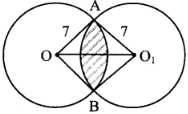
Let $O$ and $O_1$ be the centres of two circles intersecting each other at $A$ and $B$.
Then $O A=O B=O_1 A=O_1 B=7 cm$
and $OO _1=7 \sqrt{2} cm$
$OO _1^2=98$
Since $OA ^2+ O _1 A ^2=7^2$
$ =98$
$= OO _1{ }^2 \ldots \ldots[\text { from (i)] }$
$m _{\angle O_1}=90^{\circ}$
$\square OAO _1 B \text { is a square. }$
$m \angle AOB = m \angle AO O _1 B =90^{\circ}$
$=\left(90 \times \frac{\pi}{180}\right)^{\circ}=\left(\frac{\pi}{2}\right)^c $
Now, $A ($ sector $OAB )=\frac{1}{2} r ^2 \theta$
$ =\frac{1}{2} \times 7^2 \times \frac{\pi}{2}$
$=\frac{49 \pi}{4} \text { sq.cm } $
$\frac{4}{4}$ sq.cm
$ \text { and } A \left(\text { sector } O _1 AB \right)=\frac{1}{2} r ^2 \theta$
$=\frac{1}{2} \times 7^2 \times \frac{\pi}{2}$
$=\frac{49 \pi}{4} sq . cm$
$A (\square OAO , B )=(\text { side })^2=(7)^2=49 \text { sq.cm }$
$\therefore$ Required area $=$ area of shaded portion $= A ($ sector $OAB )+ A \left(\right.$ sector $\left.\left.O _1 AB \right)\right)- A (\square$ $\left.OAO _1 B \right)$
$ =\frac{49 \pi}{4}+\frac{49 \pi}{4}-49$
$=\frac{49 \pi}{2}-49$
$=49\left(\frac{\pi}{2}-1\right) \text { sq.cm } $
Image
View full question & answer
Question 34 Marks
Find the angle between hour hand and minute hand of a clock at
i) Quarter past five
ii) Quarter to twelve
View full question & answer
Question 44 Marks
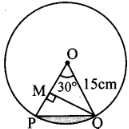
OPQ is the sector of a circle having centre at O and radius 15 cm. If m∠POQ = 30°, find the area enclosed by arc PQ and chord PQ.
Answer
Here, $O P=O Q=r=15 \mathrm{~cm}$
Also, $\mathrm{m} \angle \mathrm{POQ}=30^{\circ}$
$ =\left(30 \times \frac{\pi}{180}\right)^c$
$=\frac{\pi^c}{6}$
$\therefore \theta=\frac{\pi^c}{6} $
Now, area of sector $O P Q=\frac{1}{2} r^2 \theta$
$ =\frac{1}{2}(15)^2\left(\frac{\pi}{6}\right)$
$=\frac{225 \pi}{12} \mathrm{sq} \mathrm{cm} $
Let $Q M$ be the perpendicular from $Q$ to $O P$ meeting it at $M$.
Then $l(\mathrm{QM})=\frac{1}{2} \times l(\mathrm{OQ})=\frac{15}{2} \mathrm{~cm}$
$ \therefore \text { area of } \triangle \mathrm{OPQ}=\frac{1}{2} \times l(\mathrm{OP}) \times l(\mathrm{QM})$
$=\frac{1}{2} \times 15 \times \frac{15}{2}$
$=\frac{225}{4} \mathrm{sq} \mathrm{cm} $
Hence, the area between arc $P Q$ and chord $P Q$
$ =\text { area of sector } O P Q-\text { area of } \triangle O P Q$
$=\frac{225 \pi}{12}-\frac{225}{4}$
$=\frac{225}{4}\left(\frac{\pi}{3}-1\right) \mathrm{sq} \mathrm{cm} . $
Image
View full question & answer
Question 54 Marks
One angle of a quadrilateral has measure $\frac{2π^C}{5}$ and the measures of other three angles are in the ratio $2:3:4.$ Find their measures in degrees and radians.
Answer
We know that $\left.\theta^c=\left(\theta \times \frac{180}{\pi}\right)^{\circ}\right)$
One angle of the quadrilateral has measure
$\frac{2 \pi^c}{5}=\left(\frac{2 \pi}{5} \times \frac{180}{\pi}\right)^{\circ}=72^{\circ}$
Measures of other three angles are in the ratio 2:3:4.
Let the measures of the other three angles of the quadrilateral in degrees be $2 k, 3 k, 4 k$, where $k$ is a constant.
$\therefore 72^{\circ}+2 \mathrm{k}+3 \mathrm{k}+4 \mathrm{k}=360^{\circ}$
$\ldots\left[\right.$ Sum of the angles of a quadrilateral is $360^{\circ}$ ]
$ \therefore 9 \mathrm{k}=288^{\circ}$
$\mathrm{k}=32^{\circ} $
$\therefore$ The measures of the angles in degrees are
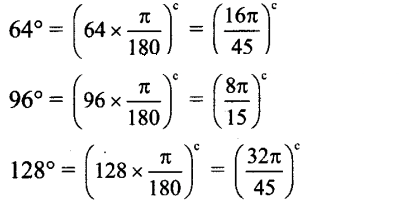
$ 2 \mathrm{k}=2 \times 32^{\circ}=64^{\circ}$
$3 \mathrm{k}=3 \times 32^{\circ}=96^{\circ}$
$4 \mathrm{k}=4 \times 32^{\circ}=128^{\circ} $
We know that $\theta^{\circ}=\left(\theta \times \frac{\pi}{180}\right)^c$
$\therefore$ The measures of the angles in radians are
Image
View full question & answer
Question 64 Marks
The measures of the angles of a triangle are in A.P. and the greatest is 5 times the smallest (least). Find the angles in degrees and radians.
Answer
Let the measures of the angles of the triangle in degrees be a – d, a, a + d, where a > d> 0.
∴ a – d + a + a + d = 180°
…[Sum of the angles of a triangle is 180°]
∴ 3a = 180°
∴ a = 60° …(i)
According to the given condition, greatest angle is 5 times the smallest angle.
∴ a + d = 5 (a – d)
∴ a + d = 5a – 5d
∴ 6d = 4a
∴ 3d = 2a
∴ 3d = 2(60°) …[From (i)]
∴ d =$\frac{120°}{3}$= 40°
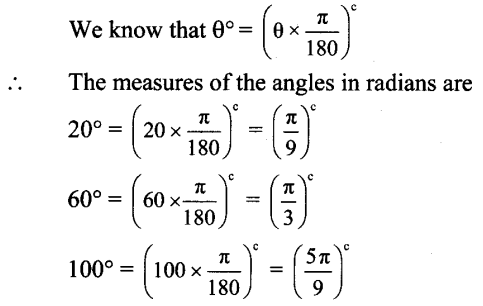
∴ The measures of the angles in degrees are
a – d = 60° – 40° = 20°
a = 60° and
a + d = 60° + 40° = 100°
Image
View full question & answer
Question 74 Marks
In a right angled triangle, the acute angles are in the ratio $4:5.$ Find the angles of the triangle in degrees and radians.
Answer
Since the triangle is aright angled triangle, one of the angles is $90^{\circ}$.
In the right angled triangle, the acute angles are in the ratio $4: 5$.
Let the measures of the acute angles of the triangle in degrees be $4 \mathrm{k}$ and $5 \mathrm{k}$, where $\mathrm{k}$ is a constant.
$\therefore 4 \mathrm{k}+5 \mathrm{k}+90^{\circ}=180^{\circ}$
$\ldots$ [Sum of the angles of a triangle is $180^{\circ}$ ]
$ \therefore 9 \mathrm{k}=180^{\circ}-90^{\circ}$
$\therefore 9 \mathrm{k}=90^{\circ}$
$\therefore \mathrm{k}=10^{\circ} $
$\therefore$ The measures of the angles in degrees are
$ 4 \mathrm{k}=4 \times 10^{\circ}=40^{\circ},$
$5 \mathrm{k}=5 \times 10^{\circ}=50^{\circ} $
and $90^{\circ}$.
we known that $\theta^{\circ}=\left(\theta \times \frac{\pi}{180}\right)^c$
$\therefore$ The measure of the angles in radius are
$40^{\circ}=\left(40 \times \frac{\pi}{180}\right)^{\circ}=\left(\frac{2 \pi}{9}\right)^{\circ}$
$50^{\circ}=\left(50 \times \frac{\pi}{180}\right)^{\circ}=\left(\frac{5 \pi}{18}\right)^{\circ}$
$90^{\circ}=\left(90 \times \frac{\pi}{180}\right)^{\circ}=\left(\frac{\pi}{2}\right)^{\circ}$
View full question & answer