MCQ 11 Mark
The parametric equations of the circle $x^2+y^2+m x+m y=0$ are
AnswerCorrect option: A. $x=\frac{-m}{2}+\frac{m}{\sqrt{2}} \cos \theta_i y=\frac{-m}{2}+\frac{m}{\sqrt{2}} \sin \theta$
$x=\frac{-m}{2}+\frac{m}{\sqrt{2}} \cos \theta_i y=\frac{-m}{2}+\frac{m}{\sqrt{2}} \sin \theta$
View full question & answer→MCQ 21 Mark
A pair of tangents are drawn to a unit circle with centre at the origin and these tangents intersect at A enclosing an angle of 60. The area enclosed by these tangents and the arc of the circle is
- A
$\frac{2}{\sqrt{3}}-\frac{\pi}{6}$
- ✓
$\sqrt{3}-\frac{\pi}{3}$
- C
$\frac{\pi}{3}-\frac{\sqrt{3}}{6}$
- D
$\sqrt{3}\left(1-\frac{\pi}{6}\right)$
AnswerCorrect option: B. $\sqrt{3}-\frac{\pi}{3}$
$\sqrt{3}-\frac{\pi}{3}$ 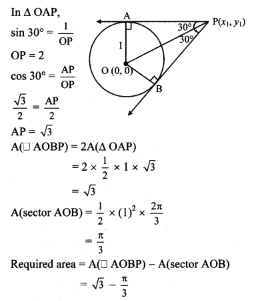
View full question & answer→MCQ 31 Mark
The equation of a circle with origin as centre and passing through the vertices of an equilateral triangle whose median is of length 3a is
- A
$x^2+y^2=9 a^2$
- B
$x^2+y^2=16 a^2$
- ✓
$x^2+y^2=4 a^2$
- D
$x^2+y^2=a^2$
AnswerCorrect option: C. $x^2+y^2=4 a^2$
$x^2+y^2=4 a^2$ Since the triangle is equilateral.
The centroid of the triangle is same as the circumcentre
and radius of the circumcircle $=\frac{2}{3}$ (median) $=\frac{2}{3}(3 a)=2 a$
Hence, the equation of the circumcircle whose centre is at $(0,0)$ and radius $2 \mathrm{a}$ is $\mathrm{x}^2+\mathrm{y}^2=$4a^2
View full question & answer→MCQ 41 Mark
If a circle passes through the points (0, 0), (a, 0), and (0, b), then find the co-ordinates of its centre.
- A
$\left(\frac{-a}{2}, \frac{-b}{2}\right)$
- B
$\left(\frac{a}{2}, \frac{-b}{2}\right)$
- C
$\left(\frac{-a}{2}, \frac{b}{2}\right)$
- ✓
$\left(\frac{a}{2}, \frac{b}{2}\right)$
AnswerCorrect option: D. $\left(\frac{a}{2}, \frac{b}{2}\right)$
$\left(\frac{a}{2}, \frac{b}{2}\right)$
View full question & answer→MCQ 51 Mark
The area of the circle having centre at (1, 2) and passing through (4, 6) is
MCQ 61 Mark
If the lines 3x – 4y + 4 = 0 and 6x – 8y – 7 = 0 are tangents to a circle, then find the radius of the circle.
- ✓
$\frac{3}{4}$
- B
$\frac{4}{3}$
- C
$\frac{1}{4}$
- D
$\frac{7}{4}$
AnswerCorrect option: A. $\frac{3}{4}$
$\frac{3}{4}$ Tangents are parallel to each other.
The perpendicular distance between tangents = diameter
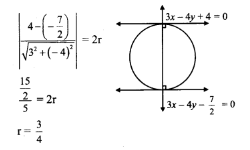
View full question & answer→MCQ 71 Mark
The equation(s) of the tangent(s) to the circle $x^2+y^2=4$ which are parallel to $x+2 y+3=$ 0 are
View full question & answer→MCQ 81 Mark
Find the equation of the circle which passes through the points (2, 3) and (4, 5), and the center lies on the straight line y – 4x + 3 = 0.
- ✓
$x^2+y^2-4 x-10 y+25=0$
- B
$x^2+y^2-4 x-10 y-25=0$
- C
$x^2+y^2-4 x+10 y-25=0$
- D
$x^2+y^2+4 x-10 y+25=0$
AnswerCorrect option: A. $x^2+y^2-4 x-10 y+25=0$
$x^2+y^2-4 x-10 y+25=0$
View full question & answer→MCQ 91 Mark
If the lines 2x – 3y = 5 and 3x – 4y = 7 are the diameters of a circle of area 154 sq. units, then find the equation of the circle.
- A
$x^2+y^2-2 x+2 y=40$
- B
$x^2+y^2-2 x-2 y=47$
- ✓
$x^2+y^2-2 x+2 y=47$
- D
$x^2+y^2-2 x-2 y=40$
AnswerCorrect option: C. $x^2+y^2-2 x+2 y=47$
$x^2+y^2-2 x+2 y=47$ Centre of circle = Point of intersection of diameters.
Solving 2x – 3y = 5 and 3x – 4y = 7, we get
x = 1, y = -1
Centre of the circle C(h, k) = C(1, -1)
∴ Area = 154
$\begin{aligned} & \pi r^2=154 \\ & \frac{22}{7} \times r^2=154 \\ & r^2=154 \times \frac{22}{7}=49 \\ & \therefore r=7\end{aligned}$
equation of the circle is
$\begin{aligned} & (x-1)^2+(y+1)^2=72 \\ & x^2+y^2-2 x+2 y=47\end{aligned}$
View full question & answer→MCQ 101 Mark
Equation of a circle which passes through (3, 6) and touches the axes is
- A
$x^2+y^2+6 x+6 y+3=0$
- B
$x^2+y^2-6 x-6 y-9=0$
- ✓
$x^2+y^2-6 x-6 y+9=0$
- D
$x^2+y^2-6 x+6 y-3=0$
AnswerCorrect option: C. $x^2+y^2-6 x-6 y+9=0$
$x^2+y^2-6 x-6 y+9=0$
View full question & answer→MCQ 112 Marks
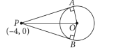
Two tangents to the circle $x^2+y^2=4$ at the points $A$ and $B$ meet at the point $P(-4,0)$. Then the area of the quadrilateral $P A O B, O$ being the origin, is
- A
$2 \sqrt{3}$ sq. units
- B
$8 \sqrt{3} sq$. units
- ✓
$4 \sqrt{3} sq$. units
- D
$6 \sqrt{3} sq$. units
AnswerCorrect option: C. $4 \sqrt{3} sq$. units
(c) : The centre of the circle is $(0,0)$ and radius is 2 units and coordinates of $P$ are $(-4,0)$.
$\therefore O P=4$ units
Also $O A=O B=2$ units [radius of circle]
$
\therefore \quad O A^2+A P^2=O P^2
$
[By Pythagoras theorem]
$\Rightarrow 2^2+A P^2=(4)^2 \Rightarrow A P^2=12 \Rightarrow A P=2 \sqrt{3}$
Similarly, $B P=2 \sqrt{3}$
Area of $P A O B=$ Area of $\triangle O A P+$ Area of $\triangle O B P$
$=\frac{1}{2} \times 2 \sqrt{3} \times 2+\frac{1}{2} \times 2 \sqrt{3} \times 2=4 \sqrt{3}$ sq. units
View full question & answer→MCQ 122 Marks
The centre of the circle whose radius is 3 units and touching internally the circle $x^2+y^2-4 x-6 y-12=$ 0 at the point $(-1,-1)$ is
- ✓
$\left(\frac{4}{5}, \frac{7}{5}\right)$
- B
$\left(\frac{4}{5}, \frac{-7}{5}\right)$
- C
$\left(\frac{-4}{5}, \frac{-7}{5}\right)$
- D
$\left(\frac{-4}{5}, \frac{7}{5}\right)$
AnswerCorrect option: A. $\left(\frac{4}{5}, \frac{7}{5}\right)$
(a) : Given equation of circle is
$x^2+y^2-4 x-6 y-12=0$
i.e., $(x-2)^2+(y-3)^2=5^2$.....(i)
So the given circle has centre $B(2,3)$ and radius 5 units.
Let $A(h, k)$ be the centre of circle having radius 3 units and touches the circle (i) at $P(-1,-1)$
In the given diagram, we have $B P=5$ and $A P=3$
$\therefore \quad A B=B P-A P=5-3=2$
$\therefore \quad A(h, k)$ divides $B P$ in the ratio $3: 2$ internally
$
\therefore h=\frac{3 \times 2+2 \times(-1)}{3+2}=\frac{4}{5} ; k=\frac{3 \times 3+2 \times(-1)}{3+2}=\frac{7}{5}
$
$\therefore \quad$ Required centre of circle is $\left(\frac{4}{5}, \frac{7}{5}\right)$.
![]() https://pg-data.sgp1.digitaloceanspaces.com/chapter_wise/16527/D5.png" alt="Image" width="110" height="">
https://pg-data.sgp1.digitaloceanspaces.com/chapter_wise/16527/D5.png" alt="Image" width="110" height=""> View full question & answer→MCQ 132 Marks
If the line $x-2 y=m(m \in Z )$ intersects the circle $x^2+y^2=2 x+4 y$ at two distinct points, then the number of possible values of $m$ are
Answer(b) : Equation of circle is $x^2+y^2=2 x+4 y$, can be written as $(x-1)^2+(y-2)^2=5$
$\therefore \quad$ Centre of circle is $(1,2)$ and radius is $\sqrt{5}$.
Distance of $(1,2)$ from line $x-2 y-m=0$
$=\left|\frac{1-4-m}{\sqrt{1^2+2^2}}\right|<\sqrt{5} \quad$ (as line intersect the circle)
$
\Rightarrow|-3-m|<5 \Rightarrow|-(m+3)|<5 \Rightarrow m+3<5
$
$
m=-7,-6,-5,-4,-3,-2,-1,0,1 \text {. }
$
$\therefore \quad$ Number of possible values of $m$ is 9 .
View full question & answer→MCQ 142 Marks
The equation of the circle whose centre lies on the line $x-4 y=1$ and which passes through the points $(3,7)$ and $(5,5)$ is
- ✓
$x^2+y^2+6 x+2 y-90=0$
- B
$x^2+y^2+6 x-2 y+90=0$
- C
$x^2+y^2+6 x+2 y+90=0$
- D
$x^2+y^2-6 x+2 y-90=0$
AnswerCorrect option: A. $x^2+y^2+6 x+2 y-90=0$
(a) : Consider the line first, we have $x-4 y=1$
$\Rightarrow x=1+4 y$
$\therefore \quad$ Any point on the line is of the form $(4 a+1, a)$, which included the centre of circle also. This point is equidistant from any point on the circumference of the circle.
$
\begin{array}{r}
\therefore \quad(4 a+1-3)^2+(a-7)^2=(4 a+1-5)^2+(a-5)^2 \\
\Rightarrow \quad 16 a^2-16 a+4+a^2-14 a+49=16 a^2-32 a+16 \\
+a^2-10 a+25
\end{array}
$
$
\begin{aligned}
& \Rightarrow \quad-12 a=12 \Rightarrow a=-1 \\
& \therefore \text { Centre of circle }=(-4+1,-1)=(-3,-1)
\end{aligned}
$
Now, radius $(r)=\sqrt{(-3-3)^2+(-1-7)^2}=\sqrt{100}=10$
$\therefore \quad$ Equation of circle is $(x+3)^2+(y+1)^2=10^2$
i.e., $x^2+y^2+6 x+2 y-90=0$
View full question & answer→MCQ 152 Marks
The parametric equation of the circle $x^2+y^2-6 x-$ $2 y+9=0$ are
- ✓
$x=3+\cos \theta, y=1+\sin \theta$
- B
$x=1+\cos \theta, y=3+\sin \theta$
- C
$x=\cos \theta, y=\sin \theta$
- D
$x=3+\sin \theta, y=1+\cos \theta$
AnswerCorrect option: A. $x=3+\cos \theta, y=1+\sin \theta$
(a) : If $\left(x_1, y_1\right)$ is centre of circle and $r$ is radius then parametric equation of circle can be written as
$
x=x_1+r \cos \theta, \quad y=y_1+r \sin \theta
$
Given equation of circle is
$
x^2+y^2-6 x-2 y+9=0 \Rightarrow(x-3)^2+(y-1)^2=1
$
$\therefore \quad$ Centre of circle is $(3,1)$ and radius of circle is 1 .
Equation in parametric form is $x=3+\cos \theta, \quad y=1+\sin \theta$
View full question & answer→MCQ 162 Marks
The equation of tangents to the circle $x^2+y^2=4$ which are parallel to $x+2 y+3=0$ are
- A
$x-2 y= \pm 2 \sqrt{5}$
- B
$x-2 y= \pm 2$
- C
$x+2 y= \pm 2 \sqrt{3}$
- ✓
$x+2 y= \pm 2 \sqrt{5}$
AnswerCorrect option: D. $x+2 y= \pm 2 \sqrt{5}$
(d) : Given, equation of the circle is $x^2+y^2=4$ and equation of the line is $x+2 y+3=0$
Slope of the line $=-1 / 2$
Since, the required tangents are parallel to the given line.
$\therefore \quad$ Slope of tangents $(m)=-\frac{1}{2}$
We know that the equation of the tangents to the circle $x^2+y^2=a^2$ with slope $m$ are $y=m x \pm \sqrt{a^2\left(1+m^2\right)}$
$\therefore \quad$ The required equation of tangents are
$
\begin{aligned}
y & =-\frac{1}{2} x \pm \sqrt{(2)^2\left(1+\left(\frac{-1}{2}\right)^2\right)} \\
\Rightarrow y & =-\frac{1}{2} x \pm \sqrt{5} \Rightarrow 2 y+x= \pm 2 \sqrt{5}
\end{aligned}
$
View full question & answer→MCQ 172 Marks
Find the equation of a circle of radius 5 units whose centre lies on $x$-axis and passes through the point $(2,4)$.
- A
$x^2+y^2-12 x-11=0$
- B
$x^2+y^2-4 x-21=0$
- ✓
$x^2+y^2+2 x-24=0$
- D
$x^2+y^2+12 x-11=0$
AnswerCorrect option: C. $x^2+y^2+2 x-24=0$
(c) : Let the coordinates of the centre of the required circle be $C(a, 0)$. Since it passes through $P(2,4)$.
$\therefore C P=$ radius $\Rightarrow C P=5$
$\Rightarrow \sqrt{(a-2)^2+(0-4)^2}=5$
$\Rightarrow(a-2)^2+16=25 \Rightarrow a-2= \pm 3 \Rightarrow a=5$ or $a=-1$
Thus, the coordinates of the centre are $(5,0)$ or $(-1,0)$. Hence, the equations of the required circle are
$
(x-5)^2+(y-0)^2=5^2 \text { and }(x+1)^2+(y-0)^2=5^2
$
$\Rightarrow x^2+y^2-10 x=0$ and $x^2+y^2+2 x-24=0$
View full question & answer→MCQ 182 Marks
The intercept on the line $y=x$ by the circle $x^2+y^2-2 x=0$ is $A B$. The equation of the circle with $A B$ as a diameter is
- A
$x^2+y^2+x+y=0$
- ✓
$x^2+y^2-x-y=0$
- C
$x^2+y^2-3 x+y=0$
- D
$x^2+y^2+3 x-y=0$
AnswerCorrect option: B. $x^2+y^2-x-y=0$
(b) : Points of intersection of the line $y=x$ and circle $x^2+y^2-2 x=0$ are given by $x^2+x^2-2 x=0 \Rightarrow 2 x^2-2 x=0$ $\Rightarrow 2 x(x-1)=0 \Rightarrow x=0$ or $x=1$
When $x=0, y=0$, When $x=1, y=1$
$\therefore \quad$ Points $A$ and $B$ are $(0,0)$ and $(1,1)$
Now, the equation of a circle whose diameter is $A B$ is given by $(x-0)(x-1)+(y-0)(y-1)=0$
$
\Rightarrow x^2-x+y^2-y=0 \Rightarrow x^2+y^2-x-y=0
$
View full question & answer→MCQ 192 Marks
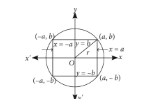
The sides of a rectangle are given by $x= \pm a$ and $y= \pm b$. The equation of the circle passing through the vertices of the rectangle is
AnswerCorrect option: B. $x^2+y^2=a^2+b^2$
(b) : Centre of the required circle $=(0,0)$.
Radius $(r)=\sqrt{(a-0)^2+(b-0)^2}$
$=\sqrt{a^2+b^2}$
$\therefore$ Equation of circle is $(x-0)^2+(y-0)^2=\left(\sqrt{a^2+b^2}\right)^2 \Rightarrow x^2+y^2=a^2+b^2$
View full question & answer→MCQ 202 Marks
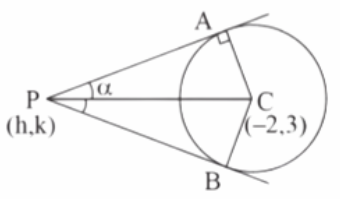
The angle between a pair of tangents drawn from a point P to the circle $x^2+y^2+4 x-6 y+9 \sin ^2 \alpha+13 \cos ^2 \alpha=0$ is $2 \alpha$.The equation of the locus of the point P is
- A
$x^2+y^2+4 x-6 y+4=0$
- B
$x^2+y^2+4 x-6 y-9=0$
- C
$x^2+y^2+4 x-6 y-4=0$
- D
$x^2+y^2+4 x-6 y+9=0$
View full question & answer→MCQ 212 Marks
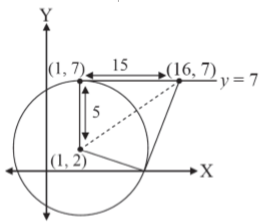
Two tangents PQ and PR drawn to the circle $x^2+y^2-2 x-4 y-20=0$ from point P(16, 7). If the centre of the circle is C, then the area of quadrilateral PQCR will be
Answer(C)
Required area $=\frac{1}{2}(5 \times 15) \times 2=75$
View full question & answer→MCQ 222 Marks
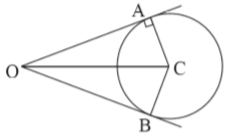
If OA and OB are the tangents from the origin to the circle $x^2+y^2+2 g x+2 f y+c=0$ and C is the centre of the circle, the area of the quadrilateral OACB is
- A
$\frac{1}{2} \sqrt{c\left(g^2+f^2-c\right)}$
- B
$\sqrt{c\left(g^2+f^2-c\right)}$
- C
$c \sqrt{g^2+f^2-c}$
- D
$\frac{\sqrt{g^2+f^2-c}}{c}$
View full question & answer→MCQ 232 Marks
Let the tangents drawn from the origin to the circle, $x^2+y^2-8 x-4 y+16=0$ touch it at the points A and B. The $(A B)^2$ is equal to
- A
$\frac{56}{5}$
- ✓
$\frac{64}{5}$
- C
$\frac{32}{5}$
- D
$\frac{52}{5}$
AnswerCorrect option: B. $\frac{64}{5}$
(B)
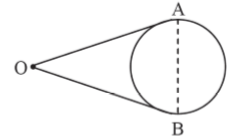
$\begin{array}{l}\text { Radius }= R =\sqrt{16+4-16}=2 \\ L= OA =\sqrt{ S _1}=\sqrt{16}=4 \\ \text { Length of } AB =\frac{2 LR }{\sqrt{ L ^2+ R ^2}} \\ \quad=\frac{2 \times 4 \times 2}{\sqrt{4^2+2^2}}=\frac{16}{\sqrt{20}}=\frac{8}{\sqrt{5}}\end{array}$
$\therefore AB ^2=\frac{64}{5}$ View full question & answer→MCQ 242 Marks
The equations of the tangents draws from the point (0, 1) to the circle $x^2+y^2-2 x+4=0$ are
- ✓
$2 x-y+1=0, x+2 y-2=0$
- B
$2 x-y+1=0, x+2 y+2=0$
- C
$2 x-y-1=0, x+2 y-2=0$
- D
$2 x-y-1=0, x+2 y+2=0$
AnswerCorrect option: A. $2 x-y+1=0, x+2 y-2=0$
(A)
Required equations are given by $SS _1= T ^2$
$ \Rightarrow\left(x^2+y^2-2 x+4 y\right)(1+4)=\{y-1(x)+2(y+1)\}^2$
$\Rightarrow 2 x^2-2 y^2-3 x+4 y+3 x y-2=0$
$\Rightarrow(2 x-y+1)(x+2 y-2)=0$
View full question & answer→MCQ 252 Marks
The equations of the tangets drawn the origin to the circle $x^2+y^2-2 r x-2 h y+h^2=0$ are
- A
$x=0, y=0$
- ✓
$\left( h ^2- r ^2\right) x-2 rh y=0, x=0$
- C
$y=0, x=4$
- D
$h ^2- r ^2 x+2 rh y=0, x=0$
AnswerCorrect option: B. $\left( h ^2- r ^2\right) x-2 rh y=0, x=0$
(B)
Required equations are given by $SS _1= T ^2$
$\Rightarrow h^2\left(x^2+y^2-2 r x-2 h y+h^2\right)=\left(r x+h y-h^2\right)^2$
$\Rightarrow\left(h^2-r^2\right) x^2-2 rh x y=0$
$\Rightarrow x\left\{\left(h^2-r^2\right) x-2 rh y\right\}=0$
$\Rightarrow x=0,\left(h^2-r^2\right) x-2 rh y=0$
View full question & answer→MCQ 262 Marks
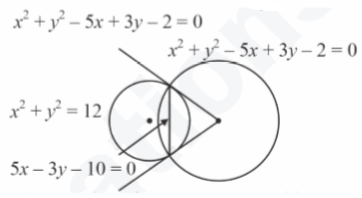
If tangents are drawn to the circle $x^2+y^2=12$ at the points where it intersects the circle $x^2+y^2-5 x+3 y-2=0$, then the coordinates of the point of intersection of those tangents are
- A
$\left(-6, \frac{18}{5}\right)$
- B
$\left(6, \frac{18}{5}\right)$
- C
$\left(-6, \frac{-18}{5}\right)$
- D
$\left(6, \frac{-18}{5}\right)$
View full question & answer→MCQ 272 Marks
The equations of tangents to the circle $x^2+y^2-22 x-4 y+25=0$ which are perpendicular to the line $5 x+12 y+8=0$ are
- ✓
$12 x-5 y+8=0,12 x-5 y=252$
- B
$12 x-5 y=0,12 x-5 y=252$
- C
$12 x-5 y-8=0,12 x-5 y+252=0$
- D
$12 x-5 y+25=0,12 x-5 y+16=0$
AnswerCorrect option: A. $12 x-5 y+8=0,12 x-5 y=252$
(A)
Equation of line perpendicular to
$5 x+12 y+8=0 \text { is } 12 x-5 y+k=0 .$
Now it is a tangent to the circle, if
Radius of circle $=$ Distance of line from centre of circle$\sqrt{121+4-25}=\left|\frac{12(11)-5(2)+k}{\sqrt{144+25}}\right|$
$\Rightarrow k =8$ or -252 .
Hence, equations of tangents are
$12 x-5 y+8=0,12 x-5 y=252$
View full question & answer→MCQ 282 Marks
The equation of the tangent to the circle $x^2+y^2-2 x-4 y-4=0$ which is perpendicular to $3 x-4 y-1=0$, is
- A
$4 x+3 y-15=0$
- B
$4 x+3 y+25=0$
- C
$4 x-3 y+15=0$
- ✓
$4 x+3 y-25=0$
AnswerCorrect option: D. $4 x+3 y-25=0$
(D)
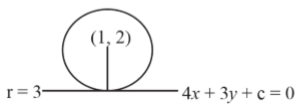
Tangent is of form $4 x+3 y+ c =0$. From condition of tangency to the circle, we get $c =-25$. Hence, equation is $4 x+3 y-25=0$. View full question & answer→MCQ 292 Marks
lf $a>2 b>0$, then the positive value of m for which $y=m x-b \sqrt{1+m^3}$ is a common tangent to $x^2+y^2= b ^2$ and $(x- a )^2+y^2= b ^2$, is
AnswerCorrect option: A. $\frac{2 b}{\sqrt{a^2-4 b^2}}$
(A)
Any tangent to $x^2+y^2= b ^2$ is $y= m x- b \sqrt{1+ m ^2}$
It touches $(x- a )^2+y^2= b ^2$
if $\frac{m a-b \sqrt{1+m^2}}{\sqrt{m^2+1}}=b$ or $m a=2 b \sqrt{1+m^3}$
or $m^2 a^2=4 b^2\left(1+m^2\right)$,
$\therefore$ $m= \pm \frac{2 b}{\sqrt{a^2-4 b^2}}$
View full question & answer→MCQ 302 Marks
Consider the circle $x^2+y^2-6 x+4 y=12$. The equation of a tangent to this circle that is parallel to the line $4 x+3 y+5=0$ is
- A
$4 x+3 y+10=0$
- B
$4 x+3 y-9=0$
- C
$4 x+3 y+9=0$
- ✓
$4 x+3 y-31=0$
AnswerCorrect option: D. $4 x+3 y-31=0$
(D)
Let the equation of tangent be
$\begin{array}{l}4 x+3 y+k=0 ...(i) \\S=x^2+y^2-6 x+4 y-12=0\end{array}$
The centre and radius of S are $(3,-2)$ and 5 units
Distance of (i) from centre of $S =$ radius
$\begin{array}{l}\Rightarrow\left|\frac{12-6+k}{5}\right|=5 \\\Rightarrow|6+k|=25 \\\Rightarrow 6+k= \pm 25 \\ \Rightarrow k=19 \text { or }-31\end{array}$
∴ Equation of tangent is $4 x+3 y+19=0$ or$4 x+3 y-31=0$
View full question & answer→MCQ 312 Marks
The equations of the tangents to the circle $x^2+y^2=a^2$ parallel to the line $\sqrt{3} x+y+3=0$ are
- ✓
$\sqrt{3} x+y \pm 2 a=0$
- B
$\sqrt{3} x+y \pm a =0$
- C
$\sqrt{3} x+y \pm 4 a=0$
- D
$\sqrt{3} y-x+3=0$
AnswerCorrect option: A. $\sqrt{3} x+y \pm 2 a=0$
(A)
Equation of line parallel to the
$\sqrt{3} x+y+3=0 \text { is } \sqrt{3} x+y+k=0$
But it is a tangent to the circle
$x^2+y^2= a ^2$, then
$\begin{array}{l}\left|\frac{k}{\sqrt{1+3}}\right|=a \\\Rightarrow k= \pm 2 a\end{array}$
Hence, the required equation is
$\sqrt{3} x+y \pm 2 a=0$
View full question & answer→MCQ 322 Marks
If the equation of the tangent to the circle $x^2+y^2-2 x+6 y-6=0$ parallel to $3 x-4 y+7=0$ is $3 x-4 y+k=0$, then the values of k are
Answer(A)
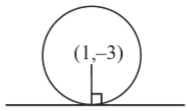
$3 x-4 y+ k =0$
Equation of circle is,
$x^2+y^2-2 x+6 y-6=0$
centre $(1,-3)$
Radius of circle $=4$
And centre of circle $=(1,-3)$
Equation of tangent is $3 x-4 y+ k =0$
$\therefore \frac{3 \times 1-4 \times(-3)+k}{\sqrt{(3)^2+(-4)^2}}= \pm 4$
Hence, $k =5,-35$ View full question & answer→MCQ 332 Marks
The equations of the tangents to circle $5 x^2+5 y^2=1$, parallel to line 3x + 4y = 1 are
AnswerCorrect option: C. $3 x+4 y= \pm \sqrt{5}$
(C)
Equations of tangents are
$y=\frac{-3}{4} x \pm \frac{1}{\sqrt{5}} \sqrt{1+\left(\frac{-3}{4}\right)^2}$
[∵ equation of tangent is $y= m x \pm a \sqrt{1+ m ^2}$ ]
$\begin{array}{ll}\therefore & y=\frac{-3}{4} x \pm \frac{1}{\sqrt{5}} \sqrt{\frac{16+9}{16}} \\ \therefore & 4 y=-3 x \pm \sqrt{5} \\ & \Rightarrow 3 x+4 y= \pm \sqrt{5}\end{array}$
View full question & answer→MCQ 342 Marks
The equation of the tangents to the circle $x^2+y^2-20 x+12 y+11=0$ having slope -2 are
- A
$y=-2 x+11$ and $y=-2 x+39$
- B
$y=-2 x-15$ and $y=-2 x+39$
- C
$y=-2 x-11$ and $y=-2 x+35$
- ✓
$y=-2 x-11$ and $y=-2 x+39$
AnswerCorrect option: D. $y=-2 x-11$ and $y=-2 x+39$
(D)
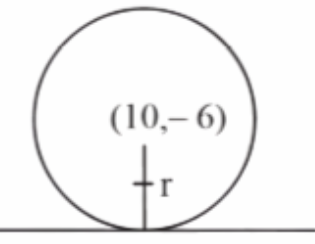
Equation of tangent $y= m x+ c$, where $m =-2$ is $y=-2 x+ c$
$\therefore 2 x+y-c=0$
Now, $x^2+y^2-20 x+12 y+11=0$
$\therefore 2 g=-20,2 f =12$
$\Rightarrow g =-10, f =6, c =11$
$\therefore$ Centre $(- g ,- f )=(10,-6)$
$\text { radius }=\sqrt{g^2+f^2-c}=\sqrt{125}=5 \sqrt{5}$
Since distance of tangent from the centre is equal to radius,
$\begin{array}{l} 5 \sqrt{5}=\left|\frac{2(10)-6-c}{\sqrt{4+1}}\right| \\ \Rightarrow 5 \sqrt{5} \times \sqrt{5}=|14-c| \\ \Rightarrow c=-11 \text { or } 39\end{array}$
∴ Equations of tangents are
$y=-2 x-11$ and $y=-2 x+39$ View full question & answer→MCQ 352 Marks
Tangents are drawn from the origin to a circle with centre at (2, -1). If the equation of one of the tangents is 3x + y = 0, the equation of the other tangent is
Answer(C)
Let the equation of other tangent from the origin be $y=m x$, then length of the perpendiculars from the centre $(2,-1)$ on the two tangents is same.
$\begin{array}{l}\left|\frac{2 m+1}{\sqrt{1+m^2}}\right|=\left|\frac{6-1}{\sqrt{9+1}}\right|=\frac{5}{\sqrt{10}} \\\Rightarrow m=-3 \text { or } \frac{1}{3}\end{array}$
∴ Slope of other tangent is $\frac{1}{3}$ and its equation is
$\begin{array}{l}y=\left(\frac{1}{3}\right) x \\\Rightarrow x-3 y=0\end{array}$
View full question & answer→MCQ 362 Marks
If the squares of the lengths tangents a point circles $x^2+y^2=a^2, x^2+y^2=b^2$ and $x^2+y^2=c^2$ are in A.P. then
- A
$a , b , c$ are in G.P.
- B
$a , b , c$ are in A.P.
- ✓
$a^2, b^2, c^2$ are in A.P.
- D
$a^2, b^2, c^2$ are in G.P.
AnswerCorrect option: C. $a^2, b^2, c^2$ are in A.P.
(C)
Let $P \left(x_1, y_1\right)$ be a point. Let $l_1^2, l_2^2, l_3^2$ be the squares of lengths of the tangents from the point P $\left(x_1, y_1\right)$.
$\begin{aligned}\therefore & l_1^2=x_1^2+y_1^2-a^2 \\& l_2^2=x_1^2+y_1^2-b^2 \\&l_3^2=x_1^2+y_1^2-c^2\end{aligned}$
Assume that $x_1^2+y_1^2= k$
$\therefore l_1^2=k-a^2 ; l_2^2=k-b^2 ; l_3^2=k-c^2$
or we can say that
$a^2=k-l_1^2 ; b^2=k-l_2^2 ; c^2=k-l_3^2$
Since $l_1^2, l_2^2$ and $l_3^2$ are in A. P., we have
$a ^2, b^2$ and $c ^2$ are in A.P.
View full question & answer→MCQ 372 Marks
The co-ordinates of the point from where the tangents are drawn to the circles, $x^2+y^2=1$, $x^2+y^2+8 x+15=0$ and $x^2+y^2+10 y+24=0$ are of same length ,are
- A
$\left(2, \frac{5}{2}\right)$
- ✓
$\left(-2, \frac{5}{2}\right)$
- C
$\left(-2, \frac{5}{2}\right)$
- D
$\left(2,-\frac{5}{2}\right)$
AnswerCorrect option: B. $\left(-2, \frac{5}{2}\right)$
(B)
Length of tangents is same i.e.,$\sqrt{S_1}=\sqrt{S_2}=\sqrt{S_3}$
We get the point from where tangent is drawn, by solving the 3 equations for $x$ and $y$.
i.e.,,$x^2+y^2=1$,
$x^2+y^2+8 x+15=0$ and
$x^2+y^2+10 y+24=0$
or $8 x+16=0$ and $10 y+25=0$
$\Rightarrow x=-2$ and $y=-\frac{5}{2}$
Hence, the point is $\left(-2,-\frac{5}{2}\right)$.
View full question & answer→MCQ 382 Marks
If the lengths of the tangents drawn from P to the circles $x^2+y^2-2 x+4 y-20=0$ and $x^2+y^2-2 x-8 y+1=0$ are in thr ratio 2 : 1 , then the locus of P is
- A
$x^2+y^2+2 x+12 y+8=0$
- B
$x^2+y^2-2 x+12 y+8=0$
- C
$x^2+y^2+2 x-12 y+8=0$
- ✓
$x^2+y^2-2 x-12 y+8=0$
AnswerCorrect option: D. $x^2+y^2-2 x-12 y+8=0$
(D)
(Let the point be $P\left(x_1, y_1\right)$
According to the given condition,
$\begin{array}{l}\frac{\sqrt{x_1^2+y_1^2-2 x_1+4 y_1-20}}{\sqrt{x_1^2+y_1^2-2 x_1-8 y_1+1}}-\frac{2}{1} \\\Rightarrow \frac{x_1^2+y_1^2-2 x_1+4 y_1-20}{x_1^2+y_1^2-2 x_1-8 y_1+1}=\frac{4}{1} \\\Rightarrow x_1^2+y_1^2-2 x_1+4 y_1-20 =4 x_1^2+4 y_1^2-8 x_1-32 y_1+4 \\\Rightarrow 3 x_1^2+3 y_1^2-6 x_1-36 y_1+24=0 \\\Rightarrow x_1^2+y_1^2-2 x_1-12 y_1+8=0\end{array}$
View full question & answer→MCQ 392 Marks
If P is a point such that the ratio of the squares of the lengths of the tangents from P to the circles $x^2+y^2+2 x-4 y-20=0$ and $x^2+y^2-4 x+2 y-44=0$ is $ 2: 3 $, then the locus of Pis a circle with centre
Answer(B)
$\frac{x^2+y^2+2 x-4 y-20}{x^2+y^2-4 x+2 y-44}=\frac{2}{3}$
$\Rightarrow x^2+y^2+14 x-16 y+28=0$
$\therefore $ Centre $=(-7,8)$
View full question & answer→MCQ 402 Marks
If the ratio of the lengths of tangents drawn from the point (f, g) to the given circle $x^2+y^2=6$ and $x^2+y^2+3 x+3 y=0$ be $ 2: 1 $, then
- A
$f^2+g^2+2 g+2 f+2=0$
- B
$f^2+g^2+4 g+4 f+4=0$
- ✓
$f^2+g^2+4 g+4 f+2=0$
- D
$f^2+g^2+4 g+2 f+4=0$
AnswerCorrect option: C. $f^2+g^2+4 g+4 f+2=0$
(C)
According to the given condition,
$\frac{f^2+g^2-6}{f^2+g^2+3 f+3 g}=\frac{4}{1}$
$\Rightarrow f^2+g^2+4 f+4 g+2=0$
View full question & answer→MCQ 412 Marks
Given the circles $x^2+y^2-4 x-5=0$ and $x^2+y^2+6 x-2 y+6=0$ let p be a point $(\alpha, \beta)$, such that the tangents from P to both the circles are equal, then
- A
$2 \alpha+10 \beta+11=0$
- B
$2 \alpha-10 \beta+11=0$
- ✓
$10 \alpha-2 \beta+11=0$
- D
$10 \alpha+2 \beta+11=0$
AnswerCorrect option: C. $10 \alpha-2 \beta+11=0$
(C)
According to the given condition,
$\alpha^2+\beta^2-4 \alpha-5=\alpha^2+\beta^2+6 \alpha-2 \beta+6$
$\therefore 10 \alpha-2 \beta+11=0$
View full question & answer→MCQ 422 Marks
The length of the tangents drawn from any point on the circle $x^2+y^2+2 g x+2 f y+ C _1=0$ to the circle $x^2+y^2+2 g x+2 f y+C_2=0$ is
- A
$\sqrt{C_1^2+C_2^2}$
- ✓
$\sqrt{C_2-C_1}$
- C
$C_1+C_2$
- D
$C _1= C _2$
AnswerCorrect option: B. $\sqrt{C_2-C_1}$
(B)
Let $\left(x_1, y_1\right)$ be any point on the circle
$x^2+y^2+2 g x+2 f y+ C _1=0$
$\therefore x_1^2+y_1^2+2 g x_1+2 f y_1+ C _1=0$
i.e. $x_1^2+y_1^2+2 g x_1+2 f y_1=- C _1$
Length of the tangent from $\left(x_1, y_1\right)$ to the circle
$x^2+y^2+2 g x+2 f y+ C _2=0$ is
$\begin{aligned}\sqrt{x_1^2+y_1^2+2 g x_1+2 f y_1+C_2} & =\sqrt{-C_1+C_2} \\& =\sqrt{C_2-C_1}\end{aligned}$
View full question & answer→MCQ 432 Marks
If the tangent at the point P on the circle $x^2+y^2+6 x+6 y=2$ meets the straight line $5 x-2 y+6=0$ at a point Q on the Y-axis, then the length of PQ is
- A
$2 \sqrt{5}$
- B
$3 \sqrt{5}$
- C
$4$
- ✓
$5$
Answer(D)
Tangent of the given circle meets the line $5 x-2 y+6=0$ at a point $Q (0,3)$ on the Y -axis.
$\therefore$ Length of tangent $=\sqrt{(0)^2+(3)^2+6(0)+6(3)-2}$
$\begin{aligned}PO & =\sqrt{9+18-2} \\& =\sqrt{25}=5\end{aligned}$
View full question & answer→MCQ 442 Marks
If circles $x^2+y^2-4 x-6 y+9=0$ and $x^2+y^2+2 x+2 y-7=0$ touch each other, then their point of contact is
- A
$\left(\frac{4}{5}, \frac{-7}{5}\right)$
- B
$\left(\frac{-4}{5}, \frac{7}{5}\right)$
- C
$\left(\frac{-4}{5}, \frac{-7}{5}\right)$
- ✓
$\left(\frac{4}{5}, \frac{7}{5}\right)$
AnswerCorrect option: D. $\left(\frac{4}{5}, \frac{7}{5}\right)$
(D)
Let $S _1: x^2+y^2-4 x-6 y+9=0$ and $S _2: x^2+y^2+2 x+2 y-7=0$
$\therefore$ the equation of the common tangent to both the circles is $S _1- S _2=0$
$\Rightarrow 6 x+8 y-16=0$
$\Rightarrow 3 x+4 y=8$ is the common equation of the tangent from the given choices,
it is clear that the point $\left(\frac{4}{5}, \frac{7}{5}\right)$ lies on the tangent.
View full question & answer→MCQ 452 Marks
If the circles given by $S \equiv x^2+y^2-14 x+6 y+33=0$ and $S^{\prime} \equiv x^2+y^2-a^2=0(a \in N)$ have 4 common tangents, then the pissible number of circles $S ^{\prime}=0$ is
Answer(B)
The centres and radii of the two circles are
$C _1(7,-3), C _2(0,0), r _1=5, r _2= a$
For 4 common tangents,
$r_1+r_2<\left|C_1 C_2\right|$
$C_1 C_2=\sqrt{7^2+(-3)^2}=\sqrt{58} \approx 7.6$
$r _1+ r _2<\left| C _1 C _2\right|$ for $a =1,2$
$\therefore$ Number of possible circles $=2$
View full question & answer→MCQ 462 Marks
The number of common tangents to the circles $x^2+y^2-4 x-6 y-12=0$ and $x^2+y^2+6 x+18 y+26=0$, is
Answer(C)
$x^2+y^2-4 x-6 y-12=0$
$\begin{array}{l} C_1=(2,3), r_1=\sqrt{4+9+12}=5 \\ x^2+y^2+6 x+18 y+26=0 \\ C_2=(-3,-9), r_2=\sqrt{9+81-26}=8 \\ C_1 C_2=\sqrt{(-3-2)^2+(-9-3)^2}=13 \\ C_1 C_2=r_1+r_2 \\ \Rightarrow \text { The given circles touch each other externally. } \\ \Rightarrow \text { Number of common tangents is } 3\end{array}$
View full question & answer→MCQ 472 Marks
The number of common tangents to circles $x^2+y^2+2 x+8 y-23=0$ and
$x^2+y^2-4 x-10 y+9=0$ is
Answer(C)
$x^2+y^2+2 x+8 y-23=0$
$\therefore \quad C _1(-1,-4), r _1=2 \sqrt{10}$
Again $x^2+y^2-4 x-10 y+9=0$
$\therefore C _2(2,5), r _2=2 \sqrt{5}$
Now $C _1 C _2$ = distance between centres.
$\therefore C _1 C _2=\sqrt{9+81}=3 \sqrt{10}=9.486$ and
$r_1+r_2=2(\sqrt{10}+\sqrt{5})=10.6$
$r_1-r_2=2 \sqrt{5}(\sqrt{2}-1)$
$=2 \times 2.2 \times 0.4$
$=4.4 \times 0.4$
$=1.76$
$C _1 C _2=2 \sqrt{10}> r _1- r _2$
$r_1-r_2 < C_1 C_2 < r_1+r_2$
⇒ Two tangents can be drawn.
View full question & answer→MCQ 482 Marks
If a circle, whose centre is (-1, 1) touches the straight line x + 2y + 12 = 0 then the co-ordinates of the point of contact are
- A
$\left(\frac{-7}{2},-4\right)$
- ✓
$\left(\frac{-18}{5}, \frac{-21}{5}\right)$
- C
- D
AnswerCorrect option: B. $\left(\frac{-18}{5}, \frac{-21}{5}\right)$
(B)
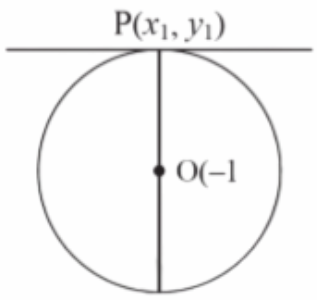
Let point of contact be $P \left(x_1, y_1\right)$.
This point lies on line $x_1+2 y_1=-12$ ...(i)
Gradient of OP $= m _1=\frac{y_1-1}{x_1+1}$
Gradient of $x+2 y+12= m _2=-\frac{1}{2}$
The two lines are perpendicular.
$\therefore \left(\frac{y_1-1}{x_1+1}\right)\left(\frac{-1}{2}\right)=-1$
$\Rightarrow 2 x_1-y_1=-3$ ...(ii)
On solving equations (i) and (ii), we get
$\left(x_1, y_1\right)=\left(\frac{-18}{5}, \frac{-21}{5}\right)$ View full question & answer→MCQ 492 Marks
The point of contact of the tangent to the circle $x^2+y^2=5$ at the point (1,-2) which touches the circle ,$x^2+y^2-8 x+6 y+20=0$ is
Answer(B)
Equation of the tangent at $(1,-2)$ to the circle $x^2+y^2=5$ is $x-2 y=5$
Here, only point $(3,-1)$ lies on the tangent.
View full question & answer→MCQ 502 Marks
The line $x \cos \alpha+y \sin \alpha= p$ will be a tangent to the circle $x^2+y^2-2 a x \cos \alpha-2 a y \sin \alpha=0$, if $p =$
AnswerCorrect option: D. $0$ or 2a
(D)
$x \cos \alpha+y \sin \alpha- p =0$ is a tangent, if perpendicular from centre on it is equal to radius of the circle. Here centre is
( $a \cos \alpha, a \sin \alpha$ ) and radius is a.
$\therefore$ $\left|\frac{a \cos ^2 \alpha+a \sin ^2 \alpha-p}{\sqrt{1}}\right|=a$
i.e., $|a-p|=a \Rightarrow p=0$ or $p=2 a$
View full question & answer→MCQ 512 Marks
Line $y=x+a \sqrt{2}$ is a tangent to the circle $x^2+y^2= a ^2$ at
- A
$\left(\frac{ a }{\sqrt{2}}, \frac{ a }{\sqrt{2}}\right)$
- B
$\left(-\frac{ a }{\sqrt{2}},-\frac{ a }{\sqrt{2}}\right)$
- C
$\left(\frac{ a }{\sqrt{2}},-\frac{ a }{\sqrt{2}}\right)$
- ✓
$\left(-\frac{ a }{\sqrt{2}}, \frac{ a }{\sqrt{2}}\right)$
AnswerCorrect option: D. $\left(-\frac{ a }{\sqrt{2}}, \frac{ a }{\sqrt{2}}\right)$
(D)
Suppose that the point be $( h , k )$.
Tangent at ( $h , k$ ) is
$\begin{array}{l}h x+k y=a^2 \text { and } x-y=-\sqrt{2} a \\\text { or } \frac{h}{l}=\frac{k}{-l}=\frac{a^2}{-\sqrt{2 a}} \text { or } h=-\frac{a}{\sqrt{2}}, k=\frac{a}{\sqrt{2}}\end{array}$
Therefore, point of contact is $\left(-\frac{ a }{\sqrt{2}}, \frac{ a }{\sqrt{2}}\right)$.
View full question & answer→MCQ 522 Marks
If the straight line y = mx + c touches the circle $x^2+y^2-4 y=0$, then the value of c will be
AnswerCorrect option: C. $2\left(1+\sqrt{1+m^2}\right)$
(C)
Apply for tangency of line, $m x-y+ c =0$, centre being $(0,2)$ and radius $=2$$\left|\frac{-2+c}{\sqrt{1+m^2}}\right|=2$
$\begin{array}{l}\Rightarrow c ^2-4 c +4=4+4 m^2 \\ \Rightarrow c ^2-4 c -4 m^2=0 \\ \Rightarrow c =\frac{4 \pm \sqrt{16+16 m^2}}{2} \text { or } c =2\left(1+\sqrt{1+ m ^2}\right)\end{array}$
View full question & answer→MCQ 532 Marks
If the line ycos $\alpha=x \sin \alpha+a \cos \alpha$ be a tangent to the circle $x^2+y^2= a ^2$, then
- A
$\sin ^2 \alpha=1$
- ✓
$\cos ^2 \alpha=1$
- C
$\sin ^2 \alpha=a^2$
- D
$\cos ^2 \alpha=a^2$
AnswerCorrect option: B. $\cos ^2 \alpha=1$
(B)
The tangent is $y \cos \alpha=x \sin \alpha+\operatorname{acos} \alpha$
$\therefore y=x \tan \alpha+a$
Comparing with $y=m x+c$, we get
$m = x \tan \alpha, c = a$
It is a tangent to the circle $x^2+y^2= a ^2$,
If $c ^2= a ^2\left(1+ m ^2\right)$
i.e. $a^2=a^2\left(1+\tan ^2 \alpha\right)$
$\Rightarrow \sec ^2 \alpha=1$
$\Rightarrow \cos ^2 \alpha=1$
View full question & answer→MCQ 542 Marks
Which following lines is a tangent to the circle $x^2+y^2=25$ for all values of m?
- A
$y=m x+25 \sqrt{1+m^2}$
- ✓
$y=m x+5 \sqrt{1+m^2}$
- C
$y=m x+25 \sqrt{1-m^2}$
- D
$y=m x+5 \sqrt{1-m^2}$
AnswerCorrect option: B. $y=m x+5 \sqrt{1+m^2}$
(B)
Line $y= m x+ c$ is a tangent if
$c= \pm a \sqrt{1+m^2}$
$\therefore y=m x+5 \sqrt{1+m^2}$
View full question & answer→MCQ 552 Marks
The equations of the tangents to the circle $x^2+y^2=36$, which are inclined at an angle of $45^{\circ}$ to the X-axis are
- A
$x+y= \pm \sqrt{6}$
- B
$x=y \pm 3 \sqrt{2}$
- ✓
$y=x \pm 6 \sqrt{2}$
- D
$y=x \pm 2 \sqrt{6}$
AnswerCorrect option: C. $y=x \pm 6 \sqrt{2}$
(C)
$y= mx + c$ is a tangent, if
$c = \pm a \sqrt{1+ m ^2}$, where $m =\tan 45^{\circ}=1$
$\therefore$ The equation is $y=x \pm 6 \sqrt{2}$
View full question & answer→MCQ 562 Marks
The line 3x - 2y = k meets the circle $x^2+y^2=4 r^2$ at only point, if $k ^2$ is
- A
$20 r^2$
- ✓
$52 r^2$
- C
$\frac{52}{9} r^2$
- D
$\frac{20}{9} r^2$
AnswerCorrect option: B. $52 r^2$
(B)
$2 y=3 x- k$
$\therefore y=\frac{3}{2} x-\frac{ k }{2}$
Now $c ^2= a ^2\left(1+ m ^2\right)$
$\therefore \quad \frac{ k ^2}{4}=4 r ^2\left(1+\frac{9}{4}\right)$
$\therefore \quad k ^2=52 r ^2$
View full question & answer→MCQ 572 Marks
The line $\frac{x}{a}+\frac{y}{b}=1$ will touch the circle $x^2+y^2= c ^2$ if
AnswerCorrect option: B. $\frac{1}{ c ^2}=\frac{1}{ a ^2}+\frac{1}{b^2}$
View full question & answer→MCQ 582 Marks
If 5x - 12y + 10 = 0 and 12y - 5x + 16 = 0 are tangents of a circle, then radius of that circle is
Answer(C)
The equation of the tangents are
$5 x-12 y+10=0$ and $5 x-12 y-16=0$
Hence, they are parallel to each other. The perpendicular distance between these two lines is the diameter of the circle
$2 r=\left|\frac{c_1-c_2}{\sqrt{a^2+b^2}}\right|$
$c_1=10 ; c_2=-16 ; a=5 ; b=-12$
$\therefore \quad 2 r=\left|\frac{10-(-16)}{\sqrt{5^2+12^2}}\right|=\left|\frac{26}{13}\right|=2$
$\Rightarrow r=1$
View full question & answer→MCQ 592 Marks
The equation of the tangent to the circle $x^2+y^2+4 x-4 y+4=0$ which make equal intercepts on the positive co-ordinate axes is given by
- A
$x+y+2 \sqrt{2}=0$
- ✓
$x+y=2 \sqrt{2}$
- C
$x+y=2$
- D
$x+y=\sqrt{2}$
AnswerCorrect option: B. $x+y=2 \sqrt{2}$
(B)
Centre and radius of the circle $x^2+y^2+4 x-4 y+4=0$ are $(-2,2)$ and 2 respectively.
Let the equation of tangent be
$x+y+ c =0$.Then,
$\begin{array}{l}\left|\frac{-2+2+c}{\sqrt{2}}\right|=2 \\ \Rightarrow c= \pm 2 \sqrt{2}\end{array}$
But for positive intercepts, $c =-2 \sqrt{2}$
$\therefore$ The tangent is $x+y-2 \sqrt{2}=0$
View full question & answer→MCQ 602 Marks
If y + c = 0 is a tangent to the circle $x^2+y^2-6 x-2 y+1=0$ at (a, 4) then
Answer(B)
Here, $g =-3, f =-1$
Equation of tangent at $(a, 4)$ is
$\begin{array}{l}a x+4 y-3(x+a)-(y+4)+1=0 \\\Rightarrow(a-3) x+3 y-3 a-4+1=0 \\\Rightarrow(a-3) x+3 y-3(a+1)=0 \\\Rightarrow \frac{(a-3)}{3} x+y-(a+1)=0\end{array}$
Comparing with $y+ c =0$, we get
$\frac{ a -3}{3}=0 \Rightarrow a =3$
$-(a+1)=c \Rightarrow c=-4$
$\therefore a c=-12$
View full question & answer→MCQ 612 Marks
If x + y = 2 is a tangent to $x^2+y^2=2$ then the equation of the tanget at the same point of contact to the circle $x^2+y^2+3 x+3 y-8=0$ is
Answer(C)
Equation of the tangent to $x^2+y^2=2$ at $( h , k )$ is $h x+ k y=2$
By comparing $h x+ k y=2$ with $x+y=2$,
point of contact is $(1,1)$.
Equation of the tangent to $x^2+y^2+3 x+3 y-8=0$ at $(1,1)$ is
$\begin{array}{l}x(1)+y(1)+\frac{3}{2}(x+1)+\frac{3}{2}(y+1)-8=0 \\\Rightarrow 5 x+5 y-10=0 \\\Rightarrow x+y=2\end{array}$
View full question & answer→MCQ 622 Marks
The X-axis touches the circle whose centre is (0, 1) The equation of the tangent to the circle at (1, 1) is
Answer(B)
The equation of the circle with centre $(0,1)$ is
$x^2+(y-1)^2=a^2$
It passes through the point $(1,1)$.
$\therefore$ $1^2+(1-1)^2=a^2$
$\Rightarrow$ radius is 1 .
The equation of the circle is $x^2+y^2-2 y=0$.
$\therefore$ The equation of the tangent at $(1,1)$ is
$\begin{array}{l}x+y-y-1=0 \\\Rightarrow x-1=0\end{array}$
View full question & answer→MCQ 632 Marks
If the centre of a circle is (-6, 8) and it passes through the origin, then equation to its tangent at origin, is
Answer(B)
Centre $(-6,8)$, radius $=\sqrt{6^2+8^2}=10$
$\therefore$ Equation of circle is $x^2+y^2+12 x-16 y=0$
$\therefore$ Equation of tangent at $(0,0)$ is
$6 x-8 y=0 \Rightarrow 3 x=4 y$
View full question & answer→MCQ 642 Marks
The area of triangle formed by the tangent normal drawn at $(1, \sqrt{3})$ to the circle $x^2+y^2=4$ and positive X-axis, is
- ✓
$2 \sqrt{3}$
- B
$\sqrt{3}$
- C
$4 \sqrt{3}$
- D
$3 \sqrt{3}$
AnswerCorrect option: A. $2 \sqrt{3}$
(A)
Equation of the tangent at $(1, \sqrt{3})$ is
$x+\sqrt{3} y-4=0$
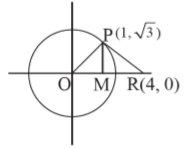
$PM=\sqrt{3} \text { and } OR=4$
Hence, the required area $=\frac{1}{2} \times 4 \times \sqrt{3}=2 \sqrt{3}$ View full question & answer→MCQ 652 Marks
Equation of tangent to the circle $x^2+y^2=10$ at the point with abscissa 1 is
- ✓
$x \pm 3 y=10$
- B
$3 x \pm y=10$
- C
$3 x \pm 3 y=10$
- D
$x-y=3$
AnswerCorrect option: A. $x \pm 3 y=10$
(A)
Abscissa $=1$
Hence, given equation of circle reduces to
$y^2=9$
$\Rightarrow y= \pm 3$
$\therefore$ Equation of tangent at
$(1, \pm 3)$ to $x^2+y^2=10$ is $x(1)+y( \pm 3)=10$
View full question & answer→MCQ 662 Marks
The equation of the tangent to the circle $x^2+y^2=50$ at the point, where the line x - 7 = 0 meets the circle, is
- A
- B
- C
$x \pm 7 y=50$
- ✓
$7 x \pm y=50$
AnswerCorrect option: D. $7 x \pm y=50$
(D)
The equation of the tangent to the circle $x^2+y^2=50$ is $x x_1+y y_1=50$
The circle meets the line $x-7$.
$\therefore (7)^2+y_1^2=50$
$\Rightarrow y_1^2=50-49=1$
$\Rightarrow y_1= \pm 1$
$\therefore$ Equation of the tangent is $7 x \pm y=50$
View full question & answer→MCQ 672 Marks
Let the line segment joining the centres of the circles $x^2-2 x+y^2=0$ and $x^2+y^2+4 x+8 y+16=0$ intersect the another circle at P and Q respectively. Then the equation of the circle with PQ as its diameter is
- A
$5 x^2+5 y^2-2 x-16 y+8=0$
- B
$5 x^2+5 y^2-8 x-24 y+27=0$
- C
$5 x^2+5 y^2+8 x+24 y+27=0$
- ✓
$5 x^2+5 y^2+2 x+16 y+8=0$
AnswerCorrect option: D. $5 x^2+5 y^2+2 x+16 y+8=0$
(D)
The centres of two circles are $C_1(1,0)$ and $C_2(-2,-4)$ and their radii are 1 and 2 units respectively.
Let C be the centre of the required circle.
Then, $C P=C Q=1$.
$\therefore$ $C C_1=2$ and $C C_2=3$.
Clearly, C divides $C _1 C _2$ in the ratio $2: 3$.
Therefore, coordinates of C are
$\left(\frac{-4+3}{2+3}, \frac{-8+0}{2+3}\right)=\left(-\frac{1}{5},-\frac{8}{5}\right) .$
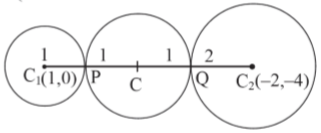
Hence, equation of the required circle is
$\begin{array}{l}\left(x+\frac{1}{5}\right)^2+\left(y+\frac{8}{5}\right)^2=1^2 \\\Rightarrow 5 x^{2}+5 y^{2}+2 x+16 y+8=0\end{array}$ View full question & answer→MCQ 682 Marks
The equation of the circle which passes through the points of intersection of the circles $x^2+y^2-6 x=0$ and $x^2+y^2-6 y=0$ and has its centre at $\left(\frac{3}{2}, \frac{3}{2}\right)$ is
- A
$x^2+y^2+3 x+3 y+9=0$
- B
$x^2+y^2+3 x+3 y=0$
- ✓
$x^2+y^2-3 x-3 y=0$
- D
$x^2+y^2-3 x-3 y+9=0$
AnswerCorrect option: C. $x^2+y^2-3 x-3 y=0$
(C)
$C_1: x^2+y^2-6 x=0$ ....(i)
$C _2: x^2+y^2-6 y=0$ ....(ii)
Solving (i) and (ii), we get
$x=y$ ....(iii)
Substituting (iii) in (i), we get
$y=3$
$\therefore x=3$
Point on circle is $P (3,3)$ and
$\begin{aligned} & \text { centre }=\left(\frac{3}{2}, \frac{3}{2}\right) \\ \therefore & \text { Radius }=\sqrt{\left(3-\frac{3}{2}\right)^2+\left(3-\frac{3}{2}\right)^2}=\frac{3}{\sqrt{2}}\end{aligned}$
$\therefore$ equation of the circle is
$\begin{array}{l}\left(x-\frac{3}{2}\right)^2+\left(y-\frac{3}{2}\right)^2=\frac{9}{2} \\\Rightarrow x^2+y^2-3 x-3 y=0\end{array}$
View full question & answer→MCQ 692 Marks
If one diameters of the circle $x^2+y^2-2 x-6 y+6=0$ is a chord to the circle with centre (2, 1), then the radius of the bigger circle is
Answer(D)
The centre of the given circle is $C_1(1,3)$ and
radius $=\sqrt{(-1)^2+(-3)^2-6}$
$=\sqrt{1+9-6}$
$=2$
$C _1 C _2=\sqrt{(2-1)^2+(1-3)^2}$
$=\sqrt{1+4}=\sqrt{5}$
$\therefore$ Radius of bigger circle $=\sqrt{(\sqrt{5})^2+2^2}$
$=\sqrt{5+4}$
$=3$
View full question & answer→MCQ 702 Marks
If one of given diameters of the circle, given by the equation, $x^2+y^2-4 x+6 y-12=0$, is a chord of a circle S, whose centre is at (-3, 2), then the radius of S is
- ✓
$5 \sqrt{3}$
- B
$5$
- C
$10$
- D
$5 \sqrt{2}$
AnswerCorrect option: A. $5 \sqrt{3}$
(A)
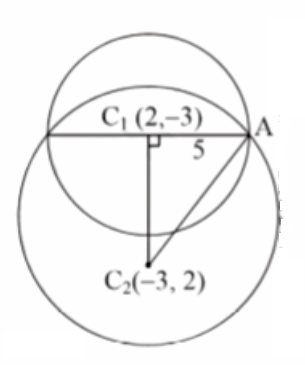
The centre of the given circle is $C _1(2,-3)$ and radius
$\begin{array}{l}=\sqrt{(-2)^2+3^2-(-12)} \\=5 \\C_1 C_2=\sqrt{(-3-2)^2+(2+3)^2} \\\quad=\sqrt{25+25} \\\quad=\sqrt{50}\end{array}$
$\therefore$ Radius of S is $C _2 A=\sqrt{(\sqrt{50})^2+5^2}$
$\begin{array}{l}=\sqrt{75} \\=5 \sqrt{3}\end{array}$ View full question & answer→MCQ 712 Marks
If one of the diameters of the curve $x^2+y^2-4 x-6 y+9=0$ is a chord of a circle with centre (1, 1), then the radius of this circle is
Answer(A)
Given equation of circle is
$x^2+y^2-4 x-6 y+9=0$
$\Rightarrow x^2-4 x+4+y^2-6 y+9-4=0$
$\Rightarrow(x-2)^2+(y-3)^2=4$
$\therefore$ centre $=(2,3)$, radius $=2$
The diameter of this circle is a chord of circle with centre $O (1,1)$.
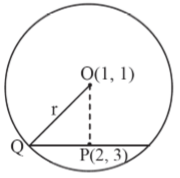
$OP =\sqrt{(3-1)^2+(2-1)^2}=\sqrt{5}$
$QP =2$
$\therefore r^2=(\sqrt{5})^2+2^2 \Rightarrow r=3$ View full question & answer→MCQ 722 Marks
For all values of $\theta$, the locus of the point of intersection of the lines $x \cos \theta+y \sin \theta= a$ and $x \sin \theta-y \cos \theta=b$ is
Answer(B)
The point of intersection is
$x= a \cos \theta+ b \sin \theta$
$y= a \sin \theta- b \cos \theta$
$\therefore \quad x^2+y^2= a ^2+ b ^2$
Hence, it is equation of a circle.
View full question & answer→MCQ 732 Marks
Radius parametric equation represented by $x=2 a\left(\frac{1-t^2}{1+t^2}\right), y=\frac{4 a t}{1+t^2}$ is
Answer(D)
$x=2 a\left(\frac{1-t^2}{1+t^2}\right)$ ...(i)
$y=\frac{4 at }{1+ t ^2}$ ...(ii)
Squaring and adding (i) and (ii), we get
$x^2+y^2=4 a ^2 \cdot \frac{\left(1- t ^2\right)^2}{\left(1+ t ^2\right)^2}+\frac{16 a ^2 t ^2}{\left(1+ t ^2\right)^2}$
$=\frac{4 a^2}{\left(1+t^2\right)^2}\left[1-2 t^2+t^4+4 t^2\right]$
$=\frac{4 a^2}{\left(1+t^2\right)^2}\left(1+t^2\right)^2$
$\therefore \quad x^2+y^2=(2 a)^2$
$\therefore \quad$ Radius $=2 a$
View full question & answer→MCQ 742 Marks
For what value of k, the points (0, 0), (1, 3), (2, 4) and (k, 3) are con-cyclic?
Answer(B)
The equation of circle through points $(0,0)$, $(1,3)$ and $(2,4)$ is
$x^2+y^2-10 x=0$
Point ( $k, 3$ ) will be on the circle, if
$\begin{array}{l}k^2+9-10 k=0 \\\Rightarrow k^2-10 k+9=0 \\\Rightarrow k^2-9 k-k+9=0 \\\Rightarrow(k-1)(k-9)=0 \\\Rightarrow k=1 \text { or } k=9\end{array}$
View full question & answer→MCQ 752 Marks
If a circle passes through the points (0, 0), (a, 0), (0, b), then its centre is
- A
- B
- ✓
$\left(\frac{a}{2}, \frac{b}{2}\right)$
- D
$\left(\frac{b}{2},-\frac{a}{2}\right)$
AnswerCorrect option: C. $\left(\frac{a}{2}, \frac{b}{2}\right)$
(C)
Let the equation of circle be
$x^2+y^2+2 g x+2 f y+c=0$
Now on passing through the given points, we get three equations
$c=0$ ...(i)
$a^2+2 g a+c=0$....(ii)
$b^2+2 f b+c=0$ ....(iii)
Solving equations (i), (ii) and (iii), we get
$g=-\frac{a}{2}, f=-\frac{b}{2}$
Hence, the centre is $\left(\frac{ a }{2}, \frac{b}{2}\right)$.
View full question & answer→MCQ 762 Marks
The locus of the centre of the circle which cuts off intercepts of length 2a and 2b from X-axis and Y-axis respectively, is
- A
$x+y= a + b$
- B
$x^2+y^2=a^2+b^2$
- ✓
$x^2-y^2=a^2-b^2$
- D
$x^2+y^2=a^2-b^2$
AnswerCorrect option: C. $x^2-y^2=a^2-b^2$
(C)
Since X -intercept $=2 a$
$\therefore 2 \sqrt{g^2-c}=2 a$$\quad\ldots(i)$
Also, Y -intercept $=2 b$
$\therefore 2 \sqrt{f^2-c}=2 b$$\quad\ldots(ii)$
On squaring (i) and (ii) and then subtracting (ii) from (i), we get
$g^2-f^2=a^2-b^2$
Hence, the locus is
$x^2-y^2=a^2-b^2$
View full question & answer→MCQ 772 Marks
The equation of the circle passing through the point (2, 1) and touching Y-axis at the origin is
- A
$x^2+y^2-5 x=0$
- ✓
$2 x^2+2 y^2-5 x=0$
- C
$x^2+y^2+5 x=0$
- D
AnswerCorrect option: B. $2 x^2+2 y^2-5 x=0$
(B)
We have the equation of circle
$x^2+y^2+2 g x+2 f y+c=0$
But it passes through $(0,0)$ and $(2,1)$.
$\therefore \quad c=0$
$5+4 g+2 f=0$ ....(i)
Also $\sqrt{ g ^2+ f ^2- c }=| g |$
$\Rightarrow f =0$ $\ldots [\because c=0]$
$\therefore g=-\frac{5}{4}$ ....[From (i)]
Hence, the equation will be $2 x^2+2 y^2-5 x=0$.
View full question & answer→MCQ 782 Marks
A circle is concentric with the circle $x^2+y^2-6 x+12 y+15=0$ and has area double of its area. The equation of the circle is
- ✓
$x^2+y^2-6 x+12 y-15=0$
- B
$x^2+y^2-6 x+12 y+15=0$
- C
$x^2+y^2-6 x+12 y+45=0$
- D
$x^2+y^2-6 x+12 y-45=0$
AnswerCorrect option: A. $x^2+y^2-6 x+12 y-15=0$
(A)
Equation of circle concentric to given circle is
$x^2+y^2-6 x+12 y+k=0$
Since area of required circle $=2$ (area of given circle)$\begin{array}{l}\Rightarrow \sqrt{9+36-k}=\sqrt{2} \sqrt{9+36-15} \\\Rightarrow 45-k=60 \\\Rightarrow k=-15\end{array}$
Hence, the required equation of circle is
$x^2+y^2-6 x+12 y-15=0$
View full question & answer→MCQ 792 Marks
The equation of the circle whose radius is 5 and which touches the circle $x^2+y^2-2 x-4 y-20=0$ externally at the point (5, 5), is
- A
$x^2+y^2-18 x-16 y-120=0$
- ✓
$x^2+y^2-18 x-16 y+120=0$
- C
$x^2+y^2+18 x+16 y-120=0$
- D
$x^2+y^2+18 x-16 y+120=0$
AnswerCorrect option: B. $x^2+y^2-18 x-16 y+120=0$
(B)
Let the centre of the required circle be $\left(x_1, y_1\right)$. Centre of given circle is $(1,2)$ and
$r =\sqrt{1+4+20}=5$
$\therefore$ radii of both circles are same.
$\therefore$ Point of contact $(5,5)$ is the mid point of the line joining the centres of both circles.
$\begin{array}{l} \therefore \frac{x_1+1}{2}=5 \text { and } \frac{y_1+2}{2}=5 \\\Rightarrow x_1=9, y_1=8\end{array}$
Hence, the required equation is
$(x-9)^2+(y-8)^2=25$
$\Rightarrow x^2+y^2-18 x-16 y+120=0$
View full question & answer→MCQ 802 Marks
If the circles $x^2+y^2+2 \lambda x+2=0$ and $x^2+y^2+4 y+2=0$ touch each other, then $\lambda=$
- A
$\pm 1$
- ✓
- C
$\pm 3$
- D
$\pm 4$
Answer(B)
The centres of two circles are $C_1(-\lambda, 0)$ and $C _2(0,-2)$ and their radii are $\sqrt{\lambda^2-2}$ and $\sqrt{2}$.
The given circles touches each other, if
$\sqrt{\lambda^2+4}=\sqrt{\lambda^2-2}+\sqrt{2}$
$\Rightarrow \lambda^2+4=\lambda^2-2+2+2 \sqrt{2} \sqrt{\lambda^2-2}$
$\Rightarrow \sqrt{2}=\sqrt{\lambda^2-2}$
$\Rightarrow \lambda^2=4$
$\Rightarrow \lambda= \pm 2$
View full question & answer→MCQ 812 Marks
The equation of a circle of radius 5 which lies within the circle $x^2+y^2+14 x+10 y-26=0$ and touches it at the point (-1, 3) is
- ✓
$x^2+y^2+8 x+2 y-8=0$
- B
$x^2+y^2+10 x+2 y+1=0$
- C
$x^2+y^2+8 x+4 y-4=0$
- D
$x^2+y^2+8 x+6 y=0$
AnswerCorrect option: A. $x^2+y^2+8 x+2 y-8=0$
(A) Consider option (A),
$x^2+y^2+8 x+2 y-8=0$
Point $(-1,3)$ is common to both circle and lies on above circle also.
Since point $(-1,3)$ satisfies the equation of circle in option (A).
$\therefore$ correct answer is option (A).
View full question & answer→MCQ 822 Marks
A circle $x^2+y^2+2 g x+2 f y+ c =0$ passing through (4, -2) is concentric to the circle $x^2+y^2-2 x+4 y+20=0$ then the value of c will be
Answer(A)
Circle $x^2+y^2+2 gr +2 fy + c =0$
is concentric with $x^2+y^2-2 x+4 y+20=0$.
$\therefore$ centre is $(1,-2)$ and
radius $=\sqrt{(4-1)^2+(-2+2)^2}=\sqrt{3^2+0^2}=3$
Also, $r=\sqrt{g^2+f^2-c}$
$\therefore 3=\sqrt{(-1)^2+(2)^2-c}$
$\therefore 9=1+4-c$
$\therefore c=-4$
View full question & answer→MCQ 832 Marks
The equation of the circle concentric with the circle $x^2+y^2+8 x+10 y-7=0$ and passing through the centre of the circle $x^2+y^2-4 x-6 y=0$ is
- A
$x^2+y^2+8 x+10 y+59=0$
- ✓
$x^2+y^2+8 x+10 y-59=0$
- C
$x^2+y^2-4 x-6 y+87=0$
- D
$x^2+y^2-4 x-6 y-87=0$
AnswerCorrect option: B. $x^2+y^2+8 x+10 y-59=0$
(B)
Centre of the required circle is $(-4,-5)$ and it passes through $(2,3)$.
$\therefore$ $\text { Radius }=\sqrt{(-4-2)^2+(-5-3)^2}=10$
$\therefore$ Equation of the required circle is
$(x+4)^2+(y+5)^2=(10)^2$
$\Rightarrow x^2+y^2+8 x+10 y-59=0$
View full question & answer→MCQ 842 Marks
The equation of the circle with centre at (1, -2) and passing through the centre of the given circle $x^2+y^2+2 y-3=0$, is
- ✓
$x^2+y^2-2 x+4 y+3=0$
- B
$x^2+y^2-2 x+4 y-3=0$
- C
$x^2+y^2+2 x-4 y-3=0$
- D
$x^2+y^2+2 x-4 y+3=0$
AnswerCorrect option: A. $x^2+y^2-2 x+4 y+3=0$
(A)
Centre of the given circle is $(0,-1)$.
$\therefore$ the required circle passes through $(0,-1)$.
$\therefore$ $r=\sqrt{(0-1)^2+(-1+2)^2}=\sqrt{ } 2$
Hence, the required equation is
$(x-1)^2+(y+2)^2=(\sqrt{2})^2$
$\Rightarrow x^2+y^2-2 x+4 y+3=0$
View full question & answer→MCQ 852 Marks
The equation of the circle concentric with the circle $x^2+y^2-4 x-6 y-3=0$ and touching Y-axis is
- A
$x^2+y^2-4 x-6 y-9=0$
- ✓
$x^2+y^2-4 x-6 y+9=0$
- C
$x^2+y^2-4 x-6 y+3=0$
- D
$x^2+y^2-4 x-6 y-3=0$
AnswerCorrect option: B. $x^2+y^2-4 x-6 y+9=0$
(B)
Centre of the circle
$x^2+y^2-4 x-6 y-3=0 \text { is } C(2,3)$
Since, it touches the Y -axis
$\therefore$ $r-2$
Hence required equation of the circle is
$(x-2)^2+(y-3)^2=2^2$
$\Rightarrow x^2+y^2-4 x-6 y+9=0$
View full question & answer→MCQ 862 Marks
A variable circle passes through the fixed point A(p, q) and touches X-axis. The locus of the other end of diameter through A is
- ✓
$(x-p)^2=4 q y$
- B
$(x-q)^2=4 p y$
- C
$(y-p)^2=4 q x$
- D
$(y-q)^2=4 p x$
AnswerCorrect option: A. $(x-p)^2=4 q y$
(A)
Let another end of the diameter be ( $h , k$ ).
Since centre is the midpoint of the diameter.
$\therefore \quad$ Centre $=\left(\frac{ p + h }{2}, \frac{ q + k }{2}\right)$
Since the circle touches X -axis,
radius $=\left|\frac{q+k}{2}\right|$
$\Rightarrow \sqrt{( h - p )^2+( k - q )^2}=2\left|\frac{ q + k }{2}\right|$
$\Rightarrow( h - p )^2+( k - q )^2=( q + k )^2$
$\Rightarrow( h - p )^2=( k + q )^2-( k - q )^2$
$\Rightarrow( h - p )^2=4 k y$
$\therefore $ Locus of $( h , k )$ is $(x- p )^2=4 q y$
View full question & answer→MCQ 872 Marks
The point diametrically opposite to the point P(1, 0) on the circle $x^2+y^2+2 x+4 y-3=0$ is
Answer(B)
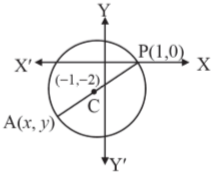
Let $A (x, y)$ be the required point.
Given equation of circle is
$x^2+y^2+2 x+4 y-3=0$
$\therefore$ Centre $=(-1,-2)$
Since C is the midpoint of AP.
$\therefore$ $A=(-3,-4)$ View full question & answer→MCQ 882 Marks
If one end of a diameter of the circle $x^2+y^2-4 x-6 y+11=0$ be (3, 4), then the other end is
Answer(C)
Let another end of the diameter be $(x, y)$.
Centre of the given circle is $(2,3)$.
Since centre is the midpoint of the diameter.
$\therefore 2=\frac{3+x}{2}, 3=\frac{4+y}{2}$
$\Rightarrow x=1, y=2$
$\Rightarrow(x, y)=(1,2)$
Alternate Method:
Here, $\left(x_1, y_1\right)=(3,4)$
$\therefore$ $(x, y)-(-(3-4),-(4-6))$...[Using Shortcut 6]$=(1,2)$
View full question & answer→MCQ 892 Marks
If the equation $\frac{K(x+1)^2}{3}+\frac{(y+2)^2}{4}=1$ represents a circle, then K =
- ✓
$\frac{3}{4}$
- B
$1$
- C
$\frac{4}{3}$
- D
AnswerCorrect option: A. $\frac{3}{4}$
(A)
The given equation represents a circle, if coeff. of $x^2=\operatorname{coeff}$, of $y^2$
After solving the given equation , we get
$\frac{K}{3}=\frac{1}{4} \Rightarrow K=\frac{3}{4}$
View full question & answer→MCQ 902 Marks
The equation of the circle passing through the point (1, 0) and (0, 1) and having the smallest radius is
- A
$x^2+y^2-2 x-2 y+1=0$
- ✓
$x^2+y^2-x-y=0$
- C
$x^2+y^2+2 x+2 y-7=0$
- D
$x^2+y^2+x+y-2=0$
AnswerCorrect option: B. $x^2+y^2-x-y=0$
(B)
Circle whose diametric end points are $(1,0)$ and $(0,1)$ will be of smallest radius.
$\therefore$ By using diameter form, equation of circle is
$(x-1)(x-0)+(y-0)(y-1)=0$
$\Rightarrow x^2+y^2-x-y=0$
View full question & answer→MCQ 912 Marks
The equation of the circle whose centre is $(1,-3)$ and which touches the line $2 x-y-4=0$ is
- ✓
$5 x^2+5 y^2-10 x+30 y+49=0$
- B
$5 x^2+5 y^2+10 x-30 y+49=0$
- C
$5 x^2+5 y^2-10 x+30 y-49=0$
- D
$5 x^2+5 y^2-10 x-30 y+49=0$
AnswerCorrect option: A. $5 x^2+5 y^2-10 x+30 y+49=0$
(A)
$\text { Radius of circle }=\left|\frac{2(1)-1(-3)-4}{\sqrt{4+1}}\right|=\frac{1}{\sqrt{5}}$
$\therefore$ Equation is $(x-1)^2+(y+3)^2=\left(\frac{1}{\sqrt{5}}\right)^2$
$\Rightarrow x^2+y^2-2 x+6 y+10=\frac{1}{5}$
$\Rightarrow 5 x^2+5 y^2-10 x+30 y+49=0$
View full question & answer→MCQ 922 Marks
The equation of a circle which touches both axes and the line 3x -4y + 8 = 0 and whos centre lies in the third quadrant is
- A
$x^2+y^2-4 x+4 y-4=0$
- B
$x^2+y^2-4 x+4 y+4=0$
- ✓
$x^2+y^2+4 x+4 y+4=0$
- D
$x^2+y^2-4 x-4 y-4=0$
AnswerCorrect option: C. $x^2+y^2+4 x+4 y+4=0$
(C)
The equation of circle in third quadrant touching the coordinate axes with centre $(- a ,- a )$ and radius ' a ' is
$x^2+y^2+2 a x+2 a y+a^2=0$ ...(i)
Since, line $3 x-4 y+8=0$ touches the circle
$\therefore$ perpendiular distance from centre of the circle to the line $=$ radius
$\therefore$ $\left|\frac{3(-a)-4(-a)+8}{\sqrt{9+16}}\right|=a$
$\Rightarrow a=2$
Substituting $a =2$ in equation (i), we get
$x^2+y^2+4 x+4 y+4=0$
This is the required equation of the circle
View full question & answer→MCQ 932 Marks
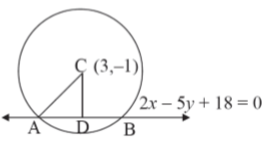
The equation of the circle whose centre is (3, -1) and which cuts off a chord of length 6 on the line 2x - 5y + 18 = 0 is
MCQ 942 Marks
Equation of the circle which touches the lines x = 0, y = 0 and 3x + 4y = 4 is
- A
$x^2-4 x+y^2+4 y+4=0$
- ✓
$x^2-4 x+y^2-4 y+4=0$
- C
$x^2+4 x+y^2+4 y+4=0$
- D
$x^2+4 x+y^2-4 y+4=0$
AnswerCorrect option: B. $x^2-4 x+y^2-4 y+4=0$
(B)
Let centre of circle be ( $h , k$ ).
Since it touches both axes, therefore $h = k = a$
Hence, equation can be $(x-a)^2+(y-a)^2=a^2$
But it also touches the line $3 x+4 y=4$
$\therefore\left|\frac{3 a+4 a-4}{\sqrt{9+16}}\right|=a$
$\Rightarrow a =2$
Hence, the required equation of circle is
$(x-2)^2+(y-2)^2=2^2$
$\Rightarrow x^2+y^2-4 x-4 y+4=0$
View full question & answer→MCQ 952 Marks
The equation of the circle which passes throug the points (2, 3) and (4, 5) and the centre lies on the straight line y - 4x + 3 = 0, is
- A
$x^2+y^2+4 x-10 y+25=0$
- ✓
$x^2+y^2-4 x-10 y+25=0$
- C
$x^2+y^2-4 x-10 y+16=0$
- D
$x^2+y^2-14 y+8=0$
AnswerCorrect option: B. $x^2+y^2-4 x-10 y+25=0$
(B)
Let centre be ( $h , k$ ). Then,
$\sqrt{( h -2)^2+( k -3)^2}=\sqrt{( h -4)^2+( k -5)^2}$
$\Rightarrow-4 h+4-6 k+9=-8 h+16-10 k+25$
$\Rightarrow 4 h+4 k-28=0$
$\Rightarrow h + k -7=0$ ...(i)
Since, centre lies on the given line.
$\therefore$ $k-4 h+3=0$....(ii)
Solving (i) and (ii), we get $( h , k )=(2,5)$
$\therefore$ centre is $(2,5)$ and
$\text { radius }=\sqrt{(2-2)^2+(5-3)^2}=2$
$\therefore$ the required equation of the circle is$\begin{array}{l}(x-2)^2+(y-5)^2=(2)^2 \\\Rightarrow x^2+y^2-4 x-10 y+25=0\end{array}$
View full question & answer→MCQ 962 Marks
A circle has radius 3 units and its centre lies of the line y = x - 1. Then the equation of the circle if it passes through point (7, 3), is
- ✓
$x^2+y^2-8 x-6 y+16=0$
- B
$x^2+y^2+8 x+6 y+16=0$
- C
$x^2+y^2-8 x-6 y-16=0$
- D
$x^2+y^2+8 x-6 y-16=0$
AnswerCorrect option: A. $x^2+y^2-8 x-6 y+16=0$
(A)
Let its centre be ( $h , k$ ), then
$h-k=1$....(i)
Also, radius $a =3$
$\therefore$ Equation of the circle is$(x-h)^2+(y-k)^2=9$
Also, it passes through $(7,3)$
$\text { i.e., }(7-h)^2+(3-k)^2=9$.....(ii)
From (i) and (ii), we get
$h=4, k=3$
$\therefore$ Equation is $x^2+y^2-8 x-6 y+16=0$
View full question & answer→MCQ 972 Marks
The lines 2x - 3y = 5 and 3x - 4y = 7 are the diameters of a circle of area 154 square units The equation of the circle is
- A
$x^2+y^2+2 x-2 y=62$
- ✓
$x^2+y^2-2 x+2 y=47$
- C
$x^2+y^2+2 x-2 y=47$
- D
$x^2+y^2-2 x+2 y=62$
AnswerCorrect option: B. $x^2+y^2-2 x+2 y=47$
(B)
Centre of circle $=$ Point of intersection of diameters $=(1,-1)$
Now, area $=154$
$\Rightarrow \pi r^2=154\Rightarrow r=7$
Hence, the equation of required circle is
$(x-1)^2+(y+1)^2=7^2$
$\Rightarrow x^2+y^2-2 x+2 y=47$
View full question & answer→MCQ 982 Marks
If the lines 2x + 3y + 1 = 0 and 3x -y - 4 = 0 lie along diameters of a circle of circumferenc $10 \pi$ , then the equation of the circle is
- A
$x^2+y^2+2 x-2 y-23=0$
- B
$x^2+y^2-2 x-2 y-23=0$
- C
$x^2+y^2+2 x-2 y+23=0$
- ✓
$x^2+y^2-2 x+2 y-23=0$
AnswerCorrect option: D. $x^2+y^2-2 x+2 y-23=0$
(D)
Since the centre always lies on the diameter.
Solving $2 x+3 y+1=0$ and $3 x-y-4=0$, the co-ordinates of the centre are $(1,-1)$.
Given, circumference $=10 \pi$
$\therefore \quad 2 \pi r=10 \pi \Rightarrow r=5$
∴ the equation of the circle is
$(x-1)^2+(y+1)^2=5^2$
$\Rightarrow x^2+y^2-2 x+2 y-23=0$
View full question & answer→MCQ 992 Marks
The equation of the circle whose diameter lies on 2x+3y=3 and 16x-y=4 which passes through (4, 6) is
AnswerCorrect option: A. $5\left(x^2+y^2\right)-3 x-8 y=200$
(A)
Since the centre always lies on the diameter.
Solving $2 x+3 y=3$ and $16 x-y=4$,
we get co-ordinates of the centre $=\left(\frac{3}{10}, \frac{4}{5}\right)$.
The circle passes through $(4,6)$.
$\therefore \quad r^2=\left(4-\frac{3}{10}\right)^2+\left(6-\frac{4}{5}\right)^2$
$=\left(\frac{37}{10}\right)^2+\left(\frac{26}{5}\right)^2=\frac{4073}{100}$
∴ the equation of the circle is
$\left(x-\frac{3}{10}\right)^2+\left(y-\frac{4}{5}\right)^2=\frac{4073}{100}$
$\Rightarrow 100 x^2+100 y^2-60 x-160 y=4000$
$\Rightarrow 5\left(x^2+y^2\right)-3 x-8 y=200$
View full question & answer→MCQ 1002 Marks
If the lines x + y = 6 and x + 2y = 4 be diameters of the circle whose diameter is 20, then the equation of the circle is
- ✓
$x^2+y^2-16 x+4 y-32=0$
- B
$x^2+y^2+16 x+4 y-32=0$
- C
$x^2+y^2+16 x+4 y+32=0$
- D
$x^2+y^2+16 x-4 y+32=0$
AnswerCorrect option: A. $x^2+y^2-16 x+4 y-32=0$
(A)
Here, $r =10$ (radius)
Centre will be the point of intersection of the diameters, i.e., $(8,-2)$.
Hence, required equation is
$\begin{array}{l}(x-8)^2+(y+2)^2=10^2 \\\Rightarrow x^2+y^2-16 x+4 y-32=0\end{array}$
View full question & answer→MCQ 1012 Marks
The equation of the circle having centre (1, -2) and passing through the point of intersection of
lines 3x + y = 14, 2x + 5y = 18 is
- ✓
$x^2+y^2-2 x+4 y-20=0$
- B
$x^2+y^2-2 x-4 y-20=0$
- C
$x^2+y^2+2 x-4 y-20=0$
- D
$x^2+y^2+2 x+4 y-20=0$
AnswerCorrect option: A. $x^2+y^2-2 x+4 y-20=0$
(A)
The point of intersection of $3 x+y-14=0$ and $2 x+5 y-18=0$ is $(4,2)$.
Centre of the circle is $(1,2)$.
$\therefore$ radius $=\sqrt{(4-1)^2+(2+2)^2}=5$
∴ the equation of the circle is
$(x-1)^2+(y+2)^2=5^2$
$\therefore x^2+y^2-2 x+4 y-20=0$
View full question & answer→MCQ 1022 Marks
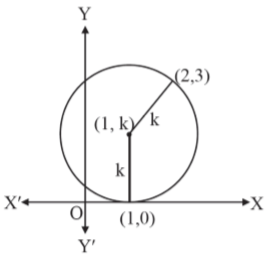
The length of the diameter of the circle which touches the X-axis at the point (1, 0) and passes through the point (2, 3) is
- A
$\frac{10}{3}$
- B
$\frac{3}{5}$
- C
$\frac{6}{5}$
- D
$\frac{5}{3}$
View full question & answer→MCQ 1032 Marks
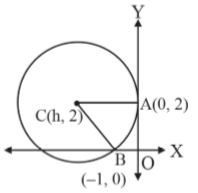
The circle passing through the point (-1, 0) and touching the Y-axis at (0, 2) also passes through the point
- A
$\left(-\frac{3}{2}, 0\right)$
- B
$\left(-\frac{5}{2}, 2\right)$
- C
$\left(-\frac{3}{2}, \frac{5}{2}\right)$
- D
$(-4,0)$
View full question & answer→MCQ 1042 Marks
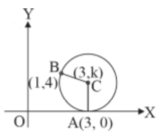
The equation of the circle which touches X-axis at (3, 0) and passes through (1, 4) is given by
- A
$x^2+y^2-6 x-5 y+9=0$
- B
$x^2+y^2+6 x+5 y-9=0$
- C
$x^2+y^2-6 x+5 y-9=0$
- D
$x^2+y^2+6 x-5 y+9=0$
View full question & answer→MCQ 1052 Marks
ABCD is a square, the length of whose side is a. Taking AB and AD as the coordinate axes, the equation of the circle passing through the vertices of the square is
- A
$x^2+y^2+a x+a y=0$
- ✓
$x^2+y^2- a x- a y=0$
- C
$x^2+y^2+2 a x+2 a y=0$
- D
$x^2+y^2-2 a x-2 a y=0$
AnswerCorrect option: B. $x^2+y^2- a x- a y=0$
(B)
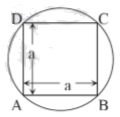
According to the figure, $A (0,0), B ( a , 0)$, $C ( a , a )$ and $D (0, a )$.
and centre is $\left(\frac{ a }{2}, \frac{ a }{2}\right)$.
∴ the equation of the circle is
$\begin{array}{l}\left(x-\frac{a}{2}\right)^2+\left(y-\frac{a}{2}\right)^2=\frac{a^2}{2} \\\Rightarrow x^2+y^2-a x-a y=0\end{array}$ View full question & answer→MCQ 1062 Marks
The equation of the circle passing through the origin and cutting intercepts of length 3 and 4 units from the positive axes, is
- A
$x^2+y^2+6 x+8 y+1=0$
- B
$x^2+y^2-6 x-8 y=0$
- C
$x^2+y^2+3 x+4 y=0$
- ✓
$x^2+y^2-3 x-4 y=0$
AnswerCorrect option: D. $x^2+y^2-3 x-4 y=0$
(D)
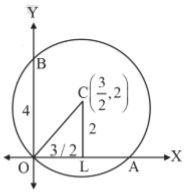
Given, $OA =3$ and
OB = 4
$\therefore OL =\frac{3}{2}$ and $CL =2$
By pythagoras theorem,
$OC ^2= OL ^2+ LC ^2$
$OC ^2=\left(\frac{3}{2}\right)^2+2^2$
$=\frac{25}{4}$
$\therefore OC =\frac{5}{2}$
The centre of the circle is $\left(\frac{3}{2}, 2\right)$ and radius $=\frac{5}{2}$.
∴ the equation of the circle is
$\begin{aligned}\left(x-\frac{3}{2}\right)^2+(y-2)^2 & =\left(\frac{5}{2}\right)^2 \\ \therefore \quad x^2+y^2-3 x-4 y & =0\end{aligned}$
View full question & answer→MCQ 1072 Marks
The equation of the circle with centre (2, 2) which passes through (4, 5) is
- A
$x^2+y^2-4 x+4 y-77=0$
- ✓
$x^2+y^2-4 x-4 y-5=0$
- C
$x^2+y^2+2 x+2 y-59=0$
- D
$x^2+y^2-2 x-2 y-23=0$
AnswerCorrect option: B. $x^2+y^2-4 x-4 y-5=0$
(B)
Centre $(2,2)$ and
$\begin{aligned} r & =\sqrt{(4-2)^2+(5-2)^2} \\ & =\sqrt{13}\end{aligned}$
Hence, required equation is $\begin{array}{l}(x-2)^2+(y-2)^2=(\sqrt{13})^2 \\\Rightarrow x^2+y^2-4 x-4 y-5=0\end{array}$
View full question & answer→MCQ 1082 Marks
The equation of the circle of radius 5 and touching the coordinate axes in third quadrant is
- A
$(x-5)^2+(y+5)^2=25$
- B
$(x+4)^2+(y+4)^2=25$
- C
$(x+6)^2+(y+6)^2=25$
- ✓
$(x+5)^2+(y+5)^2=25$
AnswerCorrect option: D. $(x+5)^2+(y+5)^2=25$
(D)
Since circle touches the co-ordinate axes in III quadrant.
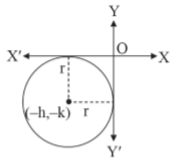
$\therefore $ Radius $=- h =- k$
Hence, $h = k =-5$
∴ Equation of circle is $(x+5)^2+(y+5)^2=25$ View full question & answer→MCQ 1092 Marks
The equation of the circle in the first quadrant which touches each axis at a distance 5 from the origin, is
- A
$x^2+y^2+5 x+5 y+25=0$
- ✓
$x^2+y^2-10 x-10 y+25=0$
- C
$x^2+y^2-5 x-5 y+25=0$
- D
$x^2+y^2+10 x+10 y+25=0$
AnswerCorrect option: B. $x^2+y^2-10 x-10 y+25=0$
(B)
The centre of the circle which touches each axis in first quadrant at a distance 5 , will be $(5,5)$ and radius will be 5 .
∴ equation of the circle is
$\begin{array}{l}(x-5)^2+(y-5)^2=(5)^2 \\\Rightarrow x^2+y^2-10 x-10 y+25=0\end{array}$
View full question & answer→MCQ 1102 Marks
The equation of director circle of the circle $x^2+y^2= a ^2$ is
- A
$x^2+y^2=4 a^2$
- ✓
$x^2+y^2=\sqrt{2} a ^2$
- C
$x^2+y^2-2 a ^2=0$
- D
AnswerCorrect option: B. $x^2+y^2=\sqrt{2} a ^2$
(B)
Director circle has its radius $\sqrt{2}$ times that of radius of the given circle.
$\therefore$ The required equation is $x^2+y^2=2 a ^2$.
View full question & answer→MCQ 1112 Marks
The square of the length of the tangent from (3, -4) on the circle $x^2+y^2-4 x-6 y+3=0$ is
Answer(C)
Length of tangent
$=\sqrt{3^2+(-4)^2-4(3)-6(-4)+3}=\sqrt{40}$
∴ Square of length of tangent $=40$
View full question & answer→MCQ 1122 Marks
Square of the length of the tangent drawn from the point $(\alpha, \beta)$ to the circle $a x^2+a y^2=r^2$ is
- A
$a \alpha^2+a \beta^2-r^2$
- ✓
$\alpha^2+\beta^2-\frac{r^2}{a}$
- C
$\alpha^2+\beta^2+\frac{ r ^2}{ a }$
- D
$\alpha^2+\beta^2-r^2$
AnswerCorrect option: B. $\alpha^2+\beta^2-\frac{r^2}{a}$
View full question & answer→MCQ 1132 Marks
If the length of the tangent segment from the point (5, 3) to the circle
$x^2+y^2+10 x+ k y-17=0$ is 7, then k equals
Answer(A)
Length of tangent segment
$\begin{array}{l}=\sqrt{5^2+3^2+10(5)+k(3)-17}=7 \\\Rightarrow 67+3 k=49 \\\Rightarrow k=-6\end{array}$
View full question & answer→MCQ 1142 Marks
The length of the tangent from the origin to the circle $3 x^2+3 y^2-4 x-6 y+2=0$ is
AnswerCorrect option: B. $\frac{\sqrt{2}}{\sqrt{3}}$
(B)
Equation of the circle is
$3 x^2+3 y^2-4 x-6 y+2=0$
$\Rightarrow x^2+y^2-\frac{4 x}{3}-\frac{6 y}{3}+\frac{2}{3}=0$
∴ Length of the tangent from the origin is
$\sqrt{0^2+0^2-\left(\frac{4}{3}\right)(0)-\left(\frac{6}{3}\right)(0)+\frac{2}{3}}=\sqrt{\frac{2}{3}}$
View full question & answer→MCQ 1152 Marks
The length of the tangent from the point (-3, 8) to the circle $x^2+y^2-8 x+2 y+1=0$ is
- A
$\sqrt{91}$
- ✓
$\sqrt{114}$
- C
$\sqrt{79}$
- D
$\sqrt{131}$
AnswerCorrect option: B. $\sqrt{114}$
(B)
Length of the tangent from the point $(-3,8)$ is
$\sqrt{(-3)^2+8^2-8(-3)+2(8)+1}$
$=\sqrt{9+64+24+16+1}=\sqrt{114}$
View full question & answer→MCQ 1162 Marks
The length of tangent from the point (2, -3) to the circle $2 x^2+2 y^2=1$ is
- A
- B
$10 \sqrt{2}$
- ✓
$\frac{5}{\sqrt{2}}$
- D
$5 \sqrt{2}$
AnswerCorrect option: C. $\frac{5}{\sqrt{2}}$
(C)
Equation of the circle is $2 x^2+2 y^2-1=0$
$\Rightarrow x^2+y^2-\frac{1}{2}=0$
Length of the tangent from the point $(2,-3)$ is
$\sqrt{2^2+(-3)^2-\frac{1}{2}}=\sqrt{13-\frac{1}{2}}=\frac{5}{\sqrt{2}}$
View full question & answer→MCQ 1172 Marks
The circles $x^2+y^2=9$ and $x^2+y^2-12 y+27= 0$ touch each other. The equation of their common tangent is
Answer(B)
Let $S_1=x^2+y^2-12 y+27=0$
and $S _2=x^2+y^2-9=0$
Then equation of common tangent is
$\begin{array}{l}S_1-S_2=0 \\\Rightarrow-12 y+36=0 \\\Rightarrow y=3\end{array}$
View full question & answer→MCQ 1182 Marks
The two circles $x^2+y^2-2 x+6 y+6=0$ and $x^2+y^2-5 x+6 y+15=0$ touch each other. The equation of their common tangent is
Answer(A)
Let $S _1=x^2+y^2-2 x+6 y+6=0$
and $S _2 \equiv x^2+y^2-5 x+6 y+15=0$
Then equation of common tangent is
$\begin{array}{l}S_1-S_2=0 \\\Rightarrow 3 x=9 \\\Rightarrow x=3\end{array}$
View full question & answer→MCQ 1192 Marks
The value of c, for which the line y = 2x + c is a tangent to the circle $x^2+y^2=16$, is
- A
$-16 \sqrt{5}$
- B
- ✓
$4 \sqrt{5}$
- D
$16 \sqrt{5}$
AnswerCorrect option: C. $4 \sqrt{5}$
(C)
$c= \pm a \sqrt{1+m^2}$
Here, $a=4, m=2$
$\therefore c= \pm 4 \sqrt{1+4}= \pm 4 \sqrt{5}$
View full question & answer→MCQ 1202 Marks
The line $\sqrt{3} x+y- c = 0$ is a tangent to the circle $x^2+y^2=4$, if c is equal to
- A
$\pm 16$
- ✓
$\pm 4$
- C
$\pm 1$
- D
$\pm 2$
AnswerCorrect option: B. $\pm 4$
(B)
The line $y=m x+c$ is a tangent to the circle
$x^2+y^2=a^2$, if $c^2=a^2 m^2+a^2$
Here, $a =2, m=-\sqrt{3}$
$\therefore c^2=4(3)+4=16$
$\Rightarrow c= \pm 4$
View full question & answer→MCQ 1212 Marks
If the line x = 7 touches the circle $x^2+y^2-4 x-6 y-12=0$ then the co-ordinates of the point of contact are
Answer(A)
Putting $x=7$, we get $y^2-6 y+9=0$
$\Rightarrow y=3,3$
Hence, the point of contact is $(7,3)$.
View full question & answer→MCQ 1222 Marks
If the line y= mx + c be a tangent to the circle $x^2+y^2=a^2$, then the point of contact is
- A
$\left(\frac{- a ^2}{ c }, a ^2\right)$
- B
$\left(\frac{ a ^2}{ c }, \frac{- a ^2 m}{ c }\right)$
- ✓
$\left(\frac{-a^2 m}{c}, \frac{a^2}{c}\right)$
- D
$\left(\frac{-a^2 c}{m}, \frac{a^2}{m}\right)$
AnswerCorrect option: C. $\left(\frac{-a^2 m}{c}, \frac{a^2}{c}\right)$
(C)
Find points of intersection by simultaneously solving for $x$ and $y$ from $y= m x+ c$ and $x^2+y^2=a^2$ which comes out as $\left(-\frac{a^2 m}{c}, \frac{a^2}{c}\right)$
View full question & answer→MCQ 1232 Marks
The equation of tangent to the circle at $x=5 \cos \theta, y=5 \sin \theta, \theta=\frac{\pi}{3}$ is
AnswerCorrect option: A. $x+y \sqrt{3}=10$
(A)The equation of the tangent to the circle
$x^2+y^2= a ^2$ at $P (\theta)$ is $x \cos \theta+y \sin \theta= a$
Here, $a=5, \theta=\frac{\pi}{3}$
The equation of the tangent is
$x \cos \frac{\pi}{3}+y \sin \frac{\pi}{3}=5$
$\Rightarrow x\left(\frac{1}{2}\right)+y\left(\frac{\sqrt{3}}{2}\right)=5$
$\Rightarrow x+y \sqrt{3}=10$
View full question & answer→MCQ 1242 Marks
The equation of the tangent to the circle $x^2+y^2-x+3 y=10$ at $(- 2, 1)$ is
Answer(A)
Equation of tangent is given by
$x x_1+y y_1+ g \left(x+x_1\right)+ f \left(y+y_1\right)+ c =0$
$\therefore-2 x+y-\frac{1}{2}(x-2)+\frac{3}{2}(y+1)-10=0$
$\Rightarrow-4 x+2 y-x+2+3 y+3-20=0$
$\Rightarrow-5 x+5 y-15=0$
$\Rightarrow x-y+3=0$
View full question & answer→MCQ 1252 Marks
The equation of the tangent to the circle $x^2+y^2+2 x-1=0$ at $(-1, \sqrt{2})$ is
- ✓
$y-\sqrt{2}=0$
- B
$y+x-\sqrt{2}=$
- C
$x+\sqrt{2}=0$
- D
$x-\sqrt{2}=0$
AnswerCorrect option: A. $y-\sqrt{2}=0$
(A)
The equation of the tangent to the circle
$x^2+y^2+2 g x+2 f y+c=0$ at $\left(x_1, y_1\right)$ is
$xx_1+y y_1+ g \left(x+x_1\right)+ f \left(y+y_1\right)+ c =0$
Here, $g =1, f =0, c =-1$
∴ The equation of the tangent at $(-1, \sqrt{2})$ is $-x+\sqrt{2} y+x-1-1=0$
$\Rightarrow \sqrt{2} y=2 \quad \Rightarrow y=\sqrt{2}$
$\Rightarrow y-\sqrt{2}=0$
View full question & answer→MCQ 1262 Marks
The equation of the tangent to the circle $x^2+y^2= r ^2$ at (a, b) is $a x+b y-\lambda=0$, where $\lambda$ is
Answer(C)
Equation of tangent at $( a , b )$ is
$a x+b y-r^2=0$
Comparing with $ax + b y-\lambda=0$, we get $\lambda=r^2$
View full question & answer→MCQ 1272 Marks
The gradient of the tangent at (6, 8) on the circle $x^2+y^2=100$ is
- A
$\frac{3}{4}$
- ✓
$\frac{-3}{4}$
- C
$\frac{4}{3}$
- D
$\frac{-3}{2}$
AnswerCorrect option: B. $\frac{-3}{4}$
(B)
Equation of tangent at $(6,8)$ to
$x^2+y^2=100$ is $6 x+8 y=100$
$\therefore y=\frac{-6}{8} x+\frac{100}{8}$
$\Rightarrow m=\frac{-6}{8}=\frac{-3}{4}$
View full question & answer→MCQ 1282 Marks
A circle with centre (a, b) passes through origin. The equation of the tangent to the cit at the origin is
Answer(B)The slope of the tangent will be
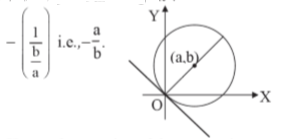
Hence, the equation of the tangent is $y=-\frac{ a }{ b } x$
i.e., $b y+ a x=0$ View full question & answer→MCQ 1292 Marks
The equation of the tangent to the circle $x^2+y^2=17$ at the point (1, -4) is
Answer(B)
The equation of the tangent to the circle $x^2+y^2= a ^2$ at $\left(x_1, y_1\right)$ is $x x_1+y y_1= a ^2$
Here, $x_1=1, y_1=-4$
$\therefore$ The equation of the tangent at $(1,-4)$ is
$x-4 y=17$
View full question & answer→MCQ 1302 Marks
The centre of the circle x = 1 + 2 cos $\theta$, $y=3+2 \sin \theta$, is
Answer(B)
$\frac{x+1}{2}=\cos \theta$ ...(i)
and $\frac{y-3}{2}=\sin \theta$ (ii)
Squaring (i) and (ii) and adding, we get
$\left(\frac{x+1}{2}\right)^2+\left(\frac{y-3}{2}\right)^2=1$
$\Rightarrow(x+1)^2+(y-3)^2=4$,
$\therefore$ Centre is $(-1,3)$.
View full question & answer→MCQ 1312 Marks
The parametric representation of the circle $(x-3)^2+(y+4)^2=25$ is
- A
$x=5+3 \cos \theta, y=5-3 \sin \theta$
- B
$x=5+3 \cos \theta, y=5+3 \sin \theta$
- ✓
$x=3+5 \cos \theta, y=-4+5 \sin \theta$
- D
$x=3+5 \cos \theta, y=-3+5 \sin \theta$
AnswerCorrect option: C. $x=3+5 \cos \theta, y=-4+5 \sin \theta$
(C)
$(x-3)^2+(y+4)^2=5^2$
Comparing with $(x- h )^2+(y- k )^2= r ^2$, we get
$h=3, k=-4, r=5$
$\therefore $ Parametric equations are $x=3+5 \cos \theta, y=-4+5 \sin \theta$
View full question & answer→MCQ 1322 Marks
The parametric form of the equation of circle $4 x^2+4 y^2=9$ is
- ✓
$x=\frac{3}{2} \cos \theta, y=\frac{3}{2} \sin \theta$
- B
$x=\frac{2}{5} \sin \theta, y=\frac{2}{5} \cos \theta$
- C
$x=\frac{3}{4} \sin \theta, y=\frac{3}{4} \cos \theta$
- D
$x=3 \sin \theta, y=\sqrt{2} \cos \theta$
AnswerCorrect option: A. $x=\frac{3}{2} \cos \theta, y=\frac{3}{2} \sin \theta$
(A)
$4 x^2+4 y^2=9$
$\Rightarrow x^2+y^2=\frac{9}{4} \Rightarrow x^2+y^2=\left(\frac{3}{2}\right)^2$
$\therefore x=\frac{3}{2} \cos \theta, y=\frac{3}{2} \sin \theta$
View full question & answer→MCQ 1332 Marks
If the line x + 2by + 7 = 0 is a diameter of the circle $x^2+y^2-6 x+2 y=0$ then b =
Answer(D)
Here, the centre of circle $(3,-1)$ must lie on the line $x+2 by+7=0$.
$\therefore \ 3-2 b+7=0$
$\Rightarrow b=5$
View full question & answer→MCQ 1342 Marks
Which of the following line is a diameter of the circle $x^2+y^2-6 x-8 y-9=0 ?$
Answer(C)
Centre $(3,4)$ of the given circle is satisfying only $x+y=7$
∴ Option $( C )$ is the correct answer.
View full question & answer→MCQ 1352 Marks
Circle $x^2+y^2+6 y=0$ touches
- A
- B
- C
X-axis at the point (3, 0)
- D
Y-axis at the point (0, 2)
View full question & answer→MCQ 1362 Marks
The circle $x^2+y^2+4 x-4 y+4=0$ touches
Answer(C)
Both axis, as centre is $(-2,2)$ and radius is 2 .
View full question & answer→MCQ 1372 Marks
If the radius of the circle $x^2+y^2+2 g x+2 f y+c=0$ is r, then it will touch both the axes, if
- A
- B
- ✓
$g=f=\sqrt{c}=r$
- D
$g = f$ and $c ^2= r$
AnswerCorrect option: C. $g=f=\sqrt{c}=r$
(C)
Given conditions are $g=f=r$
and $\sqrt{g^2+f^2-c}=r$
$\Rightarrow g=\sqrt{c}=f=r$
View full question & answer→MCQ 1382 Marks
If the circle $x^2+y^2+2 g x+2 f y+c=0$ touches X-axis, then
- A
$g=f$
- ✓
$g ^2= c$
- C
$f ^2= c$
- D
$g ^2+ f ^2= c$
AnswerCorrect option: B. $g ^2= c$
(B)
Circle $x^2+y^2+2 g x+2 f y+c=0$ touches X-axis
$\therefore $ radius $=$ ordinate of centre
$\Rightarrow \sqrt{g^2+f^2-c}=(-f)$
$\Rightarrow g ^2= c$
View full question & answer→MCQ 1392 Marks
For the circle $x^2+y^2+6 x-8 y+9=0$, which of the following statements is true?
- A
Circle passes through the point (-3, 4)
- ✓
- C
- D
Answer(B)
Intercept made by the circle on the X -axis
$=2 \sqrt{9-9}=0$... [Using Shortcut 2]
$\therefore$ Intercept cut on X -axis is zero.
Hence, circle touches $X$-axis.
View full question & answer→MCQ 1402 Marks
For the circle $x^2+y^2+3 x+3 y=0$, which of the following relation is true?
- A
- B
- C
- ✓
Circle passes through origin
AnswerCorrect option: D. Circle passes through origin
(D)
If $c=0$, circle passes through origin.
View full question & answer→MCQ 1412 Marks
$ax ^2+2 y^2+2 b x y+2 x-y+ c =0$ represents a circle through the origin, if
Answer(D)
The given equation represents a circle.
if coeff, of $x^2=\operatorname{coeff}$. of $y^2$ and coeff. of $x y=0 $
$\therefore a=2$ and $b=0$
Also, it passes through origin.
$\therefore c=0$
View full question & answer→MCQ 1422 Marks
The equation $a x^2+b y^2+2 h x y+2 g x+2 f y+c=0$ will represent a circle, if
- A
- B
- ✓
$a=b \neq 0$ and $h=0$
- D
AnswerCorrect option: C. $a=b \neq 0$ and $h=0$
View full question & answer→MCQ 1432 Marks
Radius of the circle $x^2+y^2+2 x \cos \theta+2 y \sin \theta-8=0$ is
- A
- ✓
- C
$2 \sqrt{3}$
- D
$\sqrt{10}$
Answer(B)
Radius $=\sqrt{\cos ^2 \theta+\sin ^2 \theta+8}=3$
View full question & answer→MCQ 1442 Marks
The centre and radius of the circle $2 x^2+2 y^2-x=0$ are
- ✓
$\left(\frac{1}{4}, 0\right)$ and $\frac{1}{4}$
- B
$\left(-\frac{1}{2}, 0\right)$ and $\frac{1}{2}$
- C
$\left(\frac{1}{2}, 0\right)$ and $\frac{1}{2}$
- D
$\left(0,-\frac{1}{4}\right)$ and $\frac{1}{4}$
AnswerCorrect option: A. $\left(\frac{1}{4}, 0\right)$ and $\frac{1}{4}$
(A)
Here, $g =\frac{-1}{4}, f =0$ and $c =0$
$\therefore$ centre $=(-g,-f)=\left(\frac{1}{4}, 0\right)$
and $r=\sqrt{\frac{1}{16}+0-0}=\frac{1}{4}$
View full question & answer→MCQ 1452 Marks
If the radius of the circle $x^2+y^2-18 x+12 y+ k =0$ is 11, then k =
Answer(C)
$\begin{array}{l}(\text { Radius })^2=g^2+f^2-c \\ \Rightarrow 121=81+36-k \Rightarrow k=-4\end{array}$
View full question & answer→MCQ 1462 Marks
The equation $x^2+y^2+4 x+6 y+13=0$ represents a
- A
- B
pair of coincident straight lines
- C
pair of concurrent straight lines
- ✓
Answer(D)
Here, $g =2, f =3$ and $c =13$
$\therefore \quad r=\sqrt{g^2+f^2-c}$
$\therefore \quad r=\sqrt{4+9-13}=0$
option (D) is the correct answer.
View full question & answer→MCQ 1472 Marks
The circle represented by the equation $x^2+y^2+2 g x+2 f y+c=0$ will be a point circle, if
- ✓
$g^2+f^2=c$
- B
$g ^2+ f ^2> c$
- C
$g ^2+ f ^2+ c =0$
- D
$g ^2+ f ^2< c$
AnswerCorrect option: A. $g^2+f^2=c$
(A)
Using condition of point circle,
$\begin{array}{l}\text { Radius }=\sqrt{g^2+f^2-c}=0 \\\Rightarrow g^2+f^2-c\end{array}$
View full question & answer→MCQ 1482 Marks
Radius of circle (x - 5)(x - 1) + (y - 7)(y - 4) = 0 is
- A
- B
- ✓
$\frac{5}{2}$
- D
$\frac{7}{2}$
AnswerCorrect option: C. $\frac{5}{2}$
(C)
Extremities of diameter are $(5,7)$ and $(1,4)$.
Radius is half of the distance between them.
$\therefore $ Radius $=\frac{1}{2} \sqrt{(4)^2+(3)^2}$
$=\frac{5}{2}$
View full question & answer→MCQ 1492 Marks
The equation of a circle whose diameter is the line joining the points (-4, 3) and (12, -1) is
- A
$x^2+y^2+8 x+2 y+51=0$
- B
$x^2+y^2+8 x-2 y-51=0$
- C
$x^2+y^2+8 x+2 y-51=0$
- ✓
$x^2+y^2-8 x-2 y-51=0$
AnswerCorrect option: D. $x^2+y^2-8 x-2 y-51=0$
(D)
By diameter form, the required equation is
$\left(x-x_1\right)\left(x-x_2\right)+\left(y-y_1\right)\left(y-y_2\right)=0$
$\therefore \quad(x+4)(x-12)+(y-3)(y+1)=0$
$\therefore \quad x^2+y^2-8 x-2 y-51=0$
View full question & answer→MCQ 1502 Marks
The equation $\left(x-x_1\right)\left(x-x_2\right)+\left(y-y_1\right)\left(y-y_2\right)=0$ represents a circle whose centre is
- A
$\left(\frac{x_1-x_2}{2}, \frac{y_1-y_2}{2}\right)$
- ✓
$\left(\frac{x_1+x_2}{2}, \frac{y_1+y_2}{2}\right)$
- C
$\left(x_1, y_2\right)$
- D
$\left(x_2, y_2\right)$
AnswerCorrect option: B. $\left(\frac{x_1+x_2}{2}, \frac{y_1+y_2}{2}\right)$
(B)
The given equation represents a circle having line segment joining $\left(x_1, y_1\right)$ and $\left(x_2, y_2\right)$ as a diameter.
∴ the coordinates of its centre are
$\left(\frac{x_1+x_2}{2}, \frac{y_1+y_2}{2}\right)$.
View full question & answer→MCQ 1512 Marks
A circle which passes through origin and cuts intercepts on axes a and b, the equation of circle is
- ✓
$x^2+y^2-a x-b y=0$
- B
$x^2+y^2+a x+b y=0$
- C
$x^2+y^2-a x+b y=0$
- D
$x^2+y^2+a x-b y=0$
AnswerCorrect option: A. $x^2+y^2-a x-b y=0$
(A)
Centre is $\left(\frac{ a }{2}, \frac{b}{2}\right)$ and radius $=\sqrt{\frac{ a ^2+ b ^2}{4}}$
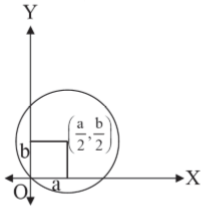
Hence, equation of circle is
$x^2+y^2-a x-b y=0$ View full question & answer→MCQ 1522 Marks
If $(\alpha, \beta)$ is the centre of a circle passing through the origin, then its equation is
- A
$x^2+y^2-\alpha x-\beta y=0$
- B
$x^2+y^2+2 \alpha x+2 \beta y=0$
- ✓
$x^2+y^2-2 \alpha x-2 \beta y=0$
- D
$x^2+y^2+\alpha x+\beta y=0$
AnswerCorrect option: C. $x^2+y^2-2 \alpha x-2 \beta y=0$
(C)
Radius $=$ Distance from origin $=\sqrt{\alpha^2+\beta^2}$
$\therefore(x-\alpha)^2+(y-\beta)^2=\alpha^2+\beta^2$
$\Rightarrow x^2+y^2-2 \alpha x-2 \beta y=0$
View full question & answer→MCQ 1532 Marks
A circle touches the Y-axis at the point (0, 4) and cuts the X-axis in a chord of length 6 units. The radius of the circle is
Answer(C)
Let $O^{\prime}$ be the centre
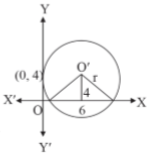
From the figure,
Radius $(r)=\sqrt{(4)^2+(3)^2}=5$ View full question & answer→MCQ 1542 Marks
Equation of circle with centre $(- a,- b)$ and radius $\sqrt{a^2-b^2}$ is
- ✓
$x^2+y^2+2 a x+2 b y+2 b^2=0$
- B
$x^2+y^2-2 a x-2 b y-2 b^2=0$
- C
$x^2+y^2-2 a x-2 b y+2 b^2=0$
- D
$x^2+y^2-2 a x+2 b y+2 a ^2=0$
AnswerCorrect option: A. $x^2+y^2+2 a x+2 b y+2 b^2=0$
(A)
$x^2+y^2+2 a x+2 b y+2 b^2=0$
Centre $=(-a,-b)$
∴ option (A) is the correct answer.
View full question & answer→MCQ 1552 Marks
The equation of the circle which touches X-axis and whose centre is (1, 2), is
- A
$x^2+y^2-2 x+4 y+1=0$
- ✓
$x^2+y^2-2 x-4 y+1=0$
- C
$x^2+y^2+2 x+4 y+1=0$
- D
$x^2+y^2+4 x+2 y+4=0$
AnswerCorrect option: B. $x^2+y^2-2 x-4 y+1=0$
(B)
Since the circle touches X -axis,
radius $=2$.
$\therefore \quad$ the equation of the circle is
$(x-1)^2+(y-2)^2=2^2$
$\Rightarrow x^2+y^2-2 x-4 y+1=0$
View full question & answer→MCQ 1562 Marks
The equation of the circle which touches both axes and whose centre is (x1, y1) is
- A
$x^2+y^2+2 x_1(x+y)+x_1^2=0$
- ✓
$x^2+y^2-2 x_1(x+y)+x_1^2=0$
- C
$x^2+y^2=x_1^2+y_1^2$
- D
$x^2+y^2+2 x x_1+2 y y_1=0$
AnswerCorrect option: B. $x^2+y^2-2 x_1(x+y)+x_1^2=0$
(B)
The equation of circle with centre $\left(x_1, y_1\right)$ is
$\left(x-x_1\right)^2+\left(y-y_1\right)^2=r^2$
Since the circle touches both the axes,
$x_1=y_1= r$
$\therefore\left(x-x_1\right)^2+\left(y-x_1\right)^2=x_1^2$
$\Rightarrow x^2+y^2-2 x_1(x+y)+x_1^2=0$
View full question & answer→MCQ 1572 Marks
The equation of the circle which touches both the axes and whose radius is a, is
- ✓
$x^2+y^2-2 a x-2 a y+a^2=0$
- B
$x^2+y^2+a x+a y-a^2=0$
- C
$x^2+y^2+2 a x+2 a y- a ^2=0$
- D
$x^2+y^2- a x- a y+ a ^2=0$
AnswerCorrect option: A. $x^2+y^2-2 a x-2 a y+a^2=0$
(A)
Required equation is $(x-a)^2+(y-a)^2=a^2$
$\Rightarrow x^2+y^2-2 a x-2 a y+a^2=0$
View full question & answer→MCQ 1582 Marks
Centre of the circle $(x-3)^2+(y-4)^2=5$ is
View full question & answer→