Questions · Page 2 of 2

Solve the Following Question.(3 Marks)

Question 513 Marks
Find the equations of the tangents to the ellipse: $\frac{x^2}{5}+\frac{y^2}{4}=1$ passing through the point $(2,-2)$.
Answer
Given equation of the ellipse is $\frac{x^2}{5}+\frac{y^2}{4}=1$.

Comparing this equation with $\frac{x^2}{\mathrm{a}^2}+\frac{y^2}{\mathrm{~h}^2}=1$, we get

$a^2=5$ and $b^2=4$

Equations of tangents to the ellipse $\frac{x^2}{\mathrm{a}^2}+\frac{y^2}{\mathrm{~b}^2}=1$ having slope $m$ are

$y=m x \pm \sqrt{a^2 m^2+b^2}$

Since (2, -2) lies on both the tangents,

$\begin{aligned} & -2=2 m \pm \sqrt{5 m^2+4} \\ & -2-2 m= \pm \sqrt{5 m^2+4}\end{aligned}$

Squaring both the sides, we get

$\begin{aligned} & 4 m^2+8 m+4=5 m^2+4 \\ & m^2-8 m=0 \\ & m(m-8)=0 \\ & m=0 \text { or } m=8\end{aligned}$

These are the slopes of the required tangents.

By slope point form y – y1 = m(x – x1),

the equations of the tangents are

y + 2 = 0(x – 2) and y + 2 = 8(x – 2)

y + 2 = 0 and y + 2 = 8x – 16

y + 2 = 0 and 8x – y – 18 = 0
View full question & answer
Question 523 Marks
Find $k$, if the line $3 x+4 y+k=0$ touches $9 x^2+16 y^2=144$.
Answer
Given equation of the ellipse is $9 x^2+16 y^2=144$.

$\frac{x^2}{16}+\frac{y^2}{9}=1$

Comparing this equation with $\frac{x^2}{\mathrm{a}^2}+\frac{y^2}{\mathrm{~b}^2}=1$, we get

$a^2=16$ and $b^2=9$

Given equation of line is 3x + 4y + k = 0,

i.e., $\mathrm{y}=-\frac{3}{4} x-\frac{k}{4}$

Comparing this equation with y = mx + c, we get

$m=\frac{-3}{4}$ and $c=\frac{-\mathrm{k}}{4}$

For the line $y=m x+c$ to be a tangent to the ellipse $\frac{x^2}{a^2}+\frac{y^2}{b^2}=1$, we must have

$\begin{aligned} & c^2=a^2 m^2+b^2 \\ & \left(\frac{-k}{4}\right)^2=16\left(\frac{-3}{4}\right)^2+9 \\ & \frac{k^2}{16}=9+9 \\ & \frac{k^2}{16}=18 \\ & k^2=288 \\ & k= \pm 12 \sqrt{ } 2\end{aligned}$

View full question & answer
Question 533 Marks
Determine whether the line $x+3 y \sqrt{2}=9$ is a tangent to the ellipse $\frac{x^2}{9}+\frac{y^2}{4}=1$. If so,

find the co-ordinates of the point of contact.

Answer
Given equation of the ellipse is $\frac{x^2}{9}+\frac{y^2}{4}=1$

Comparing this equation with $\frac{x^2}{\mathrm{a}^2}+\frac{y^2}{\mathrm{~b}^2}=1$, we get

$a^2=9$ and $b^2=4$

Given equation of line is x + 3y√2 = 9,

i.e., $y=\frac{-1}{3 \sqrt{2}} x+\frac{3}{\sqrt{2}}$

Comparing this equation with y = mx + c, we get

$m=\frac{-1}{3 \sqrt{2}}$ and $c=\frac{3}{\sqrt{2}}$

For the line $y=m x+c$ to be a tangent to the ellipse $\frac{x^2}{\mathrm{a}^2}+\frac{y^2}{b^2}=1$, we must have

$\begin{aligned} & c^2=a^2 m^2+b^2 \\ & c^2=\left(\frac{3}{\sqrt{2}}\right)^2=\frac{9}{2}\end{aligned}$

$\mathrm{a}^2 \mathrm{~m}^2+\mathrm{b}^2=9\left(\frac{-1}{3 \sqrt{2}}\right)^2+4=\frac{1}{2}+4=\frac{9}{2}=\mathrm{c}^2$

The given line is a tangent to the given ellipse

and point of contact is

$\left(\frac{-a^2 m}{c}, \frac{b^2}{c}\right)=\left(\frac{(-9)\left(\frac{-1}{3 \sqrt{2}}\right)}{\frac{3}{\sqrt{2}}}, \frac{4}{\frac{3}{\sqrt{2}}}\right)=\left(1, \frac{4 \sqrt{2}}{3}\right)$

View full question & answer
Question 543 Marks
Show that the line $8 y+x=17$ touches the ellipse $x^2+4 y^2=17$. Find the point of contact.
Answer
Given equation of the ellipse is $x^2+4 y^2=17$

$\frac{x^2}{17}+\frac{y^2}{\frac{17}{4}}=1$

Comparing this equation with $\frac{x^2}{\mathrm{a}^2}+\frac{y^2}{\mathrm{~b}^2}=1$, we get

$a^2=17$ and $b^2=\frac{17}{4}$

Given equation of line is 8y + x = 17,

$y=\frac{-1}{8} x+\frac{17}{8}$

Comparing this equation with y = mx + c, we get

$m=\frac{-1}{8}$ and $c=\frac{17}{8}$

For the line $y=m x+c$ to be a tangent to the ellipse $\frac{x^2}{a^2}+\frac{y^2}{b^2}=1$, we must have

$\begin{aligned} & c^2=a^2 m^2+b^2 \\ & c^2=\left(\frac{17}{8}\right)^2=\frac{289}{64} \\ & a^2 \mathrm{~m}^2+\mathrm{b}^2=17\left(\frac{-1}{8}\right)^2+\frac{17}{4}=\frac{17}{64}+\frac{17}{4}=\frac{289}{64}=\mathrm{c}^2\end{aligned}$

The given line touches the given ellipse and

point of contact is

$\begin{aligned}\left(\frac{-a^2 m}{c}, \frac{b^2}{c}\right) & =\left(\frac{-17\left(\frac{-1}{8}\right)}{\frac{17}{8}}, \frac{\frac{17}{4}}{\frac{17}{8}}\right) \\ & =(1,2)\end{aligned}$

View full question & answer
Question 553 Marks
Show that the line $x-y=5$ is a tangent to the ellipse $9 x^2+16 y^2=144$. Find the point of

contact

Answer
Given equation of the ellipse is $9 x^2+16 y^2=144$

$\frac{x^2}{16}+\frac{y^2}{9}=1$

Comparing this equation with $\frac{x^2}{a^2}+\frac{y^2}{b^2}=1$, we get

$a^2=16$ and $b^2=9$

Given equation of line is x – y = 5, i.e., y = x – 5

$c^2=a^2 m^2+b^2$

Comparing this equation with y = mx + c, we get m = 1 and c = -5

For the line $y=m x+c$ to be a tangent to the ellipse $\frac{x^2}{a^2}+\frac{y^2}{b^2}=1$, we must have

$\begin{aligned} & c^2=a^2 m^2+b^2 \\ & c^2=(-5)^2=25 \\ & a^2 m^2+b^2=16(1)^2+9=16+9=25=c^2\end{aligned}$

The given line is a tangent to the given ellipse and point of contact

$\begin{aligned} & =\left(\frac{-\mathrm{a}^2 \mathrm{~m}}{\mathrm{c}}, \frac{\mathrm{b}^2}{\mathrm{c}}\right) \\ & =\left(\frac{(-16)(1)}{-5}, \frac{9}{-5}\right) \\ & =\left(\frac{16}{5}, \frac{-9}{5}\right)\end{aligned}$

View full question & answer
Question 563 Marks
Find the eccentricity of an ellipse, if the length of its latus rectum is one-third of its minor axis.
Answer
Let the equation of ellipse be $\frac{x^2}{a^2}+\frac{y^2}{b^2}=1$, where $a>b$.

Length of latus rectum $=\frac{2 b^2}{a}$

Length of minor axis = 2b According to the given condition,

Length of latus rectum $=\frac{1}{3}$ (Minor axis)

$\begin{aligned} & \frac{2 b^2}{a}=\frac{1}{3}(2 b) \\ & \frac{b}{a}=\frac{1}{3} \\ & b=\frac{1}{3} a \\ & b^2=\frac{1}{9} a^2\end{aligned}$

$\ldots(\mathrm{i})$

Now, $b^2=a^2\left(1-e^2\right)$

$\frac{1}{9} a^2=a^2\left(1-e^2\right) \quad \ldots[$ From (i)]

$\begin{aligned} & \frac{1}{9}=1-e^2 \\ & e^2=1-\frac{1}{9} \\ & e^2=\frac{8}{9} \\ & e=\frac{2 \sqrt{2}}{3}\end{aligned}$

$\ldots[\because 0<\mathrm{e}<1]$

View full question & answer
Question 573 Marks
Find the equation of the ellipse in standard form if : minor axis is 16 and eccentricity is $\frac{1}{3}$.
Answer
Let the required equation of ellipse be $\frac{x^2}{a^2}+\frac{y^2}{b^2}=1$, where $a>b$.

Length of minor axis = 2b Given, length of minor axis = 16

2b = 16

b = 8

$b^2=64$

Given, eccentricity (e) $=\frac{1}{3}$

Now, $b^2=a^2\left(1-e^2\right)$

$\begin{aligned} & 64=a^2\left[1-\left(\frac{1}{3}\right)^2\right] \\ & 64=a^2\left(1-\frac{1}{9}\right) \\ & 64=a^2\left(\frac{8}{9}\right) \\ & a^2=\frac{64 \times 9}{8}=72\end{aligned}$

The required equation of ellipse is $\frac{x^2}{72}+\frac{y^2}{64}=1$.

View full question & answer
Question 583 Marks
Find the equation of the ellipse in standard form if : distance between directrices is 18 and eccentricity is $\frac{1}{3}$.
Answer
Let the required equation of ellipse be $\frac{x^2}{a^2}+\frac{y^2}{b^2}=1$, where $a>b$.

Given, eccentricity (e) $=\frac{1}{3}$

Distance between directrices $=\frac{2 a}{e}$

Given, distance between directrices = 18

$\begin{aligned} & \frac{2 a}{e}=18 \\ & \frac{2 a}{\frac{1}{3}}=18 \\ & 6 a=18 \\ & a=\frac{18}{6}=3\end{aligned}$

$a^2=9$

Now, $b^2=\mathrm{a}^2\left(1-\mathrm{e}^2\right)$

$\begin{aligned} & =9\left[1-\left(\frac{1}{3}\right)^2\right] \\ & =9\left(1-\frac{1}{9}\right)=9\left(\frac{8}{9}\right)=8\end{aligned}$

The required equation of ellipse is $\frac{x^2}{9}+\frac{y^2}{8}=1$

View full question & answer
Question 593 Marks
Find the equation of the ellipse in standard form if : the length of the major axis is 10 and the distance between foci is 8.
Answer
Let the required equation of ellipse be $\frac{x^2}{a^2}+\frac{y^2}{b^2}=1$, where $a>b$.

Length of major axis = 2a

Given, length of major axis

= 10 2a = 10

a = 5

$a^2=25$

Distance between foci = 2ae

Given, distance between foci = 8

2ae = 8

2(5)e = 8

$e=\frac{8}{10}=\frac{4}{5}$

Now, $b^2=a^2\left(1-\mathrm{e}^2\right)$

$=25\left[1-\left(\frac{4}{5}\right)^2\right]$

$=25\left(1-\frac{16}{25}\right)=25\left(\frac{9}{25}\right)=9$

The required equation of ellipse is $\frac{x^2}{25}+\frac{y^2}{9}=1$.

View full question & answer
Question 603 Marks
Find the equation of the ellipse in standard form if : eccentricity $=\frac{3}{8}$ and distance between its foci $=6$.
Answer
Let the required equation of ellipse be $\frac{x^2}{a^2}+\frac{y^2}{b^2}=1$, where $a>b$.

Given, eccentricity (e) $=\frac{3}{8}$

Distance between foci = 2ae Given,

distance between foci = 6

2ae = 6

$\begin{aligned} & 2 a\left(\frac{3}{8}\right)=6 \\ & \frac{3 a}{4}=6 \\ & a=\frac{6 \times 4}{3}=8\end{aligned}$

$a^2=64$

Now, $\mathrm{b}^2=\mathrm{a}^2\left(1-\mathrm{e}^2\right)$

$\begin{aligned} & =64\left[1-\left(\frac{3}{8}\right)^2\right] \\ & =64\left(1-\frac{9}{64}\right)=64\left(\frac{55}{64}\right)=55\end{aligned}$

The required equation of ellipse is $\frac{x^2}{64}+\frac{y^2}{55}=1$.

View full question & answer
Question 613 Marks
Find the equation of the locus of a point, the tangents from which to the parabola $y^2=18 x$

are such that sum of their slopes is -3 .

Answer
Given equation of the parabola is $\mathrm{y}^2=18 \mathrm{x}$

Comparing this equation with $y^2=4 a x$, we get

⇒ 4a = 18

$\Rightarrow a=\frac{9}{2}$

Equation of tangent to the parabola $\mathrm{y}^2=4 a x$ having slope $\mathrm{m}$ is

$\begin{aligned} & \Rightarrow y=m x+\frac{a}{m} \\ & \Rightarrow y=m x+\frac{9}{2 m} \\ & \Rightarrow 2 y m=2 x m^2+9 \\ & \Rightarrow 2 x m^2-2 y m+9=0\end{aligned}$

The roots $m_1$ and $m_2$ of this quadratic equation are the slopes of the tangents.

$\begin{aligned} & m_1+m_2=-\frac{(-2 y)}{2 x}=\frac{y}{x} \\ & \text { But, } m_1+m_2=-3 \\ & \frac{y}{x}=-3\end{aligned}$

y = -3x, which is the required equation of locus.

View full question & answer
Question 623 Marks
If the tangents drawn from the point $(-6,9)$ to the parabola $y^2=k x$ are perpendicular to

each other, find k.

Answer
Given equation of the parabola is $y^2=k x$

Comparing this equation with $y^2=4 a x$, we get

⇒ 4a = k

$\Rightarrow a=\frac{k}{4}$

Equation of tangent to the parabola $y^2=4 a x$ having slope $m$ is

$y=m x+\frac{a}{m}$

Since the tangent passes through the point (-6, 9),

$\begin{aligned} & \Rightarrow 9=-6 m+\frac{k}{4 m} \\ & \Rightarrow 36 m=-24 m 2+k \\ & \Rightarrow 24 m^2+36 m-k=0\end{aligned}$

The roots m1 and m2 of this quadratic equation are the slopes of the tangents.

$m_1 m_2=\frac{-k}{24}$

Since the tangents are perpendicular to each other,

$\begin{aligned} & m_1 m_2=-1 \\ & \Rightarrow \frac{-k}{24}=-1 \\ & \Rightarrow k=24\end{aligned}$

Alternate method:

We know that, tangents drawn from a point on directrix are perpendicular. (-6, 9) lies on the directrix x = -a.

⇒ -6 = -a

⇒ a = 6

Since 4a = k

⇒ k = 4(6) = 24

View full question & answer
Question 633 Marks
Find the equation of tangent to the parabola : $y^2=36 x$ from the point $(2,9)$
Answer
Given equation of the parabola is $y^2=36 x$.

Comparing this equation with $y^2=4 a x$, we get

⇒ 4a = 36

⇒ a = 9

Equation of tangent to the parabola $y^2=4 a x$ having slope $m$ is

$y=m x+\frac{a}{m}$

Since the tangent passes through the point (2, 9),

$\begin{aligned} & \Rightarrow 9=2 m+\frac{9}{m} \\ & \Rightarrow 9 m=2 m^2+9 \\ & \Rightarrow 2 m^2-9 m+9=0 \\ & \Rightarrow 2 m^2-6 m-3 m+9=0 \\ & \Rightarrow 2 m(m-3)-3(m-3)=0 \\ & \Rightarrow(m-3)(2 m-3)=0 \\ & \Rightarrow m=3 \text { or } m=\frac{3}{2}\end{aligned}$

These are the slopes of the required tangents.

By slope point form, $y-y_1=m\left(x-x_1\right)$, the equations of the tangents are

$\begin{aligned} & \Rightarrow y-9=3(x-2) \text { and } y-9=\frac{3}{2}(x-2) \\ & \Rightarrow y-9=3 x-6 \text { and } 2 y-18=3 x-6 \\ & \Rightarrow 3 x-y+3=0 \text { and } 3 x-2 y+12=0\end{aligned}$

View full question & answer
Question 643 Marks
Find the equation of tangent to the parabola : $y^2=12 x$ from the point $(2,5)$
Answer
Given equation of the parabola is $y^2=12 x$.

Comparing this equation with $y^2=4 a x$, we get

⇒ 4a = 12

⇒ a = 3

Equation of tangent to the parabola $y^2=4 a x$ having slope $m$ is

$y=m x+\frac{a}{m}$

Since the tangent passes through the point (2, 5)

$\begin{aligned} & \Rightarrow 5=2 m+\frac{3}{m} \\ & \Rightarrow 5 m=2 m^2+3 \\ & \Rightarrow 2 m^2-5 m+3=0 \\ & \Rightarrow 2 m^2-2 m-3 m+3=0 \\ & \Rightarrow 2 m(m-1)-3(m-1)=0 \\ & \Rightarrow(m-1)(2 m-3)=0 \\ & \Rightarrow m=1 \text { or } m=\frac{3}{2}\end{aligned}$

These are the slopes of the required tangents.

By slope point form, $y-y_1=m\left(x-x_1\right)$, the equations of the tangents are

$\begin{aligned} & \Rightarrow y-5=1(x-2) \text { and } y-5=\frac{3}{2}(x-2) \\ & \Rightarrow y-5=x-2 \text { and } 2 y-10=3 x-6 \\ & \Rightarrow x-y+3=0 \text { and } 3 x-2 y+4=0\end{aligned}$

View full question & answer
Question 653 Marks
Find co-ordinates of focus, vertex, and equation of directrix and the axis of the parabola y

$=x^2-2 x+3$.

Answer
Given equation of the parabola is $y=x^2-2 x+3$

$\begin{aligned} & \Rightarrow y=x^2-2 x+1+2 \\ & \Rightarrow y-2=(x-1)^2 \\ & \Rightarrow(x-1)^2=y-2\end{aligned}$

Comparing this equation with $X^2=4 b Y$, we get

X = x – 1, Y = y – 2

⇒ 4b = 1

$\Rightarrow b=\frac{1}{4}$

The co-ordinates of vertex are (X = 0, Y = 0)

⇒ x – 1 = 0 and y – 2 = 0

⇒ x = 1 and y = 2

The co-ordinates of vertex are (1, 2).

The co-ordinates of focus are S(X = 0, Y = b)

$\begin{aligned} & \Rightarrow x-1=0 \text { and } y-2=\frac{1}{4} \\ & \Rightarrow x=1 \text { and } y=\frac{9}{4}\end{aligned}$

The co-ordinates of focus are $\left(1, \frac{9}{4}\right)$

Equation of the axis is

X = 0 x – 1 = 0, i.e., x = 1

Equation of directrix is Y + b = 0

$\begin{aligned} & \Rightarrow y-2+\frac{1}{4}=0 \\ & \Rightarrow y-\frac{7}{4}=0 \\ & \Rightarrow 4 y-7=0\end{aligned}$

View full question & answer
Question 663 Marks
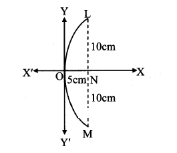
If a parabolic reflector is 20 cm in diameter and 5 cm deep, find its focus.
Answer

Image

Let LOM be the parabolic reflector such that LM is the diameter and ON is its depth.

It is given that ON = 5 cm and LM = 20 cm.

LN = 10 cm Taking O as the origin,

ON along X-axis and a line through O ⊥ ON as Y-axis.

Let the equation of the reflector be $y^2=4 a x \ldots \ldots$ (i)

Substituting $x=5$ and $y=10$ in (i), we get

$\begin{aligned} & \Rightarrow 10^2=4 a(5) \\ & \Rightarrow 100=20 a \\ & \Rightarrow a=5\end{aligned}$

Focus is at (a, 0), i.e., (5, 0)

View full question & answer
Question 673 Marks
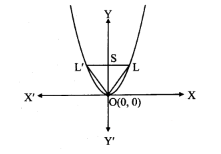
Find the area of the triangle formed by the line joining the vertex of the parabola $x^2=12 y$ to the endpoints of the latus rectum.
Answer

Image

Given the equation of the parabola is $x^2=12 y$.

Comparing this equation with $x^2=4$ by, we get

⇒ 4b = 12

⇒ b = 3

The co-ordinates of focus are S(0, b), i.e., S(0, 3)

End points of the latus-rectum are L(2b, b) and L'(-2b, b),

i.e., L(6, 3) and L'(-6, 3)

Also l(LL’) = length of latus-rectum = 4b = 12

l(OS) = b = 3

Area of $\Delta O L^{\prime}=\frac{1}{2} \times I^{\prime}\left(\mathrm{LL}^{\prime}\right) \times \mathrm{I}(\mathrm{OS})$

$=\frac{1}{2} \times 12 \times 3$

Area of ∆OLL’ = 18 sq. units

View full question & answer
Solve the Following Question.(3 Marks) - Page 2 - Maths STD 11 Science Questions - Vidyadip