Questions

Solve the Following Question.(4 Marks)

Take a timed test

34 questions · self-marked practice — reveal the answer and mark yourself.

Question 14 Marks
Two tangents to the hyperbola $\frac{x^2}{a^2}-\frac{y^2}{b^2}=1$ make angles $\theta_1, \theta_2$, with the transverse axis.

Find the locus of their point of intersection if $\tan \theta_1+\tan \theta_2=k$.

Answer
Given equation of the hyperbola is $\frac{x^2}{a^2}-\frac{y^2}{b^2}=1$

Let $\theta_1$ and $\theta_2$ be the inclinations.

$m _1=\tan \theta_1, m _2=\tan \theta_2$

Let $P\left(x_1, y_1\right)$ be a point on the hyperbola

Equation of a tangent with slope ' $m$ ' to the hyperbola $\frac{x^2}{a^2}-\frac{y^2}{b^2}=1$ is

$y = mx \pm \sqrt{a^2 m^2-b^2}$

This tangent passes through $P \left( x _1, y _1\right)$.

$\begin{aligned} & \left( y _1- mx_{1 } \right)^2=a^2 m ^2- b ^2 \\ & \left(x_1^2- a ^2\right) m ^2-2 x_1 y_1 m +\left(y_1^2+ b ^2\right)=0 \ldots \ldots \text { (i) } \\ & \end{aligned}$

This is a quadratic equation in ‘m’. It has two roots say m1 and m2, which are the slopes of two tangents drawn from P.

$\therefore m _1+ m _2=\frac{2 x_1 y_1}{x_1^2-a^2}$

$\begin{aligned} & \text { Since } \tan \theta_1+\tan \theta_2=k, \\ & \frac{2 x_1 y_1}{x_1^2-a^2}=k\end{aligned}$

$\therefore P \left( x _1, y _1\right)$ moves on the curve whose equation is $k \left( x ^2- a ^2\right)=2 xy$.
View full question & answer
Question 24 Marks
Show that the line $2 x-y=4$ touches the hyperbola $4 x^2-3 y^2=24$. Find the point of
Answer
Given equation of die hyperbola is $4 x^2-3 y^2=24$.

$\therefore \frac{x^2}{6}-\frac{y^2}{8}=1$

Comparing this equation with $\frac{x^2}{ a ^2}-\frac{y^2}{h^2}=1$, we get

$a^2=6$ and $b^2=8$

Given equation of line is 2x – y = 4

∴ y = 2x – 4

Comparing this equation with y = mx + c, we get

m = 2 and c = -4

For the line $y=m x+c$ to be a tangent to the hyperbola $\frac{x^2}{a^2}-\frac{y^2}{b^2}=1$, we must have

$\begin{aligned} & c^2=a^2 m^2-b^2 \\ & c^2=(-4)^2=16 \\ & a^2 m^2-b^2=6(2)^2-8=24-8=16\end{aligned}$

∴ The given line is a tangent to the given hyperbola and point of contact

$\begin{aligned} & =\left(-\frac{ a ^2 m }{ c },-\frac{ b ^2}{ c }\right) \\ & =\left(\frac{-6(2)}{-4}, \frac{-8}{-4}\right) \\ & =(3,2)\end{aligned}$

View full question & answer
Question 34 Marks
Tangents are drawn through a point $P$ to the ellipse $4 x^2+5 y^2=20$ having inclinations $\theta_1$

and $\theta_2$ such that $\tan \theta_1+\tan \theta_2=2$. Find the equation of the locus of $P$.

Answer
Given equation of the ellipse is $4 x^2+5 y^2=20$.

$\therefore \frac{x^2}{5}+\frac{y^2}{4}=1$

Comparing this equation with $\frac{x^2}{a^2}+\frac{y^2}{b^2}=1$, we get

$a^2=5$ and $b^2=4$

Since inclinations of tangents are $\theta_1$ and $\theta_2$,

$m_1=\tan \theta_1$ and $m_2=\tan \theta_2$

Equation of tangents to the ellipse $\frac{x^2}{a^2}+\frac{y^2}{h^2}=1$ having slope $m$ are

$\begin{aligned} & y=m x \pm \sqrt{a^2 m^2+b^2} \\ & \therefore y=m x \pm \sqrt{5 m^2+4} \\ & \therefore y-m x= \pm \sqrt{5 m^2+4}\end{aligned}$

Squaring both the sides, we get

$\begin{aligned} & y=m x \pm \sqrt{a^2 m^2+b^2} \\ & \therefore y=m x \pm \sqrt{5 m^2+4} \\ & \therefore y-m x= \pm \sqrt{5 m^2+4}\end{aligned}$

Squaring both the sides, we get

$\begin{aligned} & y^2-2 m x y+m^2 x^2=5 m^2+4 \\ & \therefore\left(x^2-5\right) m^2-2 x y m+\left(y^2-4\right)=0\end{aligned}$

The roots m1 and m2 of this quadratic equation are the slopes of the tangents.

$\therefore m _1+ m _2=\frac{-(-2 x y)}{x^2-5}=\frac{2 x y}{x^2-5}$

Given, $\tan \theta_1+\tan \theta_2=2$

$\begin{aligned} & \therefore m _1+ m _2=2 \\ & \therefore \frac{2 x y}{x^2-5} \\ & \therefore xy = x ^2-5 \\ & \therefore x ^2- xy -5=0, \text { which is the required equation of the locus of } P .\end{aligned}$

View full question & answer
Question 44 Marks
Show that the line $8 y+x=17$ touches the ellipse $x^2+4 y^2=17$. Find the point of contact.
Answer
Given equation of the ellipse is $x^2+4 y^2=17$.

$\therefore \frac{x^2}{17}+\frac{y^2}{\frac{17}{4}}=1$

Comparing this equation with $\frac{x^2}{a^2}+\frac{y^2}{b^2}=1$ we get

$a^2=17$ and $b^2=\frac{17}{4}$

Given equation of line is $8 y+x=17$,

i.e., $y=\frac{-1}{8} x+\frac{17}{8}$

Comparing this equation with $y=m x+c$, we get

$m=\frac{-1}{8}$ and $c=\frac{17}{8}$

For the line $y = mx + c$ to be a tangent to the ellipse $\frac{x^2}{ a ^2}+\frac{y^2}{ b ^2}=1$, we must have

$\begin{aligned} & c^2=a^2 m^2+b^2 \\ & c^2=\left(\frac{17}{8}\right)^7=\frac{289}{64} \\ & a^2 m^2+b^2=17\left(\frac{-1}{8}\right)^2+\frac{17}{4} \\ & =\frac{17}{64}+\frac{17}{4} \\ & =\frac{289}{64} \\ & =c^2\end{aligned}$

$\therefore$ The given line touches the given ellipse and point of contact is

$\begin{aligned} & \left(\frac{-a^2 m}{c}, \frac{b^2}{c}\right)=\left(\frac{-17\left(\frac{-1}{8}\right)}{\frac{17}{8}}, \frac{\frac{17}{4}}{\frac{17}{8}}\right) \\ & =(1,2) .\end{aligned}$

View full question & answer
Question 54 Marks
Find the equation of the tangent to the ellipse $\frac{x^2}{5}+\frac{y}{4}=1$ passing through the point (2,-2).
Answer
Given equation of the ellipse is $\frac{x^2}{5}+\frac{y^2}{4}=1$

Comparing this equation with $\frac{x^2}{a^2}+\frac{y^2}{b^2}=1$, we get

$a^2=5$ and $b^2=4$

Equations of tangents to the ellipse $\frac{x^2}{a^2}+\frac{y^2}{b^2}=1$ having slope $m$ are

$y=m x \pm \sqrt{a^2 m^2+b^2}$

Since (2, -2) lies on both the tangents,

$\begin{aligned} & -2=2 m \pm \sqrt{5 m^2+4} \\ & \therefore-2-2 m= \pm \sqrt{5 m^2+4}\end{aligned}$

Squaring both the sides, we get

$\begin{aligned} & 4 m ^2+8 m+4=5 m ^2+4 \\ & \therefore m ^2-8 m =0 \\ & \therefore m ( m -8)=0 \\ & \therefore m =0 \text { or } m =8\end{aligned}$

These are the slopes of the required tangents.

∴ By slope point form y – y1 = m(x – x1),

the equations of the tangents are y + 2 = 0(x – 2) and y + 2 = 8(x – 2)

∴ y + 2 = 0 and y + 2 = 8x – 16

∴ y + 2 = 0 and 8x – y – 18 = 0.

View full question & answer
Question 64 Marks
For the hyperbola $\frac{x^2}{100}-\frac{y^2}{25}=1$, prove that $S A . S^{\prime} A=25$, where $S$ and $S^{\prime}$ are the foci and

A is the vertex.

Answer
Given equation of the hyperbola is $\frac{x^2}{100}-\frac{y^2}{25}=1$

Comparing this equation with $\frac{x^2}{ a ^2}-\frac{y^2}{ b ^2}=1$, we get

$\begin{aligned} & a ^2=100 \text { and } b ^2=25 \\ & \therefore a =10 \text { and } b=5 \\ & \therefore \text { Co-ordinates of vertex is } A(a, 0) \text {, i.e., } A(10,0)\end{aligned}$

$\begin{aligned} & \text { Eccentricity, } e=\frac{\sqrt{a^2+b^2}}{a} \\ & =\frac{\sqrt{100+25}}{10} \\ & =\frac{\sqrt{125}}{10} \\ & =\frac{5 \sqrt{5}}{10} \\ & =\frac{\sqrt{5}}{2}\end{aligned}$

Co-ordinates of the foci are S(ae, 0) and S'(-ae, 0)

i.e., $S\left(10\left(\frac{\sqrt{5}}{2}\right), 0\right)$ and $S^{\prime}\left(-10\left(\frac{\sqrt{5}}{2}\right), 0\right)$

i.e., S(5√5, 0) and S'(-5√5, 0)

Since S, A and S’ lie on the X-axis,

SA = |5√5 – 10| and S’A = |-5√5 – 10|

= |-(5√5 + 10)|

= |5√5 + 10|

∴ SA . S’A = |5√5 – 10| |5√5 + 10|

= |(5√5)2 – (10)2|

= |125 – 100|

= |25|

SA . S’A = 25

View full question & answer
Question 74 Marks
$x^2-y^2=16$
Answer
Given equation of the hyperbola is $x^2-y^2=16$$\therefore \frac{x^2}{16}-\frac{y^2}{16}=1$
Comparing this equation with $\frac{x^2}{a^2}-\frac{y^2}{b^2}=1$, we get
$ a ^2=16 \text { and } b ^2=16$
$\therefore a =4 \text { and } b =4$
$\therefore a = 4$ and $b = 4$
(i) Length of transverse axis = 2a = 2(4) = 8
Length of conjugate axis = 2b = 2(4) = 8
(ii) We know that
$e  =\frac{\sqrt{a^2+b^2}}{a}$
$ =\frac{\sqrt{16+16}}{4} $
$ =\frac{\sqrt{32}}{4} $
$ =\frac{4 \sqrt{2}}{4} $
$ =\sqrt{2}$
Co-ordinates of foci are $S(ae, 0)$ and $S'(-ae, 0),$
i.e., $S(4\sqrt{2}, 0)$ and $S'(-4√2, 0)$
Equations of the directrices are $x= \pm \frac{a}{e}$
$\therefore x= \pm \frac{4}{\sqrt{2}}$
$\therefore x= \pm 2 \sqrt{2}$
(iv) Length of latus rectum $=\frac{2 b^2}{a}=\frac{2(16)}{4}=8$
(v) Distance between foci = 2ae = 2(4)(√2) = 8√2
(vi) Distance between directrices $=\frac{2 a}{e}=\frac{2(4)}{\sqrt{2}}=4 \sqrt{2}$
View full question & answer
Question 84 Marks
$\frac{x^2}{144}-\frac{y^2}{25}=1$
Answer
Given equation of the hyperbola $\frac{x^2}{144}-\frac{y^2}{25}=1$Comparing this equation with $\frac{x^2}{a^2}-\frac{y^2}{h^2}=1$
$a^2=144 \text { and } b^2=25$
$\because a=12 \text { and } b=5$
(i) Length of transverse axis = 2a = 2(12) = 24 Length of conjugate axis = 2b = 2(5) = 10 lengths of the principal axes are 24 and 10.
$25=144\left( e ^2-1\right)$
$\frac{25}{144}= e ^2-1$
$e ^2=1+\frac{25}{144}$
$e ^2=\frac{169}{144}$
$e =\frac{13}{12} \ldots \ldots .[\because e >1]$
Co-ordinates of foci are S(ae, 0) and S'(-ae, 0)
i.e., $S\left(12\left(\frac{13}{12}\right), 0\right)$ and $S^{\prime}\left(-12\left(\frac{13}{12}\right), 0\right)$
i.e., $S(13,0)$ and $S^{\prime}(-13,0)$
(iii) Equations of the directrices are $x= \pm \frac{a}{e}$
$\text { i.e., } x= \pm \frac{12}{\left(\frac{13}{12}\right)}$
$\text { i.e., } x= \pm \frac{144}{13}$
(iv) Length of latus rectum $=\frac{2 b^2}{a}=\frac{2(25)}{12}=\frac{25}{6}$
(v) Distance between foci $=2 ae =2(12)\left(\frac{13}{12}\right)=26$
(vi) Distance between directrices $=\frac{2 a }{ e }=\frac{2(12)}{\left(\frac{13}{12}\right)}=\frac{288}{13}$
View full question & answer
Question 94 Marks
$16 x^2+25 y^2=400$
Answer
Given equation of the ellipse is $16 x^2+25 y^2=400$
$\frac{x^2}{25}+\frac{y^2}{16}=1$
Comparing this equation with $\frac{x^2}{a^2}+\frac{y^2}{b^2}=1$, we get
$a^2=25 \text { and } b^2=16$
$\therefore a=5 \text { and } b=4$
$\text { Since } a>b,$
X-axis is the major axis and Y-axis is the minor axis
(i) Length of major axis = 2a = 2(5) = 10
Length of minor axis = 2b = 2(4) = 8
Lengths of the principal axes are 10 and 8.
$b^2=a^2\left(1-e^2\right)$
$16=25\left(1- e ^2\right)$
$\frac{16}{25}=1- e ^2$
$e ^2=1-\frac{16}{25}$
$e ^2=\frac{9}{25}$
$e =\frac{3}{5} \ldots \ldots[\because 0< e <1]$
Co-ordinates of the foci are S(ae, 0) and S'(-ae, 0),
i.e., $S\left(5\left(\frac{3}{5}\right), 0\right)$ and $S^{\prime}\left(-5\left(\frac{3}{5}\right), 0\right)$,
i.e., S(3, 0) and S'(-3, 0)
Equations of the directrices are $x= \pm \frac{a}{e}$
i.e., $x= \pm \frac{5}{\left(\frac{3}{5}\right)}$
i.e., $x= \pm \frac{25}{3}$
(iv) Length of latus rectum $=\frac{2 b^2}{a}=\frac{2(16)}{5}=\frac{32}{5}$
(v) Distance between foci $=2 ae =2(5)\left(\frac{3}{5}\right)=6$
(vi) Distance between directrices $=\frac{2 a}{e}=\frac{2(5)}{\left(\frac{3}{5}\right)}=\frac{50}{3}$
View full question & answer
Question 104 Marks
Find the .
(i) lengths of the principal axes
(ii) co-ordinates of the foci
(iii) equations of directrices
(iv) length of the latus rectum
(v) Distance between foci
(vi) distance between directrices of the curve
$\frac{x^2}{25}+\frac{y^2}{9}=1$
Answer
Given equation of the ellipse is $\frac{x^2}{25}+\frac{y^2}{9}=1$
Comparing this equation with $\frac{x^2}{a^2}+\frac{y^2}{b^2}=1$, we get
$a^2=25 \text { and } b^2=9$
$\therefore a=5 \text { and } b=3$
Since a > b,
X-axis is the major axis and Y-axis is the minor axis.
(i) Length of major axis = 2a = 2(5) = 10
Length of minor axis = 2b = 2(3) = 6
∴ Lengths of the principal axes are 10 and 6.
We know that $e =\frac{\sqrt{a^2-b^2}}{a}$
$\therefore e=\frac{\sqrt{25-9}}{5}=\frac{4}{5}$
Co-ordinates of the foci are S(ae, 0) and S'(-ae, 0)
i.e., $S\left(5\left(\frac{4}{5}\right), 0\right)$ and $S^{\prime}\left(-5\left(\frac{4}{5}\right), 0\right)$,
i.e., $S(4,0)$ and $S^{\prime}(-4,0)$
Equations of the directrices are $x = \pm \frac{a}{e}$
$\text { i.e., } x= \pm \frac{5}{\frac{4}{5}}$
$\text { i.e., } x= \pm \frac{25}{4}$
Length of latus rectum $=\frac{2 b^2}{a}=\frac{2(3)^2}{5}=\frac{18}{5}$
Distance between foci $=2 ae =2(5)\left(\frac{4}{5}\right)=8$
Distance between directrices $=\frac{2 a}{e}=\frac{2(5)}{\frac{4}{5}}=\frac{25}{2}$
View full question & answer
Question 114 Marks
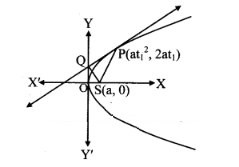
The tangent at point $P$ on the parabola $y^2=4 a x$ meets the $Y$-axis in $Q$. If $S$ is the focus,show that SP subtends a right angle at Q.
Answer
Let $P \left(a t_1^2, 2 at _1\right)$ be a point on the parabola and$S(a, 0)$ be the focus of parabola $y^2=4 a x$
Image
Since the tangent passing through point P meet Y-axis at point Q,
equation of tangent at $P \left(a t_1^2, 2 a t_1\right)$ is
$yt t _1= x +a t_1^2 \ldots .$. (i)
∴ Point Q lie on tangent
∴ put x = 0 in equation (i)
$y t_1=a t_1^2$
$y=a t_1$
$\therefore$ Co-ordinate of point $Q\left(0, at _1\right)$
$S =( a , 0), P \left( a t_1^2, 2 a t_1\right), Q \left(0, at _1\right)$
$ \text { Slope of } SQ  =\frac{y_2-y_1}{x_2-x_1}=\frac{a t_1-0}{0-a}=\frac{a t_1}{- a }=- t _1$
$\text { Slope of } PQ  =\frac{y_2-y_1}{x_2-x_1}$
$& =\frac{2 a t_1-a t_1}{a t_1{ }^2}=\frac{a t_1}{a t_1{ }^2}=\frac{1}{t_1}$
Slope of $SQ \times$ Slope of $PQ$
$=-t_1 \times \frac{1}{t_1}=-1$
∴ SP subtends a right angle at Q.
View full question & answer
Question 124 Marks
The slopes of the tangents drawn from $P$ to the parabola $y^2=4 a x$ are $m_1$ and $m_2$, showing that :
1.$m_1-m_2=k$
2.$\left(\frac{ m _1}{ m _2}\right)= k$, where $k$ is a constant.
Answer
Let $P \left( x _1, y _1\right)$ be any point on the parabola $y ^2=4 ax$.
Equation of tangent to the parabola $y^2=4$ ax having slope $m$ is $y=m x+\frac{a}{m}$
This tangent passes through $P \left( x _1, y _1\right)$.
$y_1=m x_1+\frac{a}{m}$
$m y_1=m^2 x_1+a$
$m^2 x_1-m y_1+a=0$
This is a quadratic equation in ‘m’.
The roots m1 and m2 of this quadratic equation are the slopes of the tangents drawn from P.
$\therefore m_1+m_2=\frac{y_1}{x_1}, m_1 m_2=\frac{a}{x_1}$
$\text { i. }\left(m_1-m_2\right)^2=\left(m_1+m_2\right)^2-4 m_1 m_2$
$=\left(\frac{y_1}{x_1}\right)^2-\frac{4 a}{x_1}=\frac{y_1^2-4 a x_1}{x_1^2}$
$\therefore \quad m _1- m _2=\sqrt{\frac{y_1^2-4 a x_1}{x_1^2}}$
Since $\left(x_1, y_1\right)$ and a are constants, $m_1-m_2$ is a constant.
$\therefore m _1- m _2= k _1$ where $k$ is constant.
2.Since $\left( x _1, y _1\right)$ and a are constants, $m _1 m _2$ is a constant.
$\left(\frac{ m _1}{ m _2}\right)= k$, where $k$ is a constant.
View full question & answer
Question 134 Marks
A line touches the circle $x ^2+ y ^2=2$ and the parabola $y ^2=8 x$. Show that its equation is $y =$±(x + 2).
Answer
Given equation of the parabola is $y^2=8 x$Comparing this equation with $y ^2=4 ax$, we get
$4a = 8$
$a = 2$
Equation of tangent to given parabola with slope m is
$y=m x+\frac{2}{m}$
$m^2 x-m y+2=0 \ldots \text { (i) }$
Equation of the circle is $x^2+y^2=2$
Its centre = (0, 0) and Radius = √2 Line
(i) touches the circle.
Length of perpendicular from the centre to the line (i) = radius
$\Rightarrow\left|\frac{m^2(0)-m(0)+2}{\sqrt{m^4+m^2}}\right|=\sqrt{ } 2$
$\Rightarrow \frac{4}{m^4+m^2}=2$
$\Rightarrow m^4+m^2-2-0$
$\Rightarrow\left(m^2+2\right)\left(m^2-1\right)=0$
Since $m^2 \neq-2$,
$m^2-1=0$
$\Rightarrow m= \pm 1$
When m = 1, equation of the tangent is
$y=(1) x+\frac{2}{(1)}$
$y=(x+2) \ldots .(i)$
When m = -1, equation of the tangent is
$y=(-1) x+\frac{2}{(-1)}$
$y=-x-2$
$y=-(x+2) \ldots .(\text { ii) }$
From (i) and (ii), equation of the common tangents to the given parabola is y = ±(x + 2)
View full question & answer
Question 144 Marks
Find the cartesian co-ordinates of the points on the parabola $y^2=12 x$ whose parameters are $: 1.2 2.-3$
Answer
Given equation of the parabola is $y^2=12 x$Comparing this equation with $y^2=4 a x$, we get
$4a = 12$
$\therefore a = 3$
If t is the parameter of the point P on the parabola, then
$P(t)=\left(a t^2, 2 a t\right)$
$\text { i.e., } x=a t^2 \text { and } y=2 a t \ldots . \text { (i) }$
(i) Given,$t = 2$
Substituting $a = 3$ and $t = 2$ in (i), we get
$x=3(2)^2 \text { and } y=2(3)(2)$
$x=12 \text { and } y=12$
$\therefore$ The cartesian co-ordinates of the point on the parabola are $(12, 12).$
Given, $t = -3$
Substitùting $a = 3$ and $t = -3$ in (i), we get
$\therefore x = 27$ and $y = -18$
$\therefore$ The cartesian co-ordinates of the point on the parabola are $(27, -18).$
View full question & answer
Question 154 Marks
The line $x-y+3=0$ touches the hyperbola whose foci are $( \pm \sqrt{41,0})$. Find the equation of the hyperbola.
Answer
Let the equation of the hyperbola be
$
\frac{x^2}{a^2}-\frac{y^2}{b^2}=1 \text {. }
$
Its foci $( \pm a e, 0)$ are $( \pm \sqrt{41,0})$
$
\therefore a e=\sqrt{41}
$
$\therefore a^2 e^2=41$
$
\therefore a^2+b^2=41
$
(2) $\left(\mathrm{a}^2 \mathrm{e}^2=\mathrm{a}^2+\mathrm{b}^2\right)$
The given line is $y=x+3$
Comparing this with $y=m x+c$, we get
$
m=1, c=3
$
Since the given line touches the hyperbola
$\therefore$ It satisfies the condition of tangency.
$
\begin{aligned}
& \therefore a^2 m^2-b^2=c^2 \\
& \therefore a^2(1)^2-b^2=(3)^2 \\
& \therefore a^2-b^2=9
\end{aligned}
$
By adding (2) and (3), we get
$
2 a^2=50 \therefore a^2=25
$
from (2), we get
$
25+b^2=41 \therefore b^2=16
$
From (1), the equation of the required hyperbola is
$
\frac{x^2}{25}-\frac{y^2}{16}=1
$
View full question & answer
Question 164 Marks
If the line $2 x+y+k=0$ is tangent to the hyperbola $\frac{x^2}{6}-\frac{y^2}{8}=1$ then find the value of $k$.
Answer
The equation of the hyperbola is $\frac{x^2}{6}-\frac{y^2}{8}=1$.
The equation of the line is $2 x+y+k=0$
$
\therefore y=-2 x-k
$
Putting this value of $y$ in the equation of hyperbola, we get
$
\begin{aligned}
& \frac{x^2}{6}-\frac{(-2 x-k)^2}{8}=1 \\
& \therefore 4 x^2-3\left(4 x^2+4 k x+k^2\right)=24 \\
& \therefore 4 x^2-12\left(4 x^2-12 k x-3 k^2\right)=24 \\
& \therefore 8 x^2+12 k x+\left(3 k^2+24\right)=0 \ldots \ldots .
\end{aligned}
$
Since given line touches the hyperbola
$\therefore$ the quadratic equation (1) in $x$ has equal roots.
$\therefore$ its discriminant $=0$ i.e. $\mathrm{b}^2-4 \mathrm{ac}=0$
$
\begin{aligned}
& \therefore(12 k)^2-4(8)\left(3 k^2+24\right)=0 \\
& \therefore 144 k^2-32\left(3 k^2+24\right)=0 \\
& \therefore 9 k^2-2\left(3 k^2+24\right)=0 \\
& \therefore 9 k^2-6 k^2-48=0 \\
& \therefore 3 k^2=48 \\
& \therefore k^2=16 \\
& \therefore k^2= \pm 4
\end{aligned}
$
View full question & answer
Question 174 Marks
Show that the line $4 x-3 y=16$ touches the hyperbola $16 x^2-25 y^2=400$. Find the co-ordinates of the point of contact.
Answer
The equation of the hyperbola is $\frac{x^2}{25}-\frac{y^2}{16}=1$.
Comparing it with the equation $\frac{x^2}{a^2}-\frac{y^2}{b^2}=1$. we have $a^2=25, b^2=16$
The equation of the line is $3 y=4 x-16$
$\therefore y=\frac{4}{3} x-\frac{16}{3}$
$\therefore$ Comparing it with the equation
$y=m x+c$
We get $m=\frac{4}{3}, c=\frac{-16}{3}$
Now
$
\begin{aligned}
& a^2 m^2-b^2=25\left(\frac{16}{9}\right)-16 \\
& =\frac{256}{9}=\left(\frac{-16}{3}\right)^2=c^2
\end{aligned}
$
Thus the condition of tangency is satisfied.
$\therefore$ the given line touches the hyperbola.

Let $P\left(x_1, y_1\right)$ be the point of contact.
$\therefore x_1=\frac{-a^2 m}{c}=\frac{-25\left(\frac{4}{3}\right)}{\left(-\frac{16}{3}\right)}=\frac{25}{4}$
and $y_1=\frac{-b^2}{c}=\frac{-16}{-16 / 3}=3$
$\therefore$ the point of contact is $P\left(\frac{25}{4}, 3\right)$

View full question & answer
Question 184 Marks
Find the coordinates of the focus, equation of the directrix, length of latus rectum and coordinates of end points of latus rectum of each of the following parabolas.
i) $y^2=28 x$
ii) $3 x^2=8 y$
Answer
i) $y^2=28 x$
Equation of the parabola is $y^2=28 x$
comparing this equation with $y^2=4 a x$, we get $4 a=28 \therefore a=7$
Coordinates of the focus are $S(a, 0)=(7,0)$
Equation of the directrix is $x+a=0$ that is $x+7=0$
Length of latus rectum $=4 a=4 \times 7=28$
End points of latus rectum are $(a, 2 a)$ and $(a,-2 a)$. that is $(7,14)$ and $(7,-14)$
ii) $3 x^2=8 y$
Equation of the parabola is $3 x^2=8 y$ that is $x^2=\frac{8}{3} y$
comparing this equation with $x^2=4 \mathrm{~b} y$, we get $4 b=\frac{8}{3} \therefore b=\frac{2}{3}$
Co-ordinates of the focus are $\mathrm{S}(0, b)=$ $\left(0, \frac{2}{3}\right)$
Equation of the directrix is $y+\mathrm{b}=0$ that is $y+\frac{2}{3}=0$ that is $3 y+2=0$
Length of latus rectum $=4 b=4 \times\left(\frac{2}{3}\right)=\frac{8}{3}$
Coordinates of end points of latus rectum are
$(2 b, b)$ and $(-2 b, b)$. that is $\left(\frac{4}{3}, \frac{2}{3}\right)$ and $\left(-\frac{4}{3}, \frac{2}{3}\right)$
View full question & answer
Question 194 Marks
Show that the line $3 x-4 y+10=0$ is a tangent to the hyperbola $x^2-4 y^2=20$. Also, findthe point of contact.
Answer
Given equation of the hyperbola is $x^2-4 y^2=20$$\frac{x^2}{20}-\frac{y^2}{5}=1$
Comparing this equation with $\frac{x^2}{ a ^2}-\frac{y^2}{ b ^2}=1$, we get
$a^2=20$ and $b^2=5$
Given equation of line is $3 x-4 v+10=0$.
$y=\frac{3 x}{4}+\frac{5}{2}$
Comparing this equation with $y = mx + c,$ we get
$m=\frac{3}{4}$ and $c=\frac{5}{2}$
For the line $y=m x+c$ to be a tangent to the hyperbola $\frac{x^2}{a^2}-\frac{y^2}{b^2}=1$, we must have
$ c ^2= a ^2 m ^2- b ^2$
$c ^2=\left(\frac{5}{2}\right)^2=\frac{25}{4}$
$a^2 m^2-b^2=20\left(\frac{3}{4}\right)^2-5$
$=20\left(\frac{9}{16}\right)-5=\frac{45}{4}-5=\frac{25}{4}= c ^2$
The given line is a tangent to the given
hyperbola and point of contact
$=\left(\frac{-a^2 m}{c}, \frac{-b^2}{c}\right)$
$=\left(\frac{-20\left(\frac{3}{4}\right)}{\left(\frac{5}{2}\right)}, \frac{-5}{\left(\frac{5}{2}\right)}\right)=(-6,-2)$
View full question & answer
Question 204 Marks
Find the equation of the tangent to the hyperbola.: $9 x^2-16 y^2=144$ at the point $L$ of the latus rectum in the first quadrant.
Answer
Given equation of the hyperbola is
$9 x^2-16 y^2=144$
$\therefore \quad \frac{x^2}{16}-\frac{y^2}{9}=1$
Comparing this equation with $\frac{x^2}{ a ^2}-\frac{y^2}{ b ^2}=1$,
we get
$ a^2=16 \text { and } b ^2=9$
$\therefore \quad a=4 \text { and } b=3$
Since the point $L$ lies in the first quadrant,
Latus rectum of the hyperbola is
$L \left( ae , \frac{ b ^2}{ a }\right)$
Now, $b ^2= a ^2\left( e ^2-1\right)$
$\therefore 9=16\left( e ^2-1\right)$
$\therefore \frac{9}{16}= e ^2-1$
$\therefore e ^2=\frac{9}{16}+1=\frac{25}{16}$
$\therefore e =\frac{5}{4} \quad \ldots[\because e >1]$
$\therefore \quad \text { ae }=4\left(\frac{5}{4}\right)=5$
$\therefore \quad L \left( ae , \frac{ b ^2}{ a }\right)= L \left(5, \frac{9}{4}\right)$
Equation of the tangent to the hyperbola
$\frac{x^2}{ a ^2}-\frac{y^2}{ b ^2}=1$ at $\left(x_1, y_1\right)$ is
$\frac{x x_1}{ a ^2}-\frac{y y_1}{b^2}=1$
$\therefore \quad$ Equation of the tangent at $L \left(5, \frac{9}{4}\right)$ is
$ \frac{5 x}{16}-\frac{\frac{9}{4} y}{9}=1$
$\therefore \quad \frac{5 x}{16}-\frac{y}{4}=1$
$\therefore \quad 5 x-4 y=16$
View full question & answer
Question 214 Marks
Find the equation of the tangent to the hyperbola.: $\frac{x^2}{16}-\frac{y^2}{9}=1$ at the point in a first quadrant whose ordinate is 3.
Answer
Given equation of the hyperbola is $\frac{x^2}{16}-\frac{y^2}{9}=1$.

Comparing this equation with $\frac{x^2}{ a ^2}-\frac{y^2}{ b ^2}=1$,

we get

$a ^2=16$ and $b ^2=9$

Let $P \left(x_1, 3\right)$ be the point on the hyperbola in the

first quadrant at which the tangent is drawn.

Substituting $x=x_1$ and $y=3$ in equation of

hyperbola, we get

$\begin{array}{ll} & \frac{x_1^2}{16}-\frac{3^2}{9}=1 \\ \therefore \quad & \frac{x_1^2}{16}-1=1 \\ \therefore \quad & \frac{x_1^2}{16}=2 \\ \therefore \quad & x_1^2=32 \\ \therefore \quad & x_1= \pm 4 \sqrt{2}\end{array}$

Since $P$ lies in the first quadrant,

$P \equiv(4 \sqrt{2}, 3)$

Equation of the tangent to the hyperbola

$\frac{x^2}{ a ^2}-\frac{y^2}{ b ^2}=1$ at $\left(x_1, y_1\right)$ is

$\frac{x x_1}{ a ^2}-\frac{y y_1}{ b ^2}=1$

Equation of the tangent at $P(4 \sqrt{2}, 3)$ is

$\begin{aligned} & \frac{4 \sqrt{2} x}{16}-\frac{3 y}{9}=1 \\ \therefore \quad & \frac{\sqrt{2}}{4} x-\frac{y}{3}=1 \\ \therefore \quad & 3 \sqrt{2} x-4 y=12\end{aligned}$

View full question & answer
Question 224 Marks
$P$ and $Q$ are two points on the ellipse $\frac{x^2}{a^2}+\frac{y^2}{h^2}=1$ with eccentric angles $\theta_1$ and $\theta_2$. Findthe equation of the locus of the point of intersection of the tangents at $P$ and $Q$ if $\theta_1+\theta_2=\frac{\pi}{2}$.
Answer
Given equation of the ellipse is $\frac{x^2}{a^2}+\frac{y^2}{b^2}=1$.$\theta_1$ and $\theta_2$ are the eccentric angles of a tangent.
Equation of tangent at point $P$ is
$\frac{x}{a} \cos \theta_1+\frac{y}{b} \sin \theta_1=1........(i)$
Equation of tangent at point $Q$ is
$\frac{x}{a} \cos \theta_2+\frac{y}{b} \sin \theta_2=1………(ii)$
$\theta_1+\theta_2=\frac{\pi}{2}.........[$ Given$]$
$\theta_2=\frac{\pi}{2}-\theta_1$
$\frac{x}{ a } \cos \left(\frac{\pi}{2}-\theta_1\right)+\frac{y}{ b } \sin \left(\frac{\pi}{2}-\theta_1\right)=1$
$\frac{x}{ a } \sin \theta_1+\frac{y}{ b } \cos \theta_1=1...........(ii)$
From $(i)$ and $(ii),$ we get
$\frac{x}{ a } \cos \theta_1+\frac{y}{ b } \sin \theta_1=\frac{x}{ a } \sin \theta_1+\frac{y}{ b } \cos \theta_1$
Let $M \left(x_1, y_1\right)$ be the point of intersection of the
tangents.
$\frac{x_1}{a} \cos \theta_1+\frac{y_1}{b} \sin \theta_1=\frac{x_1}{a} \sin \theta_1+\frac{y_1}{b} \cos \theta_1$
$\frac{x_1}{a}\left(\cos \theta_1-\sin \theta_1\right)=\frac{y_1}{b}\left(\cos \theta_1-\sin \theta_1\right)..........(iii)$
If $\cos \theta_1-\sin \theta_1=0,$
$\cos \theta_1=\sin \theta_1$
$\tan \theta_1=1$
$\theta_1=\frac{\pi}{4}$
Since $\theta_1+\theta_2=\frac{\pi}{2}, \theta_2=\frac{\pi}{2}-\frac{\pi}{4}=\frac{\pi}{4}$
i.e., points $P$ and $Q$ coincide, which is not possible, as $P$ and $Q$ are two different points.
$\cos \theta 1 – \sin \theta 1 \neq 0$
Dividing equation $(iii)$ by $\left(\cos \theta_1-\sin \theta_1\right)$, we get
$\frac{x_1}{a}=\frac{y_1}{h}$
$b x_1-a y_1=0$
$b x-a y=0$, which is the required equation of locus of point $M$.
View full question & answer
Question 234 Marks
Show that the locus of the point of intersection of tangents at two points on an ellipse, whose eccentric angles differ by a constant, is an ellipse.
Answer
$\frac{x}{ a }\left(\cos \theta_1 \sin \theta_2-\cos \theta_2 \sin \theta_1\right)=\sin \theta_2-\sin \theta_1$
$-\frac{x}{ a }\left[\sin \left(\theta_1-\theta_2\right)\right]=\sin \theta_2-\sin \theta_1$
$-\frac{x}{ a } \sin k =\sin \theta_2-\sin \theta_1$
$-\frac{x}{ a }=\frac{\sin \theta_2-\sin \theta_1}{\sin k }$
Let $P\left(\theta_1\right)$ and $Q\left(\theta_2\right)$ be any two points on the given ellipse such that $\theta_1-\theta_2=k$, where $k$ is
a constant.
The equation of the tangent at point $P\left(\theta_1\right)$ is
$\frac{x \cos \theta_1}{ a }+\frac{y \sin \theta_1}{ h }=1 \ldots \ldots$ (i)
The equation of the tangent at point $Q\left(\theta_2\right)$ is
$\frac{x \cos \theta_2}{ a }+\frac{y \sin \theta_2}{ b }=1 \ldots \ldots$ (ii)
Multiplying equation (i) by $\cos \theta_2$ and equation (ii) by $\cos \theta_1$ and subtracting, we get
$\frac{y}{b}\left(\sin \theta_1 \cos \theta_2-\sin \theta_2 \cos \theta_1\right)=\cos \theta_2-\cos \theta_1$
$\frac{y}{b}\left[\sin \left(\theta_1-\theta_2\right)\right]=\cos \theta_2-\cos \theta_1$
$\frac{y}{b} \sin k =\cos \theta_2-\cos \theta_1$
$\frac{y}{b}=\frac{\cos \theta_2-\cos \theta_1}{\sin k }$
$\ldots$ (iii)
Similarly,
Multiplying equation (i) by $\sin \theta_2$ and
equation (ii) by $\sin \theta_1$ and subtracting, we get
$\frac{x}{ a }\left(\cos \theta_1 \sin \theta_2-\cos \theta_2 \sin \theta_1\right)=\sin \theta_2-\sin \theta_1$
$-\frac{x}{ a }\left[\sin \left(\theta_1-\theta_2\right)\right]=\sin \theta_2-\sin \theta_1$
$-\frac{x}{ a } \sin k =\sin \theta_2-\sin \theta_1$
$-\frac{x}{ a }=\frac{\sin \theta_2-\sin \theta_1}{\sin k }$
$\ldots$..iv)
Squaring (iii) and (iv) and adding, we get
$\frac{x^2}{ a ^2}+\frac{y^2}{ b ^2}=\frac{\left(\cos \theta_2-\cos \theta_1\right)^2+\left(\sin \theta_2-\sin \theta_1\right)^2}{\sin ^2 k }$
$=\frac{1}{\sin ^2 k }\left[\cos ^2 \theta_2+\sin ^2 \theta_2+\cos ^2 \theta_1+\sin ^2 \theta_1\right.$
$\left.-2\left(\sin \theta_1 \sin \theta_2+\cos \theta_1 \cos \theta_2\right)\right]$
$\frac{x^2}{a^2}+\frac{y^2}{b^2}=\frac{2-2 \cos \left(\theta_1-\theta_2\right)}{\sin ^2 k }$
$=\frac{2-2 \cos k}{\sin ^2 k}$
$=\frac{2(1-\cos k)}{\sin ^2 k}=\frac{4 \sin ^2 \frac{k}{2}}{4 \sin ^2 \frac{k}{2} \cos ^2 \frac{k}{2}}$
$\frac{x^2}{ a ^2}+\frac{y^2}{ b ^2}=\sec ^2 \frac{ k }{2}$, which is an ellipse.
View full question & answer
Question 244 Marks
Tangents are drawn through a point $P$ to the ellipse $4 x^2+5 y^2=20$ having inclinations $\theta_1$and $\theta_2$ such that $\tan \theta_1+\tan \theta_2=2$. Find the equation of the locus of $P$.
Answer
Given equation of the ellipse is $4 x^2+5 y^2=20$.
$\frac{x^2}{5}+\frac{y^2}{4}=1$
Comparing this equation with $\frac{x^2}{a^2}+\frac{y^2}{b^2}=1$, we get
$a^2=5$ and $b^2=4$
Since inclinations of tangents are $\theta_1$ and $\theta_2$,
$m_1=\tan \theta_1$ and $m_2=\tan \theta_2$
Equation of tangents to the ellipse $\frac{x^2}{a^2}+\frac{y^2}{b^2}=1$ having slope $m$ are
$y=m x \pm \sqrt{a^2 m^2+b^2}$
$y=m x \pm \sqrt{5 m^2+4}$
$y-m x= \pm \sqrt{5 m^2+4}$
Squaring both the sides, we get
$y^2-2 m x y+m^2 x^2=5 m^2+4$
$\left(x^2-5\right) m^2-2 x y m+\left(y^2-4\right)=0$
The roots $m_1$ and $m_2$ of this quadratic equation are the slopes of the tangents.
$m _1+ m _2=\frac{-(-2 x y)}{x^2-5}=\frac{2 x y}{x^2-5}$
Given, $\tan \theta_1+\tan \theta_2=2$
$m_1+m_2=2$
$\frac{2 x y}{x^2-5}=2$
$x y=x^2-5$
$x^2-x y-5=0$, which is the required equation of the locus of $P$.
View full question & answer
Question 254 Marks
Find the equation of the locus of a point, the tangents from which to the ellipse $3 x^2+5 y^2$= 15 are at right angles.
Answer
Given equation of the ellipse is $3 x^2+5 y^2=15$.
$\frac{x^2}{5}+\frac{y^2}{3}=1$
Comparing this equation with $\frac{x^2}{ a ^2}+\frac{y^2}{ b ^2}=1$, we get
$a^2=5$ and $b^2=3$
Equations of tangents to the ellipse $\frac{x^2}{ a ^2}+\frac{y^2}{ b ^2}=1$ having slope $m$ are
$y=m x \pm \sqrt{a^2 m^2+b^2}$
$y=m x \pm \sqrt{5 m^2+3}$
$y-m x= \pm \sqrt{5 m^2+3}$
Squaring both the sides, we get
$y^2-2 m x y+m^2 x^2=5 m^2+3$
$\left(x^2-5\right) m^2-2 x y m+\left(y^2-3\right)=0$
The roots $m_1$ and $m_2$ of this quadratic equation are the slopes of the tangents.
$m_1 m_2=\frac{y^2-3}{x^2-5}$
Since the tangents are at right angles,
$m_1 m_2=-1$
$\frac{y^2-3}{x^2-5}=-1$
$y^2-3=-x^2+5$
$x^2+y^2=8$, which is the required equation of the locus.
Alternate method: The locus of the point of intersection of perpendicular tangents is the director circle of an ellipse.
The equation of the director circle of an ellipse $\frac{x^2}{a^2}+\frac{y^2}{b^2}=1$ is $x^2+y^2=a^2+b^2$
Here, $a^2=5$ and $b^2=3$
$x^2+y^2=5+3$
$x^2+y^2=8$, which is the required equation of the locus.
View full question & answer
Question 264 Marks
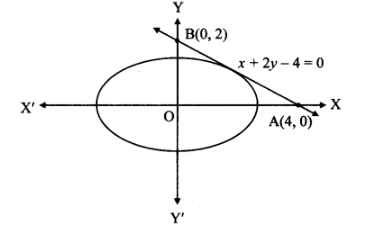
A tangent having slope $\left(-\frac{1}{2}\right)$ the ellipse $3 x^2+4 y^2=12$ intersects the $X$ and $Y$ axes in the

points A and B respectively. If O is the origin, find the area of the triangle AOB.

Answer
Given equation of the ellipse is $3 x^2+4 y^2=12$.

$\frac{x^2}{4}+\frac{y^2}{3}=1$

Comparing this equation with $\frac{x^2}{a^2}+\frac{y^2}{b^2}=1$, we get

$a^2=4, b^2=3$

Equations of tangents to the ellipse $\frac{x^2}{\sigma^2}+\frac{y^2}{b^2}=1$ having slope $m$ are

$y=m x \pm \sqrt{a^2 m^2+b^2}$

Here, $m=-\frac{1}{2}$

Equations of the tangents are

$\begin{aligned} & y=\frac{-1}{2} x \pm \sqrt{4\left(-\frac{1}{2}\right)^2+3}=\frac{-1}{2} x \pm 2 \\ & 2 y=-x \pm 4 \\ & x+2 y \pm 4=0\end{aligned}$

Consider the tangent x + 2y – 4 = 0

Let this tangent intersect the $\mathrm{X}$-axis at $\mathrm{A}\left(\mathrm{x}_1, 0\right)$ and $\mathrm{Y}$-axis at $\mathrm{B}\left(0, \mathrm{y}_1\right)$.

$\begin{aligned} & x_1+0-4=0 \text { and } 0+2 y_1-4=0 \\ & x_1=4 \text { and } \mathrm{y}_1=2 \\ & \mathrm{~A}=(4,0) \text { and } B=(0,2) \\ & \mathrm{I}(\mathrm{OA})=4 \text { and } \mathrm{I}(\mathrm{OB})=2\end{aligned}$

Image

Area of $\triangle \mathrm{AOB}=\frac{1}{2} \times \mathrm{I}(\mathrm{OA}) \times \mathrm{I}(\mathrm{OB})$

$\begin{aligned} & =\frac{1}{2} \times 4 \times 2 \\ & =4 \text { sq.units }\end{aligned}$

View full question & answer
Question 274 Marks
Find the equation of the ellipse in standard form if : eccentricity is $\frac{2}{3}$ and passes through $\left(2, \frac{-5}{3}\right)$
Answer
Let the required equation of ellipse be $\frac{x^2}{a^2}+\frac{y^2}{b^2}=1$, where $a>b$.

Given, eccentricity $(e)=\frac{2}{3}$

The ellipse passes through $\left(2, \frac{-5}{3}\right)$.

Substituting $x=2$ and $y=\frac{-5}{3}$ in equation of ellipse, we get

$\begin{aligned} & \frac{2^2}{a^2}+\frac{\left(-\frac{5}{3}\right)^2}{b^2}=1 \\ & \frac{4}{a^2}+\frac{25}{9 \mathrm{~b}^2}=1 \\ & \frac{4}{\mathrm{a}^2}+\frac{25}{9 \mathrm{a}^2\left(1-\mathrm{e}^2\right)}=1 \quad \ldots\left[\because \mathrm{b}^2=\mathrm{a}^2\left(1-\mathrm{e}^2\right)\right]\end{aligned}$

Multiplying throughout by $a^2$, we get

$4+\frac{25}{9\left(1-e^2\right)}=a^2$

$4+\frac{25}{9\left[1-\left(\frac{2}{3}\right)^2\right]}=a^2$

$4+\frac{25}{9\left(1-\frac{4}{9}\right)}=a^2$

$\begin{aligned} & 4+\frac{25}{5}=a^2 \\ & 4+5=a^2 \\ & a^2=9\end{aligned}$

Now, $\mathrm{b}^2=\mathrm{a}^2\left(1-\mathrm{e}^2\right)$

$\begin{aligned} & =9\left[1-\left(\frac{2}{3}\right)^2\right] \\ & =9\left(1-\frac{4}{9}\right)=9\left(\frac{5}{9}\right)=5\end{aligned}$

The required equation of ellipse is $\frac{x^2}{9}+\frac{y^2}{5}=1$.

View full question & answer
Question 284 Marks
Find the equation of the ellipse in standard form if : the distance between its directrices is 10 and which passes through (-√5, 2).
Answer
Let the required equation of ellipse be $\frac{x^2}{a^2}+\frac{y^2}{b^2}=1$, where $a>b$.

Distance between directrices $=\frac{2 a}{e}$

Given, distance between directrices = 10

$\frac{2 a}{e}=10$

a = 5e …..(i)

The ellipse passes through (-√5, 2).

Substituting x = -√5 and y = 2 in equation of ellipse, we get

$\begin{aligned} & \frac{(-\sqrt{5})^2}{a^2}+\frac{2^2}{b^2}=1 \\ & \frac{5}{a^2}+\frac{4}{b^2}=1 \\ & \frac{5}{a^2}+\frac{4}{a^2\left(1-e^2\right)}=1 \quad \ldots\left[\because b^2=a^2\left(1-e^2\right)\right]\end{aligned}$

Multiplying throughout by $\mathrm{a}^2$, we get

$5+\frac{4}{1-e^2}=a^2$

$5+\frac{4}{1-\mathrm{e}^2}=(5 \mathrm{e})^2 \quad \ldots[$ From (i) $]$

$\begin{aligned} & 5\left(1-\mathrm{e}^2\right)+4=25 \mathrm{e}^2\left(1-\mathrm{e}^2\right) \\ & 5-5 \mathrm{e}^2+4=25 \mathrm{e}^2-25 \mathrm{e}^4 \\ & 25 \mathrm{e}^4-30 \mathrm{e}^2+9=0 \\ & \left(5 \mathrm{e}^2-3\right)^2=0 \\ & 5 \mathrm{e}^2-3=0 \\ & \mathrm{e}^2=\frac{3}{5}\end{aligned}$

From $(\mathrm{i}), \mathrm{a}=5 \mathrm{e}$

$\begin{aligned} & a^2=25 e^2=25 \times \frac{3}{5} \\ & a^2=15\end{aligned}$

We know that,

$\begin{aligned} & b^2=a^2\left(1-\mathrm{e}^2\right) \\ & \mathrm{b}^2=15\left(1-\frac{3}{5}\right)\end{aligned}$

$\begin{aligned} & b^2=15\left(\frac{2}{5}\right) \\ & b^2=6\end{aligned}$

The required equation of ellipse is $\frac{x^2}{15}+\frac{y^2}{6}=1$.

View full question & answer
Question 294 Marks
Find the equation of the ellipse in standard form if : passing through the points (-3, 1) and (2, -2).
Answer
Let the required equation of ellipse be $\frac{x^2}{a^2}+\frac{y^2}{b^2}=1$, where $a>b$.

The ellipse passes through the points (-3, 1) and (2, -2).

Substituting x = -3 and y = 1 in equation of ellipse, we get

$\begin{aligned} & \frac{(-3)^2}{a^2}+\frac{1^2}{b^2}=1 \\ & \frac{9}{a^2}+\frac{1}{b^2}=1\end{aligned}$

$\ldots$..(i)

Substituting $x=2$ and $y=-2$ in equation of

ellipse, we get

$\frac{2^2}{a^2}+\frac{(-2)^2}{b^2}=1$

$\frac{4}{a^2}+\frac{4}{b^2}=1$

$\ldots$..(ii)

Let $\frac{1}{\mathrm{a}^2}=\mathrm{A}$ and $\frac{1}{\mathrm{~b}^2}=\mathrm{B}$

Equations (i) and (ii) become

9A + B = 1 …..(iii)

4A + 4B = 1 …..(iv)

Multiplying (iii) by 4, we get

36A + 4B = 4 …..(v)

Subtracting (iv) from (v), we get

32A = 3

$\mathrm{A}=\frac{3}{32}$

Substituting $A=\frac{3}{32}$ in (iv), we get

$\begin{aligned} & 4\left(\frac{3}{32}\right)+4 B=1 \\ & \frac{3}{8}+4 B=1 \\ & 4 B=1-\frac{3}{8} \\ & 4 B=\frac{5}{8} \\ & B=\frac{5}{32}\end{aligned}$

Since $\frac{1}{a^2}=A$ and $\frac{1}{b^2}=B$,

$\frac{1}{a^2}=\frac{3}{32}$ and $\frac{1}{b^2}=\frac{5}{32}$

$a^2=\frac{32}{3}$ and $b^2=\frac{32}{5}$

The required equation of ellipse is

$\frac{x^2}{\left(\frac{32}{3}\right)}+\frac{y^2}{\left(\frac{32}{5}\right)}$, i.e., $3 x^2+5 y^2=32$

View full question & answer
Question 304 Marks
Find the equation of the ellipse in standard form if : the latus rectum has length 6 and foci are (±2, 0).
Answer
Given, the length of the latus rectum is 6, and co-ordinates of foci are (±2, 0). The foci of the ellipse are on the X-axis.

Let the required equation of ellipse be $\frac{x^2}{a^2}+\frac{y^2}{b^2}=1$, where $a>b$.

Length of latus rectum $=\frac{2 b^2}{a}$

$\begin{aligned} & \frac{2 b^2}{a}=6 \\ & b^2=3 a \ldots .(i)\end{aligned}$

Co-ordinates of foci are (±ae, 0)

ae = 2

$\begin{aligned} & a^2 e^2=4 \ldots \text { (ii) } \\ & \text { Now, } b^2=a^2\left(1-e^2\right) \\ & b^2=a^2-a^2 e^2 \\ & 3 a=a^2-4 \ldots \ldots[\text { From (i) and (ii)] } \\ & a^2-3 a-4=0 \\ & a^2-4 a+a-4=0 \\ & a(a-4)+1(a-4)=0 \\ & (a-4)(a+1)=0 \\ & a-4=0 \text { or } a+1=0 \\ & a=4 \text { or } a=-1\end{aligned}$

Since a = -1 is not possible,

a = 4

$a^2=16$

$b^2=3(4)=12$

The required equation of ellipse is $\frac{x^2}{16}+\frac{y^2}{12}=1$.

View full question & answer
Question 314 Marks
Find the equation of the ellipse in standard form if : the distance between foci is 6 and the distance between directrices is $\frac{50}{3}$.
Answer
Let the required equation of ellipse be $\frac{x^2}{a^2}+\frac{y^2}{b^2}=1$, where $a>b$.

Distance between foci = 2ae Given,

distance between foci = 6

2ae = 6

ae = 3

$a=\frac{3}{e} \ldots \ldots$ (i)

Distance between directrices $=\frac{2 \pi}{e}$

Given, distance between directrices $=\frac{50}{3}$

$\begin{aligned} & \frac{2 \mathrm{a}}{\mathrm{e}}=\frac{50}{3} \\ & \frac{\mathrm{a}}{\mathrm{e}}=\frac{25}{3} \\ & \frac{3}{\mathrm{e}}=\frac{25}{3}\end{aligned}$

...[From (i)]

$\begin{aligned} & \frac{3}{e^2}=\frac{25}{3} \\ & \mathrm{e}^2=\frac{9}{25} \\ & \mathrm{e}=\frac{3}{5}\end{aligned}$

$\ldots[\therefore 0<\mathrm{e}<1]$

Substituting e $=\frac{3}{5}$ in (i), we get

$\begin{aligned} & a=\frac{3}{\frac{3}{5}} \\ & a=5 \\ & a^2=25\end{aligned}$

Now, $\begin{aligned} \mathrm{b}^2 & =\mathrm{a}^2\left(1-\mathrm{e}^2\right) \\ & =25\left[1-\left(\frac{3}{5}\right)^2\right] \\ & =25\left(1-\frac{9}{25}\right)=25\left(\frac{16}{25}\right)=16\end{aligned}$

The required equation of ellipse is $\frac{x^2}{25}+\frac{y^2}{16}=1$.

View full question & answer
Question 324 Marks
A circle whose centre is $\left(4_t-1\right)$ passes through the focus of the parabola $x^2+16 y=0$.

Show that the circle touches the directrix of the parabola.

Answer
Given equation of the parabola is $x^2+16 y=0$.

$\Rightarrow x^2=-16 y$

Comparing this equation with $\mathrm{x}^2=-4$ by, we get

⇒ 4b = 16

'⇒ b = 4

Focus = S(0, -b) = (0, -4)

Centre of the circle is C(4, -1) and it passes through focus S of the parabola.

Radius = CS

$\begin{aligned} & =\sqrt{(4-0)^2+(-1+4)^2} \\ & =\sqrt{16+9} \\ & =5\end{aligned}$

Equation of the directrix is y – b = 0, i.e.,y – 4 = 0

Length of the perpendicular from centre C(4, -1) to the directrix

$\begin{aligned} & =\left|\frac{0(4)+1(-1)-4}{\sqrt{(0)^2+(1)^2}}\right| \\ & =\left|\frac{-1-4}{1}\right| \\ & =5 \\ & =\text { radius }\end{aligned}$

∴ The circle touches the directrix of the parabola.

View full question & answer
Question 334 Marks
The towers of a bridge, hung in the form of a parabola, have their tops 30 metres above the roadway and are 200 metres apart. If the cable is 5 metres above the roadway at the centre of the bridge, find the length of the vertical supporting cable 30 metres from the centre.
Answer
Let CAB be the cable of the bridge and X’OX be the roadway.

Let A be the centre of the bridge.

From the figure, vertex of parabola is at A(0, 5).

Let the equation of parabola be

$x^2=4 b(y-5) \ldots(i)$

Since the parabola passes through (100, 30).

Substituting x = 100 and y = 30 in (i), we get

$\begin{aligned} & \Rightarrow 100^2=4 b(30-5) \\ & \Rightarrow 100^2=4 b(25) \\ & \Rightarrow 100^2=100 b \\ & \Rightarrow b=100\end{aligned}$

Substituting the value of b in (i), we get

$x^2=400(y-5) \ldots($ (ii)

Let l metres be the length of vertical supporting cable.

Then P(30, l) lies on (ii).

$\begin{aligned} & \Rightarrow 30^2=400(1-5) \\ & \Rightarrow 900=400(1-5) \\ & \Rightarrow \frac{9}{4}=1-5 \\ & \Rightarrow 1=\frac{9}{4}+5 \\ & \Rightarrow 1=\frac{9}{4} m=7.25 \mathrm{~m}\end{aligned}$

The length of the vertical supporting cable is 7.25 m.

View full question & answer
Question 344 Marks
Find the equation of common tangent to the parabolas $y^2=4 x$ and $x^2=32 y$.
Answer
Given equation of the parabola is $y^2=4 x$

Comparing this equation with $y^2=4 a x$, we get

⇒ 4a = 4

⇒ a = 1

Let the equation of common tangent be

$y=m x+\frac{1}{m} \ldots(i)$

Substituting $y=m x+\frac{1}{m}$ in $x^2=32 y$, we get

$\begin{aligned} & \Rightarrow x^2=32\left(m x+\frac{1}{m}\right)=32 m x+\frac{32}{m} \\ & \Rightarrow m x^2=32 m^2 x+32 \\ & \Rightarrow m x^2-32 m^2 x-32=0 \ldots \ldots \text { (ii) }\end{aligned}$

Line (i) touches the parabola $x^2=32 y$.

The quadratic equation (ii) in x has equal roots.

Discriminant = 0

$\begin{aligned} & \Rightarrow\left(-32 m^2\right)^2-4(m)(-32)=0 \\ & \Rightarrow 1024 m^4+128 m=0 \\ & \Rightarrow 128 m\left(8 m^3+1\right)=0 \\ & \Rightarrow 8 m^3+1=0 \ldots \ldots[\because m \neq 0] \\ & \Rightarrow m^3=-\frac{1}{8} \\ & \Rightarrow m=-\frac{1}{2}\end{aligned}$

Substituting $m=-\frac{1}{2}$ in $(\mathrm{i})$, we get

$\begin{aligned} & \Rightarrow y=-\frac{1}{2} x+\frac{1}{\left(-\frac{1}{2}\right)} \\ & \Rightarrow y=-\frac{1}{2} x-2\end{aligned}$

⇒ x + 2y + 4 = 0, which is the equation of the common tangent.

View full question & answer