Sample QuestionsDifferentiation questions
One sample from each question group in this chapter. Select any group above to see the full set with answer keys.
If $f ( x )=\frac{x^{50}}{50}+\frac{x^{49}}{49}+\frac{x^{48}}{48}+\ldots+\frac{x^2}{2}+x+1$, then $f ^{\prime}(1)=$
Answer: C.
View full solution →If $f(x)=x^2+\sin x+1$, for $x \leq 0$ $=x^2-2 x+1$, for $x \leq 0$, then
- ✓
$f$ is continuous at $x=0$, but not differentiable at $x=0$
- B
$f$ is neither continuous nor differentiable at $x=0$
- C
$f$ is not continuous at $x=0$, but differentiable at $x=0$
- D
$f$ is both continuous and differentiable at $x=0$
Answer: A.
View full solution →If $f(x)=2 x+6$, for $0 \leq x \leq 2$
$=a x^2+b x$, for $2is differentiable at $x=2$, then the values of $a$ and $b$ are
- A
$a=-\frac{3}{2}, b=3$
- B
$a=\frac{3}{2}, b=8$
- C
$a=\frac{1}{2}, b=8$
- ✓
$a=-\frac{3}{2}, b=8$
Answer: D.
View full solution →Suppose $f(x)$ is the derivative of $g(x)$ and $g(x)$ is the derivative of $h(x)$.
If $h(x)=a \sin x+b \cos x+c$, then $f(x)+h(x)=$
- A
- ✓
$C$
- C
$- C$
- D
$-2(a \sin x+b \cos x)$
Answer: B.
View full solution →If $y =\frac{5 \sin x-2}{4 \sin x+3}$, then $\frac{d y}{d x}=$
- A
$\frac{7 \cos x}{(4 \sin x+3)^2}$
- ✓
$\frac{23 \cos x}{(4 \sin x+3)^2}$
- C
$-\frac{7 \cos x}{(4 \sin x+3)^2}$
- D
$-\frac{15 \cos x}{(4 \sin x+3)^2}$
Answer: B.
View full solution →If $f(2)=4, f^{\prime}(2)=1$, then find $\lim _{x \rightarrow 2}\left[\frac{x f(2)-2 f(x)}{x-2}\right]$
View full solution →Differentiate the following w.r.t. x :
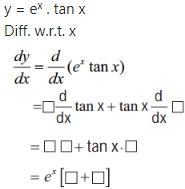
$y = e^x \log x$
View full solution →Differentiate the following w.r.t. x :
$y=\left(x^2+2\right)^2 \sin x$
View full solution →Differentiate the following w.r.t. x :
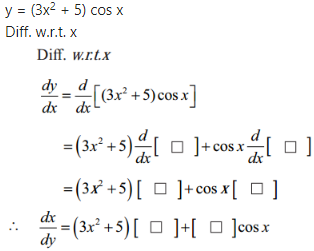
$y = x^3 \log\ x$
View full solution →Differentiate the following w.r.t. x :
$y = x^5\ tan\ x$
View full solution →If $y =\frac{ e ^x}{\sqrt{x}}$, find $\frac{d y}{d x}$ when $x =1$
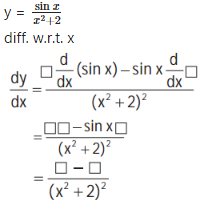
View full solution →Differentiate the following w.r.t. x : $y=\frac{5 e^x-4}{3 e^x-2}$
View full solution →Differentiate the following w.r.t. x : $y=\frac{x^2+3}{x^2-5}$
View full solution →Differentiate the following w.r.t. $x: y=\left(x^3-2\right) \tan x-x \cos x+7^x \cdot x^7$
View full solution →Differentiate the following w.r.t. $x: y=x^4+x \sqrt{x} \cos x-x^2 e^x$
View full solution →Test whether the function
$f(x) = 5x – 3x^2,$ for $x \geq 1$
$= 3 – x,$ for $x < 1$
is differentiable at $x = 1.$
View full solution →Test whether the function
$f(x) = x^2 + 1,$ for $x \geq 2$
$= 2x + 1,$ for $x < 2$
is differentiable at $x = 2.$
View full solution →Determine whether the following function is differentiable at $x=3$ where,
$f(x)=x^2+2, \text { for } x \geq 3$
$=6 x-7, \text { for } x<3$
View full solution →Differentiate the following w.r.t. x :$y=\frac{x^2 \sin x}{x+\cos x}$
View full solution →Differentiate the following w.r.t. x :$y=\frac{x \log x}{x+\log x}$
View full solution →Differentiate $\tan x$ and $\sec x$ w.r.t. $x$ using the formulae for differentiation of $\frac{u}{v}$ and $\frac{1}{v}$ respectively.
View full solution →Discuss whether the function f(x) = |x + 1| + |x – 1| is differentiable ∀ x ∈ R.
Find the values of p and q that make function f(x) differentiable everywhere on R.
f(x) = 3 – x, for x < 1
= px2 + qx, for x ≥ 1.
Examine the function
$f(x) = x^2 \cos(\frac{1}{x})$ for $x \neq 0$
$= 0,$ for $x = 0$
View full solution →Show that the function f is not differentiable at $x = -3,$
where $f(x) = x^2 + 2$ for $x < -3$
$= 2 – 3x$ for $x \geq -3$
View full solution →Find the derivatives of the following w.r.t. x by using the method of the first principle.
x√x
Determine all real values of p and q that ensure the function
f(x) = px + q, for x ≤ 1
= tan $\frac{\pi x}{4}$for 1 < x < 2
is differentiable at x = 1.
View full solution →Determine the values of $p$ and $q$ that make the function $f(x)$ differentiable on $R$ where
$f(x) = px^3,$ for $x < 2$
$= x^2 + q,$ for $x \geq 2$
View full solution →If $f(x)=a \sin x-b \cos x, f^{\prime}\left(\frac{\pi}{4}\right)=\sqrt{2}$ and $f^{\prime}\left(\frac{\pi}{6}\right)=2$, then find $f(x)$.
View full solution →If $f(x)$ is a quadratic polynomial such that $f(0) = 3, f'(2) = 2$ and $f'(3) = 12$, then find $f(x).$
View full solution →If f(x) = sin x – cos x if x ≤ $\frac{\pi}{2}$
= 2x – π + 1 if x > $\frac{\pi}{2}$
Test the continuity and differentiability of f at x =$\frac{\pi}{2}$
View full solution →View full solution →View full solution →View full solution →