Question 13 Marks
Prove The Theorem : If $\theta$ is the acute angle between non-vertical lines having slopes $m_1$ and $m_2$ then
$
\tan \theta=\left|\frac{m_1-m_2}{1+m_1 m_2}\right|
$
$
\tan \theta=\left|\frac{m_1-m_2}{1+m_1 m_2}\right|
$
Answer
View full question & answer→Proof : Let $\alpha$ and $\beta$ be the inclinations of non-vertical lines having slopes $m_1$ and $m_2$. $\alpha \neq 90^{\circ}$ and $\beta \neq 90^{\circ}$.
$
\therefore \tan \alpha=m_1 \text { and } \tan \beta=m_2
$
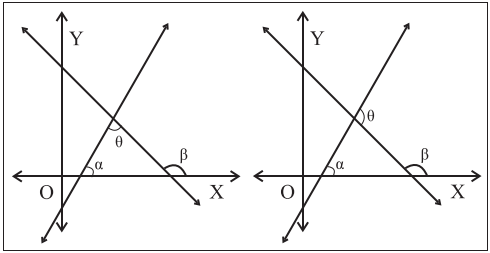
From Fig. 5.7 and 5.8 , we observe that
$
\begin{aligned}
& \theta=\beta-\alpha \text { or } \theta=\pi-(\beta-\alpha) \\
& \therefore \tan \theta=\tan (\beta-\alpha) \text { or } \tan \theta=\tan \{\pi-(\beta-\alpha)\} \\
& \qquad \quad=-\tan (\beta-\alpha) \\
& \therefore \tan \theta=|\tan (\beta-\alpha)|=|\tan (\alpha-\beta)| \\
& \therefore \tan \theta=\left|\frac{\tan \alpha-\tan \beta}{1+\tan \alpha \tan \beta}\right|=\left|\frac{m_1-m_2}{1+m_1 m_2}\right|
\end{aligned}
$
Note that as $\theta$ is the acute angle, lines are not perpendicular to each other. Hence $m_1 m_2 \neq-1$.
$
\therefore 1+m_1 m_2 \neq 0
$
$
\therefore \tan \alpha=m_1 \text { and } \tan \beta=m_2
$
From Fig. 5.7 and 5.8 , we observe that
$
\begin{aligned}
& \theta=\beta-\alpha \text { or } \theta=\pi-(\beta-\alpha) \\
& \therefore \tan \theta=\tan (\beta-\alpha) \text { or } \tan \theta=\tan \{\pi-(\beta-\alpha)\} \\
& \qquad \quad=-\tan (\beta-\alpha) \\
& \therefore \tan \theta=|\tan (\beta-\alpha)|=|\tan (\alpha-\beta)| \\
& \therefore \tan \theta=\left|\frac{\tan \alpha-\tan \beta}{1+\tan \alpha \tan \beta}\right|=\left|\frac{m_1-m_2}{1+m_1 m_2}\right|
\end{aligned}
$
Note that as $\theta$ is the acute angle, lines are not perpendicular to each other. Hence $m_1 m_2 \neq-1$.
$
\therefore 1+m_1 m_2 \neq 0
$