Question 15 Marks
Show that the straight lines $L_1 = (b + c)x + ay + 1 = 0, L_2 = (c + a)x + by + 1 = 0$ and $L_3 = (a + b)x + cy + 1 = 0$ are concurrent.
AnswerIf the lines are concurrent, If they have the common point of intersection.
$(b + c)x + ay + 1 = 0$
$(c + a)x + by + 1 = 0$
$(a + b)x + cy + 1 = 0$
Solving $(1)$ and $(2)$
$\text{y}=\frac{-1-(\text{b}+\text{c})\text{x}}{\text{a}}$
Putting in $(2)$
$(\text{c}+\text{a})\text{x}+\text{b}\frac{(-1-(\text{b}+\text{c})\text{x})}{\text{a}}+1=0$
$acx + a^2x + b - b^2x -bcx + a = 0$
$x(ac + a^2 - b^2 -bc) = b - a$
$x(ac - bc + a^2 - b^2) = b - a$
$x(c(a - b) + (a - b)(a + b)) = b - a$
$x(c + a + b) = -1 [$Cancelling $(a - b)$ both sides$]$
$\text{x}=\frac{-1}{\text{a}+\text{b}+\text{c}}$
$\text{y}=\frac{-1+\frac{(\text{b}+\text{c})(-1)}{\text{a}+\text{b}+\text{c}}}{\text{a}}=\frac{-\text{a}-\text{b}-\text{c}-\text{b}-\text{c}}{\text{a}(\text{a}+\text{b}+\text{c})}$
Putting the value of x, y in (3);
$(\text{a}+\text{b})\Big(\frac{-1}{\text{a}+\text{b}+\text{c}}\Big)+\text{c}\Big(\frac{-\text{a}-2\text{b}-2\text{c}}{\text{a}(\text{a}+\text{b}+\text{c})}\Big)+1=0$
$-\text{a}^2-\text{ba}-\text{ac}-2\text{bc}-2\text{c}^2+\text{a}^2+\text{ab}+\text{ac}=0$
$0 = 0$
Hence, the lines are concurrent.
View full question & answer→Question 25 Marks
A line is such that its segment between the straight lines 5x - y - 4 = 0 and 3x + 4y - 4 = 0 is bisected at the point (1, 5). Obtain its equation.
Answer5x - y - 4 = 0 ...(1)3x + 4y - 4 = 0 ...(2)
P(1, 5)
Let (a, b) lie on 2; (c, d) on 1
We get 3a + 4b = 4 ...(3)
5c - d = 4 ...(4)
from midpoint formula, we have
a + b = 2 ...(5)
b + d = 10 ...(6)
Solving 3 and 5 we get 4b - 3c = -2 ...(7)
Solving 4 and 6 we get 5c + b = 14 ...(8)
Solving 7 and 8 we get $\text{c}=\frac{58}{23}$
Substitute c in 5 we get $\text{a}=\frac{-12}{23}$
Substitute above values similarly in other equations we get
$(\text{a},\text{b})=\Big(\frac{-12}{23},\frac{32}{23}\Big)$
$(\text{c},\text{d})=\Big(\frac{58}{23},\frac{198}{23}\Big)$
Slope of line connecting above points is $\frac{198-32}{58+12}=\frac{83}{35}$
Required equation of line is
$\text{y}-5=\frac{83}{35}(\text{x}-1)$
$35\text{y}-175=83\text{x}-83$
$83\text{x}-35\text{y}+92=0$
View full question & answer→Question 35 Marks
Find the values of the parameter a so that the point (a, 2) is an interior point of the triangle formed by the lines x + y - 4 = 0, 3x - 7y - 8 = 0 and 4x - y - 31 = 0.
AnswerLet ABC be the triangle. The coordinates of the vertices of the triangle ABC are marked in the following fugure.point (a, 2) lie inside or on the trianlge if.
- A and P lie on the same side of BC.
- B and P lie on the same side of AC.
- C and P lie on the same side of AB.
A and P must be on the same side of BC if,
$\big(7(3)-7(-3)-8\big)(3\text{a}-7(2)-8)>0$
$(21+21-8)(3\text{a}-14-8)>0$
$3\text{a}-22>0$
$\text{a}>\frac{22}{3} \ ...(\text{i})$
B and P must be on the same side of AC if,
$\Big(4\Big(\frac{18}{5}\Big)-\Big(\frac{2}{5}\Big)-31\Big)(4\text{a}-2-31)>0$
$4\text{a}-33>0$
$\text{a}>\frac{33}{4} \ ...(\text{ii})$
C and P must be on the same side of AB if,
$\Big(\frac{209}{25}+\frac{61}{25}\Big)-4\Big)(\text{a}+2-4)>0$
$\text{a}+2>0$
$\text{a}>-2 \ ...(\text{iii})$
From i, ii, and iii
$\text{a}\in\Big(\frac{22}{3},\frac{33}{4}\Big)$ View full question & answer→Question 45 Marks
Find the equations to the straight lines which go through the origin and trisect the portion of the straight line 3x + y = 12 which is intercepted between the axes of coordinates.
AnswerThe required straight line passes through (0, 0) and trisect the part of the line 3x + y = 12 that lies between the axes of coordinates.The line 3x + y = 12 has A(4, 0) and B(0, 12) as X and Y intercepts.
Let P and Q be the points of trisection of AB.
Since P divides AB in the ratio 1 : 2, coordinates of P are:
$\text{P}=\frac{1(0)+2(4)}{1+2},\frac{1(12)+2(0)}{1+2}=\Big(\frac{8}{3},4\Big)$
Since Q divides BA in the ratio 1 : 2, coordinates of Q are:
$\text{Q}=\frac{2(0)+1(4)}{1+2},\frac{1(0)+1(12)}{1+2}=\Big(\frac{4}{3},8\Big)$
Equation of line through (0, 0) and $\text{p}\Big(\frac{8}{3},4\Big)$ is:
$\text{y}-0=\frac{4-0}{\frac{8}{3}-0}(\text{x}-0)$
$\text{y}-0=\frac{12}{8}\text{x}$
$\text{2y}=\text{3x}$
Equation of line through (0, 0) and $ \text{Q}\Big(\frac{4}{3},8\Big)$ is:
$\text{y}-0=\frac{8-0}{\frac{4}{3}-0}(\text{x}-0)=\text{6x}$
$\text{y}=\text{6x}$
View full question & answer→Question 55 Marks
Find the image of the point (2, 1) with respect to the line mirror x + y - 5 = 0.
AnswerLet the image of the point P(2, 1) in the mirror AB be $\text{Q}(\alpha,\beta).$ Then, PQ is perpendicular bisected at R.
The coordinates of R are
$\Big(\frac{\alpha+2}{2},\frac{\beta+1}{2}\Big)$
And lie on the line x + y - 5 = 0
$\Big(\frac{\alpha+2}{2}\Big)+\Big(\frac{\beta+1}{2}\Big)-5=0$
$\alpha+2+\beta+1-10=0$
$\alpha+\beta=7 \ ...(1)$
Since PQ is $\perp$ to AB
(Slope of AB) × (Slope of PQ) = -1
$-1\times\Big(\frac{\beta-1}{\alpha-2}\Big)=-1$
$\beta-1=\alpha-2$
$\beta-\alpha=-1 \ ...(2)$
Solving (1) and (2), we get
$\alpha=5$ and $\beta=2$
$\therefore$ Image of (1, 2) in x + y - 5 = 0 is (4, 3).
View full question & answer→Question 65 Marks
Find the equation to the straight line which bisects the distance between the points (a, b), (a', b') and also bisects the distance between the points (-a, b) and (a', -b').
AnswerThe line that bisects the distance between the points A(a, b), B(a', b') and between C(-a, b), D(a', -b') means a line passing through the midpoint of AB and CDmid point of AB is $\Big(\frac{\text{a}+\text{a}'}{2},\frac{\text{b}+\text{b}'}{2}\Big)$
mid point of CD is $\Big(\frac{-\text{a}+\text{a}'}{2},\frac{\text{b}-\text{b}'}{2}\Big)$
Equation is $\text{y}-\text{y}_1=\text{m}(\text{x}-\text{x}_1)$
$\text{y}-\text{y}_1=\frac{\text{y}_2-\text{y}_1}{\text{x}_2-\text{x}_1}(\text{x}-\text{x}_1)$
$\text{y}-\Big(\frac{\text{b}+\text{b}'}{2}\Big)=\frac{\Big(\frac{\text{b}-\text{b}'}{2}\Big)-\Big(\frac{\text{b}+\text{b}'}{2}\Big)}{\Big(\frac{-\text{a}+\text{a}'}{2}-\frac{\text{a}+\text{a}'}{2}\Big)}\Big(\text{x}-\Big(\frac{\text{a}+\text{a}'}{2}\Big)\Big)$
$\text{y}-\Big(\frac{\text{b}-\text{b}'}{2}\Big)=\frac{\frac{\text{b}}{2}-\frac{\text{b}'}{2}-\frac{\text{b}}{2}-\frac{\text{b}'}{2}}{-\frac{\text{a}}{2}+\frac{\text{a}'}{2}-\frac{\text{a}}{2}-\frac{\text{a}'}{2}}\Big(\text{x}-\Big(\frac{\text{a}+\text{a}'}{2}\Big)\Big)$
$\text{y}-\Big(\frac{\text{b}+\text{b}'}{2}\Big)=\frac{+\text{b}'}{\text{a}}\Big(\text{x}-\Big(\frac{\text{a}+\text{a}'}{2}\Big)\Big) $
$2\text{ay}-2\text{b}'\text{x}=\text{ab}-\text{a}'\text{b}'$
View full question & answer→Question 75 Marks
The vertices of a quadrilateral are A (-2, 6), B (1, 2), C (10, 4) and D (7, 8). Find the equation of its diagonals.
AnswerThe quadrilateral ABCD has diagonals AC and BD.The required equation is
Since, A(-2, 6), C(10, 4), the equation for AC is:
$\text{y}-6=\frac{4-6}{10-(-2)}(\text{x}-(-2))\ \Big[\text{y}-\text{y}_1=\frac{\text{y}_2-\text{y}_1}{\text{x}_2-\text{x}_1}(\text{x}-\text{x}_1)\Big]$
$\text{y}-6=-\frac{12}{6}(\text{x}+2)$
$\text{y}-6=\frac{-(\text{x}+2)}{6}$
$\text{6y}-36=-\text{x}-2$
$\text{x}+\text{6y}-34=0$
Since, B(1, 2), D(7, 8), the equation for BD is:
$\text{y}-\text{y}_1=\frac{\text{y}_2-\text{y}_1}{\text{x}_2-\text{x}_1}(\text{x}-\text{x}_1)$
$\text{y}-2=\frac{8-2}{7-1}(\text{x}-1)$
$\text{y}-2=\frac{6}{6}(\text{x}-1)$
$\text{y}-2=\text{x}-1$
$\text{x}-\text{y}+1=0$
View full question & answer→Question 85 Marks
Find the equation of the straight line which cuts off intercepts on x-axis twice that on y-axis and is at a unit distance from the origin.
AnswerThe equation of line in intercept from is $\frac{\text{x}}{\text{a}}+\frac{\text{y}}{\text{b}}=1$
Intercept on y-axis = 2a (given)
$\therefore$ equation is
$\frac{\text{x}}{2\text{a}}+\frac{\text{y}}{\text{a}}=1$
$\text{ax}+2\text{ay}=2\text{a}^2 \ ...(1)$
Now, perpendicular distance of (1) from origin is given unity
$\Rightarrow\frac{|\text{ax}_1+\text{by}_1+\text{c}|}{\sqrt{\text{a}^2+\text{b}^2}}=1$
$\text{a}=\text{a},\text{b}=2\text{a},\text{c}=-2\text{a}^2,\text{x}_1=0,\text{y}_1=0$
$=\frac{|\text{a}(0)+2\text{a}(0)-2\text{a}^2|}{\sqrt{(2\text{a})^2+(\text{a})^2}}=1$
$\Rightarrow-2\text{a}^2=\sqrt{5}\text{a}$
$\Rightarrow4\text{a}^2=\text{a}^25$
$\text{a}^2=\frac{5}{4}\Rightarrow\text{a}=\pm\frac{\sqrt{5}}{4}$
$\therefore$ the intercept form of straight line is
$\frac{\text{x}}{2\text{a}}+\frac{\text{y}}{\text{a}}=1$
$\frac{\text{x}}{\pm\frac{2\sqrt{5}}{4}}+\frac{\text{y}}{\pm\frac{\sqrt{5}}{4}}=1$
$\text{x}+2\text{y}=\pm\sqrt{5}$
$\text{x}+2\text{y}\pm\sqrt{5}=0$
View full question & answer→Question 95 Marks
Find the angle between the line joining the points (2, 0), (0, 3) and the line x + y = 1.
AnswerThe equation between the points
$(2,0)\\{\text{x}_1,\text{y}_1}$ and $(0,3)\\{\text{x}_2,\text{y}_2}$
Slope of line $=\frac{\text{y}_2-\text{y}_1}{\text{x}_2-\text{x}_1}$
$\text{m}_1=\frac{3-0}{0-2}=\frac{-3}{2}$
Also, slope of line $\text{x}+\text{y}=1$
Converting in the form $\text{y}=\text{mx}+\text{c}$
$\text{y}=1-\text{x}$
$\Rightarrow\text{m}_2=-1$
Thus, $\tan\theta=$ angle between the lines
$\Rightarrow\tan\theta=\Big|\frac{\text{m}_1-\text{m}_2}{1+\text{m}_1\text{m}_2}\Big|$
$=\Bigg|\frac{\frac{-3}{2}-(-1)}{1+\big(\frac{-3}{2}\big)(-1)}\Bigg|=\Bigg|\frac{\frac{-3}{2}+1}{1+\frac{3}{2}}\Bigg|$
$=\Bigg|\frac{\frac{-3+2}{2}}{\frac{2+3}{2}}\Bigg|=\Bigg|\frac{\frac{-1}{2}}{\frac{5}{2}}\Bigg|=\frac{1}{5}$
$\Rightarrow\theta=\tan^{-1}\Big(\frac{1}{5}\Big)$
View full question & answer→Question 105 Marks
Find the equations of the medians of a triangle, the equations of whose sides are:
3x + 2y + 6 = 0, 2x - 5y + 4 = 0 and x - 3y - 6 = 0
AnswerThe given equation are as follows:
3x + 2y + 6 = 0 ...(1)
2x - 5y + 4 = 0 ...(2)
x - 3y -6 = 0 ....(3)
In triangle ABC, let equation (1), (2) and (3) represent the sides AB, BC and CA, respectively.
Solving (1) and (2)
x = -2, y = 0
Thus, AB and BC intersect at B(-2, 0).
Solving (1) and (3)
$\text{x}=-\frac{6}{11},\text{y}=-\frac{24}{11}$
Thus, AB and CA intersect at $\text{A}\Big(\frac{6}{11},-\frac{24}{11}\Big)$
Similarly, Solving (2) and (3)
x = -42, y = -16
Thus, BC and CA intersect at C(-42, - 16).
Let D, E and F be the midpoint the sides BC , CA and AB, respectively. Then,
Then, we have:
$\text{D}=\big(\frac{-2-42}{2},\frac{0-16}{2}\big)=(-22, -8)$
$\text{E}=\bigg(\frac{-\frac{6}{11}-42}{2},\frac{-\frac{24}{11}-16}{2}\bigg)=\Big(\frac{-234}{11},-\frac{100}{11}\Big)$
$\text{F}=\bigg(\frac{-\frac{6}{11}-2}{2},\frac{-\frac{24}{11}+0}{2}\bigg)=(-\frac{14}{11},-\frac{12}{11})$
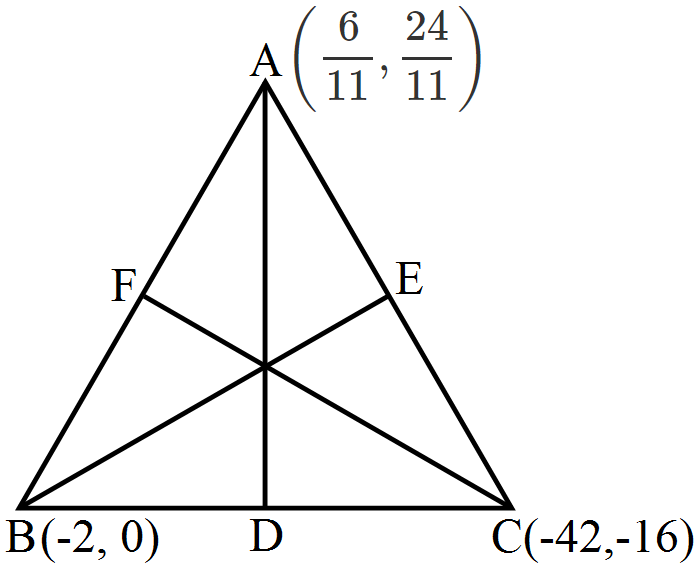
Now, the equation of median AD is
$\text{y}+\frac{24}{11}=\frac{-8+\frac{24}{11}}{-22+\frac{6}{11}}(\text{x} +\frac{6}{11})$
$\Rightarrow16\text{x}-59\text{y}-120 = 0$
The equation of median BE is
$\text{y}-0=\frac{-\frac{100}{11}-0}{-\frac{234}{11}+2}(x+2)$
$\Rightarrow25\text{x}-53\text{y}+50=0$
And, the equation of median CF is
$\text{y}+16=\frac{-\frac{12}{11}+16}{-\frac{14}{11}+42}(\text{x}+42)$
$\Rightarrow41\text{x}-112\text{y}-70=0$ View full question & answer→Question 115 Marks
Find the equation of the straight line through the point $(\alpha,\beta)$ and perpendicular to the line $lx + my + n = 0.$
AnswerAny line is given by equation
$y - y_1 = m(x - x_1) ...(1)$
where $(x_1y_1)$ is $(\alpha,\beta)$
And m is negative reciprocal of slope of line $lx + my + n = 0.$
i.e; $\text{y}=\frac{-\text{lx}}{\text{m}}-\frac{\text{n}}{\text{m}}$
$\Rightarrow $ Slope of line $=\frac{\text{-l}}{\text{m}}$
Putting the data in $(i),$ we get
$\text{y}-\beta=\frac{\text{m}}{\text{l}}(\text{x}-\alpha)$
$\text{ly}+\text{mx}=\text{m}\alpha+\text{l}\beta$
$\text{m}(\text{x}-\alpha)=\text{l}(\text{y}-\beta)$
View full question & answer→Question 125 Marks
Find the point of intersection of the following pairs of lines:
$\text{y}=\text{m}_1\text{x}+\frac{\text{a}}{\text{m}_1}$ and $\text{y}=\text{m}_2\text{x}+\frac{\text{a}}{\text{m}_2}$
Answer$\text{y}=\text{m}_1+\frac{\text{a}}{\text{m}_1}$ and $\text{y}=\text{m}_2\text{x}+\frac{\text{a}}{\text{m}_2}$
Putting value of y from one equation to another
$\text{m}_1+\frac{\text{a}}{\text{m}_1}=\text{m}_2\text{x}+\frac{\text{a}}{\text{m}_2}$
$\text{x}(\text{m}_1-\text{m}_2)=\frac{\text{a}}{\text{m}_2}-\frac{\text{a}}{\text{m}_1}=\text{a}\Big(\frac{\text{m}_1-\text{m}_2}{\text{m}_1\text{m}_2}\Big)$
$\Rightarrow\text{x}=\frac{\text{a}}{\text{m}_1\text{m}_2}$
$\Rightarrow\text{y}=\text{m}_1\text{x}+\frac{\text{a}}{\text{m}_1}$
$=\text{m}_1\Big(\frac{\text{a}}{\text{m}_1\text{m}_2}\Big)+\frac{\text{a}}{\text{m}_1}$
$=\frac{\text{a}}{\text{m}_2}+\frac{\text{a}}{\text{m}_1}$
$=\text{a}\Big(\frac{\text{m}_1+\text{m}_2}{\text{m}_1\text{m}_2}\Big)$
Thus, the point of in intersection is
$\Big(\frac{\text{a}}{\text{m}_1\text{m}_2},\text{a}\Big(\frac{1}{\text{m}_1}+\frac{1}{\text{m}_2}\Big)\Big)$
View full question & answer→Question 135 Marks
Find the conditions that the straight lines $y = m_1x + c_1, y = m_2x + c_2$ and $y = m_3x + c_3$ may meet in a point.
AnswerThe three lines are
$y = m_1x + c_1 ...(1)$
$y = m_2x + c_2 ...(2)$
$y = m_3x + c_3 ...(3)$
Collinear or they meet at a point only when they have common point of intersection solving $(1)$ and $(2)$ for $x$ and $y$
$m_1x + c_1 = m_2x + c_2$
$x(m_1 - m_2) = c_2 - c_1$
$\text{x}=\frac{\text{c}_2-\text{c}_1}{\text{m}_1-\text{m}_2}$
$\Rightarrow y = m_1x + c_1$
$=\text{m}_1\Big(\frac{\text{c}_2-\text{c}_1}{\text{m}_1-\text{m}_2}\Big)+\text{c}_1$
$= m_1c_2 - m_1c_1 + m_1c_1 - m_2c_1$
Putting $x$ and $y$ in $(3)$
$\text{m}_1\text{c}_2-\text{m}_1\text{c}_1=\text{m}_3\frac{(\text{c}_2-\text{c}_1)}{\text{m}_1-\text{m}_2}+\text{c}_3$
$m_1^2c_2 - m_1m_2c_2 - m_1m_2c_1 + m_2^2c_1 = m_3c_2 - m_3c_1 + m_1c_3 - m_2c_3$
$\Rightarrow m_1(c_2- c_3) + m_2(c_3 - c_1) + m_3(c_1 - c_2) = 0$
View full question & answer→Question 145 Marks
Find the equations of the lines through the point of intersection of the lines x - y + 1 = 0 and 2x - 3y + 5 = 0 whose distance from the point (3, 2) is $\frac{7}{5}.$
AnswerSolving two equations of lines x - y + 1 = 0 and 2x - 3y + 5 = 0 we get, intersection point (2, 3).
Let equation of a line passing through (2, 3) be y = mx + c
$\therefore$ 3 = 2m + c
c = 3 - 2m
Equation of the line is y = mx + 3 -2m ...(1)
Perpendicular distance of above line from $(3,2)=\frac{7}{5}$
$\Big|\frac{3\text{m}-2+3-2\text{m}}{\sqrt{\text{m}^2+1}}\Big|=\frac{7}{5}$
$\Big|\frac{\text{m}+1}{\sqrt{\text{m}^2+1}}\Big|=\frac{7}{5}$
$\frac{(\text{m}+1)^2}{\text{m}^2+1}=\frac{49}{25}$
$25(\text{m}^2+2\text{m}+1)=49\text{m}^2+49$
$25\text{m}^2+50\text{m}+25=49\text{m}^2+49$
$24\text{m}^2-50\text{m}+24=0$
$12\text{m}^2-25\text{m}+12=0$
$\text{m}=\frac{4}{3},\text{m}=\frac{3}{4}$
Substituting m in (1), we get,
$\text{y}=\frac{4}{3}\text{x}+3-\frac{2\times4}{3}$
$3\text{y}=4\text{x}+1$
$4\text{x}-3\text{y}+1=0$
$\text{y}=\frac{3}{4}\text{x}+3-\frac{2\times3}{4}$
$4\text{y}-3\text{y}+1=0$
Equations of lines are 4x - 3y + 1 = 0 and 4y - 3y + 1 = 0
View full question & answer→Question 155 Marks
Find the tangent of the angle between the lines which have intercepts $3, 4$ and $1, 8$ on the axes respectively.
Answer$\mathrm{Line_1}$ is $\frac{\text{x}}{3}+\frac{\text{y}}{4}=1$
i.e $4\text{x}+3\text{y}=12$
$\mathrm{Line_2}$ is $\frac{\text{x}}{1}+\frac{\text{y}}{8}=1$
i.e $8\text{x}+\text{y}=8$
Slope of $\mathrm{Line_1}$ and $\mathrm {Line_2}$ is $\frac{-4}{3}$ and $\frac{-8}{1}$ respectively.
Thus, $\tan\theta=\Big|\frac{\text{m}_1-\text{m}_2}{1+\text{m}_1\text{m}_2}\Big|$
$=\Bigg|\frac{\frac{-4}{3}-(-8)}{1+\big(\frac{-4}{3}\big)(-8)}\Bigg|$
$=\Bigg|\frac{\frac{-4}{2}+8}{1+\frac{32}{3}}\Bigg|=\Bigg|\frac{-4+24}{3+32}\Bigg|$
$=\Big|\frac{20}{35}\Big|=\frac{4}{7}$
Thus, $\tan\theta=\frac{4}{7}.$
View full question & answer→Question 165 Marks
Find the equation of the straight line which has y-intercept equal to $\frac{4}{3}$ and is perpendicular to 3x - 4y + 11 = 0.
AnswerAny line having y-intercept equal to $\frac{4}{3}$ passes through the point $\Big(0,\frac{4}{3}\Big)\$\text{x}_1,\text{y}_1)$
Slope of line 3x - 4y + 11 = 0
$\text{y}=\frac{3}{4}\text{x}+\frac{11}{4}$
$\Rightarrow\text{m}=\frac{3}{4}$
The required line is perpendicular to the given line, therefore its slope is $\frac{-4}{3}$
⇒ Equation of required line is
$\text{y}-\text{y}_1=\text{m}'(\text{x}-\text{x}_1)$
$\text{y}-\frac{4}{3}=\frac{-4}{3}(\text{x}-0)$
$4\text{x}+3\text{y}-4=0$
View full question & answer→Question 175 Marks
Find the equations to the straight lines which pass through the point $(h, k)$ and are inclined at angle $\tan^{-1}$ m to the straight line $y = mx + c.$
AnswerThe required equation is
$y - k = m'(x - h)$
And this line is inclined at $\tan^{-1}m$ to straight line $y = mx + c.$
slope $=\text{m}=\tan\theta$
Passing through $(\text{h, k})\ \text{x}_1,\text{y}_1)$
$\therefore$ Equation of line is
$\text{y} - \text{y} _1 = \text{m} (\text{x} - \text{x} _1) \ ...(\text{i} )$
Also, $\tan\theta=\big|\frac{\text{m}-\text{m'}}{1+\text{mm'}}\big|$
Here, $\text{m} = \text{m}'$
$\therefore\tan\theta=\frac{\text{m}-\text{m}}{1+\text{m}^2}$ or $\big|\frac{-\text{m}-\text{m}}{1-\text{m}^2}\big|$
$=0$ or $\frac{+2\text{m}}{1-\text{m}^2}$
Substituting in $(i)$
$\text{y} - \text{k} = 0$
$\Rightarrow\text{y} = \text{k}$ or
$\text{y}-\text{k}=\frac{+2\text{m}}{1-\text{m}^2}(\text{x}-\text{h})$
$(1-\text{m}^2)(\text{y}-\text{k})=+2\text{m}(\text{x}-\text{h})$
View full question & answer→Question 185 Marks
The line 2x + 3y = 12 meets the x-axis at A and y-axis at B. The line through (5, 5) perpendicular to AB meets the x-axis and the line AB at C and E respectively. If O is the origin of coordinates, find the area of figure OCEB.
AnswerThe line 2x + 3y = 12 meets the x-axis at A and y-axis at B
⇒ A is 2x = 12 = x = 6
$\therefore$ A is (6, 0)
⇒ A is 3y = 12
y = 4
$\therefore$ B is (0, ,4)
Line through (5, 5) perpendicular to 2x + 3y = 12 will have slope $=\frac{3}{2}$
$\text{y}-\text{y}_1=\text{m}(\text{x}-\text{x}_1)$
$\text{y}-5=\frac{3}{2}(\text{x}-5)$
2y - 3x = -5 is eq of lline which meets x-axis at C and the line at E
$\therefore$ C is -3x = -5
$\text{x}=\frac{-5}{3}$
$\therefore$ E is $\Big(\frac{5}{3},0\Big)$
E ⇒ point of intersection of two lines
2x + 3y = 12
2y - 3x = -5
The area of OBCE = are of AOB - area of ACE
$\Rightarrow\frac{1}{2}\times\text{AO}\times\text{OB}-\frac{1}{2}\times\text{AC}\times\text{CE}$
$\Rightarrow\frac{24}{2}-\frac{1}{2}\times\sqrt{13}\times\frac{2}{3}\sqrt{13}$
$\Rightarrow\frac{24}{2}-\frac{1}{2}\times\frac{2}{3}\times13$
$\Rightarrow12-\frac{13}{3}$
$\Rightarrow\frac{23}{3} \ \text{sq units}$
View full question & answer→Question 195 Marks
Show that the path of a moving point such that its distances from two lines 3x - 2y = 5 and 3x + 2y = 5 are equal is a straight line.
AnswerLet P(h, k) be a moving point such that it is equidistant from the lines 3x - 2y - 5 = 0 and 3x + 2y - 5 = 0, then
$\Big|\frac{3\text{h}-2\text{k}-5}{\sqrt{9+4}}\Big|=\Big|\frac{3\text{h}+2\text{k}-5}{\sqrt{9+4}}\Big|$
$|3\text{h}-2\text{k}-5|=|3\text{h}+2\text{k}-5|$
$4\text{k}=0\Rightarrow\text{k}=0$ or $6\text{h}-10=0\Rightarrow3\text{h}=5$
Hence, the locus of (h, k) is y = 0 or 3x = 5, which are straight lines.
View full question & answer→Question 205 Marks
Find the equation of the diagonals of the square formed by the lines $x = 0, y = 0, x = 1$ and $y = 1.$
Answer
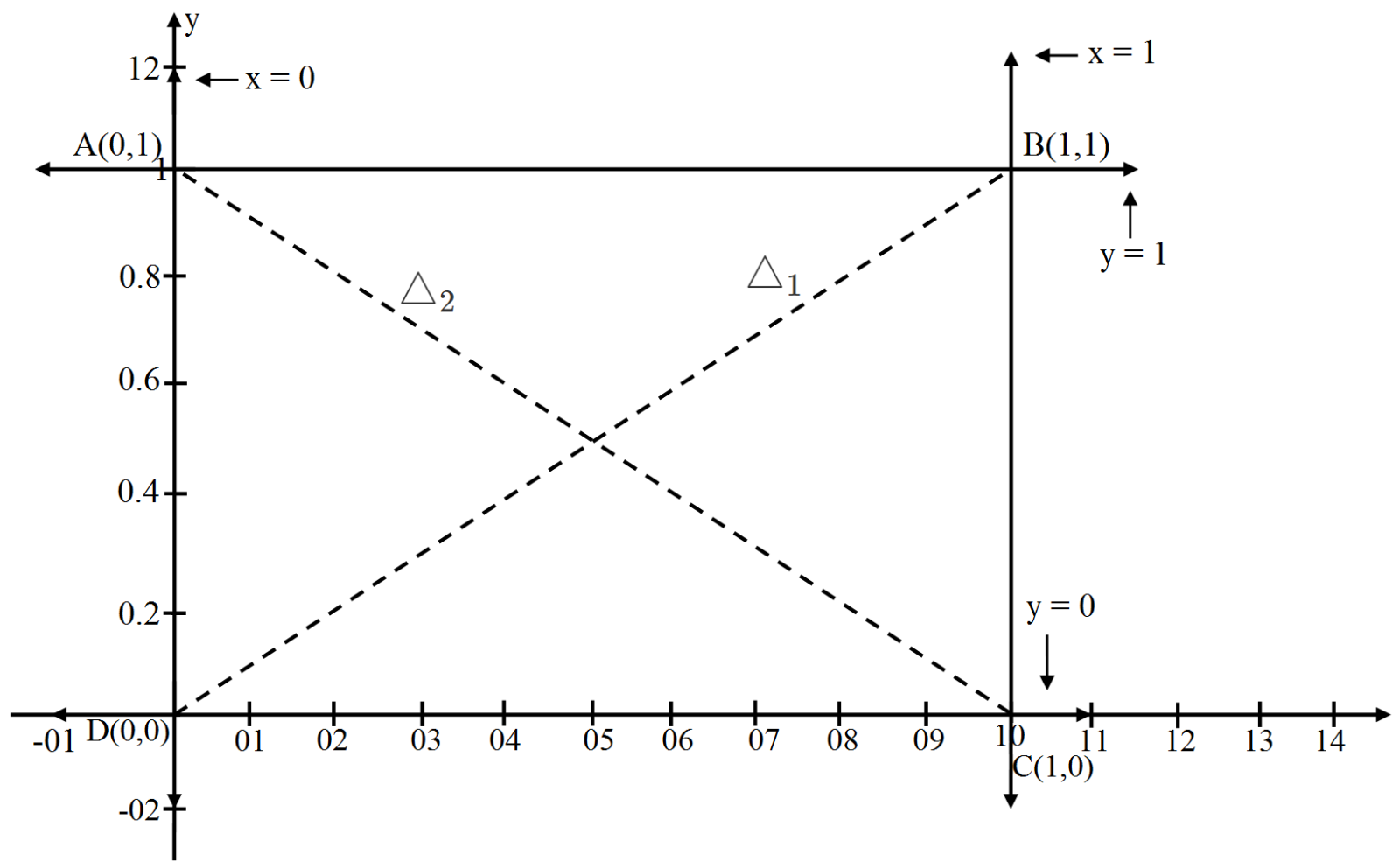
When we draw all the given equation of lines on the graph we get the points of intersection $A(0, 1), B(1, 1), C(1, 0)$ and $D(0, 0).$
Let $d_1$ be the diagonal formed by joining the points $B$ and $D.$
Let $d_2$ be the diagonal formed by joining the points $A$ and $C.$
Equation of the diagonal $d_1$ is given by,
$(\text{y}-1)=\frac{(0-1)}{(0-1)}(\text{x}-1)$
$(\text{y}-1)=1(\text{x}-1)$
$\text{y}=\text{x}$
Equation of the diagonal $d_2$ is given by,
$(\text{y}-1)=\frac{(0-1)}{(1-0)}(\text{x}-0)$
$(\text{y}-1)=-\text{1x}$
$\text{y}+\text{x}=1$
$\therefore $ The equations of the diagonals are $\text{y}=\text{x}$ and $\text{y}+\text{x}=1.$ View full question & answer→Question 215 Marks
If sum of perpendicular distances of a variable point P (x, y) from the lines x + y - 5 = 0 and 3x - 2y + 7 = 0 is always 10. Show that P must move on a line.
AnswerIt is given that the sum of the perpendicular distance of a variable point p(x, y) from the lines (x + y - 5) = 0 and 3x - 2y + 7 = 0 is always 10.
Therefore, $\frac{\text{x}+\text{y}-5}{\sqrt{2}}+\frac{3\text{x}-2\text{y}+7}{\sqrt{13}}=10$
$\big(3\sqrt{2}+\sqrt{13}\big)\text{x}+\big(\sqrt{13}-2\sqrt{2}\big)\text{y}+\big(7\sqrt{2}-5\sqrt{13}-10\sqrt{26}\big)=0$
Clearly, it is a straight line.
View full question & answer→Question 225 Marks
Find the angles between the following pairs of straight lines:
3x + 4y - 7 = 0 and 4x - 3y + 5 = 0
AnswerTo find angles between the lines, convert the equations in the form$\text{y}=\text{mx}+\text{c}$
$3\text{x}+4\text{y}-7=0$
$\Rightarrow4\text{y}=-3\text{x}+7$
$\text{y}=\frac{-3}{4}\text{y}+\frac{7}{4}$
$\Rightarrow\text{m}_1=\frac{-3}{4}$
Also, $4\text{x}-3\text{y}+5=0$
$\Rightarrow3\text{y}=4\text{x}+5$
$\Rightarrow\text{y}=\frac{4}{3}\text{x}+\frac{5}{3}$
$\Rightarrow\text{m}_1=\frac{4}{3}$
The angle between the lines is given by
$\tan\theta=\Big|\frac{\text{m}_1-\text{m}_2}{1+\text{m}_1\text{m}_2}\Big|$
$=\Bigg|\frac{\frac{-3}{4}-\frac{4}{3}}{1+\frac{(-3)}{4}\big(\frac{4}{3}\big)}\Bigg|=\Bigg|\frac{\frac{-3}{4}-\frac{4}{3}}{1-1}\Bigg|$
$\Rightarrow\theta=\frac{\pi}{2}$ or $90^\circ$
View full question & answer→Question 235 Marks
Find the coordinates of the foot of the perpendicular from the point (-1, 3) to the line 3x- 4y - 16 = 0.
AnswerLet foot of perpendicular of P(-1, 3) on line 3x - 4y = 16 be $\text{Q}(\alpha,\beta)$
Then,
(Slope of line) × (Slope of PQ) = -1
$\frac{3}{4}\times\frac{\beta-3}{\alpha+1}=-1$
$3(\beta-3)=-4\alpha-4$
$3\beta-9=-4\alpha-4$
$=4\alpha+3\beta=5 \ ...(1)$
$\alpha$ and $\beta$ should lie on 3x -4y = 16
$\therefore 3\alpha-4\beta = 16 \ ...(2)$
From (1) and (2)
$\alpha=\Big(\frac{68}{25}\Big), \ \beta=\Big(\frac{-49}{25}\Big)$
$\therefore$ Q is $\Big(\frac{68}{25},\frac{-49}{25}\Big)$
View full question & answer→Question 245 Marks
Show that the product of perpendiculars on the line $\frac{\text{x}}{\text{a}}\cos\theta+\frac{\text{y}}{\text{b}}\sin\theta=1$ from the points $\Big(\sqrt{\text{a}^2-\text{b}^2},0\Big)$ is $\text{b}^2.$
AnswerPerpendicular distance from $\Big(\sqrt{\text{a}^2-\text{b}^2},0\Big)$ to $\frac{\text{x}}{\text{a}}\cos\theta+\frac{\text{y}}{\text{b}}\sin\theta=1$
$\begin{vmatrix}\frac{\frac{\sqrt{\text{a}^2-\text{b}^2}}{\text{a}}\cos\theta+\frac{0\text{x}}{\text{b}}\sin\theta-1}{\frac{\cos^2\theta}{\text{a}^2}+\frac{\sin^2\theta}{\text{b}^2}}\end{vmatrix}$
$=\frac{\frac{\sqrt{\text{a}^2-\text{b}^2}}{\text{a}}\cos\theta-1}{\frac{\cos^2\theta}{\text{a}^2}+\frac{\sin^2\theta}{\text{b}^2}} \ ...(\text{i})$
Also, perpendicular from $\Big(-\sqrt{\text{a}^2-\text{b}^2},0\Big)$ to $\frac{\text{x}}{\text{a}}\cos\theta+\frac{\text{y}}{\text{b}}\sin\theta-1=0$
$\begin{vmatrix}\frac{-\frac{\sqrt{\text{a}^2-\text{b}^2}}{\text{a}}\cos\theta+0-1}{\frac{\cos^2\theta}{\text{a}^2}+\frac{\sin^2\theta}{\text{b}^2}}\end{vmatrix} \ ...(\text{ii})$
(i) × (ii)
$\frac{\Big(\frac{\text{a}^2-\text{b}^2}{\text{a}}\Big)\cos^2\theta-1}{\frac{\cos^2\theta}{\text{a}^2}+\frac{\sin^2\theta}{\text{b}^2}}=\text{b}^2$
View full question & answer→Question 255 Marks
If two opposite vertices of a square are $(1, 2)$ and $(5, 8),$ find the coordinates of its other two vertices and the equations of its sides.
AnswerLet $A(1, 2), C(5, 8), B(x_1, y_1), D(x_2,y_2)$
Slope of $\text{AC}=\frac{8-2}{5-1}=\frac{6}{4}=\frac{3}{2}$
Let $m$ be the slope of a line making on angle $45^\circ $ with $AC$
$\therefore\tan45^\circ=\Bigg|\frac{\text{m}_1-\frac{3}{2}}{1+\text{m}\times\frac{3}{2}}\Bigg|$
$1=\frac{\text{m}-\frac{3}{2}}{1+\frac{3\text{m}}{2}}$
$1+\frac{3\text{m}}{2}=\text{m}-\frac{3}{2}$ or, $1+\frac{3\text{m}}{2}=-\Big(\text{m}-\frac{3}{2}\Big)$
$\frac{3\text{m}}2-\text{m}=\frac{-3}{2}-1$ or, $1+\frac{3\text{m}}2=-\text{m}+\frac{3}{2}$
$\frac{1}{2}\text{m}=\frac{-5}{2}$ or, $\frac{3\text{m}}{2}+\text{m}=\frac{3}{2}-1$
$\text{m}=-5$ or, $\frac{5\text{m}}{2}=\frac{1}{2}$
$\text{m}=\frac{1}{5}$
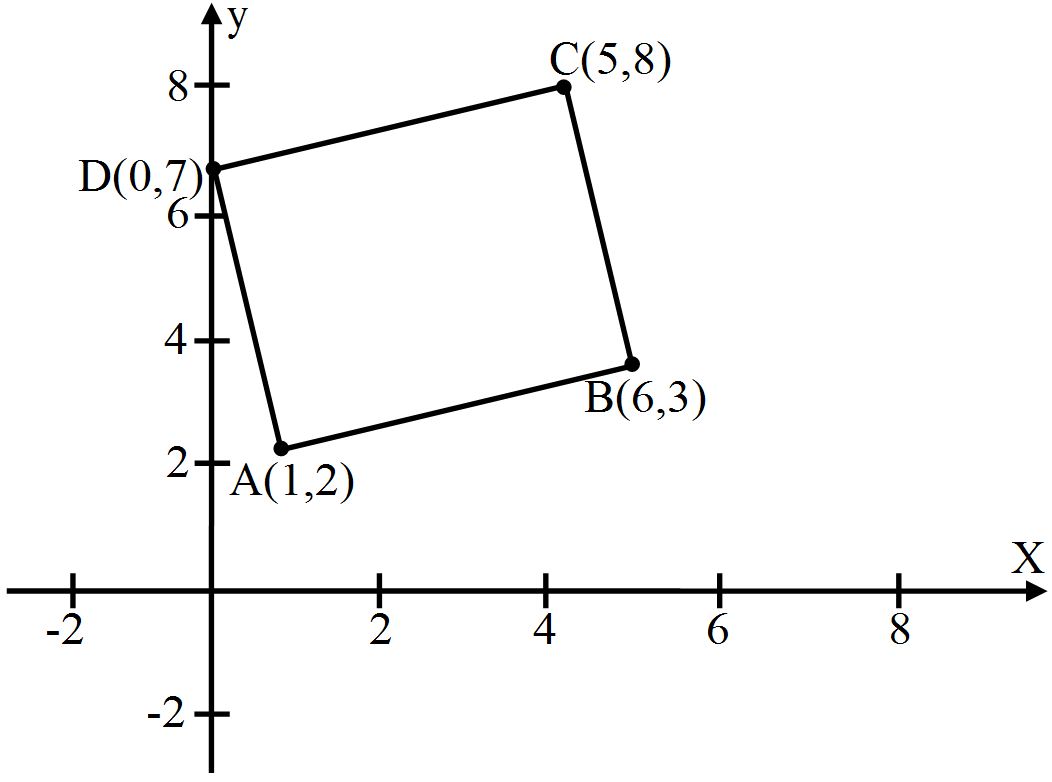
Hence, equation of AD
$y - 2 = -5(x - 1)$
$5x + y = 7$
Equation of $CD$
$\text{y}-8=\frac{1}{5}(\text{x}-5)$
$\text{y}-8=\frac{\text{x}}{5}-1$
$5\text{y}-\text{x}=39$
Hence, the coodinates are $(6, 3), (0, 7).$
The equation of $AB$ is
$\text{y}-2=\frac{1}{5}(\text{x}-1)$
$\Rightarrow5\text{y}-10=\text{x}-1$
$\Rightarrow\text{x}-5\text{y}+9=0$
And the equation of $BC$ is
$\text{y}-8=-5(\text{x}-5)$
$\Rightarrow\text{y}-8=-5\text{x}+25$
$\Rightarrow5\text{x}+\text{y}-33=0$ View full question & answer→Question 265 Marks
Prove that the points $(2, -1), (0, 2), (2, 3)$ and $(4, 0)$ are the coordinates of the vertices of a parallelogram and find the angle between its diagonals.
AnswerLet $A(2, -1), B(0, 2), C(2, 3)$ and $D(4, 0)$ be the vertices.
Slope of $\text{AB}=\frac{2+1}{0-2}=-\frac{3}{2}$
Slope of $\text{BC}=\frac{3-2}{2-0}=-\frac{1}{2}$
Slope of $\text{CD}=\frac{0-3}{4-2}=-\frac{3}{2}$
Slope of $\text{DA}=\frac{-1-0}{2-4}=\frac{1}{2}$
Thus, $AB$ is parallel to $CD$ and $BC$ is parallel to $DA$
Therefore, the given points are the vertices of parallelogram.
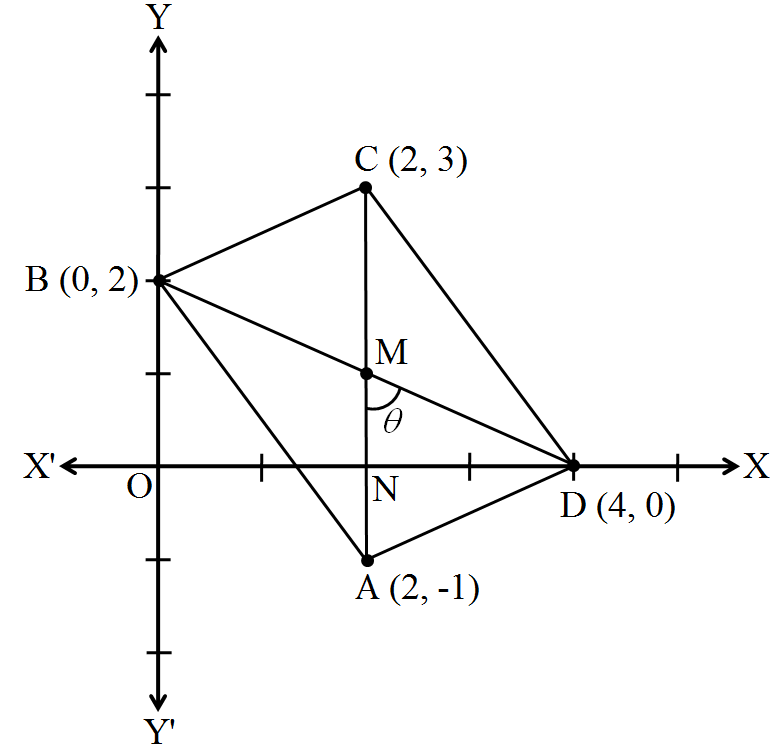
Now, let us find the angle between the diagonals $AC$ and $BD$.
Let $m_1$ and $m_2$ be the slopes of $AC$ and $BD,$
respectively. $\therefore\text{m}_1=\frac{3+1}{2-2}=\infty$
$\text{m}_2=\frac{0-2}{4-0}=-\frac{1}{2}$
Thus, the diagonal $AC$ is parallel to the $y-$axis.
$\therefore\angle\text{ODB}-\tan^{-1}\big(\frac{1}{2}\big)$ In trianlge $MND,$
$\angle\text{DMN}=\frac{\pi}{2}-\tan^{-1}\big(\frac{1}{2}\big)$
Hence, the acute angle between the diagonals is $\frac{\pi}{2}-\tan^{-1}\big(\frac{1}{2}\big).$ View full question & answer→Question 275 Marks
Determine whether the point (-3, 2) lies inside or outside the triangle whose sides are given by the equations x + y - 4 = 0, 3x - 7y + 8 = 0, 4x - y - 31 = 0.
AnswerLet ABC be the triangle, then coordinates of the vertices are marked in the following figure.
p(-3, 2) lie inside if.
A and P, B and P, C and P lie on the same side of BC, AC and BA respectively.
If A and P lie on the same jside of bc then,
(3(7) - 7(-3) + 8)(3(-3) - 7(2) + 8) > 0
(21 + 21 + 8)(-9 - 14 + 8) > 0
But, (50)(-15) is not > 0
$\therefore$ The point (-3, 2) is outside ABC.
View full question & answer→Question 285 Marks
In what ratio is the line joining the points (2, 3) and (4, -5) divided by the line passing through the points (6, 8) and (-3, -2).
AnswerIn what ratio is the line joining the points (2, 3) and (4, -5) divided by the line passing through the points (6, 8) and (-3, -2)Let the equation of AB joining the points (6, 8) and (-3, -2) be
$\text{y}-\text{y}_1=\text{m}(\text{x}-\text{x}_1)$
$\text{y}-\text{y}_1=\frac{\text{y}_2-\text{y}_1}{\text{x}_2-\text{x}_1}(\text{x}-\text{x}_1)$
$\text{y}-8=\frac{-2-8}{-3-6}(\text{x}-6)$
$\text{y}-8=\frac{10}{9}(\text{x}-6)$
$\text{9y}-\text{10x}=12\ ....(\text{i})$
Suppose the line joining (2, 3) and (4, -5) is divided by the line 9y - 10x = 12 in the ratio k : 1 at the point (x, y), then
$\text{x}=\frac{\text{k}(4)+1(2)}{\text{k}+1},\text{y}\frac{\text{k}(-5)+1(3)}{\text{k}+1}$
Substituiting in equation (i), we get:
$\frac{9(-5\text{k}+3)}{\text{k}+1}-10\Big(\frac{4\text{k}+2}{\text{k}+1}\Big)=12$
$\Rightarrow-45\text{k}+27-40\text{k}-20=12\text{k}+12$
$\Rightarrow97\text{k}=5$
$\Rightarrow\text{k}=\frac{5}{27}$
View full question & answer→Question 295 Marks
Show that the tangent of an angle between the lines $\frac{\text{x}}{\text{a}}+\frac{\text{y}}{\text{b}}=1$ and $\frac{\text{x}}{\text{a}}-\frac{\text{y}}{\text{b}}=1$ is $\frac{2\text{ab}}{\text{a}^2-\text{b}^2}.$
AnswerLet the line $\frac{\text{x}}{\text{a}}+\frac{\text{y}}{\text{b}}=1$ be AB $\frac{\text{x}}{\text{a}}-\frac{\text{y}}{\text{b}}=1$ be CD.
Equation of AB, $\frac{\text{bx}+\text{ay}}{\text{ab}}=1$
$\Rightarrow\text{ay}=-\text{bx}+\text{ab}$
$\Rightarrow\text{y}=-\frac{\text{bx}}{\text{a}}+\text{b}$
Therefore $\text{m}_1=-\frac{\text{b}}{\text{a}}$
Similarly, the equation of CD, $\frac{\text{bx}-\text{ay}}{\text{ab}}=1$
$\Rightarrow\text{bx}-\text{ay}=\text{ab}$
$\Rightarrow\text{ay}=\frac{\text{bx}}{\text{a}}-\text{a}$
Therefore, $\text{m}_2=\frac{\text{b}}{\text{a}}$
The tangent of angle between the lines AB and CD is
$\Rightarrow\tan\theta=\Big|\frac{\text{m}_1-\text{m}_2}{1+\text{m}_1\text{m}_2}\Big|$
$=\Bigg|\frac{-\frac{\text{b}}{\text{a}}-\frac{\text{b}}{\text{a}}}{1+\big(-\frac{\text{b}}{\text{a}}\big)\big(\frac{\text{b}}{\text{a}}\big)}\Bigg|=\Bigg|\frac{-\frac{2\text{b}}{\text{a}}}{\frac{\text{a}^2-\text{b}^2}{\text{a}^2}}\Bigg|$
$=\Big|\frac{-2\text{ab}}{\text{a}^2-\text{b}^2}\Big|$
$=\frac{2\text{ab}}{\text{a}^2-\text{b}^2}$
The tangent of the angle between the lines $=\frac{2\text{ab}}{\text{a}^2-\text{b}^2}$
View full question & answer→Question 305 Marks
Show that the lines $a^2x + ay + 1 = 0$ is perpendicular to the lines $x - ay = 1$ for all non-zero real values of $a.$
Answer$a^2x + ay + 1 = 0$
$x - ay = 1$
Converting these two equations inn the form $y = mx + c$
$\text{y}=-\frac{\text{a}^2}{\text{a}}\text{x}-\frac{1}{\text{a}}=-\text{ax}-\frac{1}{\text{a}}$
$\Rightarrow\text{m}_1=-\text{a}$
Also, $\text{y}=\frac{\text{x}}{\text{a}}-\frac{1}{\text{a}}$
$\Rightarrow\text{m}_2=\frac{1}{\text{a}}$
Thus, $\text{m}_1\text{m}_2=-\text{a}\times\frac{1}{\text{a}}=-1$
The two lines are perpendicular as the product of slopes is $-1$.
View full question & answer→Question 315 Marks
What are the points on X-axis whose perpendicular distance from the straight line $\frac{\text{x}}{\text{a}}+\frac{\text{y}}{\text{b}}=1$ is a?
AnswerAny point on x-axis is $(\pm\text{a},0)\$\text{x}_1,\text{y}_1)$
Perpendicular distance from a line bx + ay = ab is
$\Big|\frac{\text{ax}_1+\text{by}_1+\text{c}}{\sqrt{\text{a}^2+\text{b}^2}}\Big|=\text{a}$
where,
$\text{a}=\text{b}, \ \text{b}=\text{a}, \ \text{c}=\text{-ab}, \ \text{x}_1=\pm\text{a}, \ \text{y}_1=0$
$=\Big|\frac{\text{b}(\text{x})+\text{a}(0)-\text{ab}}{\sqrt{\text{a}^2+\text{b}^2}}\Big|=\text{a}$
$\text{a}=0$ or
$=\frac{\text{b}(\text{x})+\text{a}(0)-\text{ab}}{\sqrt{\text{a}^2+\text{b}^2}}=\text{a}$
$\frac{\text{b}}{\text{a}}\text{x}=\pm\sqrt{\text{a}^2+\text{b}^2}+\text{b}$
$\text{x}=\frac{\text{a}}{\text{b}}\Big(\text{b}\pm\sqrt{\text{a}^2+\text{b}^2}\Big)$
$\text{x}=0$
View full question & answer→Question 325 Marks
Find the equation of a line perpendicular to the line $3x - y + 5 = 0$ and at a distance of $3$ units from the origin.
AnswerAny line perpendicular to line $\sqrt{3}\text{x}-\text{y}+5=0$
will have the slope $\frac{-1}{\text{m}}$
Where,
$\text{m}\Rightarrow\text{y}=\text{mx}+\text{c}$
$\text{y}=\sqrt{3}\text{x}+5$
$\text{m}=\sqrt{3}$
Point is $(x_1y_1) = (3, 3)$
$\text{y}-\text{y}_1=\frac{-1}{\text{m}}(\text{x}-\text{x}_1)$
$\text{y}-3=\frac{-1}{\sqrt{3}}(\text{x}-3)$
$\text{x}+\sqrt{3}\text{y}+6=0$
Point can be $(-3, -3)$
Then, equation is
$\text{x}+\sqrt{3}\text{y}-6$
$\therefore \ \text{x}+\sqrt{3}\text{y}\pm6$
View full question & answer→Question 335 Marks
If the lines $p_1x + q_1y = 1, p_2x + q_2y = 1$ and $p_3x + q_3y = 1$ be concurrent, show that the points $(p_1, q_1), (p_2, q_2)$ and $(p_3, q_3)$ are collinear.
AnswerIf the lines are concurrent, then the lines have common point of intersection.
The given line are
$p_1x + q_1y = 1 ...(1)$
$p_2x + q_2y = 1 ...(2)$
$p_3x + q_3y = 1 ...(3)$
Solving $(1)$ and $(2)$
$\text{x}=\frac{1-\text{q}_1\text{y}}{\text{p}_1}$
$\text{p}_2\Big(\frac{1-\text{q}_1\text{y}}{\text{p}_1}\Big)+\text{q}_2\text{y}=1$
$\text{p}_2=\text{p}_2\text{q}_1\text{y}+\text{p}_1\text{q}_2\text{y}=\text{p}_1$
$\text{y}=\frac{\text{p}_1-\text{p}_2}{\text{p}_1\text{q}_2-\text{p}_2\text{q}_1}\Rightarrow\text{x}=\frac{1-\text{q}_1\Big(\frac{\text{p}_1-\text{p}_2}{\text{p}_1\text{q}_2-\text{p}_2\text{q}_1}\Big)}{\text{p}_1}$
Putting $x, y$ in $(3)$
$\text{p}_3[(\text{p}_1\text{q}_2 - \text{p}_2\text{q}_1) - \text{q}_1\text{p}_1 - \text{q}_1\text{p}_2][\text{p}_1\text{q}_2 - \text{p}_2\text{p}_1] + \text{q}_3\text{p}_1(\text{p}_1 - \text{p}_2) = 1$
$(\text{p}_1\text{p}_3\text{q}_2 - \text{p}_2\text{p}_3\text{q}_1 - \text{p}_1\text{p}_3\text{q}_1 + \text{p}_2\text{p}_3\text{q}_1)(\text{p}_1\text{q}_2 - \text{p}_2\text{q}_1) + \text{q}_3\text{p}_1^2 - \text{q}_3\text{p}_1\text{p}_2 = 1$
$(\text{p}_1\text{p}_3\text{q}_2 - \text{p}_1\text{p}_3\text{q}_1)(\text{p}_1\text{q}_2 - \text{p}_1\text{q}_2) + \text{q}_3\text{p}_1^2 - \text{q}_3\text{p}_1\text{p}_2 = 1$
$\text{p}_1^2\text{p}_3\text{q}_2^2 - \text{p}_1\text{p}_2\text{p}_3\text{q}_1\text{q}_2 - \text{p}_1^2\text{p}_3\text{q}_1\text{q}_2 + \text{p}_1\text{p}_2\text{p}_3\text{q}_1^2 + \text{q}_3\text{p}_1^2 + \text{q}_3\text{p}_1\text{p}_2 = 1$
Also if $(p_1q_1)(p_2q_2)(p_3q_3)$ are collinear
Then,
$\text{p}_1(\text{q}_2 - \text{q}_3) + \text{p}_2(\text{q}_3 - \text{q}_1) + \text{p}_3(\text{q}_1 - \text{q}_3) = 0$
From (1)
$\text{p}_1[\text{p}_1\text{p}_3\text{q}_2^2 - \text{p}_2\text{p}_3\text{q}_1\text{q}_2 - \text{p}_1\text{p}_3\text{q}_1\text{q}_2 - \text{p}_1\text{p}_3\text{q}_1\text{q}_2 + \text{p}_2\text{p}_3\text{q}_1^2 + \text{q}_3\text{p}_1 - \text{q}_3\text{p}_2] = 1$
$\text{p}_1[\text{p}_3\text{q}_2(\text{p}_1\text{q}_2 - \text{p}_2\text{q}_1) - \text{p}_3\text{q}_1(\text{p}_1\text{q}_2 - \text{p}_2\text{q}_1) + \text{q}_3(\text{p}_1 - \text{p}_2)] = 1$
Hence, the points are collinear.
View full question & answer→Question 345 Marks
If the three lines $ax + a^2y + 1 = 0, bx + b^2y + 1 = 0$ and $cx + c^2y + 1 = 0$ are concurrent, show that at least two of three constants $a, b, c$ are equal.
AnswerIf three lines are concurrent then the point of intersection of $(1)$ and $(2)$ should verify the $(3)$ line, where
$ax + a^2y + 1 = 0 ...(1)$
$bx + b^2y + 1 = 0 ...(2)$
$cx + c^2y + 1 = 0 ...(3)$
Solving $(1)$ and $(2)$
$\text{x}=\frac{-1-\text{a}^2\text{y}}{\text{a}}\Rightarrow\text{b}\Big(\frac{-1-\text{a}^2\text{y}}{\text{a}}\Big)+\text{b}^2\text{y}+1=0$
$-\text{b}-\text{a}^2\text{by}+\text{ab}^2\text{y}+\text{a}=0$
$\text{y}=\frac{\text{b}-\text{a}}{\text{ab}(\text{b}-\text{a})}=\frac{1}{\text{ab}}$
$\Rightarrow\text{x}=\frac{1-\text{a}^2\times\frac{1}{\text{ab}}}{\text{a}}=\frac{1-\frac{\text{a}}{\text{b}}}{\text{a}}=\frac{\text{b}-\text{a}}{\text{ab}}$
Putting in $(3)$
$\text{c}\Big(\frac{\text{b}-\text{a}}{\text{ab}}\Big)+\text{c}^2\Big(\frac{1}{\text{ab}}\Big)+1=0$
$bc - ac + c^2 + ab = 0$
$bc + c^2 - ac + ab = 0$
$c(b + c) - a(c - b) = 0$
$\Rightarrow $ Either $c = b \Rightarrow 2bc = 0 \Rightarrow 2c^2 = 0 \Rightarrow c = 0$
View full question & answer→Question 355 Marks
If a, b, c are in A.P., prove that the straight lines ax + 2y + 1 = 0, bx + 3y + 1 = 0 and cx + 4y + 1 = 0 are concurrent.
AnswerIf a, b, c are in A.P.
b - a = c - b
2b = a + c [Common difference]
To prove that the straight lines are concurent then they ihave the common point of intersection.
ax + 2y + 1 = 0 ...(1)
bx + 3y + 1 = 0 ...(2)
cx + 4y + 1 = 0 ...(3)
Solving (1) and (2)
$\text{x}=\frac{-1-2\text{y}}{\text{a}}$
Put in (2)
$\text{b}=\Big(\frac{-1-2\text{y}}{\text{a}}\Big)+3\text{y}+1=0$
$\text{y}=\frac{\text{b}-\text{a}}{3\text{a}-2\text{b}}\Rightarrow\text{x}=\frac{-1-\frac{2(\text{b}-\text{a})}{3\text{a}-2\text{b}}}{\text{a}}=\frac{-3\text{a}+2\text{b}-2\text{b}+2\text{a}}{\text{a}(3\text{a}-2\text{b})}$
$\text{x}=\frac{-1}{3\text{a}-2\text{b}}$
Putting x, y in (3)
$\text{c}\Big(\frac{-1}{3\text{a}-2\text{b}}\Big)+4\Big(\frac{\text{b}-\text{a}}{3\text{a}-2\text{b}}\Big)+1=0$
$-\text{c}+4\text{b}-4\text{a}+3\text{a}-2\text{b}=0$
$-\text{a}+2\text{b}-\text{c}=0$
$-\text{a}+\text{a}+\text{c}-\text{c}=0$
$0 = 0$
View full question & answer→Question 365 Marks
Find the equation of the straight line perpendicular to $5x - 2y = 8$ and which passes through the mid-point of the line segment joining $(2, 3)$ and $(4, 5).$
AnswerThe equation of the required line is
$y - y_1 = m(x - x_1) ...(1)$
$(x_1, y_1)$ is mid point of $(2,3)\ \text{x}_1,\text{y}_1)$ and $(4,5)\ \text{x}_2,\text{y}_2)$
$\Rightarrow\text{x}=\frac{\text{x}_1+\text{x}_2}{2},\text{y}=\frac{\text{y}_1+\text{y}_2}{2}$
$\Rightarrow\text{x}=\Big(\frac{2+4}{2}\Big),\text{y}=\Big(\frac{3+5}{2}\Big)$
$\Rightarrow(\text{x}_1\text{y}_1)\Leftrightarrow(3,4)$
Also slope of given line is $5x - 2y = 8$
$\text{y}=\frac{5}{2}\text{x}-4$
$\Rightarrow\text{m}'=\frac{5}{2}$
Required line is perpendicular to the given line
$\therefore \ \text{m}=\frac{-2}{5}$
Putting $m$ and $(x_1, y_1)$ in $(1)$
$\text{y}-4=\frac{-2}{5}(\text{x}-3)$
$5\text{y}+2\text{x}=26$
$2\text{x}+5\text{y}-26=0$
View full question & answer→Question 375 Marks
Prove that the lines $\text{y}=\sqrt{3}\text{x}+1,\text{y}=4$ and $\text{y}=-\sqrt{3}\text{x}+2$ form an equilateral triangle.
AnswerThe given equations are as follows:
$\text{y}=\sqrt3\text{x}+1\ ...(1)$
$\text{y}=4\ ...(2)$
$\text{y} = -\sqrt{3}\text{x}+2\ ...(3)$
In triangle ABC, let equation (1), (2) and (3) represent the sides AB, BC and CA, respectively.
Solving (1) and (2)
$\text{x}= \sqrt3,\text{y}=4$
Thus, AB and BC intersect at $\text{B}\big(\sqrt3,4\big)$
Solving (1) and (3)
$\text{x} = \frac{1}{2\sqrt3}, \text{y} = \frac{3}{2}$
Thus, AB and CA intersect at $\text{A}\big(\frac{1}{2\sqrt3},\frac{3}{2}\big).$
Similarly, solving (2) and (3)
$\text{x} = -\frac{2}{\sqrt3}, \text{y}= 4$
Thus, BC and AC intersect at $\text{C}\big(-\frac{2}{\sqrt{3}},4\big).$
Now, we have:
$\text{AB}=\sqrt{\Big(\frac{1}{2\sqrt{3}}-\sqrt{3}\Big)^2+\Big(\frac{3}{2}-4\Big)^2}=\frac{5}{\sqrt3}$
$\text{BC}=\sqrt{\Big(\sqrt{3}+\frac{2}{\sqrt3}\Big)^2+\Big(4-4\Big)^2}=\frac{5}{\sqrt3}$
$\text{AC}=\sqrt{\Big(\frac{1}{2\sqrt3}+\frac{2}{\sqrt3}\Big)^2+\Big(\frac{3}{2}-4\Big)^2}=\frac{5}{\sqrt3}$
Hence, the given lines form an equilateral triangle.
View full question & answer→Question 385 Marks
Find the equation of the straight line perpendicular to $2x - 3y = 5$ and cutting off an intercept $1$ on the positive direction of the $x-$axis.
AnswerLet the equation of the required line be $y - y1 = m(x - x1),$ where $'m'$ denotes the slope of the line and $(x_1, y_1)$ be the point through which the line passes.
Since the x-intercept of the line is 1 on the positive direction of the x-axis therefore the line passes through $(1, 0)$
Also, $2x - 3y = 5$
$3y = 2x - 5$
$\text{y}=\frac{2\text{x}}{3}-\frac{5}{3}$
Therefore, the slope of the given line is $\frac{2}{3}$
Slope of the required line $=\frac{-2}{\frac{2}{3}}=-\frac{3}{2}$
Therefore the equation of the required line is
$\text{y}-\text{y}_1=\text{m}(\text{x}-\text{x}_1)$
$\text{y}-0=\frac{2}{3}(\text{x}-1)$
$\text{y}=-\frac{3}{2}(\text{x}-1)$
$2\text{y}=-3\text{x}+3$
The equation of the required line is $3x + 2y - 3 = 0$
View full question & answer→Question 395 Marks
Show that the perpendicular bisectors of the sides of a triangle are concurrent.
AnswerLet coordinates of $\triangle\text{ABC}$ A(0, 0), B(a, 0), c(0, b).
Then mid points of AB, BC and CA are →
$\text{D}\Big(\frac{\text{a}}{2},0\Big), \text{E}\Big(\frac{\text{a}}{2},\frac{\text{b}}{2}\Big)$ and $\text{F}\Big(0,\frac{\text{b}}{2}\Big)$
Then equation of CD, AE and BF are
$\text{CD}\Rightarrow\text{y}-\text{b}=\frac{\text{a}-\text{b}}{\frac{\text{a}}{2}-0}(\text{x}-0)$
$\Rightarrow\text{y}-\text{b}=\frac{-2\text{b}}{\text{a}}(\text{x})$
$\Rightarrow\text{ay}-\text{ab}=-2\text{bx}$
$\Rightarrow\text{ay}+2\text{bx}-\text{ab}=0 \ ...(1)$
$\text{BF}\Rightarrow\text{y}-0=\frac{\frac{\text{b}}{2}-0}{0-\text{a}}(\text{x}-0)$
$\Rightarrow\text{y}=\frac{-\text{b}}{2\text{a}}(\text{x}-\text{a})$
$\Rightarrow-2\text{ay}-\text{bx}=\text{ba} \ ...(2)$
$\text{AE}\Rightarrow\text{y}-0=\frac{0-\frac{\text{b}}{2}}{0-\frac{\text{a}}{2}}(\text{x}-0)$
$\Rightarrow\text{ya}=+\text{bx} \ ...(3)$
Adding (1), (2) and (3)
$\text{ay}+2\text{bx}-\text{ab}+2\text{b}^2-2\text{ay}-\text{bx}-\text{ab}+\text{ay}-\text{bx}=0$
then,
$\lambda_1\text{L}_1+\lambda_2\text{L}_2+\lambda_3\text{L}_3=0.$ where $\lambda_1=\lambda_2=\lambda_3=1.$
Hence, lines are concurrent.
View full question & answer→Question 405 Marks
Prove that the family of lines represented by $\text{x}(1+\lambda)=\text{y}(2-\lambda)+5=0,$ $\lambda$ being arbitrary, pass through a fixed point. Also, find that point.
Answer$\text{x}(1+\lambda)+\text{y}(2-\lambda)+5=0$
$\Rightarrow\text{x}+\text{x}\lambda+2\text{y}-\lambda\text{y}+5=0$
$\Rightarrow\lambda(\text{x}-\text{y})+(\text{x}+2\text{y}+5)=0$
$\Rightarrow(\text{x}+2\text{y}+5)+\lambda(\text{x}-\text{y})=0$
This is of the form $\text{L}_1+\lambda\text{L}_2=0$
So it represents a line passing through the intersection of x - y = 0 and x + 2y = -5.
Solving the two equations, we get $\Big(\frac{-5}{3},\frac{-5}{3}\Big)$ which is the fixed point through which the given family of lines passes for any value of $\lambda.$
View full question & answer→Question 415 Marks
Show that the area of the triangle formed by the lines $y = m_1x, y = m_2x$ and $y = c$ is equal to $\frac{\text{c}^2}{4}(\sqrt{33}+\sqrt{11}),$ , where $m_1, m_2$ are the roots of the equation $\text{x}^2+(\sqrt{3}+2)\text{x}+\sqrt{3}-1=0.$
Answer$y = m_1x, y = m_2x$ and $ y = c$
Vertices of triangle formed by above lines are
$\text{A}(0,0) ; \ \text{B}(\frac{\text{c}}{\text{m}_1},\text{c}); \ \text{C}(\frac{\text{c}}{\text{m}_2},\text{c})$
So Area of triangle when three vertices are given is
$\frac{1}{2}(\text{x}_1(\text{y}_2-\text{y}_3)+\text{x}_2(\text{y}_3-\text{y}_1)+\text{x}_3(\text{y}_1-\text{y}_2))$
$=\frac{1}{2}\bigg[\bigg|\frac{\text{c}^2}{\text{m}_1}-\frac{\text{c}^2}{\text{m}_2}\bigg|\bigg]=\frac{\text{c}^2}{2}\bigg[\bigg|\frac{\text{m}_2-\text{m}_1}{\text{m}_1\text{m}_2}\bigg|\bigg]$
Given $m_1$ and $m_2$ are roots of $\text{x}^2+(\sqrt3+2)\text{x}+\sqrt3-1=0$
Product of roots $=\text{m}_1\text{m}_2=\sqrt3-1$
$|\text{m}_2-\text{m}_1|=\sqrt{(\text{m}_2+\text{m}_1)^2-4\text{m}_1\text{m}_2}=\sqrt{(\sqrt3+2)^2-4\sqrt3+4}$
$|\text{m}_2-\text{m}_1|=\sqrt{3+4+4\sqrt3-4\sqrt3+4}=\sqrt{11}$
Area $=\frac{\text{c}^2}{2}\bigg[\frac{\sqrt11}{\sqrt3-1}\bigg]$
Rationalising denominator gives $\frac{\text{c}^2}{4}\big[\sqrt33+\sqrt11\big]$
Hence proved
View full question & answer→Question 425 Marks
Find the equation of the straight line which passes through the point of intersection of the lines 3x - y = 5 and x + 3y = 1 and makes equal and positive intercepts on the axes.
AnswerThe required line is
$(3\text{x}-\text{y}-5)+\lambda(\text{x}+3\text{y}-1)=0$
or, $(3+\lambda)\text{x}+(-1+3\lambda)\text{y}-5-\lambda=0$
or, $\frac{\text{x}}{\Big(\frac{5+\lambda}{3+\lambda}\Big)}+\frac{\text{y}}{\frac{5+\lambda}{3\lambda-1}}=1$
And the line makes equal and positive intercepts with the line (given)
$\therefore \ \frac{5+\lambda}{3+\lambda}=\frac{5+\lambda}{3\lambda-1}$
$3\lambda-1=3+\lambda$
$2\lambda=4$
$\lambda=2$
$\therefore$ The required line is
3x - y - 5 + 2x + 6y - 2 = 0
or, 5x + 5y = 7
View full question & answer→Question 435 Marks
Prove that the following sets of three lines are concurrent:
15x - 18y + 1 = 0, 12x + 10y - 3 = 0 and 6x + 66y - 11 = 0
AnswerIf the lines are concurrent then point of intersection of any two lines satisfies the third line
15x - 18y + 1 = 0 ...(1)
12x + 10y - 3 = 0 ...(2)
6x + 66y - 11 = 0 ...(3)
Solving (1) and (2)
$\text{x}=\frac{18\text{y}-1}{5}$
$12\Big(\frac{18\text{y}-1}{15}\Big)+10\text{y}-3=0$
$216\text{y}-12+150\text{y}-45=0$
$366\text{y}=57$
$\text{y}=\frac{57}{366}=\frac{19}{122}$
$\Rightarrow\text{x}=\frac{18\text{y}-1}{15}$
$=\frac{18\times\frac{19}{122}-1}{15}$
$=\frac{18\times19-122}{122\times15}$
$=\frac{342-122}{1730}$
$=\frac{220}{1730}$
$=\frac{22}{173}$
Putting x and y in (3)
$6\Big(\frac{22}{173}\Big)+66\Big(\frac{19}{122}\Big)-11=0$
$6\times22\times122+66\times19\times173-11\times173\times122=0$
$0=0$
View full question & answer→Question 445 Marks
Find the equations of the lines through the point of intersection of the lines x - 3y + 1 = 0 and 2x + 5y - 9 = 0 and whose distance from the origin is $\sqrt{5}.$
AnswerThe required line is
$\text{x}-3\text{y}+1+\lambda(2\text{x}+5\text{y}-9)=0$
or, $(1+2\lambda)\text{x}+(-3+5\lambda)\text{y}+1-9\lambda=0$
Distance from origin of this line is
$\Bigg|\frac{(1+2\lambda)0+(-3+5\lambda)0+1-9\lambda}{\sqrt{(1+2\lambda)^2+(5\lambda-3)^2}}\Bigg| \ \Big[\text{using} \ \frac{\text{ax}_1+\text{by}_1+\text{c}}{\sqrt{\text{a}^2+\text{b}^2}}\Big]$
$\Rightarrow\sqrt{5}=\Big|\frac{1-9\lambda}{\sqrt{1+4\lambda^2+4\lambda+25\lambda^2+9-30\lambda}}\Big|$
$\Rightarrow\sqrt{5}=\Big|\frac{1-9\lambda}{\sqrt{10+29\lambda^2-26\lambda}}\Big|$
$\Rightarrow5(10+29\lambda^2-26\lambda)=(1-9\lambda)^2$
$\Rightarrow50+145\lambda^2-130\lambda=1+81\lambda^2-18\lambda^2$
$\Rightarrow64\lambda^2-112\lambda+49=0$
$\Rightarrow(8\lambda-7)^2=0$ or, $\lambda=\frac{7}{8}$
$\therefore$ Required line is
$\text{x}-3\text{y}+1+\frac{7}{8}(2\text{x}+5\text{y}-9)=0$
$\Rightarrow8\text{x}-24\text{y}+8+14\text{x}+35\text{y}-63=0$
$\Rightarrow22\text{x}+11\text{y}-55=0$
$\Rightarrow2\text{x}+\text{y}-5=0$
View full question & answer→Question 455 Marks
Find the equation of straight line passing through (-2, -7) and having an intercept of length 3 between the straight lines 4x + 3y = 12 and 4x + 3y = 3.
AnswerThe equation of any line passing through (-2, -7) is$\frac{\text{x}+2}{\cos\theta}_+\frac{\text{y}+7}{\sin\theta}=\text{r}$
B and C are at distance r and (r + 3)
Thus, coordinates of B and C are $(-2+\text{r}\cos\theta,\ -7+\text{r}\sin\theta)$ and $(-2 + (\text{r} + 3)\cos\theta,\ -7+(\text{r}+3)\sin\theta)$
B lies on 4x + 3y = 12
$\Rightarrow4(-2+\text{r}\cos\theta)+3(-7+\text{r}\sin\theta)=12\dots(1)$
C lies on 4x + 3y = 3
$\Rightarrow4(-2+(\text{r}+3)\cos\theta)+3(-7+(\text{r}+3)\sin\theta)=3\dots(2)$
Subtarcting (1) from (2)
$12\cos\theta +9\sin\theta=-9$
$\Rightarrow4\cos\theta=-3(1-\sin\theta)$
$\Rightarrow16\cos^2\theta=9(1+\sin^2\theta-2\sin\theta)$
$\Rightarrow16(1-\sin^2\theta)=9(1+\sin^2\theta-2\sin\theta)$
$\Rightarrow16-16\sin^2\theta =9+9\sin^2\theta-18\sin\theta$
$\Rightarrow25\sin^2\theta-18\sin\theta-7=0$
$\Rightarrow25\sin^2\theta-25\sin\theta+7\sin\theta-7=0$
$\Rightarrow25\sin\theta(\sin\theta-1)-7(\sin\theta-1)=0$
$\sin\theta=1,\ \sin\theta=\frac{7}{25}$
Now, $\sin\theta=1\Rightarrow\cos\theta=0$
$\therefore\text{x}+2=0\dots(1)$
and if, $\sin\theta=\frac{7}{25}$ then $\cos\theta=\frac{24}{5}$
$\therefore\frac{\text{x}+2}{\frac{24}{25}}=\frac{\text{y}+7}{\frac{7}{25}}$
$\Rightarrow7\text{x}+\text{24y}+182=9\dots(2)$
View full question & answer→Question 465 Marks
The equations of perpendicular bisectors of the sides $AB$ and $AC$ of a triangle $ABC$ are $x - y + 5 = 0$ and $x + 2y = 0$ respectively. If the point $A$ is $(1, -2),$ find the equation of the line $BC.$
AnswerLet $(x_1, y_1)$ and $(x_2, y_2)$ be the coordinates of $B$ and $C.$
Perpendicular bisector of $AB$ is $x - y + 5 = 0$
Its slope $= 1$
Coordinates of $F \Big(\frac{\text{x}_1+1}{2},\frac{\text{y}_1-2}{2}\Big)$
$F$ lies on the $x - y + 5 = 0$
$\Rightarrow\frac{\text{x}_1+1}{2}-\frac{\text{y}_1-2}{2}+5=0$
$\Rightarrow\text{x}_1+1-\text{y}_1+2+10=0$
$\text{x}_1-\text{y}_1+13=0 \ ...(1)$
AB is perpendicular to HF
(Slope of AB)(Slope of HF) = -1
$\Big(\frac{\text{y}_1+2}{\text{X}_1-1}\Big)(1)=-1$
$\text{x}_1+\text{y}_1+1=0 \ ...(2)$
Solving equation (1) and (2),
$x_1 = -7, y_1 = 6$
Thus, $B$ is $(-7, 6)$
Now, perpendicular bisector of $AC$ is
$x + 2y = 0$
Slope of this is $=-\frac{1}{2}$
Mid-point of $\text{ACE}=\Big(\frac{\text{x}_2+1}{2},\frac{\text{y}_2-2}{2}\Big)$
E lies on perpendicular bisector of AC
$\Rightarrow\Big(\frac{\text{x}_2+1}{2}\Big)+2\Big(\frac{\text{y}_2-2}{2}\Big)=0$
$\text{x}_2+1+2\text{y}_2-4=0$
$\text{x}_2+2\text{y}_2-3=0 \ ...(3)$
AC is perpendicular to HE
(Slope of AC)(Slope of HE) = -1
$\Big(\frac{\text{y}_2+2}{\text{x}_2-1}\Big)\Big(-\frac{1}{2}\Big)=-1$
$\text{y}_2+2=2\text{x}_2-2$
$2\text{x}_2-\text{y}_2=4 \ ...(4)$
Solving equation (3) and (4), we get
$\text{x}_2=\frac{11}{5},\text{y}_2=\frac{2}{5}$
Thus, point C is $\Big(\frac{11}{5},\frac{2}{5}\Big)$
Equation of BC is
$\text{y}-\text{y}_1=\frac{\text{y}_2-\text{y}_1}{\text{x}_2-\text{x}_1}(\text{x}-\text{x}_1)$
$\text{y}-6=\frac{\frac{2}{5}-6}{\frac{11}{5}+7}(\text{x}+7)$
$\text{y}-6=\frac{-\frac{28}{5}}{\frac{46}{5}}(\text{x}+7)$
$\text{y}-6={\frac{-14}{23}}(\text{x}+7)$
$23\text{y}-138=-14\text{x}-98$
$14\text{x}+23\text{y}-40=0$
View full question & answer→Question 475 Marks
Find the equations to the altitudes of the triangle whose angular points are A(2, -2), B(1, 1) and C(-1, 0).
AnswerAD,BE and CF are the three altitudes of the triangle We know, Slope of AD × Slope of BC = -1; AD passes through A(2, -2) Slope of BE × Slope of AC = -1; AD passes through A(1, 1) Slope of CF × Slope of AB = -1; AD passes through C(-1, 0) Slope of $\text{BC}=\frac{0-1}{-1-1}=\frac{-1}{-2}=\frac{1}{2} \Rightarrow$ Slope of AD = -2 Slope of $\text{AC}=\frac{0-(-2)}{-1-2}=\frac{2}{-3}=\frac{-2}{3}\Rightarrow$ Slope of $\text{BE}=\frac{3}{2}$ Slope of $\text{AB}=\frac{1+2}{1-2}=\frac{3}{-1}=-3\Rightarrow$ Slope of $\text{CF}=\frac{1}{3}$ So, for AD, we have $\text{y}-\text{y}_1=\text{m}(\text{x}-\text{x})_1$$\Rightarrow\ \text{y}-(-2)=-2(\text{x}-2)$
$\Rightarrow\ \text{y}+2=-2\text{x}+4$
$\Rightarrow\ \text{2x}+\text{y}-2=0$
And, for BE, WE have
$\Rightarrow\text{y}-\text{y}_1=\text{m}(\text{x}-\text{x}_1)$
$\Rightarrow\text{y}-1=\frac{3}{2}(\text{x}-1)$
$\Rightarrow\ \text{2y}-\text{3x}+1=0$
And, for CF, We have
$\text{y}-\text{y}=\text{m}(\text{x}-\text{x}_1)$$\Rightarrow\ \text{y}-0=\frac{1}{3}(\text{x}+1)$
$\Rightarrow\ \text{x}-\text{3y}+1=0$
View full question & answer→Question 485 Marks
Two sides of an isosceles triangle are given by the equations $7x - y + 3 = 0$ and $x + y - 3 = 0$ and its third side passes through the point $(1, -10)$. Determine the equation of the third side.
AnswerSolving $7x - y + 3 = 0$ and $x + y - 3 = 0$ we get, $A (0, 3)$
The slope of $7x - y + 3 = 0 (m_1)$ and $x + y - 3 = 0 (m_2)$ are $7$ and $-1$ respectively.
Any line through the point $(1, -10)$ is
$y + 10 = m (x - 1) ...(i)$
Since it make equal angle say $\theta$ with the given lines, therefore
$\tan\theta=\frac{\text{m}-7}{1+7\text{m}}=\frac{\text{m}-(-1)}{1+\text{m}(-1)}$
$\Rightarrow\text{m}=-3\text{ or }\frac{1}{3}$
Putting in $(i)$
$y + 10 = -3 (x - 1)$
$y + 10 = -3x + 3$
$3x + y + 7 = 0$
$\text{y}+10=\frac{1}{3}(\text{x}-1)\Rightarrow\frac{\text{x}}{3}-\frac{1}{3}$
$3\text{y}-\text{x}+31=0$
View full question & answer→Question 495 Marks
Prove that the area of the parallelogram formed by the lines 3x - 4y + a = 0, 3x - 4y + 3a= 0, 4x - 3y - a = 0 and 4x - 3y - 2a = 0 is $\frac{2\text{a}^2}{7}$ sq.units.
AnswerThe area of a parallelogram is
$=\frac{|\text{c}_1-\text{d}_1||\text{c}_2-\text{d}_2|}{|\text{a}_2\text{b}_1-\text{b}_2\text{a}_1|}$
$=\frac{|-\text{a}+2\text{a}||3\text{a}-\text{a}|}{|3(-3)-4(-4)|}$
$=\frac{\text{a}\times2\text{a}}{7}$
$=\frac{2}{7}\text{a}^2$
Hence proved.
View full question & answer→Question 505 Marks
Find the projection of the point $(1, 0)$ on the line joining the points $(-1, 2)$ and $(5, 4).$
AnswerLet $AB$ be the line, $A = (-1, 2), B = (5, -4)$
Then, equation of line $AB$ is
$\text{y}-\text{y}_1=\text{m}(\text{x}-\text{x}_1)$
$\text{y}-\text{y}_1=\frac{\text{y}_2-\text{y}_1}{\text{x}_2-\text{x}_1}(\text{x}-\text{x}_1)$
$\text{y}-2=\frac{4-2}{5+1}(\text{x}+1)$
$\text{y}-2=\frac{2}{6}(\text{x}+1)$
$3\text{y}-\text{x}=7 \ ...(1)$
Slope $=\frac{1}{3}.$
Let $P$ point $(1, 0)$ be the given point
Let $Q(x_1, y_1)$ be the projection of P
Slope of $PQ = -3 \big[\text{PQ}\perp\text{AB},\text{m}_1\text{m}_2=-1\big]$
Eq of $PQ,$
$\text{y} - 0 = -3(\text{x} - 1)$
$\text{y} = -3\text{x} + 3 \ ...(2)$
Solving $(1)$ and $(2)$
$3\text{y}-\Big(\frac{\text{y}-3}{-3}\Big)=7$
$-9\text{y}-\text{y}+3=-21$
$-10\text{y}=-24$
$\Rightarrow\frac{12}{5}=-3\text{x}+3$
$-3\text{x}=+\frac{12}{5}-3=\frac{+12-15}{5}=\frac{-3}{5}$
$\text{x}=\frac{1}{5}$
$\therefore\text{N}\Big(\frac{1}{5},\frac{`12}{5}\Big)$
View full question & answer→