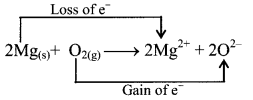
Question 14 Marks
Justify that the following reactions are redox reaction; identify the species oxidized/reduced, which acts as an oxidant and which act as a reductant.
a. $ 2Cu_2O_{(s)} + Cu_2S_{(s)} \rightarrow 6Cu_{(s)} + SO_{2(g)}$
b. $ HF_{(aq)} + OH^–_{(aq)} \rightarrow H_2O_{(l)} + F^–_{(aq)}$
c. $I_{2(aq)} + {2 S_2O_3^{2-}}_{(aq)} \rightarrow {S_4O_6^{2-}}_{(aq)} + 2I^–_{(aq)}$
a. $ 2Cu_2O_{(s)} + Cu_2S_{(s)} \rightarrow 6Cu_{(s)} + SO_{2(g)}$
b. $ HF_{(aq)} + OH^–_{(aq)} \rightarrow H_2O_{(l)} + F^–_{(aq)}$
c. $I_{2(aq)} + {2 S_2O_3^{2-}}_{(aq)} \rightarrow {S_4O_6^{2-}}_{(aq)} + 2I^–_{(aq)}$
Answer
View full question & answer→i. $2Cu_2O_{(s)} + Cu_2S_{(s)} \rightarrow 6Cu_{(s)} + SO_{2(g)}$_{
}
a. Write oxidation number of all the atoms of reactants and products.

b. Identify the species that undergoes change in oxidation number.
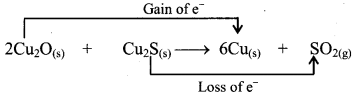
c. The oxidation number of S increases from $-2$ to $+4$ and that of Cu decreases from $+1$ to $0$. Because oxidation number of one species increases and that of the other decreases, the reaction is a redox reaction.
d. The oxidation number of S increases by loss of electrons and therefore, $S$ is a reducing agent and it itself is oxidised. On the other hand, the oxidation number of $Cu$ decreases by gain of electrons and therefore, Cu is an oxidising agent and itself is reduced.
Result:
ii. $HF_{(aq)} + OH^–_{(aq)} \rightarrow H_2O_{(l)} + F^–_{(aq)}$_
a. Write oxidation number of all the atoms of reactants and products.
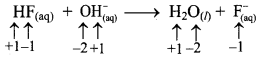
b. Since, the oxidation numbers of all the species remain same, this is NOT a redox reaction. Result:
The given reaction is NOT a redox reaction.
iii. $I_{2(aq)} + {2 S_2O_3^{2-}}_{(aq)} \rightarrow {S_4O_6^{2-}}_{(aq)} + 2I^–_{(aq)}$
a. Write oxidation number of all the atoms of reactants and products.
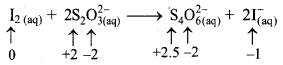
b. Identify the species that undergoes change in oxidation number.
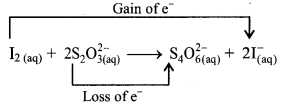
c. The oxidation number of S increases from $+2$ to $+2.5$ and that of I decreases from $0$ to $-1.$ Because oxidation number of one species increases and that of the other decreases, the reaction is a redox reaction.
d. The oxidation number of S increases by loss of electrons and therefore, S is a reducing agent and itself is oxidised. On the other hand, the oxidation number of I decreases by gain of electrons and therefore, I is an oxidising agent and itself is reduced.
Result:
}
a. Write oxidation number of all the atoms of reactants and products.
b. Identify the species that undergoes change in oxidation number.
c. The oxidation number of S increases from $-2$ to $+4$ and that of Cu decreases from $+1$ to $0$. Because oxidation number of one species increases and that of the other decreases, the reaction is a redox reaction.
d. The oxidation number of S increases by loss of electrons and therefore, $S$ is a reducing agent and it itself is oxidised. On the other hand, the oxidation number of $Cu$ decreases by gain of electrons and therefore, Cu is an oxidising agent and itself is reduced.
Result:
- The given reaction is a redox reaction.
- Oxidant/oxidising agents $($Reduced species$): Cu_2O/ Cu_2S$
- Reductant/reducing agent $($Oxidised species$): Cu_2S$
ii. $HF_{(aq)} + OH^–_{(aq)} \rightarrow H_2O_{(l)} + F^–_{(aq)}$_
a. Write oxidation number of all the atoms of reactants and products.
b. Since, the oxidation numbers of all the species remain same, this is NOT a redox reaction. Result:
The given reaction is NOT a redox reaction.
iii. $I_{2(aq)} + {2 S_2O_3^{2-}}_{(aq)} \rightarrow {S_4O_6^{2-}}_{(aq)} + 2I^–_{(aq)}$
a. Write oxidation number of all the atoms of reactants and products.
b. Identify the species that undergoes change in oxidation number.
c. The oxidation number of S increases from $+2$ to $+2.5$ and that of I decreases from $0$ to $-1.$ Because oxidation number of one species increases and that of the other decreases, the reaction is a redox reaction.
d. The oxidation number of S increases by loss of electrons and therefore, S is a reducing agent and itself is oxidised. On the other hand, the oxidation number of I decreases by gain of electrons and therefore, I is an oxidising agent and itself is reduced.
Result:
- The given reaction is a redox reaction.
- Oxidant/oxidising agent (Reduced species):$ I_2$_
- Reductant/reducing agent (Oxidised species):$ S_2O_3^{2-}$