Questions

MCQ

Take a timed test

44 questions · auto-graded multiple-choice test.

MCQ 11 Mark
What does magnetic quantum number describe ?
  • A
    Shape of an orbital
  • B
    Size of an orbital
  • C
    Spin of an electron
  • Orientation of an orbital in the given subshell
Answer
Correct option: D.
Orientation of an orbital in the given subshell
View full question & answer
MCQ 21 Mark
Which of the following is not hydrogen like species?
  • A
    $\mathrm{He}^{+}$
  • B
    $\mathrm{Be}^{3+}$
  • C
    $\mathrm{Li}^{2+}$
  • $\mathrm{He}$
Answer
Correct option: D.
$\mathrm{He}$
View full question & answer
MCQ 31 Mark
Calculate the radius of first orbit of $\mathrm{Be}^{3+}$
  • $13.23 \mathrm{pm}$
  • B
    $52.9 \mathrm{pm}$
  • C
    $17.63 \mathrm{pm}$
  • D
    $26.45 \mathrm{pm}$
Answer
Correct option: A.
$13.23 \mathrm{pm}$
View full question & answer
MCQ 41 Mark
What is the number of nucleons present in an atom having 29 electrons and 34 neutrons in it?
  • A
    34
  • B
    5
  • 63
  • D
    29
Answer
Correct option: C.
63
C
View full question & answer
MCQ 51 Mark

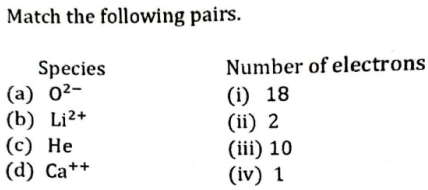
Image
  • A
    (a)-(i),(b)-(ii),(c)-(iv),(d)-(iii)
  • B
    (a)-(ii),(b)-(iii),(c)-(i),(d)-(iv)
  • (a)-(iii),(b)-(iv),(c)-(ii),(d) - (i)
  • D
    (a)-(iv),(b)-(i),(c)-(iii),(d) - (ii)
Answer
Correct option: C.
(a)-(iii),(b)-(iv),(c)-(ii),(d) - (i)
C
View full question & answer
MCQ 61 Mark
What is the energy associated with first orbit of $Li ^{2+}\left( R _{ H }=2.18 \times 10^{-18}\right) ?$
  • $-19.62 \times 10^{-18} \mathrm{~J}$
  • B
    $-34.88 \times 10^{-18} \mathrm{~J} $
  • C
    $-2.18 \times 10^{-18} \mathrm{~J}$
  • D
    $-8.72 \times 10^{-18} \mathrm{~J}$
Answer
Correct option: A.
$-19.62 \times 10^{-18} \mathrm{~J}$
View full question & answer
MCQ 71 Mark
Which among the following statements is TRUE about isotones?
  • A
    These have same chemical properties.
  • B
    These occupy same positions in the modern periodic table.
  • These are nuclides having the same number of neutrons but different number of protons and hence different mass numbers.
  • D
    These have different number of neutrons and same number of protons.
Answer
Correct option: C.
These are nuclides having the same number of neutrons but different number of protons and hence different mass numbers.
C
View full question & answer
MCQ 81 Mark
Principal Quantum number describes
  • A
    shape of orbital
  • size of the orbital
  • C
    spin of electron
  • D
    orientation of in the orbital electron cloud
Answer
Correct option: B.
size of the orbital
View full question & answer
MCQ 91 Mark
“No two electrons in the same atoms can have identical set of four quantum numbers”. This statement is known as
  • Pauli’s exclusion principle
  • B
    Hund’s rule
  • C
    Aufbau rule
  • D
    Heisenberg uncertainty principle
Answer
Correct option: A.
Pauli’s exclusion principle
View full question & answer
MCQ 101 Mark
p-orbitals are ……. in shape.
  • A
    spherical
  • dumb bell
  • C
    double dumb bell
  • D
    diagonal
Answer
Correct option: B.
dumb bell
dumbbell
View full question & answer
MCQ 111 Mark
The value of Plank’s constant is
  • $6.626 \times 10^{-34} Js$
  • B
    $6.023 \times 10^{-24} Js$
  • C
    $1.667 \times 10^{-28} Js$
  • D
    $6.626 \times 10^{-28} Js$
Answer
Correct option: A.
$6.626 \times 10^{-34} Js$
View full question & answer
MCQ 121 Mark
The energy difference between the shells goes on ……….. when moved away from the nucleus.
  • A
    Increasing
  • decreasing
  • C
    equalizing
  • D
    static
Answer
Correct option: B.
decreasing
decreasing
View full question & answer
MCQ 131 Mark
What is the wave number of photon emitted during transition from orbit, $n=4$ to $n=2$ in hydrogen atom $\left[R_{ H }=109677 \ cm ^{-1}\right]$ ?
  • $20564.44 \ cm ^{-1}$
  • B
    $23032.17 \ cm ^{-1}$
  • C
    $15354.78 \ cm ^{-1}$
  • D
    $25225.7 \ cm ^{-1}$
Answer
Correct option: A.
$20564.44 \ cm ^{-1}$
$(a): n_1=2 ; n_2=4, Z=1$
$\overline{ v }=\frac{1}{\lambda}=R Z^2\left(\frac{1}{n_1^2}-\frac{1}{n_2^2}\right)$
$\bar{v}=$ Wave number,
$\lambda=$ Wavelength,
$R=$ Rydberg constant,
$Z=$ Atomic number,
$n_1=$ Lower energy level,
$n_2=$ Higher energy level
$\bar{v}=109677 \times 1^2\left(\frac{1}{2^2}-\frac{1}{4^2}\right)$
$\bar{v}=109677 \times \frac{3}{16}=20564.44 \ cm ^{-1}$
View full question & answer
MCQ 141 Mark
Which from following rule/principle states that "No two electrons in an atom can have the same set of four quantum numbers".
  • Pauli's exclusion principle
  • B
    Hund's rule
  • C
    Aufbau rule
  • D
    Heisenberg uncertainty principle
Answer
Correct option: A.
Pauli's exclusion principle
(a): According to Pauli's exclusion principle, no two electrons in an atom can have the same set of four quantum numbers.
View full question & answer
MCQ 151 Mark
What is the mass in gram of 1 atom of an element if its atomic mass is $10 u$ ?
  • A
    $2.06056 \times 10^{-22} g$
  • $1.66056 \times 10^{-23} g$
  • C
    $1.06056 \times 10^{-24} g$
  • D
    $3.66056 \times 10^{-25} g$
Answer
Correct option: B.
$1.66056 \times 10^{-23} g$
(b): 1 mole of an element contains $6.022 \times 10^{23}$ atoms.
$6.022 \times 10^{23}$ atoms weigh $10 u$ or $10 g$.
$
\text { Mass of } 1 \text { atom }=\frac{10}{6.022 \times 10^{23}}=1.66056 \times 10^{-23} g
$
View full question & answer
MCQ 161 Mark
Calculate the wave number of the photon emitted during transition from the orbit of $n=2$ to $n=1$ in hydrogen atom $\left[R_{ H }=109677 cm ^{-1}\right]$.
  • A
    $27419.3 cm ^{-1}$
  • B
    $109677.0 cm ^{-1}$
  • C
    $12064.5 cm ^{-1}$
  • $82257.8 cm ^{-1}$
Answer
Correct option: D.
$82257.8 cm ^{-1}$
(d) $: \nabla=\frac{1}{\lambda}=R Z^2\left(\frac{1}{n_1^2}-\frac{1}{m_2^2}\right)$
Here, $n_1=1: n_2=2, Z=1$
$\overline{ v }=R \times(1)^2\left(\frac{1}{ t ^2}-\frac{1}{2^2}\right)$
$\overline{ v }=\frac{3 R}{4}=\frac{3 \times 109677}{4}$ or $\overline{ v }=82257.8 cm ^{-1}$
View full question & answer
MCQ 171 Mark
Find the number of unpaired electrons for copper in ground state configuration.
  • 1
  • B
    2
  • C
    3
  • D
    4
Answer
Correct option: A.
1
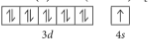
(a) $: Cu (Z=29) \div[A r) 3 d^{10} 4 s^{13}$
\begin{tabular}{|l|l|l|l|l|} \hline 1 & 1 & 1 & 1 & 1 \\ \hline \end{tabular}
34 4s
It has one unpaired electron.Image
View full question & answer
MCQ 181 Mark
Calculate the frequency if wavelength is $750 nm$.
  • A
    $2 \times 10^{14} Hz$
  • $4 \times 10^{14} Hz$
  • C
    $6 \times 10^{15} Hz$
  • D
    $8 \times 10^{15} Hz$
Answer
Correct option: B.
$4 \times 10^{14} Hz$
(b) : $\lambda=750 nm =750 \times 10^{-9} m , v =$ ?
$
u =\frac{c}{\lambda}=\frac{3 \times 10^8 ms ^{-1}}{750 \times 10^{-9} m }=4 \times 10^{14} Hz
$
View full question & answer
MCQ 191 Mark
Calculate radius of third orbit of $He ^*$.
  • A
    $52.9 pm$
  • B
    $105.8 pm$
  • $238.1 pm$
  • D
    $423.2 pm$
Answer
Correct option: C.
$238.1 pm$
(c) $: r_n=\frac{n^2}{Z} \times 0.529 A$
$
r_3=\frac{3^2}{2} \times 0.529 A \Rightarrow r_3=238.1 pm
$
View full question & answer
MCQ 201 Mark
Find the number of orbitals and maximum electrons respectively present in $M$ shell?
  • A
    4,8
  • 9,18
  • C
    16,32
  • D
    1,2
Answer
Correct option: B.
9,18
(b): For $M$ shell, $n=3$
Maximum number of orbitals $=n^2=3^2=9$
Maximum number of electrons $=2 n^2=2 \times 9=18$
View full question & answer
MCQ 211 Mark
What is the energy associated with first orbit of $Li ^{2+}$ $\left(R_H=2.18 \times 10^{-15} J \right)$ ?
  • $-19.62 \times 10^{-18} J$
  • B
    $-34.88 \times 10^{-16}$ )
  • C
    $-2.18 \times 10^{-18}$ )
  • D
    $-8.72 \times 10^{-18} J$
Answer
Correct option: A.
$-19.62 \times 10^{-18} J$
(a): $E_n=-R_H \frac{Z^2}{n^2}=\frac{-2.18 \times 10^{-18} \times Z^2}{n^2}$,
For $Li ^{2+} ; n=1, Z=3$
$
\begin{aligned}
F_n & =\frac{-2.18 \times 10^{-15} \times 3^2}{12} J =-2.18 \times 10^{-18} \times 9 J \\
& =-19,62 \times 10^{-15} J
\end{aligned}
$
View full question & answer
MCQ 221 Mark
Match the following pairs. Species Number of electrons (A) O^(2-) (i) 18 (B) Li^(2+) (ii) 2 (C) He (iii) 10 (D) Ca^(++) (iv) 1
  • A
    (A) - (i), (B) - (ii), (C) - (iv), (D) - (iii)
  • B
    (A) - (ii), (B) - (iii), (C) - (i), (D) - (iv)
  • (A) - (iii), (B) - (iv), (C) - (ii). (D) - (i)
  • D
    (A) - (iv), (B) - (i), (C) - (iii), (D) - (ii)
Answer
Correct option: C.
(A) - (iii), (B) - (iv), (C) - (ii). (D) - (i)
(c) : Number of electrons in $O ^{2-}=8+2=10$
Number of electrons in $Li ^{2+}=3-2=1$
Number of electrons in $He =2$
Number of electrons in $Ca ^{2+}=20-2=18$
View full question & answer
MCQ 231 Mark
The electronic configuration of $Ni^{2+}$ is _________ $($Atomic number of $Ni = 28)$
  • A
    $[Ar] 4s^2 3d^6$
  • B
    $[Ar] 4s^1 3d^8$
  • $[Ar] 3d^8$
  • D
    $[Ar] 4s^2 3d^8$
Answer
Correct option: C.
$[Ar] 3d^8$
$[Ar] 3d^8$
View full question & answer
MCQ 241 Mark
The ground state electronic configuration for chromium atom $(Z = 24)$ is
  • $[Ar] 3d^5 4s^1$
  • B
    $[Ar] 3d^4 4s^2$
  • C
    $[Ar] 3d^8$
  • D
    $[Ar] 4s^1 4p^5$
Answer
Correct option: A.
$[Ar] 3d^5 4s^1$
$[Ar] 3d^5 4s^1$
View full question & answer
MCQ 251 Mark
For the electron present in 1 s orbital of helium atom, the correct set of values of quantum numbers is
  • 1, 0, 0, +1/2
  • B
    1, 1, 0, +1/2
  • C
    1, 1, 1, +1/2
  • D
    2, 0, 0, +1/2
Answer
Correct option: A.
1, 0, 0, +1/2
1, 0, 0, +1/2
View full question & answer
MCQ 261 Mark
For 3d orbital, the values of n and l are ___________ respectively.
  • A
    0, 3
  • 3, 2
  • C
    3, 0
  • D
    3, 3
Answer
Correct option: B.
3, 2
3, 2
View full question & answer
MCQ 271 Mark
The two electrons have the following set of quantum numbers:<br>$\begin{aligned}&\mathrm{P}=3,2,-2,+\frac{1}{2} \\& \mathrm{Q}=3,0,0,+\frac{1}{2}\end{aligned}
$<br>Which of the following statement is TRUE?
  • A
    P and Q have same energy
  • P has greater energy than Q
  • C
    P has lesser energy than Q
  • D
    P and Q represent same electron
Answer
Correct option: B.
P has greater energy than Q
View full question & answer
MCQ 281 Mark
Which of the following pairs of d-orbitals will have electron density along the axis?
  • A
    $d_{x y}, d_{x^2-y^2}$
  • B
    $\mathrm{d}_{\mathrm{z}^2}, \mathrm{~d}_{\mathrm{xz}}$
  • C
    $d_{x z^{\prime}} d_{y z}$
  • $\mathrm{d}_{\mathrm{z}^2}, \mathrm{~d}_{\mathrm{x}^2-\mathrm{y}^2}$
Answer
Correct option: D.
$\mathrm{d}_{\mathrm{z}^2}, \mathrm{~d}_{\mathrm{x}^2-\mathrm{y}^2}$
View full question & answer
MCQ 301 Mark
Which of the following is INCORRECT?
  • A
    A nodal plane has $\psi^2$ very close to zero.
  • The value of $\psi^2$ at any finite distance from the nucleus is always zero.
  • C
    A boundary surface diagram enclosing 100 % probability density cannot be drawn.
  • D
    A boundary surface diagram is a good representation of shape of an orbtial.
Answer
Correct option: B.
The value of $\psi^2$ at any finite distance from the nucleus is always zero.
View full question & answer
MCQ 321 Mark
The number of subshells in a shell is equal to$………...$
  • $n$
  • B
    $n^2$
  • C
    $n – 1$
  • D
    $l + 1$
Answer
Correct option: A.
$n$
$n$
View full question & answer
MCQ 331 Mark
In a multi-electron atom, the energy of the orbital depends on two quantum numbers: _______________
  • A
    n and ms
  • B
    n and ml
  • C
    ml and ms
  • n and l
Answer
Correct option: D.
n and l
n and l
View full question & answer
MCQ 341 Mark
An orbital is designated by ________ quantum numbers while an electron in an atom is designated by __________ quantum numbers.
  • A
    two, three
  • B
    three, two
  • C
    four, two
  • three, four
Answer
Correct option: D.
three, four
three, four
View full question & answer
MCQ 351 Mark
The de Broglie wavelength associated with a particle of mass $10^{-6} \ kg$ moving with a velocity of $10 \ m s^{-1}$ is
  • A
    $6.63 \times 10^{-22} m$
  • $6.63 \times 10^{-29}m$
  • C
    $6.63 \times 10^{-31} m$
  • D
    $6.63 \times 10^{-34} m$
Answer
Correct option: B.
$6.63 \times 10^{-29}m$
View full question & answer
MCQ 361 Mark
Which of the following is a hydrogen$-$like species?
  • A
    $He^{2+}$
  • $Be^{3+}$
  • C
    $Li^+$
  • D
    $H^+$
Answer
Correct option: B.
$Be^{3+}$
$Be^{3+}$
View full question & answer
MCQ 371 Mark
The energy of electron in the $n^{th}$ Bohr orbit of $H-$atom is
  • A
    $-\frac{2.18 \times 10^{-16}}{\mathrm{n}^2} \mathrm{~J}$
  • B
    $-\frac{2.18 \times 10^{-18}}{n} \mathrm{~J}$
  • $-\frac{2.18 \times 10^{-18}}{\mathrm{n}^2} \mathrm{~J}$
  • D
    $-\frac{2.18 \times 10^{-16}}{\mathrm{n}} \mathrm{J}$
Answer
Correct option: C.
$-\frac{2.18 \times 10^{-18}}{\mathrm{n}^2} \mathrm{~J}$
View full question & answer
MCQ 381 Mark
In hydrogen spectrum, the series of lines appearing in ultraviolet region of electromagnetic spectrum are called ………….
  • Lyman series
  • B
    Balmer series
  • C
    Pfund series
  • D
    Brackett series
Answer
Correct option: A.
Lyman series
Lyman series
View full question & answer
MCQ 391 Mark
In the electromagnetic spectrum, the ultraviolet region is around $..........Hz.$
  • A
    $10^6$
  • B
    $10^{10}$
  • $10^{16}$
  • D
    $10^{26}$
Answer
Correct option: C.
$10^{16}$
$10^{16}$
View full question & answer
MCQ 401 Mark
In vacuum, the speed of all types of electromagnetic radiation is equal to
  • A
    $3.0 \times 10^6 \ m s^{-1}$
  • $3.0 \times 10^8 \ m s^{-1}$
  • C
    $3.0 \times 10^{10} \ m s^{-1}$
  • D
    $3.0 \times 10^{12} \ m s^{-1}$
Answer
Correct option: B.
$3.0 \times 10^8 \ m s^{-1}$
View full question & answer
MCQ 411 Mark
The number of electrons, protons and neutrons in $^{31}P^{3-}$ ion is respectively
  • A
    $15, 15, 16$
  • B
    $15, 16, 15$
  • $18, 15, 16$
  • D
    $15, 16, 18$
Answer
Correct option: C.
$18, 15, 16$
$18, 15, 16$
View full question & answer
MCQ 421 Mark
The difference between $U^{235}$ and $U^{238}$ atoms is that $U^{238}$ contains
  • A
    $3$ more protons
  • B
    $3$ more protons and $3$ more electrons
  • C
    $3$ more neutrons and $3$ more electrons
  • $3$ more neutrons
Answer
Correct option: D.
$3$ more neutrons
$3$ more neutrons
View full question & answer
MCQ 431 Mark
The isotopes of an element differ in
  • the number of neutrons in the nucleus
  • B
    the charge on the nucleus
  • C
    the number of extra-nuclear electrons
  • D
    both the nuclear charge and the number of extra-nuclear electrons
Answer
Correct option: A.
the number of neutrons in the nucleus
View full question & answer
MCQ 441 Mark
Which of the following statements about the electron is INCORRECT?
  • A
    It is a negatively charged particle.
  • The mass of electron is equal to the mass of neutron.
  • C
    It is a basic constituent of all atoms.
  • D
    It is a constituent of cathode rays.
Answer
Correct option: B.
The mass of electron is equal to the mass of neutron.
View full question & answer