Questions

Solve the following Question.(1 Marks)

Take a timed test

42 questions · self-marked practice — reveal the answer and mark yourself.

Question 11 Mark
Show that minute-hand of a clock gains 5° 30′ on the hour-hand in one minute.
Answer
Angle made by hour-hand in one minute $=\frac{360^{\circ}}{12 \times 60}=\left(\frac{1}{2}\right)^{\circ}$
Angle made by minute-hand in one minute $=\frac{360^{\circ}}{60}=6^{\circ}$
$\therefore$ Gain by minute-hand on the hour-hand in one minute
$=6^{\circ}-\left(\frac{1}{2}\right)^{\circ}=\left(5 \frac{1}{2}\right)^{\circ}=5^{\circ} 30^{\prime}$
[Note: The question has been modified.]
View full question & answer
Question 21 Mark
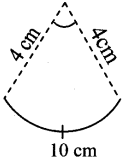
A wire of length 10 cm is bent so as to form an arc of a circle of radius 4 cm. What is the angle subtended at the centre in degrees ?
Answer
$\mathrm{S}=10 \mathrm{~cm} \text { and } \mathrm{r}=4 \mathrm{~cm}$
Since $S=r \theta$,
$10=4 \times \theta$
$\begin{aligned}
\therefore \quad \theta & =\left(\frac{5}{2}\right)^c \\
& =\left(\frac{5}{2} \times \frac{180}{\pi}\right)^{\circ} \\
& =\left(\frac{450}{\pi}\right)^{\circ}
\end{aligned}$
Image
View full question & answer
Question 31 Mark
Find the number of sides of a regular polygon if each of its interior angle is
$
\left(\frac{4 \pi}{5}\right)^c
$
View full question & answer
Question 51 Mark
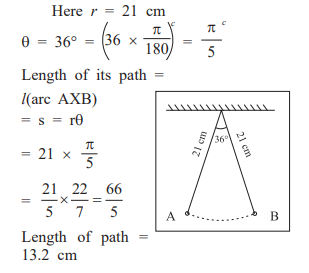
A pendulum of length 21cm oscillates through an angle of 36°. Find the length of its path.
Answer
Solution is as follows:
Image
View full question & answer
Question 61 Mark
The perimeter of a sector is equal to half of the circumference of a circle. Find the measure of the angle of the sector at the centre in radian.
View full question & answer
Question 121 Mark
The diameter of a circle is 14 cm. Find the length of the arc, subtending an angle of 54° at the centre.
View full question & answer
Question 161 Mark
Convert the following angles in degrees : $\left(\frac{-1}{4}\right)^c$
Answer
$\left(-\frac{1}{4}\right)^{ c }=\left(-\frac{1}{4} \times \frac{180}{\pi}\right)^{\circ}=\left(-\frac{45}{\pi}\right)^{\circ}$
View full question & answer
Question 171 Mark
Convert the following angles in degrees : $\frac{11 \pi^c}{18}$
Answer
$\frac{11 \pi^{ c }}{18}=\left(\frac{11 \pi}{18} \times \frac{180}{\pi}\right)^{\circ}=110^{\circ}$
View full question & answer
Question 181 Mark
Convert the following angles in degrees : $5^c$
Answer
$\quad 5^{ c }=\left(5 \times \frac{180}{\pi}\right)^{\circ}=\left(\frac{900}{\pi}\right)^{\circ}$
View full question & answer
Question 191 Mark
Convert the following angles in degrees : $\frac{-5 \pi^c}{3}$
Answer
$\quad-\frac{5 \pi^{ c }}{3}=\left(-\frac{5 \pi}{3} \times \frac{180}{\pi}\right)^{\circ}=-300^{\circ}$
View full question & answer
Question 231 Mark
Convert the following angles into radians $: 65^\circ 30′$
Answer
$65^{\circ} 30^{\circ}=65^{\circ}+30^{\prime}$
$=65^{\circ}+\left(\frac{30}{60}\right)^{\circ} \ldots\left[1^{\prime}=(1 / 60)^{\circ}\right]$
$=65^{\circ}+(1 / 2)^{\circ}$
$=\left(65+\frac{1}{2}\right)^{\circ}$
$=\left(\frac{131}{2}\right)^{\circ}$
$=\left(\frac{131}{2} \times \frac{\pi}{180}\right)^\circ$
$=\left(\frac{131 \pi}{360}\right)^\circ$
View full question & answer
Question 241 Mark
Convert the following angles into radians : -132°
Answer
$132^{\circ}=\left(-132 \times \frac{\pi}{180}\right)^{ c }=\left(-\frac{11 \pi}{15}\right)^{ c }$
[Note: Answer given in the textbook is $\frac{11 \pi}{15}$ However, as per our calculation it is $\left(\frac{-11 \pi}{15}\right)^c$ ]
View full question & answer
Question 251 Mark
Convert the following angles into radians : 250°
Answer
$250^{\circ}=\left(250 \times \frac{\pi}{180}\right)^c=\left(\frac{25 \pi}{18}\right)^c$
View full question & answer
Question 261 Mark
Convert the following angles into radians : 85°
Answer
we know that $=\theta^{\circ}=\left(\theta \times \frac{\pi}{180}\right)^c$
$85^{\circ}=\left(85 \times \frac{\pi}{180}\right)^{ c }=\left(\frac{17 \pi}{36}\right)^{ c }$
View full question & answer
Question 271 Mark
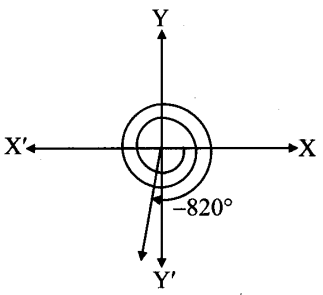
Draw the angles of the following measures and determine their quadrants : – 820°
Answer

Image

From the figure, the given angle terminates in quadrant III.

View full question & answer
Question 281 Mark
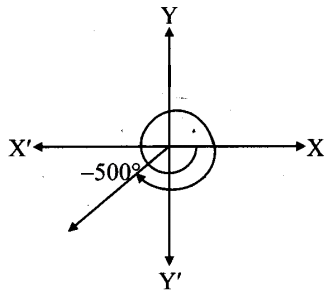
Draw the angles of the following measures and determine their quadrants : – 500°
Answer

Image

From the figure, the given angle terminates in quadrant III. [Note: Answer given in the textbook is ‘Angle lies in quadrant II’. However, we found that it lies in quadrant III.]

View full question & answer
Question 291 Mark
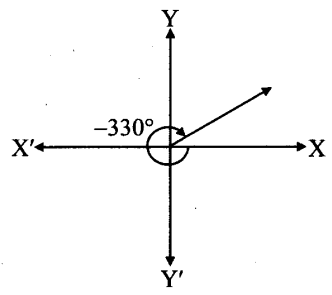
Draw the angles of the following measures and determine their quadrants : – 330°
Answer

Image

From the figure, the given angle terminates in quadrant I.

View full question & answer
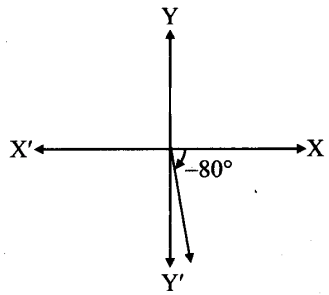
Question 301 Mark
Draw the angles of the following measures and determine their quadrants : – 80°
Answer

Image

From the figure, the given angle terminates in quadrant IV.

View full question & answer
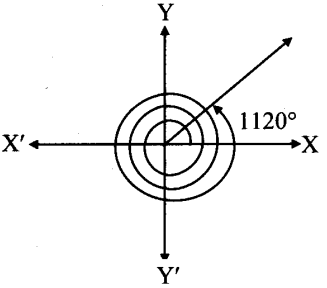
Question 311 Mark
Draw the angles of the following measures and determine their quadrants : 1120°
Answer

Image

From the figure, the given angle terminates in quadrant I.

View full question & answer
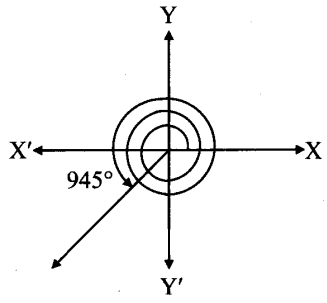
Question 321 Mark
Draw the angles of the following measures and determine their quadrants : 945°
Answer

Image

From the figure, the given angle terminates in quadrant III.

View full question & answer
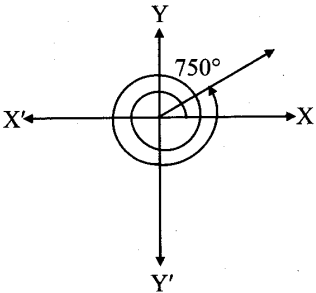
Question 331 Mark
Draw the angles of the following measures and determine their quadrants : 750°
Answer

Image

From the figure, the given angle terminates in quadrant I.

View full question & answer
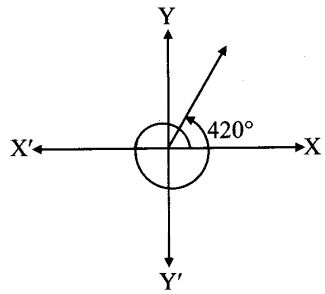
Question 341 Mark
Draw the angles of the following measures and determine their quadrants : 420°
Answer

Image

From the figure, the given angle terminates in quadrant I.

View full question & answer
Question 351 Mark
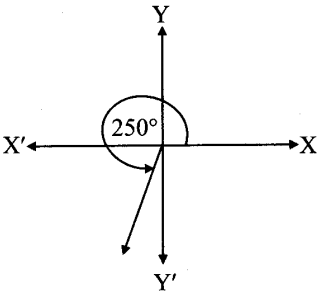
Draw the angles of the following measures and determine their quadrants : 250°
Answer

Image

From the figure, the given angle terminates in quadrant III.

View full question & answer
Question 361 Mark
Draw the angles of the following measures and determine their quadrants : -140°
Answer

Image

From the figure, the given angle terminates in quadrant III.

View full question & answer
Question 371 Mark
Determine which of the following pairs of angles are co-terminal : 900°, -900°
Answer
900°, 900°
900° – (-900°) = 900° + 900°
= 1800°
= 5(360°)
which is a multiple of 360°
∴ The given pair of angles is co-terminal.
View full question & answer
Question 381 Mark
Determine which of the following pairs of angles are co-terminal : 860°, 580°
Answer
860°, 580°
860° – 580° = 280°
which is not a multiple of 360, °.
∴ The given pair of angles is not co-terminal.
View full question & answer
Question 391 Mark
Determine which of the following pairs of angles are co-terminal : -405°, 675°
Answer
– 405°, 675°
675° – (- 405°) = 675° + 405°
= 1080°
= 3(360°),
which is a multiple of 360°.
.’. The given pair of angles is co-terminal.
View full question & answer
Question 401 Mark
Determine which of the following pairs of angles are co-terminal : -180°, 540°
Answer
-180°, 540°
540° -(-180°) = 540°+ 180°
= 720°
= 2(360°),
which is a multiple of 360°.
.’. The given pair of angles is co-terminal.
View full question & answer
Question 411 Mark
Determine which of the following pairs of angles are co-terminal : 360°, -30°
Answer
360°, – 30°
360° – (- 30°) = 360° + 30°
= 390°,
which is not a multiple of 360°.
∴ The given pair of angles is not co-terminal.
View full question & answer
Question 421 Mark
Determine which of the following pairs of angles are co-terminal : 210°, 150°
Answer
210°,- 150°
210°-(- 150°) = 210°+ 150°
= 360°
= 1 (360°),
which is a multiple of 360°.
∴ The given pair of angles is co-terminal.
View full question & answer