Questions

Solve the Following Question.(2 Marks)

🎯

Test yourself on this topic

23 questions · timed · auto-graded

Question 12 Marks
In a circle of diameter $40\ cm,$ the length of a chord is $20\ cm.$ Find the length of minor arc of the chord.
Answer
Image
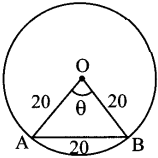
Let ' $O$ ' be the centre of the circle and $A B$ be the chord of the circle.
Here, $d=40 \mathrm{~cm}$
$\therefore r=\frac{40}{2}=20 \mathrm{~cm}$
since $O A=O B=A B$,
$\triangle O A B$ is an equilateral triangle.
The angle subtended at the centre by the minor
$\operatorname{arc} A O B \text { is } \theta=60^{\circ}=\left(60 \times \frac{\pi}{180}\right)^c=\left(\frac{\pi}{3}\right)^c$
$=I(\text { minor arc of chord } A B)=r \theta=20 \times \frac{\pi}{3}$
$=\frac{20 \pi}{3} \mathrm{~cm} $
View full question & answer
Question 22 Marks
The area of a circle is $81$ TH sq.cm. Find the length of the arc subtending an angle of $300^\circ$ at the centre and also the area of corresponding sector.
Answer
Area of circle $=\pi r^2$
But area is given to be $81 \mathrm{n}$ sq.cm
$ \therefore \pi r^2=81 \pi$
$\therefore r 2=81$
$\therefore r=9 \mathrm{~cm}$
$\theta=300^{\circ}=\left(300 \times \frac{\pi}{180}\right)^c=\left(\frac{5 \pi}{3}\right)^{\mathrm{c}}$
$\text { Since } S=r \theta$
$S=9 \times \frac{5 \pi}{3}=15 \pi \mathrm{cm}$
Area of sector $=\frac{1}{2} \times r \times S$
$=\frac{1}{2} \times 9 \times 15 \pi=\frac{135 \pi}{2} \text { sq.cm }$
View full question & answer
Question 32 Marks
Find the radius of the circle in which a central angle of $60^\circ$ intercepts an arc of length $37.4\ cm.$
Answer
Let $S$ be the length of the arc and $r$ be the radius of the circle.
$ \theta=60^{\circ}=\left(60 \times \frac{\pi}{180}\right)^c=\left(\frac{\pi}{3}\right)^c$
$S=37.4 \mathrm{~cm}$
Since $S=r \theta$,
$ 37.4=\mathrm{r} \times \frac{\pi}{3}$
$\therefore \quad 3 \times 37.4=\mathrm{r} \times \frac{22}{7} \quad \ldots\left[\because \pi=\frac{22}{7}\right]$
$\therefore \quad \mathrm{r}=\frac{3 \times 37.4 \times 7}{22}$
$\therefore \quad \mathrm{r}=35.7 \mathrm{~cm}$
View full question & answer
Question 42 Marks
Find the number of sides of a regular polygon, if each of its interior angles is $\frac{3 \pi^c}{4}$.
Answer
Each interior angle of a regular polygon
$
=\frac{3 \pi}{4}=\left(\frac{3 \pi}{4} \times \frac{180}{\pi}\right)^{\circ}=135^{\circ}
$
Interior angle + Exterior angle $=180^{\circ}$
$\therefore$ Exterior angle $=180^{\circ}-135^{\circ}=45^{\circ}$
Let the number of sides of the regular polygon be $n$.
But in a regular polygon, exterior angle $=\frac{360^{\circ}}{\text { no.of sides }}$
$
\begin{aligned}
& \therefore 45^{\circ}=\frac{360^{\circ}}{\mathrm{n}} \\
& \therefore \mathrm{n}=\frac{360^{\circ}}{45^{\circ}}=8
\end{aligned}
$
$\therefore$ Number of sides of a regular polygon $=8$.
View full question & answer
Question 52 Marks
One angle of a quadrilateral is $\frac{2 \pi}{9}$ radian and the measures of the other three angles are in the ratio $3: 5: 8$, find their measures in degree.
View full question & answer
Question 62 Marks
The difference between two acute angles of a right angled triangle is $\frac{7 \pi^c}{30}$. Find the angles of the triangle in degree.
View full question & answer
Question 72 Marks
The area of a circle is 225π sq. cm. Find the length of its arc subtending an angle of 120° at the centre. Also find the area of the corresponding sector.
View full question & answer
Question 82 Marks
The perimeter of a sector of the circle of area $64 7$ i sq.cm is $56\ cm.$ Find the area of the sector.
Answer
Area of circle $=\pi r^2$
But area is given to be $25 \pi$ sq.cm.
$ \therefore 64 \pi=\pi r^2$
$\therefore r^2=64$
$\therefore r=8 \mathrm{~cm} $
Perimeter of sector $=2 r+S$ But perimeter is given to be $20 \mathrm{~cm}$.
$\therefore 56=2(5)+S$
$\therefore 56=16+\mathrm{S}$
$\therefore S=40 \mathrm{~cm}$
Area of sector $=\frac{1}{2} \times r \times 5$
$=\frac{1}{2} \times 8 \times 40$
$=160 \mathrm{sq} \cdot \mathrm{cm} .$
View full question & answer
Question 92 Marks
The perimeter of a sector of the circle of area $25\pi$ sq.cm is $20\ cm.$ Find the area of sector.
Answer
Area of circle $=\pi r^2$
But area is given to be $25 \pi \mathrm{sq} . \mathrm{cm}$.
$ \therefore 25 \pi=\pi r^2$
$\therefore r^2=25$
$\therefore r=5 \mathrm{~cm} $ Perimeter of sector $=2 \mathrm{r}+\mathrm{S}$ But perimeter is given to be $20 \mathrm{~cm}$.
$ \therefore 20=2(5)+S$
$\therefore 20=10+\mathrm{S}$
$\therefore S=10 \mathrm{~cm} $
$ \text { Area of sector }=\frac{1}{2} \times r \times S$
$=\frac{1}{2} \times 5 \times 10$
$=25 \mathrm{sq} . \mathrm{cm} . $
View full question & answer
Question 102 Marks
The area of the circle is 2571 sq.cm. Find the length of its arc subtending an angle of 144° at the centre. Also find the area of the corresponding sector.
Answer
Area of circle $=\pi r^2$
But area is given to be $25 \pi \mathrm{sq} . \mathrm{cm}$
$ \therefore 25 \pi=\pi r^2$
$\therefore r^2=25$
$\therefore r=5 \mathrm{~cm}$
$\theta=144^{\circ}==\left(144 \times \frac{\pi}{180}\right)^c=\left(\frac{4 \pi}{5}\right)^c $
Since $s=r \theta$
$S=5\left(\frac{4 \pi}{5}\right)=4 \pi$
Also, $A$ (sector) $=\frac{1}{2} \times r \times S=\frac{1}{2} \times 5 \times 4 \pi$ $=10 \pi \mathrm{sq} \cdot \mathrm{cm}$
View full question & answer
Question 112 Marks
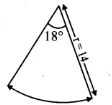
A pendulum of length 14 cm oscillates through an angle of 18°. Find the length of its path.
Answer
$\begin{array}{ll} & \text { Here, } \mathrm{r}=14 \mathrm{~cm} \text { and } \\ & \theta=18^{\circ}=\left(18 \times \frac{\pi}{180}\right)^c=\left(\frac{\pi}{10}\right)^c \\ & \text { Since } \mathrm{S}=\mathrm{r} . \theta, \\ & \mathrm{S}=14 \times \frac{\pi}{10} \\ \therefore \quad & \mathrm{S}=\frac{7 \pi}{5}=\frac{7(3.14)}{5} \quad \ldots[\because \pi=3.14] \\ & =\frac{21.98}{5}=4.4 \mathrm{~cm} \text {. (approx.) }\end{array}$
Image
View full question & answer
Question 122 Marks
Find the angle in degree subtended at the centre of a circle by an arc whose length is 15 cm, if the radius of the circle is 25 cm.
Answer
Here, $r=25 \mathrm{~cm}$ and $S=15 \mathrm{~cm}$
Since $S=r \cdot \theta$,
$15=25 \times \theta$
$\therefore \quad \theta=\left(\frac{15}{25}\right)^c$
$\begin{aligned}
\therefore \quad \theta=\left(\frac{3}{5}\right)^c & =\left(\frac{3}{5} \times \frac{180}{\pi}\right)^{\circ} \\
& =\left(\frac{108}{\pi}\right)^{\circ}=\left(\frac{108}{3.14}\right)^{\circ} \quad \ldots[\because \pi=3.14] \\
& =(34.40)^{\circ} \text { (approx.) }
\end{aligned}$
$\therefore$ The required angle in degree is $\left(\frac{108}{\pi}\right)^0$ or $(34.40)^{\circ}$ (approx.).
View full question & answer
Question 132 Marks
The radius of a circle is 9 cm. Find the length of an arc of this circle which cuts off a chord of length equal to length of radius.
Answer
Here, $r=9 \mathrm{~cm}$
Let the arc $A B$ cut off a chord equal to the radius of the circle.
Since $O A=O B=A B$,
$\triangle \mathrm{OAB}$ is an equilateral triangle.
$ \mathrm{m} \angle \mathrm{AOB}=60^{\circ}$
$\theta=60^{\circ}$
$=\left(60 \times \frac{\pi}{180}\right)^c=\left(\frac{\pi}{3}\right)^c$
$\text { Since } S=r . \theta,$
$S=9 \times \frac{\pi}{3}=3 \pi \mathrm{cm} . $
View full question & answer
Question 142 Marks
Find the length of an arc of a circle which subtends an angle of 108° at the centre, if the radius of the circle is 15 cm.
Answer
Here, $r=15 \mathrm{~cm}$ and
$ \theta=108^{\circ}=\left(108 \times \frac{\pi}{180}\right)^c=\left(\frac{3 \pi}{5}\right)^{\mathrm{c}}$
$\text { Since } S=r \cdot \theta$
$S=15 \times \frac{3 \pi}{5}$
$=9 \pi \mathrm{cm} . $
View full question & answer
Question 152 Marks
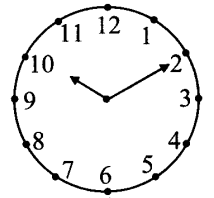
Find the angle between hour-hand and minute-hand in a clock at : 10:10
Answer
At 10:10, the minute-hand is at mark 2 and hour-hand has crossed $(\frac{1}{6})$th between 10 and 11.
Image
Angle between two consecutive marks
$\frac{360^{\circ}}{12}$ = 30°
Angle traced by hour-hand in 10 minutes
= $(\frac{1}{6})$(30°) = 5°
Angle between marks 10 and 2= 4 x 30° = 120°
… Angle between two hands of the clock at 10:10
= 120° – 5°= 115°
View full question & answer
Question 162 Marks
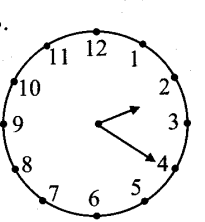
Find the angle between hour-hand and minute-hand in a clock at : 2:20
Answer
At 2 : 20, the minute-hand is at mark 4 hour hand has crossed $(\frac{1}{3})$rd of the angle between 2 and 3.
Image
Angle between two consecutive marks =$\frac{360^{\circ}}{12}$= 30°
Angle traced by hour-hand in 20 minutes
= $(\frac{1}{3})$(30°)= 10°
Angle between marks 2 and 4 = 2 x 30° = 60°
∴ Angle between two hands of the clock at 2 :20 = 60° – 10° = 50°
View full question & answer
Question 172 Marks
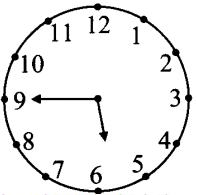
Find the angle between hour-hand and minute-hand in a clock at : quarter to six
Answer
At 5:45, the minute-hand is at mark 9 and hour- hand has crossed $(\frac{3}{4})$th of the angle between 5 and 6.
Image
Angle between two consecutive marks
$=360^{\circ} / 12=30^{\circ}$
Angle traced by hour-hand in 45 minutes
$\frac{3}{4}\left(30^{\circ}\right)=(22.5)^{\circ}=\left(22 \frac{1}{2}\right)^{\circ}$
Angle between marks 5 and 9
$=4 \times 30^{\circ}=120^{\circ}$
$\therefore$ Angle between two hands of the clock at quarter to
$\begin{aligned}
\operatorname{six} & =120^{\circ}-\left(22 \frac{1}{2}\right)^0 \\
& =\left(97 \frac{1}{2}\right)^{\circ} \\
& =97^{\circ}+\frac{1}{2}^{\circ} \\
& =97^{\circ} 30^{\prime}
\end{aligned}$
View full question & answer
Question 182 Marks
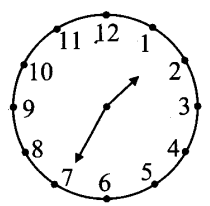
Find the angle between hour-hand and minute-hand in a clock at : thirty five past one
Answer
At $1 : 35$ the minute -hand is at mark $7$ and hour -hand has crossed $(\frac{7}{12})$th of angle between $1$ and $2.$
Image
Angle between two consecutive marks
$=360^{\circ} / 12=30^{\circ}$
Angle traced by hour-hand in 35 minutes
$=\frac{7}{12}\left(30^{\circ}\right)=\left(\frac{35}{2}\right)^{\circ}=\left(17 \frac{1}{2}\right)^{\circ} \frac{1}{3}$
Angle between marks 1 and $7=6 \times 30^{\circ}=180^{\circ}$
Angle between two hands of the clock at thirty five
$ \text { past one }=180^{\circ}-\left(17 \frac{1}{2}\right)^{\circ}=\left(162 \frac{1}{2}\right)^{\circ}$
$=162^{\circ}+\frac{1}{2}=162^{\circ} 30^{\circ} $
View full question & answer
Question 192 Marks
Find the angle between hour-hand and minute-hand in a clock at : twenty past seven
Answer
At 7 : 20 the minute -hand is at mark 4 and hour -hand has crossed $(\frac{1}{3})$rd of angle between 7 and 8.
Image
Angle between two consecutive marks
=$\frac{360^{\circ}}{12}$= 30°
Angle traced by hour-hand in 20 minutes
=$(\frac{1}{3})$(30°) (30°)= 10°
Angle between marks 4 and 7 = 3 x 30° = 90°
Angle between two hands of the clock at twenty past seven = 90° – 10° = 100°.
View full question & answer
Question 202 Marks
Find the angle between hour-hand and minute-hand in a clock at : ten past eleven
Answer
At $11: 10$, the minute-hand is at mark $2$ and hour-hand has crossed $\left(\frac{1}{6}\right)^{\text {th }}$ of the angle between $11$ and $12$ .
Image
Angle between two consecutive marks $=\frac{360^{\circ}}{12}=30^{\circ}$
Angle traced by hour-hand in $10$ minutes
$=\left(\frac{1}{6}\right)\left(30^{\circ}\right)=5^{\circ}$
Angle between marks 11 and $2=3 \times 30^{\circ}=90^{\circ}$
$\therefore$ Angle between two hands of the clock at ten past eleven $=90^{\circ}-5^{\circ}=85^{\circ}$
View full question & answer
Question 212 Marks
Express the following angles in degrees, minutes and seconds : $\left(\frac{1}{5}\right)^c$
Answer
We know that $\theta^c=\left(\theta \times \frac{180}{\pi}\right)^{\circ}$
$\therefore \quad\left(\frac{1}{5}\right)^{ c }=\left(\frac{1}{5} \times \frac{180}{\pi}\right)^{\circ} $
$=\left(\frac{36}{\pi}\right)^{\circ}$
$=\left(\frac{36}{3.14}\right)^{\circ} \quad \ldots[\because \pi=3.14] $
$=(11.46)^{\circ}$
$=11^{\circ}+(0.46)^{\circ} $
$=11^{\circ}+(0.46 \times 60){\prime} $
$=11^{\circ}+(27.6)^{\prime} $
$=11^{\circ}+27^{\prime}+(0.6)^{\prime}$
$=11^{\circ}+27^{\prime}+(0.6 \times 60)^{\prime \prime}$
$=11^{\circ} 27^{\prime}+36^{\prime \prime}$
$=11^{\circ} 27^{\prime} 36^{\prime \prime} \text { (approx.) } $
View full question & answer
Question 222 Marks
Express the following angles in degrees, minutes and seconds : $(245.33)^{\circ}$
Answer
$(245.33)^{\circ}$ $= 245^{\circ} + (0.33)^{\circ}$
$= 245^{\circ} + (0.33 \times 60)’$
$= 245^{\circ} + (19.8)’$
$= 245^{\circ} + 19’+ (0.8)’$
$= 245^{\circ} 19’+ (0.8 \times 60)”$
$= 245^{\circ} 19’+ 48″$
$= 245^{\circ} 19’ 48″$
View full question & answer
Question 232 Marks
Express the following angles in degrees, minutes and seconds : $(183.7)^{\circ}$
Answer
We know that $1^{\circ} = 60′$ and $1′ = 60″$
$= (183.7)^{\circ}$
$= 183^{\circ} +(0.7)^{\circ}$
$= 183^{\circ} + (0.7 \times 60)'$
$= 183^{\circ}+ 42′$
$= 183^{\circ} 42′$
View full question & answer
Solve the Following Question.(2 Marks) - Maths STD 11 Questions - Vidyadip