Questions

Solve the Following Question.(3 Marks)

Take a timed test

16 questions · self-marked practice — reveal the answer and mark yourself.

Question 13 Marks
A train is running on a circular track of radius 1 km at the rate of 36 km per hour. Find the angle to the nearest minute, through which it will turn in 30 seconds.
Answer
$r=1 \mathrm{~km}=1000 \mathrm{~m}$
I(Arc covered by train in 30 seconds)
$ =30 \times \frac{36000}{60 \times 60} \mathrm{~m}$
$\therefore \mathrm{S}=300 \mathrm{~m} $
Since $S=r \theta$
$300=1000 \times \theta$
$ \therefore \quad \theta=\left(\frac{3}{10}\right)^c=\left(\frac{3}{10} \times \frac{180}{\pi}\right)^{\circ}$
$=\left(\frac{54}{\pi}\right)^{\circ}$
$=\left(\frac{54 \times 7}{22}\right)^{\circ} \quad \ldots\left[\because \pi=\frac{22}{7}\right]$
$=(17.18)^{\circ}$
$=17^{\circ}+(0.18)^{\circ}$
$=17^{\circ}+(0.18 \times 60)^{\prime}=17^{\circ}+(10.8)^{\prime}$
$\therefore \theta=17^{\circ} 11^{\prime} \text { (approx.) }$
View full question & answer
Question 23 Marks
If two arcs of the same length in two circles subtend angles 65° and 110° at the centre. Find the ratio of their radii.
Answer
Let r1 and r2 be the radii of the two circles and let their arcs of same
length S subtend angles of 65° and 110° at their centres.
Angle subtended at the centre of the first circle,
$ \theta_1=65^{\circ}=\left(65 \times \frac{\pi}{180}\right)^c=\left(\frac{13 \pi}{36}\right)^c$
$\therefore \quad \mathrm{S}=\mathrm{r}_1 \theta_1=\mathrm{r}_1\left(\frac{13 \pi}{36}\right) \ ....(i)$
Angle subtended at the centre of the second circle,
$ \theta_2=110^{\circ}=\left(110 \times \frac{\pi}{180}\right)^c=\left(\frac{11 \pi}{18}\right)^c$
$\therefore  S=r_2 \theta_2=r_2\left(\frac{11 \pi}{18}\right) \ ....(ii) $
From (i) and (ii), we get
$ \mathbf{r}_1\left(\frac{13 \pi}{36}\right)=\mathrm{r}_2\left(\frac{11 \pi}{18}\right)$
$\therefore  \frac{r_1}{r_2}=\frac{22}{13}$
$\therefore  \mathrm{r}_1: \mathrm{r}_2=22: 13 $
View full question & answer
Question 33 Marks
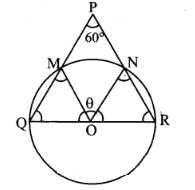
∆PQR is an equilateral triangle with side 18 cm. A circle is drawn on segment QR as diameter. Find the length of the arc of this circle within the triangle.
Answer
Let ‘O’ be the centre of the circle drawn on QR as a diameter.
Let the circle intersect seg PQ and seg PR at points M and N respectively.
Since l(OQ) = l(OM),
m∠OM Q = m∠OQM = 60°
m∠MOQ = 60°
Similarly, m∠NOR = 60°
Given, QR =18 cm.
r = 9 cm
Image

$\theta=60^{\circ}=\left(60 \times \frac{\pi}{180}\right)^c$
$=\left(\frac{\pi}{3}\right)^c$
$\therefore I(\operatorname{arc} M N)=S=r \theta=9 \times \frac{\pi}{3}=3 \pi \mathrm{cm} .$
View full question & answer
Question 43 Marks
The measures of the angles of the triangle are in A. P. The smallest angle is 40. Find the angles of the triangle in degree and in radian.
View full question & answer
Question 53 Marks
In a circle of radius 12 cms, an arc PQ subtends an angle of 30° at the centre. Find the area between the arc PQ and chord PQ.
View full question & answer
Question 63 Marks
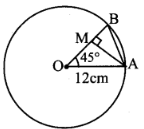
OAB is a sector of the circle having centre at O and radius 12 cm. If m∠AOB = 45°, find the difference between the area of sector OAB and ΔAOB.
Answer
Here, $r=12 \mathrm{~cm}$
$\theta=45^{\circ}=\left(45 \times \frac{\pi}{180}\right)^c=\left(\frac{\pi}{4}\right)^c$
Draw $\mathrm{AM} \perp \mathrm{OB}$
In $\triangle \mathrm{OAM}$,
$\begin{array}{ll}
\therefore \quad & \frac{1}{\sqrt{2}}=\frac{\mathrm{AM}}{12} \\
\therefore \quad & \mathrm{AM}=\frac{12}{\sqrt{2}} \times \frac{\sqrt{2}}{\sqrt{2}}=6 \sqrt{2} \mathrm{~cm} \\
\therefore \quad & \mathrm{A}(\text { sector OAB) }-\mathrm{A}(\triangle \mathrm{AOB}) \\
& =\frac{1}{2} \mathrm{r}^2 \theta-\frac{1}{2} \times \mathrm{OB} \times \mathrm{AM} \\
& =\frac{1}{2} \times(12)^2 \times \frac{\pi}{4}-\frac{1}{2} \times 12 \times 6 \sqrt{2} \\
= & \frac{1}{2} \times 144 \times \frac{\pi}{4}-36 \sqrt{2}=18 \pi-36 \sqrt{2} \\
= & 18(\pi-2 \sqrt{2}) \mathrm{sq} . \mathrm{cm} .
\end{array}$
[Note: The question has been modified.]
Image
View full question & answer
Question 73 Marks
Two arcs of the same length subtend angles of 60° and 75° at the centres of the two circles. What is the ratio of radii of two circles ?
Answer
Let $r_1$, and $r_2$ be the radii of the two circles and let their arcs of same length $S$ subtend angles of $60^{\circ}$ and $75^{\circ}$ at their centres.
Angle subtended at the centre of the first circle,
$ \theta_1=60^{\circ}=\left(60 \times \frac{\pi}{180}\right)^c=\left(\frac{\pi}{3}\right)^c$
$\therefore \mathrm{S}=\mathrm{r}_1 \theta_1=r_1\left(\left(\frac{\pi}{3}\right)\right) $
Angle subtended at the centre of the second circle,
$ \theta_2=75^{\circ}=\left(75 \times \frac{\pi}{180}\right)^{\circ}=\left(\frac{5 \pi}{12}\right)^c$
$\therefore  \mathrm{S}=\mathrm{r}_2 \theta_2=\mathrm{r}_2\left(\frac{5 \pi}{12}\right)$
$ \text { From (i) and (ii), we get }$
$ \mathrm{r}_1\left(\frac{\pi}{3}\right)=\mathrm{r}_2\left(\frac{5 \pi}{12}\right)$
$\therefore  \frac{\mathrm{r}_1}{\mathrm{r}_2}=\frac{15}{12}$
$\therefore  \frac{\mathrm{r}_1}{\mathrm{r}_2}=\frac{5}{4}$
$\therefore  \mathrm{r}_1: \mathrm{r}_2=5: 4 . $
View full question & answer
Question 83 Marks
Find the degree and radian measures of exterior and interior angles of a regular : octagon
Answer
$\text { Number of sides }=8$
$\text { Number of exterior angles }=8$
$\text { Sum of exterior angles }=360^{\circ}$
$\therefore \text { Each exterior angle }=\frac{360^{\circ}}{\text { no. of sides }}$
$=\frac{360^{\circ}}{8}$
$=45^{\circ}$
$=\left(45 \times \frac{\pi}{180}\right)^c$
$=\left(\frac{\pi}{4}\right)^c$
$\therefore \text { nterior angle }+ \text { Exterior angle }=180^{\circ}$
$\therefore \text { Each interior angle }=180^{\circ}-45^{\circ}=135^{\circ}$
$=\left(135 \times \frac{\pi}{180}\right)^c$
$=\left(\frac{3 \pi}{4}\right)^c$
View full question & answer
Question 93 Marks
Find the degree and radian measures of exterior and interior angles of a regular : septagon
Answer
We know that the sum of the measures of the exterior angles of a polygon is $360^{\circ}$. The measures of the interior angles of a regular polygon are equal. Hence, the measures of the exterior anglas of a regular polygon are also equal.
Number of sides $=7$
Number of exterior angles $=7$
$ \therefore \text { Measure of an exterior angle of a regular septagon }=\frac{360^{\circ}}{\text { no. of sides }}$
$=\frac{360^{\circ}}{7}$
$=(51.43)^{\circ}$
$=\left(\frac{360}{7} \times \frac{\pi}{180}\right)^c$
$=\left(\frac{2 \pi}{7}\right)^c $
The sum of the measures of an interior angle and an exterior angle of a regular polygon $=180^{\circ}$.
$\therefore$ Measure of an interior angle of regular septagon $=180^{\circ}-\left(\frac{360}{7}\right)^{\circ}$
$ =\left(\frac{1260-360}{7}\right)^{\circ}$
$=\left(\frac{900}{7}\right)^\circ$
$=(128.57)^{\circ}$
$=\left(\frac{900}{7} \times \frac{\pi}{180}\right)^c$
$=\left(\frac{5 \pi}{7}\right)^c $
View full question & answer
Question 103 Marks
Find the degree and radian measures of exterior and interior angles of a regular : hexagon
Answer
Number of sides $=6$
Number of exterior angles $=6$
Sum of exterior angles $=360^{\circ}$
$ \therefore \text { Each exterior angle }=\frac{360^{\circ}}{\text { no. of sides }}$
$=\frac{360^{\circ}}{6}$
$=60^{\circ}$
$=\left(60 \times \frac{\pi}{180}\right)^c$
$=\left(\frac{\pi}{3}\right)^c $
Interior angle + Exterior angle $=180^{\circ}$
$\therefore$ Each interior angle $=180^{\circ}-60^{\circ}=120^{\circ}$
$ =\left(120 \times \frac{\pi}{180}\right)^c$
$=\left(\frac{2 \pi}{3}\right)^c $
View full question & answer
Question 113 Marks
Find the degree and radian measures of exterior and interior angles of a regular : pentagon
Answer
$\text { Number of sides }=5$
$\text { Number of exterior angles }=5$
$\text { Sum of exterior angles }=360^{\circ}$
$\therefore \text { Each exterior angle }=\frac{360^{\circ}}{\text { no. of sides }}$
$=\frac{360^{\circ}}{5}$
$=72^{\circ}$
$=\left(72 \times \frac{\pi}{180}\right)^c$
$=\left(\frac{2 \pi}{5}\right)^c$
$\therefore \text { Each interior angle }=180^{\circ}-72^{\circ}=108^{\circ}$
$=\left(108 \times \frac{\pi}{180}\right)^c$
$=\left(\frac{3 \pi}{5}\right)^c$
View full question & answer
Question 123 Marks
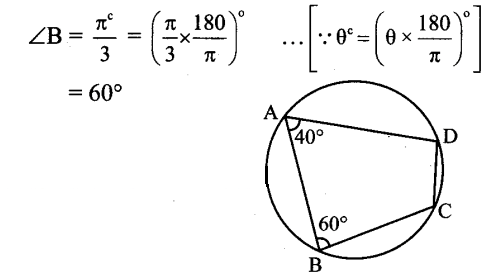
In a cyclic quadrilateral two adjacent angles are 40 and $\frac{π^C}{3}$ Find the angles of the quadralateral in degrees.
Answer
Let ABCD be the cyclic quadrilateral such that
∠A = 40° and
Image
∴ ∠A + ∠C = 180°
∴ 40° + ∠C = 180°
∴ ∠C= 180°- 40°= 140°
Also, ∠B + ∠D = 180°
… [Opposite angles of a cyclic quadrilateral are supplementary]
∴ 60° + ∠D =180°
∴ ∠D = 180°- 60° = 120°
∴ The angles of the quadrilateral in degrees are 40°, 60°, 140° and 120°.
View full question & answer
Question 133 Marks
The measures of the angles of a triangle are in the ratio 3:7:8. Find their measures in degrees and radians.
Answer
The measures of the angles of the triangle are in the ratio 3:7:8.
Let the measures of the angles of the triangle in degrees be 3k, 7k and 8k, where k is a constant.
∴ 3k + 7k + 8k = 180°
… [Sum of the angles of a triangle is 180°]
∴ 18k =180°
∴ k = 10°
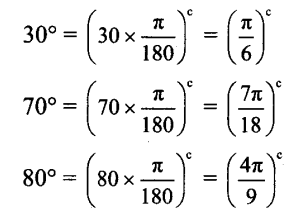
∴ The measures of the angles in degrees are
3k = 3 x 10° = 30°,
7k = 7 x 10° = 70° and
8k = 8 x 10° = 80°.
Image
View full question & answer
Question 143 Marks
The sum of two angles is $5\pi ^c$​​​​​​​ and their difference is $60^\circ $. Find their measures in degrees.
Answer
Let the measures of the two angles in degrees be $x$ and $y$.
Sum of two angles is $5 \pi^c$
$ x+y=5 \pi^c$
$x+y=\left(5 \pi \times \frac{180}{\pi}\right) \ldots\left[\theta^c=\left(\theta \times \frac{180}{\pi}\right)^{\circ}\right]$
$\therefore x+y=900^{\circ} \ldots \ldots \ldots .(\text { i) } $
$\therefore$ Difference of two angles is $60^{\circ}$.
$x-y=60^{\circ} \ldots \text {...(ii) }$
Adding (i) and (ii), we get
$ 2 \mathrm{x}=960^{\circ}$
$\therefore \mathrm{x}=480^{\circ} $
Substituting the value of $x$ in (i), we get
$ 480^{\circ}+\mathrm{y}=900^{\circ}$
$\therefore y=900^{\circ}-480^{\circ}=420^{\circ} $
$\therefore$ The measures of the two angles in degrees are $480^{\circ}$ and $420^{\circ}$.
View full question & answer
Question 153 Marks
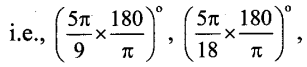
Two angles of a triangle are $\frac{5 \pi}{9}^c$ and $\frac{5 \pi}{18}^c$ Find the degree and radian measures of third angle.
Answer
Let $A B C$ be the triangle such that
$ \mathrm{m} \angle \mathrm{A}=\frac{5 \pi}{9} \text { and } \mathrm{m} \angle \mathrm{B}=\frac{5 \pi}{18}$
$\because \mathrm{m} \angle \mathrm{A}+\mathrm{m} \angle \mathrm{B}+\mathrm{m} \angle \mathrm{C}=180^{\circ}=\pi^{\mathrm{c}}$
$\therefore \frac{5 \pi}{9}+\frac{5 \pi}{18}+\mathrm{m} \angle \mathrm{C}=\pi$
$\therefore \frac{15 \pi}{18}+\mathrm{m} \angle \mathrm{C}=\pi$
$\therefore \mathrm{m} \angle \mathrm{C}=\pi-\frac{15 \pi}{18}=\frac{3 \pi}{18}=\frac{\pi}{6}$
$\text { Now, } 1^{\mathrm{c}}=\left(\frac{180}{\pi}\right)^{\circ}$
$\therefore \frac{\pi}{6}=\left(\frac{\pi}{6} \times \frac{180}{\pi}\right)^{\circ}=30^{\circ} $
Hence, the third angle of the triangle $=30^{\circ}=\left(\frac{\pi}{6}\right)^{\mathrm{c}}$.
View full question & answer
Question 163 Marks
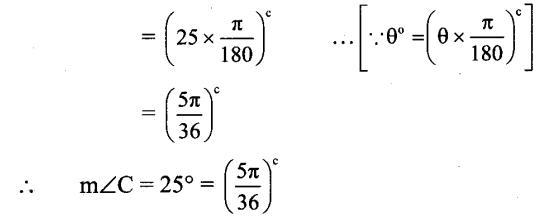
In △ABC, if $\mathrm{m} \angle \mathrm{A}=\frac{7 \pi^c}{36}, \mathrm{~m} \angle \mathrm{B}=120^{\circ}$, find $m \angle C$ in degree and radian.
Answer
We know that $\theta^c=\left(\theta \times\left(\theta \times \frac{180}{\pi}\right)^{\circ}\right)^{\circ}$
$ \text { In } \triangle A B C_r$
$\mathrm{~m} \angle \mathrm{A}=\frac{7 \pi^c}{36}=\left(\frac{7 \pi}{36} \times \frac{180}{\pi}\right)^{\circ}=35^{\circ}$
$\mathrm{m} \angle B=120^{\circ}$
$\therefore \mathrm{m} \angle \mathrm{A}+\mathrm{m} \angle B+\mathrm{m} \angle \mathrm{C}=180^{\circ} $
$\ldots$ [Sum of the angles of a triangle is $180^{\circ}$ ]
$ \therefore 35^{\circ}+120^{\circ}+\mathrm{m} \angle \mathrm{C}=180^{\circ} \mathrm{m} \angle \mathrm{C}=180^{\circ}-35^{\circ}-120^{\circ}$
$\therefore \mathrm{m} \angle \mathrm{C}=25^{\circ} $
Image
Image
View full question & answer