Question 14 Marks
The angles of a quadrilateral are in A.P. and the greatest angle is double the least. Find angles of the quadrilateral in radians.
Answer
View full question & answer→Let the measures of the angles of the quadrilateral in degrees be a $3 d, a-d, a+d, a+3 d$, where $a>d>0$
$\therefore(a-3 d)+(a-d)+(a+d)+(a+3 d)=360^{\circ}$
$\therefore$ [Sum of the angles of a quadrilateral is $360^{\circ}$ ]
$ \therefore 4 \mathrm{a}=360^{\circ}$
$\therefore \mathrm{a}=90^{\circ} $
According to the given condition, the greatest angle is double the least,
$ \therefore \mathrm{a}+3 \mathrm{~d}=2 \cdot(\mathrm{a}-3 \mathrm{~d})$
$\therefore 90^{\circ}+3 \mathrm{~d}=2 \cdot\left(90^{\circ}-3 \mathrm{~d}\right)$
$\therefore 90^{\circ}+3 \mathrm{~d}=180^{\circ}-6 \mathrm{~d} 9 \mathrm{~d}=90^{\circ}$
$\therefore \mathrm{d}=10^{\circ} $
$\therefore$ The measures of the angles in degrees are
$ a-3 d=90^{\circ}-3\left(10^{\circ}\right)=90^{\circ}-30^{\circ}=60^{\circ},$
$a-d=90^{\circ}-10^{\circ}=80^{\circ},$
$a+d=90^{\circ}+10^{\circ}=100^{\circ},$
$a+3 d=90^{\circ}+3\left(10^{\circ}\right)=90^{\circ}+30^{\circ}=120^{\circ} $
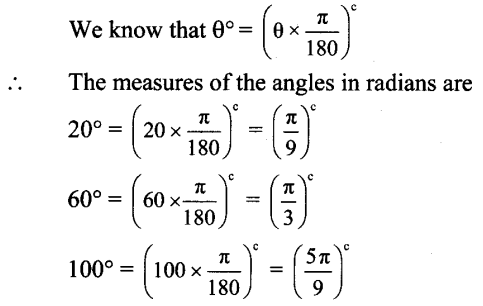
We know that $\theta^{\circ}=\left(\theta \times \frac{\pi}{180}\right)^c$
$\therefore \quad$ The measures of the angles in radians are
$ 60^{\circ}=\left(60 \times \frac{\pi}{180}\right)^c=\left(\frac{\pi}{3}\right)^c$
$80^{\circ}=\left(80 \times \frac{\pi}{180}\right)^c=\left(\frac{4 \pi}{9}\right)^c$
$100^{\circ}=\left(100 \times \frac{\pi}{180}\right)^c=\left(\frac{5 \pi}{9}\right)^c $
$120^{\circ}=\left(120 \times \frac{\pi}{180}\right)^{\circ}=\left(\frac{2 \pi}{3}\right)^{\text {c }}$
$\therefore(a-3 d)+(a-d)+(a+d)+(a+3 d)=360^{\circ}$
$\therefore$ [Sum of the angles of a quadrilateral is $360^{\circ}$ ]
$ \therefore 4 \mathrm{a}=360^{\circ}$
$\therefore \mathrm{a}=90^{\circ} $
According to the given condition, the greatest angle is double the least,
$ \therefore \mathrm{a}+3 \mathrm{~d}=2 \cdot(\mathrm{a}-3 \mathrm{~d})$
$\therefore 90^{\circ}+3 \mathrm{~d}=2 \cdot\left(90^{\circ}-3 \mathrm{~d}\right)$
$\therefore 90^{\circ}+3 \mathrm{~d}=180^{\circ}-6 \mathrm{~d} 9 \mathrm{~d}=90^{\circ}$
$\therefore \mathrm{d}=10^{\circ} $
$\therefore$ The measures of the angles in degrees are
$ a-3 d=90^{\circ}-3\left(10^{\circ}\right)=90^{\circ}-30^{\circ}=60^{\circ},$
$a-d=90^{\circ}-10^{\circ}=80^{\circ},$
$a+d=90^{\circ}+10^{\circ}=100^{\circ},$
$a+3 d=90^{\circ}+3\left(10^{\circ}\right)=90^{\circ}+30^{\circ}=120^{\circ} $
We know that $\theta^{\circ}=\left(\theta \times \frac{\pi}{180}\right)^c$
$\therefore \quad$ The measures of the angles in radians are
$ 60^{\circ}=\left(60 \times \frac{\pi}{180}\right)^c=\left(\frac{\pi}{3}\right)^c$
$80^{\circ}=\left(80 \times \frac{\pi}{180}\right)^c=\left(\frac{4 \pi}{9}\right)^c$
$100^{\circ}=\left(100 \times \frac{\pi}{180}\right)^c=\left(\frac{5 \pi}{9}\right)^c $
$120^{\circ}=\left(120 \times \frac{\pi}{180}\right)^{\circ}=\left(\frac{2 \pi}{3}\right)^{\text {c }}$