MCQ 512 Marks
The equation of the hyperbola whose foci are (-2,0) and (2,0) and eccentricity is 2 is given by
- A
$x^2-3 y^2=3$
- ✓
$3 x^2-y^2=3$
- C
$-x^2+3 y^2=3$
- D
$-3 x^2+y^2=3$
AnswerCorrect option: B. $3 x^2-y^2=3$
(B)
Given, $ae =2, e =2$
$\therefore$ (a=1)
Now, $b ^2= a ^2\left( e ^2-1\right)$
$\begin{array}{l}\Rightarrow b^2=1(4-1) \\\Rightarrow b^2=3\end{array}$
$\therefore$ The equation of hyperbola is
$\begin{array}{l}\frac{x^2}{1}-\frac{y^2}{3}=1 \\\Rightarrow 3 x^2-y^2=3\end{array}$
View full question & answer→MCQ 522 Marks
The equation of the hyperbola whose conjugent axis is 5 and the distance between the foci is 13 , is
- ✓
$25 x^2-144 y^2=900$
- B
$144 x^2-25 y^2=900$
- C
$144 x^2+25 y^2=900$
- D
$25 x^2+144 y^2=900$
AnswerCorrect option: A. $25 x^2-144 y^2=900$
(A)
Conjugate axis is 5 and distance between $foci =13$
$\begin{array}{l}\Rightarrow 2 b=5 \text { and } 2 ae=13 \\\text { Also, } b^2=a^2\left(e^2-1\right) \\\Rightarrow \frac{25}{4}=\frac{(13)^2}{4 e^2}\left(e^2-1\right) \\\Rightarrow \frac{25}{4}=\frac{169}{4}-\frac{169}{4 e^2} \\\Rightarrow e=\frac{13}{12} \\\Rightarrow a=6, b=\frac{5}{2}\end{array}$
Hence, the required equation of hyperbola is
$\frac{x^2}{36}-\frac{y^2}{\frac{25}{4}}=1$
i.e., $25 x^2-144 y^2=900$
View full question & answer→MCQ 532 Marks
If the latus rectum of an hyperbola be 8 and eccentricity be $\frac{3}{\sqrt{5}}$, then the equation of the hyperbola is
- ✓
$4 x^2-5 y^2=100$
- B
$5 x^2-4 y^2=100$
- C
$4 x^2+5 y^2=100$
- D
$5 x^2+4 y^2=100$
AnswerCorrect option: A. $4 x^2-5 y^2=100$
(A)
$\begin{array}{l}\text {Given, } \frac{2 b^2}{a}=8 \text { and } \frac{3}{\sqrt{5}}=\sqrt{1+\frac{b^2}{a^2}} \\\Rightarrow \frac{4}{5}=\frac{b^2}{a^2} \\\Rightarrow a=5, b=2 \sqrt{5}\end{array}$
Hence, the required equation of hyperbola is
$\begin{array}{l}\frac{x^2}{25}-\frac{y^2}{20}=1 \\\text { i.e., } 4 x^2-5 y^2=100\end{array}$
View full question & answer→MCQ 542 Marks
Equation of the hyperbola with eccentricity $\frac{3}{2}$ and foci $( \pm 2,0)$ is
- ✓
$\frac{x^2}{4}-\frac{y^2}{5}=\frac{4}{9}$
- B
$\frac{x^2}{9}-\frac{y^2}{9}=\frac{4}{9}$
- C
$\frac{x^2}{4}-\frac{y^2}{9}=1$
- D
$\frac{x^2}{5}-\frac{y^2}{9}=1$
AnswerCorrect option: A. $\frac{x^2}{4}-\frac{y^2}{5}=\frac{4}{9}$
(A)
$\begin{array}{l}\text {Given that, } e =\frac{3}{2} \\ foci =( \pm 2,0)=( \pm ae , 0) \\ \Rightarrow ae =2 \\ \Rightarrow a =\frac{4}{3} \\ \Rightarrow a ^2=\frac{16}{9}\end{array}$
Now, condition for eccentricity is
$\begin{aligned}b^2 & =a^2\left(e^2-1\right) \\ \therefore b^2 & =\frac{16}{9}\left(\frac{9}{4}-1\right)=\frac{16}{9}\left(\frac{5}{4}\right)=\frac{20}{9}\end{aligned}$
Now, equation of hyperbola is $\frac{x^2}{ a ^2}-\frac{y^2}{b^2}=1$
$\begin{array}{l}\Rightarrow \frac{9 x^2}{16}-\frac{9 y^2}{20}=1 \\\Rightarrow \frac{x^2}{4}-\frac{y^2}{5}=\frac{4}{9}\end{array}$
View full question & answer→MCQ 552 Marks
If the centre, vertex and focus of a hyperbola be (0, 0), (4, 0) and (6, 0) respectively, then the equation of the hyperbola is
- A
$4 x^2-5 y^2=8$
- B
$4 x^2-5 y^2=80$
- ✓
$5 x^2-4 y^2=80$
- D
$5 x^2-4 y^2=8$
AnswerCorrect option: C. $5 x^2-4 y^2=80$
(C)
Centre $(0,0)$, vertex $(4,0) \Rightarrow a =4$ and focus $(6,0)$
$\Rightarrow ae =6$
$\Rightarrow e =\frac{3}{2}$
Also, $b^2 =a^2\left(e^2-1\right)$
$=20$
Hence, required equation is $\frac{x^2}{16}-\frac{y^2}{20}=1$
i.e., $5 x^2-4 y^2=80$
View full question & answer→MCQ 562 Marks
The eccentricity of a hyperbola passing through the points $(3,0),(3 \sqrt{2}, 2)$ will be
- A
$\sqrt{13}$
- ✓
$\frac{\sqrt{13}}{3}$
- C
$\frac{\sqrt{13}}{4}$
- D
$\frac{\sqrt{13}}{2}$
AnswerCorrect option: B. $\frac{\sqrt{13}}{3}$
(B)
Let the equation of hyperbola be $\frac{x^2}{ a ^2}-\frac{y^2}{b^2}=1$
Since hyperbola passes through the points $(3,0),(3 \sqrt{2}, 2)$
$\therefore \quad \frac{9}{a^2}-0=1$ and $\frac{18}{a^2}-\frac{4}{b^2}=1$
$\Rightarrow a^2=9$ and $\frac{4}{b^2}=\frac{18}{a^2}-1$
$\Rightarrow a^2=9$ and $\frac{4}{b^2}=\frac{18}{9}-1$
$\Rightarrow a^2=9$ and $b^2=4$
Now, $e =\sqrt{1+\frac{ b ^2}{ a ^2}}=\sqrt{1+\frac{4}{9}}=\frac{\sqrt{13}}{3}$
View full question & answer→MCQ 572 Marks
The length of the transverse axis of a hyperbola is 7 and it passes through the point $(5,-2)$. The equation of the hyperbola is
- A
$\frac{5}{49} x^2-\frac{196}{51} y^2=1$
- B
$\frac{49}{4} x^2-\frac{51}{196} y^2=1$
- ✓
$\frac{4}{49} x^2-\frac{51}{196} y^2=1$
- D
$\frac{51}{4} x^2-\frac{49}{196} y^2=1$
AnswerCorrect option: C. $\frac{4}{49} x^2-\frac{51}{196} y^2=1$
(C)
$2 a=7 \Rightarrow a=\frac{7}{2}$
Also $(5,-2)$ satisfies $\frac{4}{49}(25)-\frac{51}{196}(4)=1$
and $a^2=\frac{49}{4}$
$\Rightarrow a =\frac{7}{2}$
$\therefore$ option $( C )$ is the correct answer.
View full question & answer→MCQ 582 Marks
The equations of the tangent to the hyperbola $x^2-\frac{y^2}{4}=1$, having slope $=-3$ are
- A
$x+3 y= \pm \sqrt{5}$
- B
$x-3 y= \pm \sqrt{3}$
- ✓
$3 x+y= \pm \sqrt{5}$
- D
$3 x-y= \pm 3$
AnswerCorrect option: C. $3 x+y= \pm \sqrt{5}$
(C)
Equation of the hyperbola is $\frac{x^2}{1}-\frac{y^2}{4}=1$
$a ^2=1$ and $b ^2=4$
slope $m=-3$
Equation of the tangent to the hyperbola is
$y=m x \pm \sqrt{a^2 m^2-b^2}$
$y=-3 x \pm \sqrt{1(9)-4}$
$\therefore 3 x+y= \pm \sqrt{5}$
View full question & answer→MCQ 592 Marks
If the line $y=2 x+\lambda$ be a tangent to the hyperbola $36 x^2-25 y^2=3600$, then $\lambda=$
AnswerCorrect option: C. $\pm 16$
(C)
If $y=2 x+\lambda$ is tangent to given hyperbola, then
$\lambda= \pm \sqrt{a^2 m^2-b^2}$
$= \pm \sqrt{(100)(4)-144}$
$= \pm \sqrt{256}= \pm 16$
View full question & answer→MCQ 602 Marks
The line $l x+ my + n =0$ will be a tangent to the hyperbola $\frac{x^2}{ a ^2}-\frac{y^2}{b^2}=1$, if
- A
$a^2 l^2+b^2 m^2=n^2$
- B
$a^2 l^2-b^2 m^2=n^2$
- ✓
$a m^2-b^2 n^2=a^2 l^2$
- D
AnswerCorrect option: C. $a m^2-b^2 n^2=a^2 l^2$
(C)
Given equation of line is
$\begin{array}{l}l x+m y+n=0 \\\Rightarrow y=\left(\frac{-l}{m}\right) x-\frac{n}{m} \quad\ldots(i)\end{array}$
Since the line $y= m x+ c$ touches the hyperbola
$\frac{x^2}{a^2}-\frac{y^2}{b^2}=1, \text { if } c^2=a^2 m^2-b^2$
$\therefore$ Line (i) will be a tangent to the hyperbola, if
$\begin{array}{l}\left(\frac{- n }{ m }\right)^2= a ^2\left(-\frac{l}{m}\right)^2- b ^2 \\ \Rightarrow n ^2= a ^2 l^2- b ^2 m^2\end{array}$
View full question & answer→MCQ 612 Marks
The point of contact of the tangent $y=x+2$ to the hyperbola $5 x^2-9 y^2=45$ is
- A
$\left(\frac{9}{2}, \frac{5}{2}\right)$
- ✓
$\left(\frac{5}{2}, \frac{9}{2}\right)$
- C
$\left(-\frac{9}{2},-\frac{5}{2}\right)$
- D
$\left(-\frac{5}{2}, \frac{-9}{2}\right)$
AnswerCorrect option: B. $\left(\frac{5}{2}, \frac{9}{2}\right)$
(B)
Hyperbola is $\frac{x^2}{9}-\frac{y^2}{5}=1$ and the line is $y=x+2$.
Here, $a^2=9, b^2=5, m=1, c=2$
$\begin{aligned}\text {Point of contact } & \equiv\left(\frac{-9(1)}{2}, \frac{-5}{2}\right)
\\& \equiv\left(-\frac{9}{2}, \frac{-5}{2}\right)\end{aligned}$
Alternate method:
Substitute $y=x+2$ in $5 x^2-9 y^2=45$ to get
$\begin{array}{l}(2 x+9)^2=0
\\\Rightarrow x=-\frac{9}{2} \Rightarrow y=-\frac{5}{2} .\end{array}$
The point of contact is $\left(-\frac{9}{2},-\frac{5}{2}\right)$
View full question & answer→MCQ 622 Marks
The equation of the tangent to the hyperthy $9 x^2-16 y^2=144$ at $(4 \sec \theta, 3 \tan \theta)$ is
- A
$3 x \sec \theta+y \tan \theta=1$
- B
$x \sec \theta-2 y \tan \theta=1$
- ✓
$3 x \sec \theta-4 y \tan \theta=12$
- D
$3 x \sec \theta-y \tan \theta=4$
AnswerCorrect option: C. $3 x \sec \theta-4 y \tan \theta=12$
(C)
Equation of hyperbola is $9 x^2-16 y^2=144$
$\Rightarrow \frac{x^2}{16}-\frac{y^2}{9}=1$
Equation of tangent to $\frac{x^2}{16}-\frac{y^2}{9}=1$ at
$(4 \sec \theta, 3 \tan \theta)$ is
$\frac{4(\sec \theta) x}{16}-\frac{3(\tan \theta) y}{9}=1$
$\therefore\frac{(\sec \theta) x}{4}-\frac{(\tan \theta) y}{3}=1$
$\therefore 3 x \sec \theta-4 y \tan \theta=12$
View full question & answer→MCQ 632 Marks
The equation of the tangent to the hyperbola $4 y^2=x^2-1$ at the point $(1,0)$ is
Answer(A)
The equation of the tangent to $4 y^2=x^2-1$ at
$\begin{array}{l}(1,0) \text { is } 4(y \times 0)=x \times 1-1
\\\Rightarrow x-1=0 \\\Rightarrow x=1\end{array}$
View full question & answer→MCQ 642 Marks
The auxiliary equation of circle of hyperbola $\frac{x^2}{a^2}-\frac{y^2}{b^2}=1$, is
- ✓
$x^2+y^2=a^2$
- B
$x^2+y^2= b ^2$
- C
$x^2+y^2=a^2+b^2$
- D
$x^2+y^2=a^2-b^2$
AnswerCorrect option: A. $x^2+y^2=a^2$
View full question & answer→MCQ 652 Marks
The equation $x=\frac{ e^t+ e^{-t}}{2}, y=\frac{ e^t- e^{-t}}{2}, t \in R$,represents represents
Answer(C)
$2 x=e^{t}+e^{-t} \text { and } 2 y=e^{t}-e^{-t}$
$\Rightarrow 4 x^2=e^{2 t}+2+e^{-2 t} \quad\ldots(i)$
$\text {and } 4 y^2=e^{2 t}-2+e^{-2 t} \quad\ldots(ii)$
Subtracting (ii) from (i), we get
$4 x^2-4 y^2=4$
$\Rightarrow x^2-y^2=1$
The equation represents hyperbola.
View full question & answer→MCQ 662 Marks
The eccentricity of the hyperbola $5 x^2-4 y^2+20 x+8 y=4$ is
- A
$\sqrt{2}$
- ✓
$\frac{3}{2}$
- C
- D
AnswerCorrect option: B. $\frac{3}{2}$
(B) Given equation of hyperbola is
$\begin{array}{l}5 x^2-4 y^2+20 x+8 y=4 \\\Rightarrow 5\left(x^2+4 x+4\right)-4\left(y^2-2 y+1\right)=4+20-4 \\\Rightarrow 5(x+2)^2-4(y-1)^2=20 \\\Rightarrow \frac{(x+2)^2}{4}-\frac{(y-1)^2}{5}=1 \\
\Rightarrow a^2=4, b^2=5 \\e=\frac{\sqrt{a^2+b^2}}{a}=\frac{\sqrt{4+5}}{2}=\frac{3}{2}\end{array}$
View full question & answer→MCQ 672 Marks
The distance between the directrices of the hyperbola $x=8 \sec \theta, y=8 \tan \theta$ is
- A
$16 \sqrt{2}$
- B
$\sqrt{2}$
- ✓
$8 \sqrt{2}$
- D
$4 \sqrt{2}$
AnswerCorrect option: C. $8 \sqrt{2}$
(C) Equation of the hyperbola
$x=8 \sec \theta, y=8 \tan \theta$
$\Rightarrow \frac{x}{8}=\sec \theta, \frac{y}{8}=\tan \theta$
$\because \sec ^2 \theta-\tan ^2 \theta=1$
$\Rightarrow \frac{x^2}{8^2}-\frac{y^2}{8^2}=1$
Here, $a=8, b=8$
Here, $a = b$
$\therefore $ it is a rectangular hyperbola
Eccentricity of the rectangular hyperbola $=\sqrt{2}$.
$\Rightarrow e=\sqrt{2}$
$\begin{aligned} \therefore \text {Distance between directrices } & =\frac{2 a }{ e } \\ & =\frac{2 \times 8}{\sqrt{2}} \\ & =8 \sqrt{2}\end{aligned}$
View full question & answer→MCQ 682 Marks
A point on the curve $\frac{x^2}{A^2}-\frac{y^2}{B^2}=1$ is
- A
$( A \cos \theta, B \sin \theta)$
- ✓
$( A \sec \theta, B \tan \theta)$
- C
$\left( A \cos ^2 \theta, B \sin ^2 \theta\right)$
- D
AnswerCorrect option: B. $( A \sec \theta, B \tan \theta)$
View full question & answer→MCQ 692 Marks
The directrix of the hyperbola $\frac{x^2}{9}-\frac{y^2}{4}=1$ is
- ✓
$x=\frac{9}{\sqrt{13}}$
- B
$y=\frac{9}{\sqrt{13}}$
- C
$x=\frac{6}{\sqrt{13}}$
- D
$y=\frac{6}{\sqrt{13}}$
AnswerCorrect option: A. $x=\frac{9}{\sqrt{13}}$
(A)
$\frac{x^2}{9}-\frac{y^2}{4}=1$
$\Rightarrow a^2=9, b^2=4$
$e=\frac{\sqrt{a^2+b^2}}{a}=\frac{\sqrt{9+4}}{3}=\frac{\sqrt{13}}{3}$
Directrix of hyperbola is $x= \pm \frac{a}{e}$
$\Rightarrow x= \pm \frac{3}{\frac{\sqrt{13}}{3}} \Rightarrow x= \pm \frac{9}{\sqrt{13}}$
View full question & answer→MCQ 702 Marks
The length of transverse axis of the hyperbola $3 x^2-4 y^2=32$ is
AnswerCorrect option: A. $\frac{8 \sqrt{2}}{\sqrt{3}}$
(A)
The given equation can be written as
$\begin{array}{l}\frac{x^2}{\frac{32}{3}}-\frac{y^2}{8}=1 \\\Rightarrow \frac{x^2}{\left(\frac{4 \sqrt{2}}{\sqrt{3}}\right)^2}-\frac{y^2}{(2 \sqrt{2})^2}=1 \\\Rightarrow a=\frac{4 \sqrt{2}}{\sqrt{3}}\end{array}$
$\therefore$ Length of transverse axis
$=2 a=2 \times \frac{4 \sqrt{2}}{\sqrt{3}}=\frac{8 \sqrt{2}}{\sqrt{3}}$
View full question & answer→MCQ 712 Marks
The length of the latus rectum of the hyperbola $3 x^2-y^2=4$ is
- A
$8 \sqrt{3}$
- ✓
$4 \sqrt{3}$
- C
- D
AnswerCorrect option: B. $4 \sqrt{3}$
(B)
$\text {Length of latus rectum } =\frac{2 b^2}{a}$
$=\frac{2 \times 4}{\frac{2}{\sqrt{3}}}=4 \sqrt{3}$
View full question & answer→MCQ 722 Marks
The latus-rectum of the hyperbola $16 x^2-9 y^2=144$ is
- A
$\frac{16}{3}$
- ✓
$\frac{32}{3}$
- C
$\frac{8}{3}$
- D
$\frac{4}{3}$
AnswerCorrect option: B. $\frac{32}{3}$
(B)
The given equation of hyperbola is
$\begin{array}{l}16 x^2-9 y^2=144 \Rightarrow \frac{x^2}{9}-\frac{y^2}{16}=1 \\\text { L.R. }=\frac{2 b^2}{a}=\frac{2 \times 16}{3}=\frac{32}{3}\end{array}$
View full question & answer→MCQ 732 Marks
The difference of the focal distance of any point on the hyperbola $9 x^2-16 y^2=144$, is
Answer(A)
The hyperbola is $\frac{x^2}{16}-\frac{y^2}{9}=1$
Difference of the focal distances on the hyperbola $=2 a =$ length of transverse axis
Difference of focal distance $=8$
View full question & answer→MCQ 742 Marks
If the length of the transverse and conjugate axes of a hyperbola be 8 and 6 respectively, then the difference of focal distances of any point of the hyperbola will be
Answer(A)
$2 a=8,2 b=6$
Difference of the focal distances on the hyperbola $=2 a =$ length of transverse axis
Difference of focal distances of any point of the hyperbola $=8$
View full question & answer→MCQ 752 Marks
If $(4,0)$ and $(-4,0)$ be the vertices and $(6,0)$ and $(-6,0)$ be the foci of a hyperbola, then its eccentricity is
- A
$\frac{5}{2}$
- B
- ✓
$\frac{3}{2}$
- D
$\sqrt{2}$
AnswerCorrect option: C. $\frac{3}{2}$
(C)
$\text {Vertices }( \pm 4,0) \equiv( \pm a, 0)$
$\Rightarrow a=4$
$\text {Foci }( \pm 6,0) \equiv( \pm a e, 0)$
$\Rightarrow e=\frac{6}{4}=\frac{3}{2}$
View full question & answer→MCQ 762 Marks
Eccentricity of hyperbola $\frac{x^2}{ k }+\frac{y^2}{ k ^2}=1( k <0)$ is
- A
$\sqrt{1+k}$
- B
$\sqrt{1-k}$
- C
$\sqrt{1+\frac{1}{k}}$
- ✓
$\sqrt{1-\frac{1}{k}}$
AnswerCorrect option: D. $\sqrt{1-\frac{1}{k}}$
(D)
$\frac{y^2}{ k ^2}-\frac{x^2}{- k }=1$
$\text { Also }, a ^2= b ^2\left( e ^2-1\right)$
$\Rightarrow- k = k ^2\left( e ^2-1\right)$
$\Rightarrow-\frac{1}{ k }= e ^2-1$
$\Rightarrow e ^2=1-\frac{1}{ k }$
$\Rightarrow e =\sqrt{1-\frac{1}{ k }}$
View full question & answer→MCQ 772 Marks
The eccentricity of the hyperbola $x^2-y^2=25$ is
- ✓
$\sqrt{2}$
- B
$\frac{1}{\sqrt{2}}$
- C
- D
$1+\sqrt{2}$
AnswerCorrect option: A. $\sqrt{2}$
(A)
$\begin{array}{l}\frac{x^2}{25}-\frac{y^2}{25}=1
\\ \text { Eccentricity }=\sqrt{2} \text { as } a = b .\end{array}$
View full question & answer→MCQ 782 Marks
The eccentricity of the hyperbola can never be equal to
- A
$\sqrt{\frac{9}{5}}$
- ✓
$2 \sqrt{\frac{1}{9}}$
- C
$2 \sqrt{\frac{1}{3}}$
- D
AnswerCorrect option: B. $2 \sqrt{\frac{1}{9}}$
(B)
Since e >1 always for hyperbola and $\frac{2}{3} < 1$.
View full question & answer→MCQ 792 Marks
The foci of the hyperbola $9 x^2-16 y^2=144$ are
- A
$( \pm 4,0)$
- B
$(0, \pm 4)$
- ✓
$( \pm 5,0)$
- D
$(0, \pm 5)$
AnswerCorrect option: C. $( \pm 5,0)$
(C)
The equation of hyperbola is
$\begin{array}{l}9 x^2-16 y^2=144 \\\Rightarrow \frac{x^2}{16}-\frac{y^2}{9}=1 \\e=\frac{\sqrt{a^2+b^2}}{a}=\frac{\sqrt{16+9}}{4}=\frac{5}{4}\end{array}$
Hence, foci are $( \pm ae , 0) \equiv\left( \pm 4 \times \frac{5}{4}, 0\right)$
$\equiv( \pm 5,0)$
View full question & answer→MCQ 802 Marks
A tangent to the ellipse $3 x^2+4 y^2=12$ with slope $=\frac{-1}{2}$ intersects X -axis and Y -axis at points A and B . If O is the origin, then the area of triangle OAB is
Answer(B)
$3 x^2+4 y^2=12$
$\Rightarrow \frac{x^2}{4}+\frac{y^2}{3}=1$
$\therefore a^2=4, b^2=3$
Equation of tangent in terms of its slope is
$y=m x+\sqrt{a^2 m^2+b^2}$
Since, $m =\frac{-1}{2}$
$\therefore y=-\frac{1}{2} x+\sqrt{4\left(\frac{-1}{2}\right)^2+3}=-\frac{1}{2} x+2$
A is on X -axis, hence put $y=0$
$0=-\frac{1}{2} x+2 \Rightarrow x=4$
$\therefore A(4,0)$ and $O A=4$
B is on Y -axis, thence put $x=0$
$y=\left(-\frac{1}{2}\right) 0+2=2 $
$B(0,2) \text { and } OB=2$
$A(\Delta OAB)=\frac{1}{2} \times 4 \times 2=4 \text { sq. units }$
View full question & answer→MCQ 812 Marks
The locus of the point of intersection of the perpendicular tangents to the ellipse $\frac{x^2}{9}+\frac{y^2}{4}=1$ is
- A
$x^2+y^2=9$
- B
$x^2+y^2=4$
- ✓
$x^2+y^2=13$
- D
$x^2+y^2=5$
AnswerCorrect option: C. $x^2+y^2=13$
(C)
The locus of point of intersection of two perpendicular tangents drawn on the ellipse is $x^2+y^2= a ^2+ b ^2$ which is called 'director- circle'.
Given ellipse is $\frac{x^2}{9}+\frac{y^2}{4}=1$,
$\therefore$ Locus is $x^2+y^2=13$
View full question & answer→MCQ 822 Marks
The equations of the tangents of the ellipse $9 x^2+16 y^2=144$ which passes through the point (2,3) is
Answer(A)
Equation of the ellipse is
$\frac{x^2}{16}+\frac{y^2}{9}=1$
The equation of the tangent to the ellipse is
$y=m x \pm \sqrt{16 m^2+9} \quad\ldots(i)$
The equation of a line passing through $(2,3)$, having slope $m$ is
$\begin{array}{l}(y-3)=m(x-2) \\y-m x=3-2 m \quad\ldots(ii) \end{array}$
Comparing (i) and (ii),
$\frac{1}{1}=\frac{1}{1}=\frac{\sqrt{16 m^2+9}}{3-2 m}$
$\therefore 16 m^2+9=(3-2 m)^2$
$=9+4 m^2-12 m$
$\therefore 12 m^2= -12 m$
$\Rightarrow m= 0 \text { or } m=-1$
$\therefore$ The tangents are $y=3$ and $x+y=5$
Alternate method :
We know, $\left(x_1^2- a ^2\right) m ^2-2 x_1 y_1 m+\left(y_1^2- b ^2\right)=0$
$\therefore (4-16) m^2-2(2)(3) m+(9-9)=0$
$\therefore m=0 \text { or } m=-1$
$\therefore$ Equations are
$y-3=0 .(x-2), \quad y-3=-1 \cdot(x-2)$
$\therefore y=3, \quad \therefore y-3=-x+2 $
$\quad\quad\quad\quad\therefore x+y=5 .$
View full question & answer→MCQ 832 Marks
The equation of the tangents drawn at the ends of the major axis of the ellipse $9 x^2+5 y^2-30 y=0$, are
- A
$y= \pm 3$
- B
$x= \pm \sqrt{5}$
- ✓
$y=0, y=6$
- D
$x=0, x=6$
AnswerCorrect option: C. $y=0, y=6$
(C)
$\begin{array}{l}9 x^2+5 y^2-30 y=0
\\\Rightarrow 9 x^2+5\left(y^2-6 y\right)=0
\\\Rightarrow 9 x^2+5\left(y^2-6 y+9\right)=45
\\\Rightarrow \frac{x^2}{5}+\frac{(y-3)^2}{9}=1\end{array}$
$\because \quad a^2 < b^2$, so axis of ellipse on $Y$-axis.
At Y - axis, put $x=0$, so we can obtain vertex.
Then $0+5 y^2-30 y=0 \Rightarrow y=0, y=6$
Therefore, tangents of vertex $y=0, y=6$
View full question & answer→MCQ 842 Marks
A man running round a race-course notes that the sum of the distance of two flag-posts from him is always 10 metres and the distance between the flag-posts is 8 metres. The area of the path he encloses in square metres is
- ✓
$15 \pi$
- B
$12 \pi$
- C
$18 \pi$
- D
$8 \pi$
AnswerCorrect option: A. $15 \pi$
(A)
Here, $2 a =10 m$ and $2 ae =8 m$
$\therefore e=\frac{4}{5}, a=5 m$
Now, $b ^2= a ^2\left(1- e ^2\right)=9$
$\Rightarrow b=3$
Thus, required area $=\pi a b=15 \pi$ sq. metre.
View full question & answer→MCQ 852 Marks
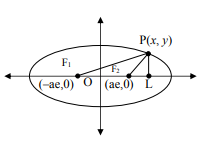
Let $P$ be a variable point on the ellipse $\frac{x^2}{a^2}+\frac{y^2}{b^2}=1$ with foci $F_1$ and $F_2$. If $A$ is the area of the triangle $PF _1 F_2$, then maximum value of A is
- A
- B
- C
$\frac{ e }{ ab }$
- D
$\frac{ ab }{ e }$
View full question & answer→MCQ 862 Marks
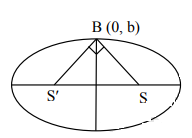
B is an extremity of the minor axis of an ellipse whose foci are S and $S ^{\prime}$. If $\angle SBS ^{\prime}$ is a right angle, then the eccentricity of the ellipse is
- A
$\frac{1}{2}$
- B
$\frac{1}{\sqrt{2}}$
- C
$\frac{2}{3}$
- D
$\frac{1}{3}$
View full question & answer→MCQ 872 Marks
The curve represented by $x=3(\cos t+\sin t)$, $y=4(\cos t-\sin t)$ is
Answer(A)
$x =3(\cos t +\sin t ), y=4(\cos t -\sin t )$
$ \Rightarrow \frac{x}{3}=\cos t +\sin t , \frac{y}{4}=\cos t -\sin t$
$\Rightarrow \frac{x^2}{9}=1+\sin 2 t , \frac{y^2}{16}=1-\sin 2 t $
$\Rightarrow \frac{x^2}{9}+\frac{y^2}{16}=2 $
$\Rightarrow \frac{x^2}{18}+\frac{y^2}{32}=1 \text { which is an ellipse. }$
View full question & answer→MCQ 882 Marks
If the eccentricity of the two ellipse $\frac{x^2}{169}+\frac{y^2}{25}=1$ and $\frac{x^2}{ a ^2}+\frac{y^2}{b^2}=1$ are equal, then the value of $\frac{a}{b}$ is
- A
$\frac{5}{13}$
- B
$\frac{6}{13}$
- ✓
$\frac{13}{5}$
- D
$\frac{13}{6}$
AnswerCorrect option: C. $\frac{13}{5}$
(C)
According to the given condition,
$\sqrt{1-\frac{25}{169}}=\sqrt{1-\frac{b^2}{a^2}}$
$\Rightarrow \frac{144}{169}=1-\frac{b^2}{a^2}$
$\Rightarrow \frac{b^2}{a^2}=\frac{25}{169}$
$\Rightarrow \frac{b}{a}=\frac{5}{13} \quad\ldots[\because a>0, b>0]$
$\Rightarrow \frac{a}{b}=\frac{13}{5}$
View full question & answer→MCQ 892 Marks
The equation $\frac{x^2}{2-r}+\frac{y^2}{r-5}+1=0$ represents an ellipse, if
Answer(B)
$\frac{x^2}{2- r }+\frac{y^2}{ r -5}+1=0$
$\Rightarrow \frac{x^2}{ r -2}+\frac{y^2}{5- r }=1$
$\text {Hence, } r >2 \text { and } r <5$
$\Rightarrow 2< r <5$
View full question & answer→MCQ 902 Marks
The locus of a variable point whose distance from (-2,0) is $\frac{2}{3}$ times its distance from the $\operatorname{linc} x=-\frac{9}{2}$, is
Answer(A)
Let point $P \left(x_1, y_1\right)$
$\begin{array}{l}\therefore \sqrt{\left(x_1+2\right)^2+y_1^2}=\frac{2}{3}\left(x_1+\frac{9}{2}\right)
\\ \Rightarrow\left(x_1+2\right)^2+y_1^2=\frac{4}{9}\left(x_1+\frac{9}{2}\right)^2
\\ \Rightarrow 9\left(x_1^2+y_1^2+4 x_1+4\right)=4\left(x_1^2+\frac{81}{4}+9 x_1\right) \\ \Rightarrow 5 x_1^2+9 y_1^2=45
\\ \Rightarrow \frac{x_1^2}{9}+\frac{y_1^2}{5}=1\end{array}$
∴ Locus of $\left(x_1, y_1\right)$ is $\frac{x^2}{9}+\frac{y^2}{5}=1$, which is equation of an ellipse.
View full question & answer→MCQ 912 Marks
An ellipse is described by using an endless string which is passed over two pins. If the axes are 6 cm and 4 cm , the necessary length of the string and the distance between the pins respectively in cm , are
AnswerCorrect option: D. $6+2 \sqrt{5}, 2 \sqrt{5}$
(D)
Given, $2 a =6,2 b=4$
i.e., $a=3, b=2$
Also, $e ^2=1-\frac{ b ^2}{ a ^2}=\frac{5}{9}$
$\Rightarrow e =\frac{\sqrt{5}}{3}$
∴ Distance between the pins $=2 ae =2 \sqrt{5} cm$
and length of string $=2 a +2 ae =6+2 \sqrt{5} cm$
View full question & answer→MCQ 922 Marks
Eccentricity of the ellipse whose latus rectum is equal to the distance between two focus points, is
- A
$\frac{\sqrt{5}+1}{2}$
- ✓
$\frac{\sqrt{5}-1}{2}$
- C
$\frac{\sqrt{5}}{2}$
- D
$\frac{\sqrt{3}}{2}$
AnswerCorrect option: B. $\frac{\sqrt{5}-1}{2}$
(B)
We have, $\frac{2 b^2}{ a }=2 ae$
$\Rightarrow b ^2= a ^2 e$
$\Rightarrow e=\frac{b^2}{a^2} \quad\ldots(i)$
Also, $e =\sqrt{1-\frac{ b ^2}{ a ^2}}$
$\Rightarrow e ^2=1- e \quad\ldots[From (i)]$
$\Rightarrow e ^2+ e -1=0$
$\therefore e =\frac{-1 \pm \sqrt{5}}{2}$
$\therefore e=\frac{\sqrt{5-1}}{2}$
View full question & answer→MCQ 932 Marks
If the distance between $a$ focus and corresponding directrix of an ellipse be 8 and the eccentricity be $\frac{1}{2}$, then length of the minor axis is
- A
- B
$4 \sqrt{2}$
- C
- ✓
$\frac{16 \sqrt{3}}{3}$
AnswerCorrect option: D. $\frac{16 \sqrt{3}}{3}$
(D)
Given that, $\frac{ a }{ e }- ae =8$ and $e =\frac{1}{2}$
$\begin{array}{l}\Rightarrow a=\frac{8 e}{\left(1-e^2\right)} \\=\frac{8.4}{2(3)}=\frac{16}{3} \\ \therefore b=\frac{16}{3} \sqrt{\left(1-\frac{1}{4}\right)}=\frac{16}{3} \frac{\sqrt{3}}{2}=\frac{8 \sqrt{3}}{3}\end{array}$
Hence, the length of minor axis is $\frac{16 \sqrt{3}}{3}$
View full question & answer→MCQ 942 Marks
The equation of ellipse whose distance between the foci is equal to 8 and distance between the directrix is 18 , is
- A
$5 x^2-9 y^2=180$
- B
$9 x^2+5 y^2=180$
- C
$x^2+9 y^2=180$
- ✓
$5 x^2+9 y^2=180$
AnswerCorrect option: D. $5 x^2+9 y^2=180$
(D)
We have, $2 ae =8, \frac{2 a }{ e }=18$
$\Rightarrow ae \times \frac{a}{e}=4 \times 9$
$\begin{array}{l}\Rightarrow a=\sqrt{4 \times 9}=6 \text { and } e=\frac{2}{3} \\\text { Also, } b=a \sqrt{1-e^2} \\\Rightarrow b=6 \sqrt{1-\frac{4}{9}}=\frac{6}{3} \sqrt{5}=2 \sqrt{5}\end{array}$
Hence, the required equation is $\frac{x^2}{36}+\frac{y^2}{20}=1$
i.e., $5 x^2+9 y^2=180$
View full question & answer→MCQ 952 Marks
The eccentricity of an ellipse, with its centre at the origin, is $\frac{1}{2}$. If one of the directrices is $x=4$, then the equation of the ellipse is
- A
$4 x^2+3 y^2=1$
- ✓
$3 x^2+4 y^2=12$
- C
$4 x^2+3 y^2=12$
- D
$3 x^2+4 y^2=1$
AnswerCorrect option: B. $3 x^2+4 y^2=12$
(B)
Since, directrix is parallel to Y -axis, hence axes of the ellipse are parallel to X -axis. Let the equation of the ellipse be
$\frac{x^2}{ a ^2}+\frac{y^2}{b^2}=1,( a > b )$
Now, $e ^2=1-\frac{ b ^2}{ a ^2}$
$\Rightarrow \frac{ b ^2}{ a ^2}=1- e ^2=1-\frac{1}{4}$
$\Rightarrow \frac{b^2}{a^2}=\frac{3}{4}$
Also, one of the directrices is $x=4$
$\Rightarrow \frac{a}{a}=4 \Rightarrow a=4 e=4 \times \frac{1}{2}=2$
$b^2=\frac{3}{4} a^2=\frac{3}{4} \times 4=3$
$\therefore$ Required equation of ellipse is $\frac{x^2}{4}+\frac{y^2}{3}=1$
$\Rightarrow 3 x^2+4 y^2=12$
View full question & answer→MCQ 962 Marks
The equation of the ellipse whose one of the vertices is (0,7) and the corresponding directrix is y = 12, is
- A
$95 x^2+144 y^2=4655$
- ✓
$144 x^2+95 y^2=4655$
- C
$95 x^2+144 y^2=13680$
- D
$144 x^2+95 y^2=13680$
AnswerCorrect option: B. $144 x^2+95 y^2=4655$
(B)
Vertex $(0,7)$ and directrix $y=12$
$\therefore \quad b =7$ and $\frac{ b }{ e }=12$
$\Rightarrow e =\frac{7}{12}$
Also, $a = b \sqrt{1- e ^2}$
$\Rightarrow a =7 \sqrt{\frac{95}{144}}$
$\Rightarrow a ^2=\frac{4655}{144}$
Hence, equation of ellipse is
$\frac{x^2}{4655 / 144}+\frac{y^2}{49}=1 \text { i.e, } 144 x^2+95 y^2=4655$
View full question & answer→MCQ 972 Marks
The equation of the ellipse whose foci are ( $\pm 5,0$ ) and one of its directrix is 5x = 36 is
- A
$\frac{x^2}{36}+\frac{y^2}{11}=1$
- B
$\frac{x^2}{6}+\frac{y^2}{\sqrt{11}}=1$
- C
$\frac{x^2}{6}+\frac{y^2}{11}=1$
- D
$\frac{x^2}{11}+\frac{y^2}{6}=1$
Answer(A)
Foci $( \pm 5,0) \equiv( \pm ae , 0),$
$\Rightarrow a e=5 \quad\ldots(i)$
Equation of directrix is $(x=\frac{ a }{ e }$)
Given, $x=\frac{36}{5}$
$
\Rightarrow \frac{a}{e}=\frac{36}{5} \quad\ldots(ii)$
$\Rightarrow a =6$ and $e =\frac{5}{6} \quad \ldots [$ From (i) and (ii) $]$
$\therefore b=a \sqrt{1-e^2}=6 \sqrt{1-\frac{25}{36}}=\sqrt{11}$
Hence, equation is $\frac{x^2}{36}+\frac{y^2}{11}=1$
View full question & answer→MCQ 982 Marks
If the centre, one of the foci and semi-major axis of an ellipse be (0 ,0),(0 ,3) and 5 , then its equation
- ✓
$\frac{x^2}{16}+\frac{y^2}{25}=1$
- B
$\frac{x^2}{25}+\frac{y^2}{16}=1$
- C
$\frac{x^2}{9}+\frac{y^2}{25}=1$
- D
$\frac{x^2}{25}+\frac{y^2}{9}=1$
AnswerCorrect option: A. $\frac{x^2}{16}+\frac{y^2}{25}=1$
(A)
Given, centre $(0,0)$, focus $(0,3), b =5$
Focus $(0,3)$
$\Rightarrow be =3$
$\Rightarrow e =\frac{3}{5}$
Also, $a = b \sqrt{1- e ^2}=5 \sqrt{1-\frac{9}{25}}=4$
Hence, the required equation is $\frac{x^2}{16}+\frac{y^2}{25}=1$
View full question & answer→MCQ 992 Marks
The latus rectum of an ellipse is 10 and the minor axis is equal to the distance between the foci. The equation of the ellipse is
- ✓
$x^2+2 y^2=100$
- B
$x^2+\sqrt{2} y^2=10$
- C
$x^2-2 y^2=100$
- D
$\sqrt{2} x^2+y^2-10$
AnswerCorrect option: A. $x^2+2 y^2=100$
(A)
Given, $\frac{2 b^2}{a}=10 \Rightarrow b^2=5 a$ and
$2 b=2 ae \Rightarrow \frac{ b }{ a }= e$
Also, $b^2=a^2\left(1-e^2\right)$
$\Rightarrow e^2=\left(1-e^2\right) \quad \ldots .\left[\because e=\frac{b}{a}\right]$
$\Rightarrow e =\frac{1}{\sqrt{2}}$
$\Rightarrow b =\frac{ a }{\sqrt{2}}$
$\Rightarrow b =5 \sqrt{2}, a =10$
Hence, equation of ellipse is
$\frac{x^2}{(10)^2}+\frac{y^2}{(5 \sqrt{2})^2}=1$
i.e., $x^2+2 y^2=100$
View full question & answer→MCQ 1002 Marks
An ellipse passes through the point (-3,1) and its eccentricity is $\sqrt{\frac{2}{5}}$. The equation of the ellipse is
- ✓
$3 x^2+5 y^2=32$
- B
$3 x^2+5 y^2=25$
- C
$3 x^2+y^2=4$
- D
$3 x^2+y^2=9$
AnswerCorrect option: A. $3 x^2+5 y^2=32$
(A)
Let the equation of ellipse be
$\frac{x^2}{a^2}+\frac{y^2}{b^2}=1$
$\because$ It passes through $(-3,1)$
$\therefore\frac{9}{a^2}+\frac{1}{b^2}=1 $
$\Rightarrow9+\frac{a^2}{b^2}=a^2 \quad\ldots(i)$
Given, eccentricity is $\sqrt{\frac{2}{5}}$
$\therefore\frac{2}{5}=1-\frac{b^2}{a^2}$
$\Rightarrow \frac{b^2}{a^2}=\frac{3}{5} \quad\ldots(ii)$
From equation (i) and (ii), we get
$a^2=\frac{32}{3}, b^2=\frac{32}{5}$
Hence, required equation of ellipse is
$3 x^2+5 y^2=32$
View full question & answer→