Question 13 Marks
Solve using intermediate value theorem:
Show that $x^3-5 x^2+3 x+6=0$ has at least two real root between $x=1$ and $x=5$
AnswerLet $f(x)=x^3-5 x^2+3 x+6$ which is a polynomial function and hence continuous on $[1,5]$
We factorise $f(x)$ by synthetic division:
$ \therefore f(x)=(x-2)\left(x^2-3 x-3\right)$
$\therefore f(1)=(1-2)(1-3-3)=5>0$
$f(2)=(2-2)(4-6-3)=0$
$\therefore x =2 \text { is a root of } f ( x )=0$
$f(3)=(3-2)(9-9-3)=-3<0$
$f(4)=(4-2)(16-12-3)=2>0$
$f$ is continuous on $[3,4]$
$f(3)<0, f(4)>0$
$\therefore$ by intermediate value theorem for continuous function $f(x)=0$ has a root between $3$ and $4$
$\therefore$ there are two roots, $x=2$ and a root between $x=3$ and $x=4$.
$\therefore f(x)=0$ has at least two root between $1$ and $5.$
View full question & answer→Question 23 Marks
Discuss the continuity of the following function at the point or on the interval indicated against them. If the function is discontinuous, identify the type of discontinuity and state whether the discontinuity is removable. If it has a removable discontinuity, redefine the function so that it becomes continuous:
$f(x)=\frac{(x+3)\left(x^2-6 x+8\right)}{x^2-x-12}$
Answer$
\begin{aligned}
& f(x)=\frac{(x+3)\left(x^2-6 x+8\right)}{x^2-x-12} \\
& f(x)=\frac{(x+3)\left(x^2-6 x+8\right)}{(x-4)(x+3)}
\end{aligned}
$
$\therefore \mathrm{f}(\mathrm{x})$ is not defined at for $\mathrm{x}=4$ and $\mathrm{x}=-3$
$\therefore$ The domain of function $f=R-\{-3,4\}$
for $x \neq-3,4$
$
\begin{aligned}
& f(x)=\frac{(x+3)(x-2)(x-4)}{(x-4)(x+3)} \\
& \therefore f(x)=x-2, x \neq-3,4 \\
& \therefore f(-3)=-5 \text { and } f(4)=2
\end{aligned}
$
$f(x)$ is discontinuous $x=4$ and $x=-3$
This discontinuity is removable.
$\therefore \mathrm{f}(\mathrm{x})$ can be redefined as
$f(x)=\frac{(x+3)\left(x^2-6 x+8\right)}{x^2-x-12}$
$=-5$, for $x=-3$
View full question & answer→Question 33 Marks
Identify discontinuity for the following function as either a jump or a removable discontinuity on their respective domain:
$
\begin{aligned}
f(x) & =\frac{x^2+x+1}{x+1}, & & \text { for } x \in[0,3) \\
& =\frac{3 x+4}{x^2-5}, & & \text { for } x \in[3,6]
\end{aligned}
$
AnswerFor $\mathrm{x} \in[0,3), \mathrm{f}(\mathrm{x})=\frac{x^2+x+1}{x+1}$, being a rational function is continuous except when its denominator $x+1=0$ i.e., at $x=-1$, which does not belong to $[0,3)$
$\therefore \mathrm{f}$ is continuous on $[0,3)$.
For $x \in[3,6], \mathrm{f}(\mathrm{x})=\frac{3 x+4}{x^2-5}$, being a rational function is continuous except when its denominator $\mathrm{x}^2$ $-5=0$ i.e., at $x= \pm \sqrt{5}$ But $\pm \sqrt{5} \notin[3,6]$
$\therefore \mathrm{f}$ is continuous on $[0,6]$ except possibly at $\mathrm{x}=3$
Continuity at $x=3$
$
\begin{aligned}
& f(x)=\frac{x^2+x+1}{x+1}, \text { for } x \in[0,3) \\
& \therefore \lim _{x \rightarrow 3-} f(x)=\lim _{x \rightarrow 3} \frac{x^2+x+1}{x+1} \\
& =\frac{\lim _{x \rightarrow 3}\left(x^2+x+1\right)}{\lim _{x \rightarrow 3}(x+1)} \\
& =\frac{9+3+1}{3+1} \\
& =\frac{13}{4}
\end{aligned}
$
Also, $f(x)=\frac{3 x+4}{x^2-5}$, for $x \in[3,6]$
$
\begin{aligned}
& \therefore \lim _{x \rightarrow 3^{+}} \mathrm{f}(x)=\mathrm{f}(3)=\frac{9+4}{9-5}=\frac{13}{4} \\
& \therefore \mathrm{f}(3)=\lim _{x \rightarrow 3^{+}} \mathrm{f}(x)=\lim _{x \rightarrow 3^{-}} \mathrm{f}(x)
\end{aligned}
$
$\therefore \mathrm{f}$ is continuous at $\mathrm{x}=3$.
Hence, $f$ is continuous on its domain $[0,6]$.
View full question & answer→Question 43 Marks
Identify discontinuity for the following function as either a jump or a removable discontinuity on their respective domain:
$
\begin{aligned}
& \mathrm{f}(\mathrm{x})=x^2+5 x+1, \text { for } 0 \leq x \leq 3 \\
& =x^3+x+5, \quad \text { for } 3<x \leq 6 \\
\end{aligned}
$
Answer$\begin{aligned} & \lim _{x \rightarrow 3^{-}} f(x)=\lim _{x \rightarrow 3^{-}}\left(x^2+5 x+1\right) \\ & =\lim _{x \rightarrow 3^{-}}(3)^2+5(3)+1 \\ & =9+15+1 \\ & =25 \\ & \lim _{x \rightarrow 3^{+}} f(x)=\lim _{x \rightarrow 3^{+}}\left(x^3+x+5\right) \\ & =(3)^3+3+5 \\ & =35 \\ & \therefore \lim _{x \rightarrow 3^{-}} f(x) \neq \lim _{x \rightarrow 3^{+}} f(x) \\ & \therefore \lim _{x \rightarrow 3} f(x) \text { does not exist } \\ & \therefore \mathrm{f}(x) \text { is discontinuous at } x=3 \\ & \therefore \mathrm{f}(x) \text { has a jump discontinuity at } x=3\end{aligned}$
View full question & answer→Question 53 Marks
Identify discontinuity for the following function as either a jump or a removable discontinuity on their respective domain:
$
\begin{aligned}
f(x) & =x^2+x-3 & & \text {, for } x \in[-5,-2) \\
& =x^2-5 & & \text {, for } x \in(-2,5]
\end{aligned}
$
Answer$f$ is continuous in $[-5,-2)$ and in $(-2,5]$ since it is a polynomial function.
Continuity at $x=-2$
$f(x)=x^2+x-3$, for $x \in[-5,-2)$
$
\therefore \lim _{x \rightarrow-2} f(x)=\lim _{x \rightarrow-2}\left(x^2+x-3\right)=4-2-3=-1
$
Also, $f(x)=x^2+5$, for $x \in[-2,5)$
$
\begin{aligned}
& \therefore \lim _{x \rightarrow 2^{+}} f(x)=\lim _{x \rightarrow-2}\left(x^2-5\right)=4-5=-1 \\
& \therefore \lim _{x \rightarrow-2^{-}} f(x)=\lim _{x \rightarrow-2^{+}} f(x)=-1 \\
& \therefore \lim _{x \rightarrow 2} f(x)=-1
\end{aligned}
$
But $\mathrm{f}(-2)$ is not defined.
$\therefore \mathrm{f}$ is discontinuous at $\mathrm{x}=-2$
This discontinuity is removable and can be removed by redefining the function as follows:
$
\begin{aligned}
& =x^2+x-3 & & \text { for } x \in[-5,-2) \\
\mathrm{f}(\mathrm{x}) & =x^2-5 & & \text { for } x \in(-2,5] \\
& =-1 & & \text { for } x=-2
\end{aligned}
$
View full question & answer→Question 63 Marks
Discuss the continuity of the following function at the point(s) or on the interval indicated against them:
$\begin{aligned}
& =2 x^2-2 x+5, & & \text { for } 0 \leq x \leq 2 \\
& =\frac{1-3 x-x^2}{1-x}, & & \text { for } 2<x<4 \\
& =\frac{x^2-25}{x-5}, & & \text { for } 4 \leq x \leq 7 \text { and } x \neq 5 \\
& =7, & & \text { for } x=5
\end{aligned}$
AnswerThe domain of $f$ is $[0,7]$
For $0 \leq x \leq 2, f(x)=2 x^2-2 x+5$, being a polynomial function is continuous.
For $2<\mathrm{x}<4, \mathrm{f}(\mathrm{x})=\frac{1-3 x-x^2}{1-x}$, being a rational function is continuous except at the point where its denominator $1-x=0$, i.e., at the point $x=1$ which does not belong to $(2,4)$.
For $4 \leq x \leq 7, x \neq 5, f(x)=\frac{x^2-25}{x-5}$, being a rational function is continuous except at the point where its denominator $x-5=0$, i.e., at the point $x=5$.
Continuity at $x=5$
$
\begin{aligned}
& f(5)=7 \quad \ldots \text { (Given) } \ldots(1) \\
& \lim _{x \rightarrow 5} f(x)=\lim _{x \rightarrow 5} \frac{x^2-25}{x-5} \\
& =\lim _{x \rightarrow 5} \frac{(x-5)(x+5)}{x-5} \\
& =\lim _{x \rightarrow 5}(x+5) \ldots[\because x \rightarrow 5, x \neq 5 \therefore x-5 \neq 0] \\
& =5+5 \\
& =10 \ldots \text { (2) }
\end{aligned}
$
From (1) and (2)
limx-> f(x) = f(5)
z >5
..f is not continuous at x = 5.
Hence, f is continuous on its domain [0, 7] except at the point x = 5, where it is discontinuous.
View full question & answer→Question 73 Marks
For what values of a and b is the function
$f(x) = ax + 2b + 18,$ for $x ≤ 0$
$= x2 + 3a – b,$ for $0 < x ≤ 2 = 8x – 2, for x > 2,$
continuous for every $x$?
Answer$f(x)$ is continuous for every $x$.....(given)
$\therefore f ( x )$ is continuous at $x =0$ and $x =2$.
As $f(x)$ is continuous at $x=0$,
$\lim _{x \rightarrow 0^{-}} f(x)=\lim _{x \rightarrow 0^{-}}+f(x)$
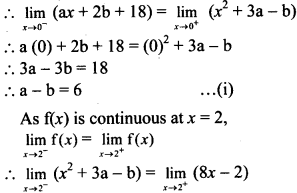
$\therefore(2)^2+3 a-b=8(2)-2$
$\therefore 4+3 a-b=14$
$\therefore 3 a-b=10 \ldots \ldots \text { (ii) }$
Subtracting (i) from (ii), we get
$2 a=4$
$\therefore a=2$
Substituting $a=2$ in (i), we get
$2-b=6$
$\therefore b=-4$
$\therefore a=2 \text { and } b=-4$
View full question & answer→Question 83 Marks
$ \text {If } \mathrm{f}(\mathrm{x})=\frac{\sin 2 x}{5 x}-\mathrm{a}, \text { for } \mathrm{x}>0$
$ =4 \text { for } \mathrm{x}=0$
$=\mathrm{x}^2+\mathrm{b}-3, \text { for } \mathrm{x}<0 $
is continuous at $x=0$, find $a$ and $b$.
Answer$f(x)$ is continuous at $x=0$ (given)
$ \therefore \lim _{x \rightarrow 0^{+}} \mathrm{f}(x)=\mathrm{f}(0)$
$\therefore \lim _{x \rightarrow 0^{+}}\left(\frac{\sin 2 x}{5 x}-\mathrm{a}\right)=4$
$\therefore \lim _{x \rightarrow 0^{+}} \frac{\sin 2 x}{5 x}-\lim _{x \rightarrow 0^{+}} \mathrm{a}=4$
$\therefore \frac{1}{5} \lim _{x \rightarrow 0^{+}} \frac{\sin 2 x}{2 x} \times(2)-\lim _{x \rightarrow 0^{+}} \mathrm{a}=4$
$\therefore \frac{1}{5}(1)(2)-\mathrm{a}=4 \quad[\because x \rightarrow 0,2 x \rightarrow 0$
$\therefore \frac{2}{5}-\mathrm{a}=4 \quad\left[ \text { and } \lim _{\theta \rightarrow 0^{+}} \frac{\sin \theta}{\theta}=1 \right]$
$\therefore \frac{2}{5}-4=\mathrm{a}$
$\therefore \mathrm{a}=-\frac{18}{5}$
$\therefore \lim _{x \rightarrow 0^{-}}\left(x^2+\mathrm{b}-3\right)=4$
$\therefore b-3 =4$
$\therefore b=7$
$\therefore \frac{-18}{5}$ and $b=7$
View full question & answer→Question 93 Marks
If $f(x)=\frac{4^{x-\pi}+4^{\pi-x}-2}{(x-\pi)^2}$ for $x \neq \pi$, is continuous at $x=\pi$, then find $f(\pi)$.
Answer$f(x)$ is continuous at $x=\pi, \ldots$. (given)
$
\begin{aligned}
& \therefore \quad \mathrm{f}(\pi)=\lim _{x \rightarrow \pi} \mathrm{f}(x)=\lim _{x \rightarrow \pi} \frac{4^{x-x}+4^{x-x}-2}{(x-\pi)^2} \\
& \text { Put } x-\pi=\mathrm{h} \\
& \text { As } x \rightarrow \pi, \mathrm{h} \rightarrow 0 \\
& \therefore \quad \mathrm{f}(\pi)=\lim _{\mathrm{h} \rightarrow 0} \frac{4^{\mathrm{h}}+4^{-\mathrm{h}}-2}{\mathrm{~h}^2} \\
&=\lim _{\mathrm{h} \rightarrow 0} \frac{4^{\mathrm{h}}+\frac{1}{4^{\mathrm{h}}}-2}{\mathrm{~h}^2} \\
&=\lim _{\mathrm{h} \rightarrow 0} \frac{\left(4^{\mathrm{h}}\right)^2+1-2\left(4^{\mathrm{h}}\right)}{4^{\mathrm{h}} \cdot\left(\mathrm{h}^2\right)} \\
&=\lim _{\mathrm{h} \rightarrow 0} \frac{\left(4^{\mathrm{h}}-1\right)^2}{4^{\mathrm{h}} \cdot \mathrm{h}^2}\\
& \ldots\left[\because \mathrm{a}^2-2 \mathrm{ab}+\mathrm{b}^2=(\mathrm{a}-\mathrm{b})^2\right]
\end{aligned}
$
$\begin{aligned} & =\lim _{h \rightarrow 0}\left(\frac{4^h-1}{h}\right)^2 \times \frac{1}{4^h} \\ & =\lim _{h \rightarrow 0}\left(\frac{4^h-1}{h}\right)^2 \times \lim _{h \rightarrow 0} \frac{1}{4^b} \\ & =(\log 4)^2 \times \frac{1}{4^0} \quad \cdots\left[\because \lim _{x \rightarrow 0} \frac{a^x-1}{x}=\log a\right] \\ & =\left(\log 2^2\right)^2 \times \frac{1}{1}=(2 \log 2)^2 \\ \therefore \quad f(\pi) & =4(\log 2)^2\end{aligned}$
View full question & answer→Question 103 Marks
If $f(x)=\frac{\cos ^2 x-\sin ^2 x-1}{\sqrt{3 x^2+1}-1}$ for $x \neq 0$, is continuous at $x=0$ then find $f(0)$.
Answer$f(x)$ is continuous at $x=0$, (given)
$\mathrm{f}(0)$
$
\begin{aligned}
& =\lim _{x \rightarrow 0} \mathrm{f}(x) \\
& =\lim _{x \rightarrow 0} \frac{\cos ^2 x-\sin ^2 x-1}{\sqrt{3 x^2+1}-1} \\
& =\lim _{x \rightarrow 0} \frac{\cos 2 x-1}{\sqrt{3 x^2+1}-1} \times \frac{\sqrt{3 x^2+1}+1}{\sqrt{3 x^2+1}+1} \\
& =\lim _{x \rightarrow 0} \frac{-(1-\cos 2 x)\left(\sqrt{3 x^2+1}+1\right)}{\left(3 x^2+1\right)-1} \\
& =\lim _{x \rightarrow 0} \frac{-2 \sin ^2 x \cdot\left(\sqrt{3 x^2+1}+1\right)}{3 x^2} \\
& =\frac{-2}{3} \lim _{x \rightarrow 0} \frac{\sin ^2 x}{x^2}\left(\sqrt{3 x^2+1}+1\right) \\
& =\frac{-2}{3} \lim _{x \rightarrow 0}\left(\frac{\sin x}{x}\right)^2 \times \lim _{x \rightarrow 0}\left(\sqrt{3 x^2+1}+1\right) \\
& =\frac{-2}{3}(1)^2 \times(\sqrt{3(0)+1}+1) \\
& =\frac{-2}{3} \times(1+1)
\end{aligned}
$
$f(0)=\frac{-4}{3}$
View full question & answer→Question 113 Marks
Which of the following functions has a removable discontinuity? $f(x)=\left(\frac{3-8 x}{3-2 x}\right)^{\frac{1}{x}}$, for $x \neq 0$.
Answer$\mathrm{f}(x)=\left(\frac{3-8 x}{3-2 x}\right)^{\frac{1}{x}} ; x \neq 0$
Here, $f(0)$ is not defined.
Consider, $\lim _{x \rightarrow 0} f(x)=\lim _{x \rightarrow 0}\left(\frac{3-8 x}{3-2 x}\right)^{\frac{1}{x}}$
$=\lim _{x \rightarrow 0}\left[\frac{3\left(1-\frac{8 x}{3}\right)}{3\left(1-\frac{2 x}{3}\right)}\right]^{\frac{1}{x}}$
$ =\lim _{x \rightarrow 0} \frac{\left(1-\frac{8 x}{3}\right)^{\frac{1}{x}}}{\left(1-\frac{2 x}{3}\right)^{\frac{1}{x}}}$
$ =\frac{\lim _{x \rightarrow 0}\left[\left(1-\frac{8 x}{3}\right)^{\frac{-3}{8 x}}\right]^{\frac{-8}{3}}}{\left[\left(1-\frac{2 x}{3}\right)^{\frac{-3}{2 x}}\right]^{\frac{-2}{3}}}$
$ =\frac{\mathrm{e}^{\frac{-8}{3}}}{\mathrm{e}^{\frac{-2}{3}}} \cdots [\because x \rightarrow 0, \frac{-8 x}{3} \rightarrow 0, \frac{-2 x}{3} \rightarrow 0$ and $\lim _{x \rightarrow 0}(1+x)^{\frac{1}{x}}=\mathrm{e}]$
$ =\mathrm{e}^{\frac{-6}{3}}=\mathrm{e}^{-2}$
$ \therefore \lim _{x \rightarrow 0} \mathrm{f}(x)$ exists.
But $f(0)$ is not defined.
$ \therefore \mathrm{f}(x)$ has a removable discontinuity at $x=0.$
This discontinuity can be removed by defining
$ f(0)=\mathrm{e}^{-2}$
$ \therefore \mathrm{f}(x)$ can be redefined as
$ f(x)=\left(\frac{3-8 x}{3-2 x}\right)^{\frac{1}{x}} ; x \neq 0$
$ =\mathrm{e}^{-2} ; x=0$
View full question & answer→Question 123 Marks
Discuss the continuity of the following functions at the points indicated against them.$\begin{aligned} f(x) & =\frac{4^x-2^{x+1}+1}{1-\cos 2 x} , \text { for } x \neq 0 \\ &= \frac{(\log 2)^2}{2} , \text { for } x=0, \text { at } x=0 .\end{aligned}$
Answer$f (0)=\frac{(\log 2)^2}{2}......($given$)$
$\lim _{x \rightarrow 0} f(x)=\lim _{x \rightarrow 0} \frac{4^x-2^{x+1}+1}{1-\cos 2 x}$
$=\lim _{x \rightarrow 0} \frac{\left(2^2\right)^x-2^x \cdot 2^1+1}{2 \sin ^2 x}$
$=\lim _{x \rightarrow 0} \frac{\left(2^x\right)^2-2\left(2^x\right)+1}{2 \sin ^2 x}$
$=\lim _{x \rightarrow 0} \frac{\left(2^x-1\right)^2}{2 \sin ^2 x}$
$\left. a^2-2 a b+b^2=(a-b)^2\right]$
$=\lim _{x \rightarrow 0} \frac{\frac{\left(2^x-1\right)^2}{x^2}}{\frac{2 \sin ^2 x}{x^2}}$
$\cdots\left[\begin{array}{l}\because x \rightarrow 0, x \neq 0, \\ \therefore x^2 \neq 0\end{array}\right] $
$=\frac{\lim _{x \rightarrow 0}\left(\frac{2^x-1}{x}\right)^2}{2 \lim _{x \rightarrow 0}\left(\frac{\sin x}{x}\right)^2}$
$=\frac{(\log 2)^2}{2(1)^2}$
$=\frac{(\log 2)^2}{2}$
$\therefore \lim _{x \rightarrow 0} f (x)= f (0)$
$\therefore f (x)$ is continuous at $x=0 \text {. }$
View full question & answer→Question 133 Marks
Discuss the continuity of the following functions at the points indicated against them.$\begin{aligned} f(x) & =\frac{e^{1 / x}-1}{e^{1 / x}+1} \quad, \quad \text { for } x \neq 0 \\ & =1 \quad \quad \quad \quad, \quad \text { for } X=0 \text {, at } X=0 .\end{aligned}$
Answer$f (0)=1($given$)$
$\lim _{x \rightarrow 0^{-}} f (x) =\lim _{h \rightarrow 0} \frac{ e ^{\frac{1}{(0-h)}}-1}{ e ^{\frac{1}{(0-h)}}+1}$
$ =\lim _{h \rightarrow 0} \frac{ e ^{\frac{-1}{h}}-1}{ e ^{\frac{-1}{b}}+1}$
$ =\lim _{h \rightarrow 0} \frac{\frac{1}{\frac{1}{h}}-1}{\frac{1}{\frac{1}{h}}+1}$
$ =\frac{0-1}{0+1}$
$ =-1$
$\lim _{x \rightarrow 0^{+}} f(x)=\lim _{h \rightarrow 0} \frac{e^{\frac{1}{(0+h)}}-1}{e^{\frac{1}{0+h}}+1}$
$=\lim _{h \rightarrow 0} \frac{e^{\frac{1}{h}}-1}{e^{\frac{1}{h}}+1}$
$=\lim _{h \rightarrow 0} \frac{e^{\frac{1}{h}}\left(1-\frac{1}{e^{\frac{1}{h}}}\right)}{e^{\frac{1}{b}}\left(1+\frac{1}{\frac{1}{\frac{1}{h}}}\right)}$
$=\frac{1-0}{1+0}$
$=1$
$\therefore \lim _{x \rightarrow 0^{-}} f (x) \neq \lim _{x \rightarrow 0^{+}} f (x)$
$\therefore f (x)$ is discontinuous at $x=0$.
View full question & answer→Question 143 Marks
Show that the following functions have a continuous extension to the point where $f(x)$ is not defined. Also, find the extension:$f(x)=\frac{x^2-1}{x^3+1}$, for $x \neq-1$
Answer$f(x)=\frac{x^2-1}{x^3+1} \text {, for } x \neq-1$
Here, $f(-1)$ is not defined.
Consider,
$\lim _{x \rightarrow-1} f(x)=\lim _{x \rightarrow-1}\left(\frac{x^2-1}{x^3+1}\right)$
$=\lim _{x \rightarrow-1} \frac{(x+1)(x-1)}{(x+1)\left(x^2-x+1\right)}$
$=\lim _{x \rightarrow-1} \frac{x-1}{x^2-x+1} \cdots\left[\begin{array}{l} \because x \rightarrow-1, x \neq-1 \\
\therefore x+1 \neq 0\end{array}\right]$
$=\frac{-1-1}{(-1)^2-(-1)+1}=-\frac{2}{3}$
$=\lim _{x \rightarrow-1} \frac{x-1}{x^2-x+1} \cdots\left[\begin{array}{l} \because x \rightarrow-1, x \neq-1 \\ \therefore x+1 \neq 0\end{array}\right]$
$=\frac{-1-1}{(-1)^2-(-1)+1}=-\frac{2}{3}$
But $f(-1)$ is not defined.
$\therefore f ( x )$ has a removable discontinuity at $x =-1$.
$\therefore$ The extension of the original function is
$f(x)=\frac{x^2-1}{x^3+1}, x \neq-1$
$=-\frac{2}{3}, x=-1$
$\therefore f(x)$ is continuous at $x=-\frac{2}{3}$
$\therefore f ( x )$ is continuous at $x =-\frac{2}{3}$
View full question & answer→Question 153 Marks
Show that the following functions have a continuous extension to the point where $f(x)$ is not defined. Also, find the extension:$f(x)=\frac{3 \sin ^2 x+2 \cos x(1-\cos 2 x)}{2\left(1-\cos ^2 x\right)}$, for $x \neq 0$.
Answer$f(x)=\frac{3 \sin ^2 x+2 \cos x(1-\cos 2 x)}{2\left(1-\cos ^2 x\right)}, \text { for } x \neq 0$
Here, $f(0)$ is not defined.
Consider,
$\lim _{x \rightarrow 0} f(x)=\lim _{x \rightarrow 0} \frac{3 \sin ^2 x+2 \cos x(1-\cos 2 x)}{2\left(1-\cos ^2 x\right)}$
$=\lim _{x \rightarrow 0} \frac{3 \sin ^2 x+2 \cos x \cdot\left(2 \sin ^2 x\right)}{2 \sin ^2 x}$
$=\lim _{x \rightarrow 0} \frac{\sin ^2 x(3+4 \cos x)}{2 \sin ^2 x}$
$=\lim _{x \rightarrow 0} \frac{3+4 \cos x}{2}$
$\cdots\left[\begin{array}{l}
\because x \rightarrow 0, x \neq 0, \sin x \neq 0 \\
\therefore \sin ^2 x \neq 0
\end{array}\right] \\
=\frac{1}{2} \lim _{x \rightarrow 0}(3+4 \cos x)=\frac{1}{3}(3+4 \cos 0)$
$=\frac{1}{2}(3+4)=\frac{7}{2}$
$\lim _{x \rightarrow 0} f(x) \text { exists. }$
But $f (0)$ is not defined.
$\therefore f ( x )$ has a removable discontinuity at $x =0$.
$\therefore$ The extension of the original function is
$f(x)=\frac{3 \sin ^2 x+2 \cos x(1-\cos 2 x)}{2\left(1-\cos ^2 x\right)}, x \neq 0$
$=\frac{7}{2}, x=0$
$\therefore f(x)$ is continuous at $x=0$
$\therefore f ( x )$ is continuous at $x =0$.
View full question & answer→Question 163 Marks
Show that the following functions have a continuous extension to the point where $f(x)$ is not defined. Also, find the extension:$f ( x )=\frac{1-\cos 2 x}{\sin x}$, for $x \neq 0$.
Answer$f(x)=\frac{1-\cos 2 x}{\sin x} \text {, for } x \neq 0$
Here, $f(0)$ is not defined.
Consider,
$\lim _{x \rightarrow 0} f(x) =\lim _{x \rightarrow 0} \frac{1-\cos 2 x}{\sin x}$
$ =\lim _{x \rightarrow 0} \frac{2 \sin ^2 x}{\sin x}$
$=2 \lim _{x \rightarrow 0}(\sin x) \quad \ldots\left[\begin{array}{l} \because x \rightarrow 0, x \neq 0 \\ \therefore \sin x \neq 0 \end{array}\right]$
$=2(\sin 0)=2 \times 0$
$ =0$
$\lim _{x \rightarrow 0} f(x)$ exists.
But $f(0)$ is not defined.
$\therefore f ( x )$ has a removable discontinuity at $x =0$.
$\therefore$ The extension of the original function is
$f(x)=\frac{1-\cos 2 x}{\sin x}$ for $x \neq 0$
$=0$ for $x=0$
$\therefore f ( x )$ is continuous at $x =0$.
View full question & answer→Question 173 Marks
Test the continuity of the following functions at the points or intervals indicated against them :
$f(x)=\frac{x^2+8 x-20}{2 x^2-9 x+10} \quad$ for $0$
$=12, \text { for } x=2$
$=\frac{2-2 x-x^2}{x-4} \quad \text { for } 3 \leq x<4$
at $x=2$
View full question & answer→Question 183 Marks
Test the continuity of the following functions at the points or intervals indicated against them :
$f(x)=\frac{(27-2 x)^{\frac{1}{3}}-3}{9-3(243+5 x)^{\frac{1}{5}}}$, for $x \neq 0$
$=2 \quad \text { for } x=0, \text { at } x=0$
Answer$f(0)=2......($ given$)$
$\lim _{x \rightarrow 0} f(x)=\lim _{x \rightarrow 0} \frac{(27-2 x)^{\frac{1}{3}}-3}{9-3(243+5 x)^{\frac{1}{3}}}$
$=\lim _{x \rightarrow 0} \frac{(27-2 x)^{\frac{1}{3}}-3}{-3\left[(243+5 x)^{\frac{1}{3}}-3 .\right]}$
$=\frac{-1}{3} \lim _{x \rightarrow 0} \frac{(27-2 x)^{\frac{1}{3}}-(27)^{\frac{1}{3}}}{(243+5 x)^{\frac{1}{3}}-(243)^{\frac{1}{3}}}$
$=\frac{-1}{3} \lim _{x \rightarrow 0} \frac{\frac{(27-2 x)^{\frac{1}{3}}-27^{\frac{1}{3}}}{(27-2 x)-27} \times[(27-2 x)-27]}{\frac{(243+5 x)^{\frac{1}{3}}-(243)^{\frac{1}{3}}}{(243+5 x)-243} \times[(243+5 x)-243]} .$
$\cdots\left[\begin{array}{l}
\because x \rightarrow 0,-2 x \rightarrow 0 \text { and } 5 x \rightarrow 0 \\
\therefore(27-2 x)-27 \rightarrow 0 \text { and }(243+5 x)-243 \rightarrow 0 \\
\therefore(27-2 x)-27 \neq 0 \text { and }(243+5 x)-243 \neq 0
\end{array}\right]$
$=\frac{-1}{3} \cdot \frac{\lim _{x \rightarrow 0} \frac{(27-2 x)^{\frac{1}{3}}-27^{\frac{1}{3}}}{(27-2 x)-27} \times(-2 x)}{\lim _{x \rightarrow 0} \frac{(243+5 x)^{\frac{1}{5}}-(243)^{\frac{1}{5}}}{(243+5 x)-243} \times(5 x)}$
$=\frac{-1}{3} \times \frac{-2}{5} \times \frac{\lim _{x \rightarrow 0} \frac{(27-2 x)^{\frac{1}{3}}-27^{\frac{1}{3}}}{(27-2 x)-27}}{\lim _{x \rightarrow 0} \frac{(243+5 x)^{\frac{1}{3}}-(243)^{\frac{1}{3}}}{(243+5 x)-243}}$
$\ldots[\because x \rightarrow 0, x \neq 0]$
$=\frac{2}{15} \times \frac{\frac{1}{3}(27)^{\frac{-2}{3}}}{\frac{1}{5}(243)^{\frac{-4}{5}}} \cdots\left[\because \lim _{x \rightarrow a } \frac{x^{ n }- a ^{ n }}{x- a }= n \cdot a ^{ n -1}\right]$
$=\frac{2}{15} \times \frac{5}{3} \times \frac{\left(3^3\right)^{\frac{-2}{3}}}{\left(3^5\right)^{\frac{-4}{5}}}$
$=\frac{2}{9} \times \frac{(3)^{-2}}{(3)^{-4}}=\frac{2}{9} \times(3)^2$
$=2$
$\therefore \lim _{x \rightarrow 0} f (x)= f (0)$
$\therefore f (x)$ is continuous at $x=0 \text {. }$
View full question & answer→Question 193 Marks
Test the continuity of the following functions at the points or intervals indicated against them : $f(x)=4 x+1$, for $x \leq 8 / 3$.
$
=\frac{59-9 x}{3} \text {, for } x>8 / 3 \text {, at } x=8 / 3 \text {. }
$
View full question & answer→Question 203 Marks
Test the continuity of the following functions at the points or intervals indicated against them : $\begin{aligned} f(x) & =\frac{x^3-8}{\sqrt{x+2}-\sqrt{3 x-2}} & & \text { for } x \neq 2 \\ & =-24 & & \text { for } x=2 \text { at } x=2\end{aligned}$
View full question & answer→Question 213 Marks
Test the continuity of the following functions at the points or intervals indicated against them : $f(x)=\frac{\sqrt{x-1}-(x-1)^{\frac{1}{3}}}{x-2}$, for $x \neq 2$
$=\frac{1}{5}, \quad \text { for } x=2$
at $X=2$
View full question & answer→Question 223 Marks
Discuss the continuity of the function $f(x)=|2 x+3|$, at $x=\frac{-3}{2}$.
Answer$f(x)=|2 x+3|, x=\frac{-3}{2}$
$|2 x+3|=2 x+3 \quad ; x \geq \frac{-3}{2}$
$=-(2 x+3) ; x<\frac{-3}{2}$
$\lim _{x \rightarrow \frac{3^{-}}{2}} f(x)=\lim _{x \rightarrow \frac{-3^{-}}{2}}|2 x+3|$
$=\lim _{x \rightarrow \frac{-3^{-}}{2}}[-(2 x+3)]$
$=-\left[2\left(\frac{-3}{2}\right)+3\right]$
$=0$
$\lim _{x \rightarrow \frac{-3^{+}}{2}} f(x)=\lim _{x \rightarrow \frac{-3^{+}}{2}}|2 x+3|$
$=\lim _{x \rightarrow \frac{3^{+}}{2}}(2 x+3)$
$=2\left(\frac{-3}{2}\right)+3$
$=0$
$f\left(\frac{-3}{2}\right)=\left|2\left(\frac{-3}{2}\right)+3\right|$
$=|0|$
$\text { = } 0$
$\therefore \quad \lim _{x \rightarrow \frac{-3^{-}}{2}} f (x)=\lim _{x \rightarrow \frac{-3^{+}}{2}} f (x)= f \left(\frac{-3}{2}\right)$
$\therefore \quad f (x) \text { is continuous at } x=\frac{-3}{2} \text {. }$
View full question & answer→