Questions

Solve the Following Question.(4 Marks)

Take a timed test

10 questions · self-marked practice — reveal the answer and mark yourself.

Question 14 Marks
Find $f(a)$, if $f$ is continuous at $x=a$ where, $f(x)=\frac{1+\cos (\pi x)}{\pi(1-x)^2}$, for $x \neq 1$ and at $a =1$
Answer
$f(x)$ is continuous at $x=1$
$\therefore f (1)=\lim _{x \rightarrow 1} f (x)$
$\therefore f (1)=\lim _{x \rightarrow 1} \frac{1+\cos \pi x}{\pi(1-x)^2}$
Put $1-x=h$
$\therefore x=1-h$
As $x \rightarrow 1, h \rightarrow 0$
$\therefore f(1)=\lim _{h \rightarrow 0} \frac{1+\cos [\pi(1-h)]}{\pi h^2}$
$=\lim _{h \rightarrow 0} \frac{1+\cos (\pi-\pi h)}{\pi h^2}$
$=\lim _{h \rightarrow 0} \frac{1-\cos \pi h}{\pi h^2}$
$=\lim _{h \rightarrow 0} \frac{1-\cos \pi h}{\pi h^2} \times \frac{1+\cos \pi h}{1+\cos \pi h}$
$=\lim _{h \rightarrow 0} \frac{1-\cos ^2 \pi h}{\pi h^2(1+\cos \pi h)}$
$=\frac{1}{\pi} \lim _{h \rightarrow 0} \frac{\sin { }^2 \pi h}{h^2(1+\cos \pi h)}$
$=\frac{1}{\pi} \lim _{h \rightarrow 0}\left(\frac{\sin \pi h}{h}\right)^2 \times \frac{1}{1+\cos \pi h}$
$=\frac{1}{\pi} \lim _{h \rightarrow 0}\left(\frac{\sin \pi h}{\pi h}\right)^2 \times \pi^2 \times \frac{1}{\lim _{h \rightarrow 0}(1+\cos \pi h)}$
$\begin{array}{l}=\frac{1}{\pi} \times(1)^2 \times \pi^2 \times \frac{1}{1+1} \ldots\left[\begin{array}{l}\text { As } h \rightarrow 0, \pi h \rightarrow 0 \\ \text { and } \lim _{\theta \rightarrow 0} \frac{\sin \theta}{\theta}=1\end{array}\right] \\ =\frac{\pi}{2}\end{array}$
View full question & answer
Question 24 Marks
Find $k$ if the following function is continuous at the point indicated against them:
$
\left.\begin{array}{rlrl}
f(x) & =\left(\frac{5 x-8}{8-3 x}\right)^{\frac{3}{2 x-4}}, & & \text { for } x \neq 2 \\
& =k_1 & & \text { for } x=2
\end{array}\right\} \text { at } x=2
$
Answer
$f(x)$ is continuous at $x=2$
$
\begin{aligned}
& \therefore \mathrm{f}(2)=\lim _{x \rightarrow 2} \mathrm{f}(x) \\
& \therefore \mathrm{k}=\lim _{x \rightarrow 2}\left(\frac{5 x-8}{8-3 x}\right)^{\frac{3}{2 x-4}}
\end{aligned}
$
Put $x-2=h$
$
\therefore \mathrm{x}=2+\mathrm{h}
$
As $\mathrm{x} \rightarrow 2, \mathrm{~h} \rightarrow 0$
$
\begin{aligned}
& \therefore k=\lim _{h \rightarrow 0}\left[\frac{5(2+h)-8}{8-3(2+h)}\right]^{\frac{3}{2 h}} \\
& =\lim _{h \rightarrow 0}\left(\frac{10+5 h-8}{8-6-3 h}\right)^{\frac{3}{2 h}} \\
& =\lim _{h \rightarrow 0}\left(\frac{2+5 h}{2-3 h}\right)^{\frac{3}{2 h}} \\
& =\lim _{h \rightarrow 0}\left[\frac{2\left(1+\frac{5 h}{2}\right)}{2\left(1-\frac{3 h}{2}\right)}\right]^{\frac{3}{2 h}}
\end{aligned}
$
$\begin{aligned} & =\lim _{h \rightarrow 0} \frac{\left(1+\frac{5 h}{2}\right)^{\frac{3}{2 h}}}{\left(1-\frac{3 h}{2}\right)^{\frac{3}{2 h}}} \\ & =\frac{\lim _{h \rightarrow 0}\left[\left(1+\frac{5 h}{2}\right)^{\frac{2}{3 h}}\right]^{\frac{5}{2} \times \frac{3}{2}}}{\lim _{h \rightarrow 0}\left[\left(1-\frac{3 h}{2}\right)^{\frac{-2}{3 h}}\right]^{\frac{-3}{2} \times \frac{3}{2}}} \\ & =\frac{e^{\frac{15}{4}}}{e^{\frac{-9}{4}}} \cdots\left[\because h \rightarrow 0, \frac{5 h}{2} \rightarrow 0, \frac{-3 h}{2} \rightarrow 0\right] \\ & =e^{\frac{24}{4}} \text { and } \lim _{x \rightarrow 0}(1+x)^{\frac{1}{2}}=e \\ & =e^6\end{aligned}$
View full question & answer
Question 34 Marks
Discuss the continuity of the following function at the point or on the interval indicated against them. If the function is discontinuous, identify the type of discontinuity and state whether the discontinuity is removable. If it has a removable discontinuity, redefine the function so that it becomes continuous:
$f(x)=\frac{(x+3)\left(x^2-6 x+8\right)}{x^2-x-12}$
Answer
$\begin{aligned}
& f(x)=\frac{(x+3)\left(x^2-6 x+8\right)}{x^2-x-12} \\
& f(x)=\frac{(x+3)\left(x^2-6 x+8\right)}{(x-4)(x+3)}
\end{aligned}$
$\therefore \mathrm{f}(\mathrm{x})$ is not defined at for $\mathrm{x}=4$ and $\mathrm{x}=-3$
$\therefore$ The domain of function $f=R-\{-3,4\}$ for $x \neq-3,4$
$\begin{aligned}
& f(x)=\frac{(x+3)(x-2)(x-4)}{(x-4)(x+3)} \\
& \therefore f(x)=x-2, x \neq-3,4 \\
& \therefore f(-3)=-5 \text { and } f(4)=2
\end{aligned}$
$f(x)$ is discontinuous $x=4$ and $x=-3$
This discontinuity is removable.
$\therefore \mathrm{f}(\mathrm{x})$ can be redefined as
$f(x)=\frac{(x+3)\left(x^2-6 x+8\right)}{x^2-x-12}$
$=-5$, for $x=-3$
View full question & answer
Question 44 Marks
Discuss the continuity of the following function at the point(s) or on the interval indicated against them:
$
\begin{aligned}
& =\frac{x^2-3 x-10}{x-5}, & & \text { for } 3 \leq x \leq 6, x \neq 5 \\
f(x) & =10, & & \text { for } x=5 \\
& =\frac{x^2-3 x-10}{x-5}, & & \text { for } 6\end{aligned}
$
View full question & answer
Question 54 Marks
For what values of $a$ and $b$ is the function
$ f(x)=\frac{x^2-4}{x-2} \text {, for } x<2 \\
=a x^2-b x+3, \text { for } 2 \leq x<3 \\
=2 x-a+b, \text { for } x \geq 3$
continuous for every $x$ on $R$ ?
Answer
$f(x)$ is continuous for every $x$ on $R.....($given$)$
$\therefore \mathrm{f}(\mathrm{x})$ is continuous at $\mathrm{x}=2$ and $\mathrm{x}=3$.
As $f(x)$ is continuous at $x=2$,
$\lim _{x \rightarrow 2^{-}} f(x)=\lim _{x \rightarrow 2^{+}} f(x)$
$\therefore \lim _{x \rightarrow 2^{-}} \frac{x^2-4}{x-2}=\lim _{x \rightarrow 2^{+}}\left(a x^2-b x+3\right)$
$\therefore \lim _{x \rightarrow 2^{-}} \frac{(x-2)(x+2)}{x-2}=\lim _{x \rightarrow 2^{+}}\left(a x^2-\mathrm{b} x+3\right)$
$\therefore \lim _{x \rightarrow 2^{-}}(x+2)=\lim _{x \rightarrow 2^{+}}\left(a x^2-\mathrm{b} x+3\right) \ldots\left[\begin{array}{l}
\because x \rightarrow 2, x \neq 2 \\
\therefore x-2 \neq 0
\end{array}\right] \\
\therefore 2+2=\mathrm{a}(2)^2-\mathrm{b}(2)+3 \ldots \text { (i) }$
$\therefore 4 \mathrm{a}-2 \mathrm{~b}+3=4$
$\therefore 4 \mathrm{a}-2 \mathrm{~b}=1 \ldots$
As $\mathrm{f}(x)$ is continuous at $x=3$, $\lim _{x \rightarrow 3^{-}} f(x)=\lim _{x \rightarrow 3^{+}} f(x)$
$\therefore \lim _{x \rightarrow 3^{-}}\left(a x^2-b x+3\right)=\lim _{x \rightarrow 3^{+}}(2 x-a+b)$
$\therefore a(3)^2-b(3)+3=2(3)-a+b$
$ \therefore 9 a-3 b+3=6-a+b$
$ \therefore 10 a-4 b=3 \ldots .(\text { (ii) }$
Multiplying $(i)$ by $2$, we get
$8 a-4 b=2 \text {...(iii) }$
Subtracting $(ii)$ from $(iii),$ we get
$-2 \mathrm{a}=-1$
$ \therefore \mathrm{a}=\frac{1}{2}$
Substituting $a=\frac{1}{2}$ in $(i),$ we get
$4\left(\frac{1}{2}\right)-2 b=1$
$ \therefore 2-2 b=1$
$ \therefore 1=2 b$
$ \therefore b=\frac{1}{2}$
$ \therefore a=\frac{1}{2}$ and $b=\frac{1}{2}$
View full question & answer
Question 64 Marks
$\begin{aligned}
& \text {If } f(x)=\frac{24^x-8^x-3^x+1}{12^x-4^x-3^x+1} \text {, for } x \neq 0 \\
& =k \text {, for } x=0
\end{aligned}$
is continuous at $x=0$, then find $k$.
Answer
$f(x)$ is continuous at $x=0 ($given$)$
$\therefore \mathrm{f}(0)=\lim _{x \rightarrow 0} \mathrm{f}(x)$
$ \therefore \mathrm{k}=\lim _{x \rightarrow 0} \frac{24^x-8^x-3^x+1}{12^x-4^x-3^x+1}$
$ =\lim _{x \rightarrow 0} \frac{8^x \cdot 3^x-8^x-3^x+1}{4^x \cdot 3^x-4^x-3^x+1}$
$ =\lim _{x \rightarrow 0} \frac{8^x\left(3^x-1\right)-1\left(3^x-1\right)}{4^x\left(3^x-1\right)-1\left(3^x-1\right)}$
$ =\lim _{x \rightarrow 0} \frac{\left(3^x-1\right)\left(8^x-1\right)}{\left(3^x-1\right)\left(4^x-1\right)}$
$ =\lim _{x \rightarrow 0} \frac{8^x-1}{4^x-1}$
$ \text { As } x \rightarrow 0,3^x \rightarrow 3^0, \\  \cdots\left[\begin{array}{l} 3^x \rightarrow 1,3^x \neq 1 \\ \therefore 3^x-1 \neq 0 \end{array}\right]$
$=\lim _{x \rightarrow 0}\left(\frac{\frac{8^x-1}{x}}{\frac{4^x-1}{x}}\right)$
$ \ldots[\because x \rightarrow 0, x \neq 0]$
$=\frac{\lim _{x \rightarrow 0} \frac{8^x-1}{x}}{\lim _{x \rightarrow 0} \frac{4^x-1}{x}}$
$ =\frac{\log 8}{\log 4} \cdots\left[\because \lim _{x \rightarrow 0}\left(\frac{\mathrm{a}^x-1}{x}\right)=\log \mathrm{a}\right]$
$ =\frac{\log (2)^3}{\log (2)^2}$
$ =\frac{3 \log 2}{2 \log 2}$
$ \mathrm{k}=\frac{3}{2}$
View full question & answer
Question 74 Marks
If $f(x)=\frac{\sqrt{2+\sin x}-\sqrt{3}}{\cos ^2 x}$, for $x \neq \frac{\pi}{2}$, is continuous at $x=\frac{\pi}{2}$ then find $f\left(\frac{\pi}{2}\right)$.
Answer
$f(x)$ is continuous at $x=\frac{\pi}{2}, ($given$)$
$\mathrm{f}\left(\frac{\pi}{2}\right)=\lim _{x \rightarrow \frac{\pi}{2}} \mathrm{f}(x)$
$ =\lim _{x \rightarrow \frac{\pi}{2}} \frac{\sqrt{2+\sin x}-\sqrt{3}}{\cos ^2 x}$
$ =\lim _{x \rightarrow \frac{\pi}{2}}\left[\frac{\sqrt{2+\sin x}-\sqrt{3}}{1-\sin ^2 x} \times \frac{\sqrt{2+\sin x}+\sqrt{3}}{\sqrt{2+\sin x}+\sqrt{3}}\right]$
$ =\lim _{x \rightarrow \frac{\pi}{2}} \frac{2+\sin x-3}{(1-\sin x)(1+\sin x)(\sqrt{2+\sin x}+\sqrt{3})}$
$ =\lim _{x \rightarrow \frac{\pi}{2}} \frac{\sin x-1}{-(\sin x-1)(1+\sin x)(\sqrt{2+\sin x}+\sqrt{3})}$
$ =\lim _{x \rightarrow \frac{\pi}{2}} \frac{1}{-(1+\sin x)(\sqrt{2+\sin x}+\sqrt{3})}$
$ \ldots\left[
\sin x \neq \frac{\pi}{2}, \sin x \rightarrow 1, \therefore \sin x-1 \neq 0
\right]$
$=\frac{-1}{\lim _{x \rightarrow \frac{\pi}{2}}(1+\sin x)(\sqrt{2+\sin x}+\sqrt{3})}$
$ =\frac{-1}{\lim _{x \rightarrow \frac{\pi}{2}}(1+\sin x) \cdot \lim _{x \rightarrow \frac{\pi}{2}}(\sqrt{2+\sin x}+\sqrt{3})}$
$ =\frac{-1}{(1+1)(\sqrt{2+1}+\sqrt{3})}$
$=\frac{-1}{2 \times 2 \sqrt{3}}f \left(\frac{\pi}{2}\right)$
$=\frac{-1}{4 \sqrt{3}}$
View full question & answer
Question 84 Marks
Which of the following functions has a removable discontinuity?
$\begin{array}{rlr}
f(x)=\frac{x^3-8}{x^2-4}, & & \text { for } x >2 \\
=3, & \text { for } x=2 \\
=\frac{e^{3(x-2)^2}-1}{2(x-2)^2}, & \text { for } x<2
\end{array}
$
View full question & answer
Question 94 Marks
Discuss the continuity of the following functions at the points indicated against them. $\begin{aligned} f(x) & =\frac{\sqrt{3}-\tan x}{\pi-3 x}, x \neq \frac{\pi}{3} \\ & =\frac{3}{4}, \quad \text { for } x=\frac{\pi}{3}, \text { at } x=\frac{\pi}{3} .\end{aligned}$
Answer
$f \left(\frac{\pi}{3}\right)=\frac{3}{4} \quad \ldots$ (given)
$
\lim _{x \rightarrow \frac{\pi}{3}} f(x)=\lim _{x \rightarrow \frac{\pi}{3}} \frac{\sqrt{3}-\tan x}{\pi-3 x}
$
Put $\frac{\pi}{3}-x= h$,
$
\therefore \quad x=\frac{\pi}{3}- h
$
As $x \rightarrow \frac{\pi}{3}, h \rightarrow 0$
$
\therefore \quad \lim _{x \rightarrow \frac{\pi}{3}} f (x)=\lim _{ h \rightarrow 0} \frac{\sqrt{3}-\tan \left(\frac{\pi}{3}- h \right)}{\pi-3\left(\frac{\pi}{3}- h \right)}
$
$
=\lim _{h \rightarrow 0} \frac{\sqrt{3}-\frac{\tan \frac{\pi}{3}-\tan h}{1+\tan \frac{\pi}{3} \tan h}}{3 h}
$
$=\lim _{h \rightarrow 0} \frac{\sqrt{3}-\frac{\sqrt{3}-\tan h}{1+\sqrt{3} \tan h}}{3 h}$
$=\lim _{h \rightarrow 0} \frac{\sqrt{3}(1+\sqrt{3} \tan h)-(\sqrt{3}-\tan h)}{3 h(1+\sqrt{3} \tan h)}$
$=\lim _{h \rightarrow 0} \frac{\sqrt{3}+3 \tan h-\sqrt{3}+\tan h}{3 h(1+\sqrt{3} \tan h)}$
$=\lim _{h \rightarrow 0} \frac{4 \tan h}{3 h(1+\sqrt{3} \tan h)}$
$=\lim _{h \rightarrow 0} \frac{4}{3(1+\sqrt{3} \tan h)} \times \frac{\tan h}{h}$
$=\frac{4}{3}\left(\lim _{h \rightarrow 0} \frac{1}{1+\sqrt{3} \tan h}\right)\left(\lim _{h \rightarrow 0} \frac{\tan h}{h}\right)$
$=\frac{4}{3}\left[\frac{1}{1+\sqrt{3}(0)}\right]$
$=\frac{4}{3}$
$\therefore \quad \lim _{x \rightarrow \frac{\pi}{3}} f (x) \neq f \left(\frac{\pi}{3}\right)$
$\therefore \quad f (x)$ is discontinuous at $x=\frac{\pi}{3}$.
View full question & answer
Question 104 Marks
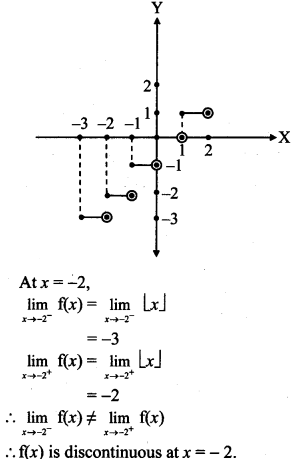
Find all the points of discontinuities of f(x) = [x] on the interval (-3, 2).
Answer
f(x) = [x], x ∈ (-3, 2)
i.e., f(x) = -3, x ∈ (-3, -2)
= -2, x ∈ [-2, -1)
= -1, x ∈ [- 1, 0)
= 0, x ∈ [0, 1)
= 1, x ∈ [1, 2)

Image

Similarly, f(x) is discontinuous at the points x = -1, x = 0, x = 1.
Thus all the integer values of x in the interval (-3, 2),
i.e., the points x = -2, x = -1, x = 0 and x = 1 are the required points of discontinuities.

View full question & answer