Questions

Solve the Following Question.(3 Marks)

Take a timed test

19 questions · self-marked practice — reveal the answer and mark yourself.

Question 13 Marks
Test whether the function
$f(x) = 5x – 3x^2,$ for $x \geq 1$
$= 3 – x,$ for $x < 1$
is differentiable at $x = 1.$
Answer
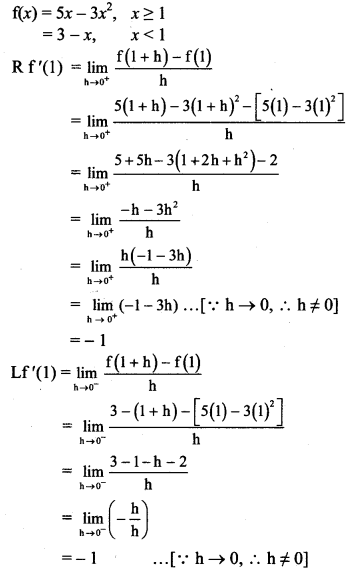
ImageHere, Lf'(1) = Rf'(1)
∴ f(x) is differentiable at x = 1.
View full question & answer
Question 23 Marks
Test whether the function
$f(x) = x^2 + 1,$ for $x \geq 2$
$= 2x + 1,$ for $x < 2$
is differentiable at $x = 2.$
View full question & answer
Question 33 Marks
Determine whether the following function is differentiable at $x=3$ where,
$f(x)=x^2+2, \text { for } x \geq 3$
$=6 x-7, \text { for } x<3$
Answer
$f(x)=x^2+2, x \geq 3$
$=6 x-7, x<3$
Differentiability at $x=3$
$
\begin{aligned}
\operatorname{Lf}^{\prime}(3) & =\lim _{h \rightarrow 0^{-}} \frac{f(3+h)-f(3)}{h} \\
& =\lim _{h \rightarrow 0^{-}} \frac{6(3+h)-7-\left(3^2+2\right)}{h} \\
& =\lim _{h \rightarrow 0^{-}} \frac{18+6 h-7-11}{h} \\
& =\lim _{h \rightarrow 0^{-}} \frac{6 h}{h}
\end{aligned}
$
$=\lim _{h \rightarrow 0^{-}} 6 \quad \ldots[\because h \rightarrow 0, \therefore h \neq 0]$
$=6$
$\operatorname{Rf}^{\prime}(3)=\lim _{h \rightarrow 0^{+}} \frac{f(3+h)-f(3)}{h}$
$=\lim _{h \rightarrow 0^{+}} \frac{(3+h)^2+2-\left(3^2+2\right)}{h}$
$=\lim _{h \rightarrow 0^{+}} \frac{h^2+6 h+9+2-11}{h}$
$=\lim _{h \rightarrow 0^{+}} \frac{h^2+6 h}{h}$
$=\lim _{h \rightarrow 0^{+}}(h+6) \ldots[\because h \rightarrow 0, \therefore h \neq 0]$
$=6$
$\text { Here, Lf }(3)=\text { Rf' }(3)$
$\therefore \text { fis differentiable at } x=3 .$
View full question & answer
Question 43 Marks
Differentiate the following w.r.t. x :$y=\frac{x^2 \sin x}{x+\cos x}$
Answer
$y=\frac{x^2 \sin x}{x+\cos x}$
Differentiating w.r.t. $x$, we get
$\frac{ d y}{ d x}=\frac{ d }{ d x}\left(\frac{x^2 \sin x}{x+\cos x}\right)$
$=\frac{(x+\cos x) \frac{ d }{ d x}\left(x^2 \sin x\right)-x^2 \sin x \frac{ d }{ d x}(x+\cos x)}{(x+\cos x)^2}$
$=\frac{(x+\cos x)\left(x^2 \frac{ d }{ d x} \sin x+\sin x \frac{ d }{ d x} x^2\right)-x^2 \sin x\left(\frac{ d }{ d x} x+\frac{ d }{ d x} \cos x\right)}{(x+\cos x)^2}$
$=\frac{(x+\cos x)\left[x^2 \cos x+\sin x(2 x)\right]-x^2 \sin x(1-\sin x)}{(x+\cos x)^2}$
$=\frac{x^3 \cos x+2 x^2 \sin x+x^2 \cos ^2 x+2 x \sin x \cos x-x^2 \sin x+x^2 \sin ^2 x}{(x+\cos x)^2}$
$=\frac{x^3 \cos x+x^2 \sin x+x^2 \cos 2 x+x^2 \sin ^2 x+2 x \sin x \cos x}{(x+\cos x)^2}$
$=\frac{x^3 \cos x+x^2 \sin x+x^2\left(\sin { }^2 x+\cos ^2 x\right)+x \sin 2 x}{(x+\cos x)^2}$
$=\frac{x^2+x^2 \sin x+x^3 \cos x+x \sin 2 x}{(x+\cos x)^2}$
$=\frac{x^2(1+\sin x+x \cos x)+x \sin 2 x}{(x+\cos x)^2}$
View full question & answer
Question 53 Marks
Differentiate the following w.r.t. x :$y=\frac{x \log x}{x+\log x}$
Answer
$y=\frac{x \log x}{x+\log x}$
Differentiating w.r.t. $x$, we get
$\begin{aligned}
& \frac{ d y}{ d x}=\frac{ d }{ d x}\left(\frac{x \log x}{x+\log x}\right) \\
= & \frac{(x+\log x) \frac{ d }{ d x}(x \log x)-x \log x \frac{ d }{ d x}(x+\log x)}{(x+\log x)^2} \\
= & \frac{(x+\log x)\left(x \frac{ d }{ d x} \log x+\log x \frac{ d }{ d x} x\right)-x \log x\left(\frac{ d }{ d x} x+\frac{ d }{ d x} \log x\right)}{(x+\log x)^2} \\
= & \frac{(x+\log x)\left[x\left(\frac{1}{x}\right)+\log x(1)\right]-x \log x\left(1+\frac{1}{x}\right)}{(x+\log x)^2} \\
= & \frac{(x+\log x)(1+\log x)-x \log x\left(1+\frac{1}{x}\right)}{(x+\log x)^2} \\
= & \frac{x+(\log x)^2}{(x+\log x)^2}
\end{aligned}$
View full question & answer
Question 63 Marks
Differentiate the following w.r.t. x :$y=\frac{x e^x}{x+e^x}$
Answer
$y=\frac{x e ^x}{x+ e ^x}$
Differentiating w.r.t. $x$, we get
$\frac{ d y}{ d x}=\frac{ d }{ d x}\left(\frac{x e ^x}{x+ e ^x}\right)$
$=\frac{\left(x+ e ^x\right) \frac{ d }{ d x} x e ^x-x e ^x \frac{ d }{ d x}\left(x+ e ^x\right)}{\left(x+ e ^x\right)^2}$
$=\frac{\left(x+ e ^x\right)\left(x \frac{ d }{ d x} e ^x+ e ^x \frac{ d }{ d x} x\right)-x e ^x\left(\frac{ d }{ d x} x+\frac{ d }{ d x} e ^x\right)}{\left(x+ e ^x\right)^2}$
$=\frac{\left(x+ e ^x\right)\left(x e ^x+ e ^x\right)-x e ^x\left(1+ e ^x\right)}{\left(x+ e ^x\right)^2}$
$=\frac{\left(x+ e ^x\right) e ^x(x+1)-x e ^x\left(1+ e ^x\right)}{\left(x+ e ^x\right)^2}$
$=\frac{ e ^x\left[\left(x+ e ^x\right)(x+1)-x\left(1+ e ^x\right)\right]}{\left(x+ e ^x\right)^2}$
$=\frac{ e ^x\left[x^2+x+x e ^x+ e ^x-x-x e ^x\right]}{\left(x+ e ^x\right)^2}$
$=\frac{ e ^x\left(x^2+ e ^x\right)}{\left(x+ e ^x\right)^2}$
$$
View full question & answer
Question 73 Marks
Differentiate the following w.r.t. x :$y=\frac{\sqrt{x}+5}{\sqrt{x}-5}$
Answer
$y=\frac{\sqrt{x}+5}{\sqrt{x}-5}$
Differentiating w.r.t. $x$, we get
$\frac{ d y}{ d x}=\frac{ d }{ d x}\left(\frac{\sqrt{x}+5}{\sqrt{x}-5}\right)$
$=\frac{(\sqrt{x}-5) \frac{ d }{ d x}(\sqrt{x}+5)-(\sqrt{x}+5) \frac{ d }{ d x}(\sqrt{x}-5)}{(\sqrt{x}-5)^2}$
$=\frac{(\sqrt{x}-5)\left(\frac{1}{2 \sqrt{x}}\right)-(\sqrt{x}+5)\left(\frac{1}{2 \sqrt{x}}\right)}{(\sqrt{x}-5)^2}$
$=\frac{\frac{1}{2 \sqrt{x}}(\sqrt{x}-5-\sqrt{x}-5)}{(\sqrt{x}-5)^2}$
$=\frac{\frac{1}{2 \sqrt{x}}(-10)}{(\sqrt{x}-5)^2}=\frac{-5}{\sqrt{x}(\sqrt{x}-5)^2}$
View full question & answer
Question 103 Marks
Discuss the continuity and differentiability of f(x) at x = 2.
f(x) = [x] if x ∈ [0, 4). [where [ ] is a greatest integer (floor) function]
View full question & answer
Question 133 Marks
Find the derivatives of the following w.r.t. x. at the points indicated against them by using the method of the first principle:

$e ^{3 x-4}$ at $x=2$

Answer
Let $f(x)=e^{3 x-4}$
$f(2)=e^{3(2)-4}=e^2$ and
$f (2+ h )= e ^{3(2+ h )-4}= e ^{3 h +2}$
By first principle, we get
$
f^{\prime}(a)=\lim _{h \rightarrow 0} \frac{f(a+h)-f(a)}{h}
$
$
\begin{aligned}
f^{\prime}(2) & =\lim _{h \rightarrow 0} \frac{f(2+h)-f(2)}{h} \\
& =\lim _{h \rightarrow 0} \frac{e^{3 h+2}-e^2}{h} \\
& =\lim _{h \rightarrow 0} \frac{e^{3 h} e^2-e^2}{h} \\
& =\lim _{h \rightarrow 0} \frac{e^2\left(e^{3 h}-1\right)}{h} \\
& =e^2 \lim _{h \rightarrow 0}\left(\frac{e^{3 h}-1}{3 h}\right) \times 3 . \quad \ldots\left[\because \lim _{x \rightarrow 0} \frac{e^{ sx }-1}{p x}=1\right] \\
& =3 e ^2(1) \quad \\
& =3 e ^2
\end{aligned}
$
View full question & answer
Question 143 Marks
Find the derivatives of the following w.r.t. x. at the points indicated against them by using the method of the first principle:
$\log (2 x+1)$ at $x=2$
Answer
$\text { Let } f(x)=\log (2 x+1)$
$\therefore f(2)=\log [2(2)+1]=\log 5 \text { and }$
$f(2+h)=\log [2(2+h)+1]=\log (2 h+5)$
By first principle, we get
$
\begin{aligned}
f^{\prime}(a) & =\lim _{h \rightarrow 0} \frac{f(a+h)-f(a)}{h} \\
f^{\prime}(2) & =\lim _{h \rightarrow 0} \frac{f(2+h)-f(2)}{h} \\
& =\lim _{h \rightarrow 0} \frac{\log (2 h+5)-\log 5}{h} \\
& =\lim _{h \rightarrow 0} \frac{\log \left(\frac{2 h+5}{5}\right)}{h}=\lim _{h \rightarrow 0} \frac{\log \left(1+\frac{2 h}{5}\right)}{h} \\
& =\lim _{h \rightarrow 0} \frac{\log \left(1+\frac{2 h}{5}\right)}{\frac{2 h}{5} \times \frac{5}{2}} \\
& =\frac{2}{5} \lim _{h \rightarrow 0} \frac{\log \left(1+\frac{2 h}{5}\right)}{\frac{2 h}{5}}=\frac{2}{5} \text { (1) } \ldots\left[\because \lim _{x \rightarrow 0} \frac{\log (1+p x)}{p x}=1\right] \\
& =\frac{2}{5}
\end{aligned}
$
View full question & answer
Question 153 Marks
Find the derivatives of the following w.r.t. x. at the points indicated against them by using the method of the first principle:
$2^{3 x+1}$ at $x=2$
Answer
Let $f (x)=2^{3 x+1}$
$\therefore \quad f (2)=2^{3(2)+1}=2^7 \text { and }$
$f(2+h)=2^{3(2+h)+1}=2^{3 h+7}$
By first principle, we get
$f^{\prime}(a)=\lim _{h \rightarrow 0} \frac{f(a+h)-f(a)}{h}$
$\therefore \quad f^{\prime}(2)=\lim _{h \rightarrow 0} \frac{f(2+h)-f(2)}{h}$
$=\lim _{ h \rightarrow 0} \frac{2^{3 h +7}-2^7}{h}$
$=\lim _{ h \rightarrow 0} \frac{2^{ sh } \cdot 2^7-2^7}{ h }$
$=\lim _{h \rightarrow 0} \frac{2^7\left(2^{3 h }-1\right)}{h}$
$=2^7 \lim _{ h \rightarrow 0}\left(\frac{2^{3 h }-1}{3 h }\right) \times 3$
$=2^7(\log 2) \times 3 \quad \ldots\left[\because \lim _{x \rightarrow 0}\left(\frac{ a ^{p x}-1}{ p x}\right)=\log a \right]$
$=384 \log 2$
View full question & answer
Question 163 Marks
Find the derivatives of the following w.r.t. x. at the points indicated against them by using the method of the first principle:

$\sqrt{2 x+5}$ at $x =2$

Answer
Let $f (x)=\sqrt{2 x+5}$
$
\begin{aligned}
\therefore \quad & f(2)=\sqrt{2(2)+5}=\sqrt{9}=3 \text { and } \\
& f(2+h)=\sqrt{2(2+h)+5}=\sqrt{2 h+9}
\end{aligned}
$
By first principle, we get
$
\begin{aligned}
f^{\prime}(a) & =\lim _{h \rightarrow 0} \frac{f(a+h)-f(a)}{h} \\
\therefore \quad f^{\prime}(2) & =\lim _{h \rightarrow 0} \frac{f(2+h)-f(2)}{h} \\
& =\lim _{h \rightarrow 0} \frac{\sqrt{2 h+9}-3}{h} \\
& =\lim _{h \rightarrow 0} \frac{\sqrt{2 h+9}-3}{h} \times \frac{\sqrt{2 h+9}+3}{\sqrt{2 h+9}+3} \\
& =\lim _{h \rightarrow 0} \frac{2 h+9-9}{h(\sqrt{2 h+9}+3)} \\
& =\lim _{h \rightarrow 0} \frac{2 h}{h(\sqrt{2 h+9}+3)} \\
& =\lim _{h \rightarrow 0} \frac{2}{\sqrt{2 h+9}+3} \quad \cdots[\because h \rightarrow 0, h \neq 0] \\
& =\frac{2}{\sqrt{0+9}+3} \\
& =\frac{2}{3+3}=\frac{1}{3}
\end{aligned}
$
View full question & answer
Question 183 Marks
Find the derivatives of the following w.r.t. x by using the method of the first principle.
$log(2x + 5)$
View full question & answer