Questions

Solve the following Question.(1 Marks)

Take a timed test

9 questions · self-marked practice — reveal the answer and mark yourself.

Question 11 Mark
If a latus-rectum of an ellipse subtends a right angle at the centre of the ellipse, then write the eccentricity of the ellipse.
Answer
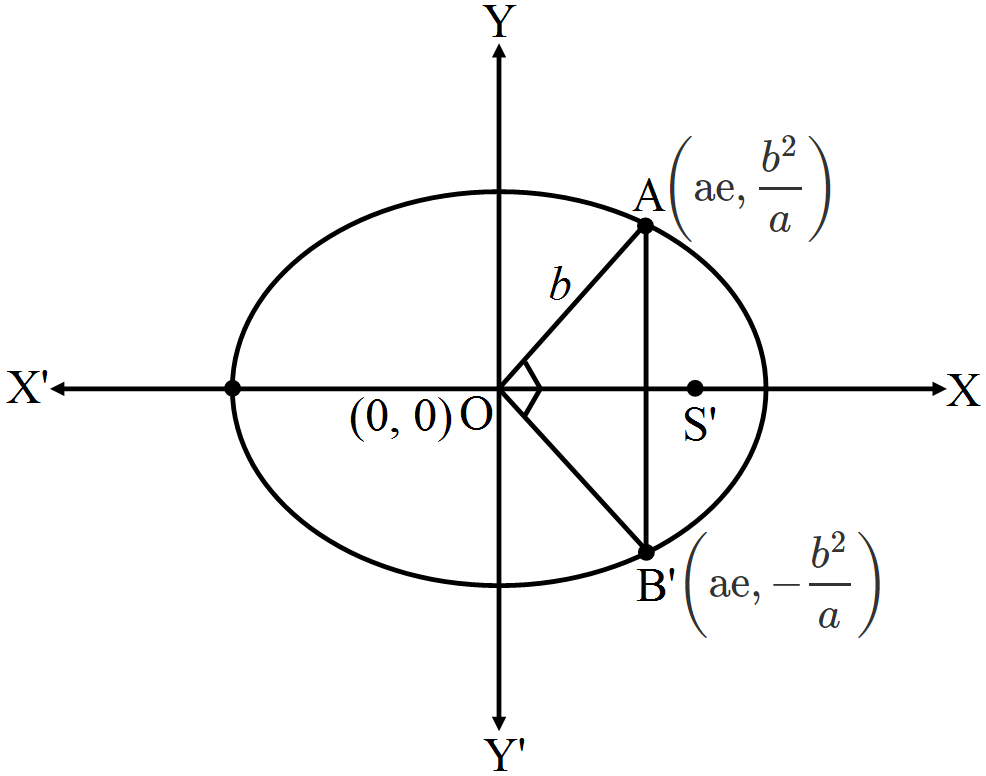
According to the Pythogoras theorem, we have:
$\text{OA}^2+\text{OB}^2=\text{AB}^2$
From the figure, we can see that
$\text{OA}=\sqrt{\big(\frac{\text{b}^2}{\text{a}}-0\big)^2+(\text{ae}-0)^2}=\sqrt{\frac{\text{b}^4}{\text{a}^2}}+\text{a}^2\text{e}^2=\text{OB}$
and $\text{AB}=\frac{2\text{b}^2}{\text{a}}$
Now, $2\Big[\text{a}^2\text{e}^2+\frac{\text{b}^4}{\text{a}^2}\Big]=\frac{4\text{b}^4}{\text{a}^2}$
$\Rightarrow\text{a}^2\text{e}^2+\frac{\text{b}^4}{\text{a}^2}=\frac{2\text{b}^4}{\text{a}^2}$
$\Rightarrow\text{a}^2\text{e}^2=-\frac{\text{b}^4}{\text{a}^2}+\frac{2\text{b}^4}{\text{a}^2}$
$\Rightarrow\text{a}^2\text{e}^2=\frac{\text{b}^4}{\text{a}^2}$
$\Rightarrow\text{e}^2=\frac{\text{b}^4}{\text{a}^4}$
$\Rightarrow\text{e}=\frac{\text{b}^2}{\text{a}^2}$
We know that $\text{e}=\sqrt{1-\frac{\text{b}^2}{\text{a}^2}}$
$\text{e}=\sqrt{1-\text{e}}$
On squaring both sides, we get:
$\text{e}^2+\text{e}-1=0$
$\Rightarrow\text{e}=\frac{-1\pm\sqrt{1+4}}{2}$ $\big(\because\ $Ecentricity cannot be negative $\big)$
$\Rightarrow\text{e}=\frac{\sqrt{5}-1}{2}$
View full question & answer
Question 21 Mark
Write the eccentricity of an ellipse whose latus-rectum is one half of the minor axis.
Answer
According to the question, the latus rectum is half its minor axis.
i.e. $\frac{2\text{b}^2}{\text{a}}=\frac{1}{2}\times2\text{b}$
$\Rightarrow2\text{b}=\text{a}$
Now, $\text{e}=\sqrt{1-\frac{\text{b}^2}{\text{a}^2}}$
$\Rightarrow\text{e}=\sqrt{1-\frac{\text{b}^2}{4\text{b}^2}}$
$\Rightarrow\text{e}=\sqrt{1-\frac{1}{4}}$
$\Rightarrow\text{e}=\frac{\sqrt{3}}{2}$
View full question & answer
Question 31 Mark
If the minor axis of an ellipse subtends an equilateral triangle with vertex at one end of major axis, then write the eccentricity of the ellipse.
Answer

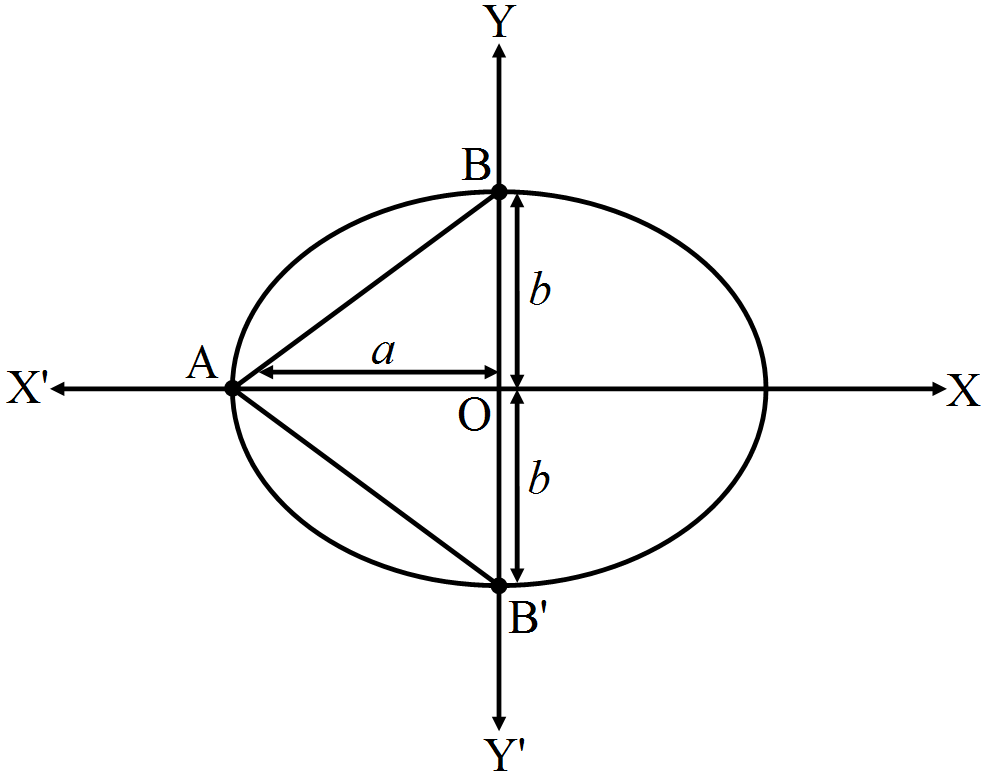
According to the question, the minor axis of the ellipse subtends an equilatreal triangle with vertex at one end of the major axis
$\text{}AB=\sqrt{\text{a}^2+\text{b}^2}$
We know that ABC is an equilateral triangle.
$\therefore\text{AB}=\text{BB}'$
$\Rightarrow\sqrt{\text{a}^2+\text{b}^2}=2\text{b}$
On squaring both sides, we have:
$\Rightarrow{\text{a}^2+\text{b}^2}=4\text{b}$
$\Rightarrow\text{a}^2=3\text{b}^2$
Now, $\text{e}=\sqrt{1-\frac{\text{b}^2}{\text{a}^2}}$
$\Rightarrow\text{e}=\sqrt{1-\frac{\text{b}^2}{3\text{b}^2}}$
$\Rightarrow\text{e}=\sqrt{1-\frac{1}{3}}$
$\Rightarrow\text{e}=\sqrt{\frac{2}{3}}$
View full question & answer
Question 41 Mark
Write the eccentricity of the ellipse $9\text{x}^2+5\text{y}^2-18\text{x}-2\text{y}-16=0.$
Answer
$9\text{x}^2+5\text{y}^2-18\text{x}-2\text{y}-16=0.$
$\Rightarrow9\big(\text{x}^2-2\text{x}\big)+5\big(\text{y}^2-\frac{2\text{y}}{5}\big)=16$
$\Rightarrow9(\text{x}^2-2\text{x}+1)+5\big(\text{y}^2-\frac{2\text{y}}{5}+\frac{1}{25}\big)=16+9+\frac{1}{5}$
$9(\text{x}-1)^2+5\big(\text{y}-\frac{1}{5}\big)^2=\frac{126}{5}$
$\frac{(\text{x}-1)^2}{\frac{14}{5}}+\frac{\big(\text{y}-\frac{1}{5}\big)^2}{\frac{126}{25}}=1$
$\Rightarrow\text{a}^2=\frac{126}{45}$ and $\text{b}^2=\frac{126}{25}$
Clearly, a < b
Now, $\text{e}=\sqrt{1-\frac{\text{a}^2}{\text{b}^2}}$
$\Rightarrow\text{e}=\sqrt{1-\frac{\frac{126}{45}}{\frac{126}{25}}}$
$\Rightarrow\text{e}=\sqrt{1-\frac{5}{9}}$
$\Rightarrow\text{e}=\frac{2}{3}$
View full question & answer
Question 51 Mark
If S and S' are two foci of the ellipse $\frac{\text{x}^2}{\text{b}^2}+\frac{\text{y}^2}{\text{b}^2}=1$ and B is an end of the minor axis such that $\triangle\text{BSS}'$ is equilateral, then write the eccentricity of the ellipse.
Answer

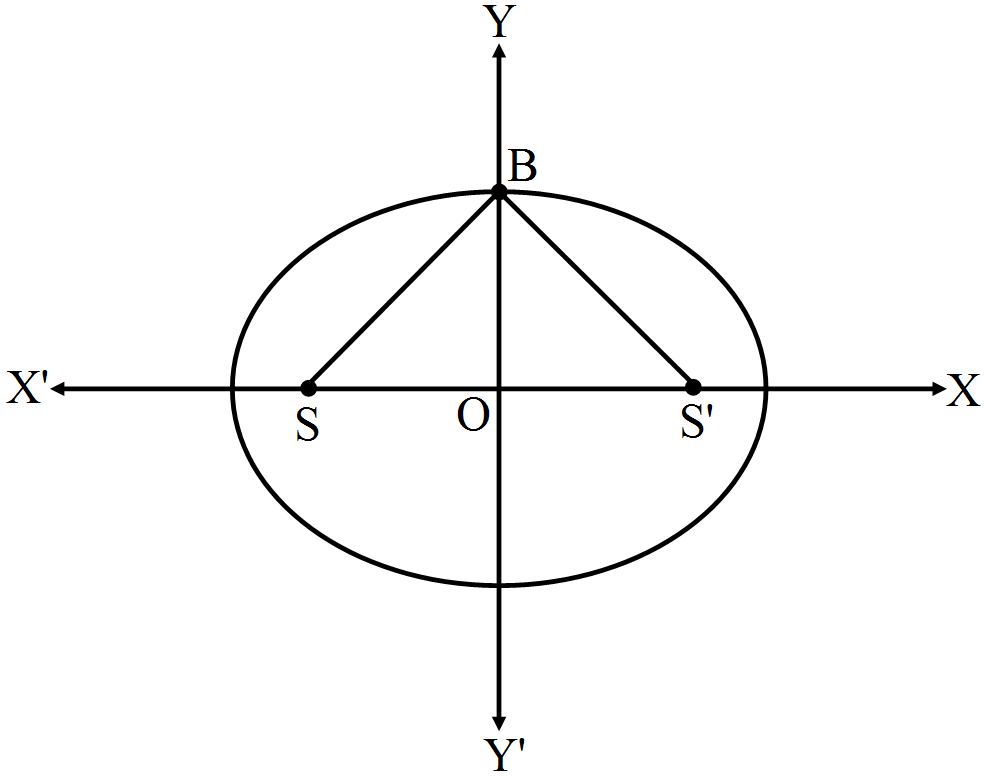
We know that the focal distance of a point B(0, b) is $\text{a}\pm\text{e}.\ 0=\text{a}$
i. e. $\text{SB}=\text{SB}'=\text{a}$
$\therefore\text{SB}=\text{SB}'=2\text{a}$
since $\triangle\text{BSS}'$ is equilateral, we have:
$\text{SB}=\text{SS}'=\text{S}'\text{B}=2\text{ae}$
$\Rightarrow2\text{ae}+2\text{ae}=2\text{a}$
$\Rightarrow4\text{ae}=\text{a}$
$\Rightarrow\text{e}=\frac{2}{4}$
$\Rightarrow\text{e}=\frac{1}{2}$
View full question & answer
Question 61 Mark
If the lengths of semi-major and semi-minor axes of an ellipse are 2 and $\sqrt{3}$ and their corresponding equations are y - 5 = 0 and x + 3 = 0, then write the equation of the ellipse.
Answer
The lengths of semi-major and semi-minor axes of an ellipse are 2 and $\sqrt{3},$ respectively. Their corrseponding equation are
so, a = 2 and $\text{b}=\sqrt{3}$
The equation of the ellipse in given by
$\frac{(\text{x}+\text{3})^2}{4}+\frac{(\text{y}-\text{5})^2}{3}=1$
$\Rightarrow3(\text{x}+3)^2+4(\text{y}-5)^2=12$
$\Rightarrow3(\text{x}^2+9+6\text{x})+4(\text{y}^2+25-10\text{y})=12$
$\Rightarrow3\text{x}^2+27+18\text{x}+4\text{y}^2+100-40\text{y}=12$
$\Rightarrow3\text{x}^2+4\text{y}^2+18\text{x}-40\text{y}+115=0$
View full question & answer
Question 71 Mark
If the distance between the foci of an ellipse is equal to the lengh of the latus-rectum, write the eccentricity of the ellipse.
Answer
According to the question, the distance between the foci of an ellipse is equal to the length of the lenght of the latus rectum.
i.e. $\frac{2\text{b}^2}{\text{a}}=2\text{ae}$
$\Rightarrow\text{e}=\frac{\text{b}^2}{\text{a}^2}$
But $\text{e}=\sqrt{1-\frac{\text{b}^2}{\text{a}^2}}$
Then $\text{e}=\sqrt{1-\text{e}}$
Squaring both sides, we get:
$\text{e}^2+\text{e}-1=0$
$\Rightarrow\text{e}\frac{-1\pm\sqrt{1+4}}{2}$ $\big(\because\ $Ecentricity cannot be negative $\big)$
$\Rightarrow\text{e}=\frac{\sqrt{5-1}}{2}$
View full question & answer
Question 81 Mark
Write the centre and eccentricity of the ellipse $3\text{x}^2+4\text{y}^2-6\text{x}+8\text{y}-5=0.$
Answer
$\Rightarrow3\text{x}^2-6\text{x}+4\text{y}^2+8\text{y}-5=0$
$\Rightarrow3(\text{x}^2-2\text{x})+4(\text{y}^2+2\text{y})=5$
$\Rightarrow3(\text{x}^2-2\text{x}+1)+4(\text{y}^2+2\text{y}+1)=5+3+4$
$\Rightarrow3(\text{x}-1)^2+4(\text{y}+1)^2=12$
$\Rightarrow\frac{3(\text{x}-1)^2}{12}+\frac{4(\text{y}+1)^2}{12}=1$
$\Rightarrow\frac{(\text{x}-1)^2}{4}+\frac{(\text{y}+1)^2}{3}=1$
Compairing it with $\frac{\text{x}^2}{\text{b}^2}+\frac{\text{y}^2}{\text{b}^2}=1,$ we get:
a = 2 and $\text{b}=\sqrt{3}$
Here, a > b, so the major and the minor axes of the ellipse are along the x−axis and y−axis, respectively.
Now, $\text{e}=\sqrt{1-\frac{\text{b}^2}{\text{a}^2}}$
$\Rightarrow\text{e}=\sqrt{1-\frac{3}{4}}$
$\Rightarrow\text{e}=\sqrt{\frac{1}{4}}$
$\therefore\ \text{e}=\frac{1}{2}$ and centre = (1, -1)
View full question & answer
Question 91 Mark
$PSQ$ is a focal chord of the ellipse $4\text{x}^2+9\text{y}^2=36$ such that $SP = 4$. If S' is the another focus, write the value of S'Q.
Answer


The give equation of the ellipse is
$4\text{x}^2+9\text{y}^2=36\ \dots(\text{i})$
$\Rightarrow\frac{\text{x}^2}{9}+\frac{\text{y}^2}{4}=1$
This is of the form $\Rightarrow\frac{\text{x}^2}{\text{a}^2}+\frac{\text{y}^2}{\text{b}^2}=1,$ where $a^2 = 9$ and $b^2 = 4$ i.e $a = 3$ and $b = 2$ clearly $a > b,$ therefore the major axis and minir axis of the ellipse are along x axis and y axis respectively.
Let, e be the ecentricity of the ellipse. Then,
$\therefore\ \text{e}=\sqrt{1-\frac{\text{b}^2}{\text{a}^2}}$
$\Rightarrow\text{e}=\sqrt{1-\frac{4}{9}}$
$=\frac{\sqrt{5}}{3}$
Therefore, coordinates of focus at $ S$ i.e $(\text{ae}, 0)=\big(\sqrt{5},0\big)$
& coordinates of foucs at S' $=(-\text{ae},0)=\big(-\sqrt{5},0\big)$
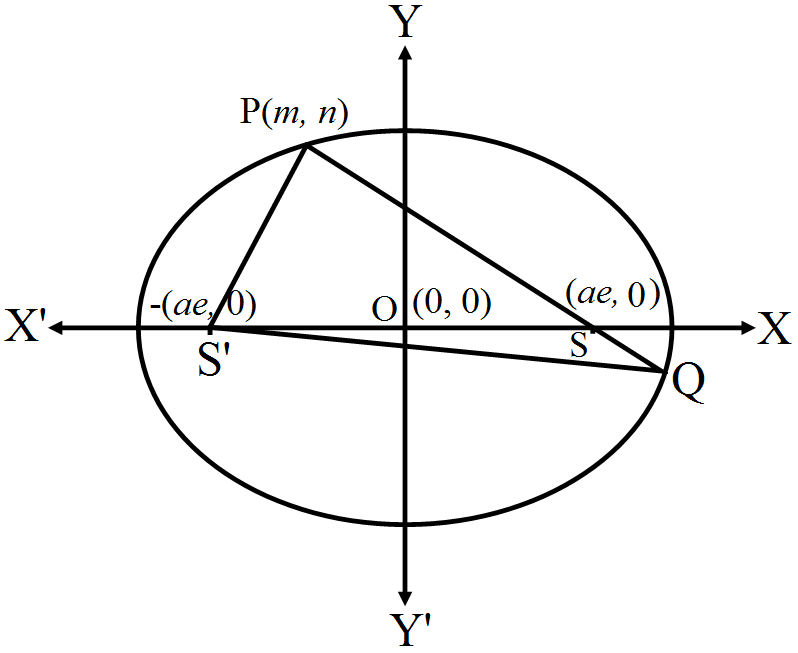
It is given that $PSQ$ is a focal chord
As we know that,
$\text{SP}+\text{S}'\text{P}=2\text{a}$
$\Rightarrow4+\text{S}'\text{P}=6$
$\big[\because\ $SP = 4 $\big]$
$\Rightarrow\text{S}'\text{P}=2$
Let coordinates of $P$ be $(m, n)$
As $\text{S}'\text{P}=2$
$\therefore\sqrt{(\text{n}-0)^2+(\text{m}+\sqrt{5})^2}=2$
$\Rightarrow\text{n}^2+\text{m}^2+5+2\sqrt{5}\text{m}=4\ \dots(\text{ii})$
& $SP = 4$
$\therefore\sqrt{(\text{n}-0)^2+(\text{m}+\sqrt{5})^2}=4$
$\Rightarrow\text{n}^2+\text{m}^2+5+2\sqrt{5}\text{m}=16\ \dots(\text{iii})$
Subtracting eq (iii) from eq (ii), we get
$4\sqrt{5}\text{m}=-12$
$\Rightarrow\text{m}=\frac{-3}{\sqrt{5}}$
& we get $\text{n}=\frac{4}{\sqrt{5}}$
$\therefore\ $coordinates of a $P$ are $\Big(\frac{-3}{\sqrt{5}},\frac{4}{\sqrt{5}}\Big)$ and coordinates of $S$ are $\big(\sqrt{5},0\big)$
$\therefore\ $Equation of the line segementf $PS$ which is extended to $PQ$ is given by
$\text{x}+2\text{y}=\sqrt{5}\ \dots(\text{iv})$
solving eq (i) & (iv) we get,
$\text{x}=\frac{-3}{\sqrt{5}}$ and $\text{y}=\frac{4}{\sqrt{5}}$ which would be the coordinates of $Q.$
$\therefore\text{S}'Q=\sqrt{\Big(\frac{-8\sqrt{5}}{50}-0\Big)^2+\Big(\frac{66\sqrt{5}}{50}+\sqrt{5}\Big)^2}$
$=\frac{26}{5}$
View full question & answer