Questions

Solve the Following Question.(4 Marks)

Take a timed test

9 questions · self-marked practice — reveal the answer and mark yourself.

Question 14 Marks
Find the eccentricity, coordinates of foci, length of the latus-rectum of the following ellipse:$9\text{x}^2+25\text{y}^2=225$
Answer
$\Rightarrow\frac{\text{x}^2}{25}+\frac{\text{y}^2}{9}=1$
This is of form $\frac{\text{x}^2}{\text{a}^2}+\frac{\text{y}^2}{\text{b}^2}=1,$ where $\text{a}^2=25$ and $\text{b}^2=9,\text{ i}.\text{e}.\text{ a}=5$ and $\text{b}=3.$
Clearly, a > b
Now, $\text{e}=\sqrt{1-\frac{\text{a}^2}{\text{b}^2}}$
$\Rightarrow\text{e}=\sqrt{1-\frac{9}{25}}$
$\Rightarrow\text{e}=\sqrt{\frac{16}{25}}$
$\Rightarrow\text{e}=\frac{4}{{5}}$
Coordinates of the foci $=(\pm, 0)=(\pm4, 0)$
Length of the latus rectum $=\frac{2\text{a}^2}{\text{b}}$
$\\=\frac{2\times9}{5}$
$=\frac{{18}}{5}$
View full question & answer
Question 24 Marks
Find the equation to the ellipse in the following case:
eccentricity $\text{e}=\frac{1}{2}$ and semi-major axis = $4$
Answer
Let the equation of the required ellipse be
$\frac{\text{x}^2}{\text{a}^2}+\frac{\text{y}^2}{\text{b}^2}=1\ \dots(\text{i})$
Then, semi-major axis = a
$\therefore\ \text{a}=4$ $\big[\because$ semi-major axis = 4$\big]$
$\Rightarrow\text{b}^2=16$
Now, $\text{b}^2=\text{a}^2\big(1-\text{e}^2\big)$
$\Rightarrow{\text{b}^2}=16\Big[1-\big(\frac{1}{2}\big)^2\Big]$ $\big[\because\text{e}=\frac{1}{2}\big]$
$\Rightarrow{\text{b}^2}=16\Big[1-\frac{1}{4}\Big]$
$\Rightarrow\text{b}^2=16\times\frac{3}{4}$
$\Rightarrow\text{b}^2=12$
Substituting the value of $a^2$ and $b^2$ in (i), we get
$\frac{\text{x}^2}{16}+\frac{\text{y}^2}{12}=1$
$\Rightarrow3\text{x}^2+4\text{y}^2=48$
This is the equation of the required ellipse.
View full question & answer
Question 34 Marks
Find the equation of the ellips whose focus is in the following case:focus is (1, 2), directricx is 3x + 4y - 5 = 0 and $\text{e}=\frac{1}{2}.$
Answer
Let P (x, y) be a point on the ellipse. Then, by definition SP - e PM
Here $\text{e}-\frac{1}{2},$ coordinates of S are (1, 2) and the eqation of directrix is 3x + 4y - 5 - 0
$\therefore\text{ SP}-\frac{1}{2}\text{ pm}$
$\Rightarrow\text{SP}^2-\frac{1}{4}(\text{PM})^2$
$\Rightarrow4\text{SP}^2-\text{PM}^2$
$\Rightarrow4\big[(\text{x}-1)^2+(\text{y}-2)^2\big]-\bigg[\frac{3\text{x}+4\text{y}-5}{\sqrt{3^2+4^2}}\bigg]^2$
$\Rightarrow\big[\text{x}^2+1-2\text{x}+\text{y}^2+4-4\text{y}\big]-\frac{(3\text{x}+4\text{y}-5)^2}{25}$
$\Rightarrow100\big[\text{x}^2+\text{y}^2-2\text{x}-4\text{y}+5\big]-(3\text{x}+4\text{y}-5)^2$
$\Rightarrow100\text{x}^2+100\text{y}-200\text{x}-400\text{y}+500=(3\text{x}+4\text{y}-5)^2$
$\Rightarrow10\text{x}^2+100\text{y}-200\text{x}-400\text{y}+500\\=(3\text{x})^2+(4\text{y})^2+(-5)^2+2\times3\text{x}\times4\text{y}\times(-5)+2\times(-5)\times3\text{x}$
$\Rightarrow100\text{x}^2+100\text{y}^2-200\text{x}-400\text{y}+500\\-9\text{x}^2+16\text{y}^2+25+24\text{xy}-40\text{y}-30\text{x}$
$\Rightarrow100\text{x}^2-9\text{x}^2+100\text{y}^2-16\text{y}^2-24\text{xy}-200\\+30\text{x}-400\text{y}+40\text{y}+500-25=0$
$\Rightarrow91\text{x}^2+84\text{y}^2-24\text{xy}-170\text{x}-360\text{y}+475-0$
This is the required equation of the ellipse.
View full question & answer
Question 44 Marks
Find the eccentricity, coordinates of foci, length of the latus-rectum of the following ellipse:
$5\text{x}^2+4\text{y}^2=1$
Answer
$\Rightarrow\frac{\text{x}^2}{\frac{1}{5}}+\frac{\text{y}^2}{\frac{1}{4}}=1$
This is of form $\frac{\text{x}^2}{\text{a}^2}+\frac{\text{y}^2}{\text{b}^2}=1,$ where $\text{a}^2=\frac{1}{5}$ and $\text{b}^2=\frac{1}{4},\text{ i}.\text{e}.\text{ a}=\frac{1}{\sqrt{5}}$and $\text{b}=\frac{1}{2}.$
Clearly b > a
Now, $\text{e}=\sqrt{1-\frac{\text{a}^2}{\text{b}^2}}$
$\Rightarrow\text{e}=\sqrt{1-\frac{\frac{1}{5}}{\frac{1}{4}}}$
$\Rightarrow\text{e}=\sqrt{1-\frac{4}{5}}$
$\Rightarrow\text{e}=\frac{1}{\sqrt{5}}$
Coordinates of the foci $=(0, \pm\text{be})=\big (0, \pm\frac{1}{2\sqrt{5}}\big)$
Length of the latus rectum $=\frac{2\text{a}^2}{\text{b}}$
$\\=\frac{2\times\frac{1}{5}}{\frac{1}{2}}$
$=\frac{4}{5}$
View full question & answer
Question 54 Marks
Find the eccentricity, coordinates of foci, length of the latus-rectum of the following ellipse:$25\text{x}^2+16\text{y}^2=1600.$
Answer
$\Rightarrow\frac{\text{x}^2}{64}+\frac{\text{y}^2}{100}=1$
This is of form $\frac{\text{x}^2}{\text{a}^2}+\frac{\text{y}^2}{\text{b}^2}=1,$ where $\text{a}^2=64$ and $\text{b}^2=100,$ i.e. $\text{ a}=8$ and $\text{b}=10.$
Clearly, b > a
Now, $\text{e}=\sqrt{1-\frac{\text{a}^2}{\text{b}^2}}$
$\Rightarrow\text{e}=\sqrt{1-\frac{64}{100}}$
$\Rightarrow\text{e}=\sqrt{1-\frac{36}{100}}$
$\Rightarrow\text{e}=\frac{6}{{10}}$ or $\frac{3}{5}$
Coordinates of the foci $=(0, \pm 6)$
Length of the latus rectum= $\frac{2\text{a}^2}{\text{b}}$
$\\=\frac{2\times64}{10}$
$=\frac{{64}}{5}$
View full question & answer
Question 64 Marks
Find the eccentricity, coordinates of foci, length of the latus-rectum of the following ellipse:
$4\text{x}^2+3\text{y}^2=1$
Answer
$\Rightarrow\frac{\text{x}^2}{\frac{1}{4}}+\frac{\text{y}^2}{\frac{1}{3}}=1$
This is of form $\frac{\text{x}^2}{\text{a}^2}+\frac{\text{y}^2}{\text{b}^2}=1,$ where $\text{a}^2=\frac{1}{4}$ and $\text{b}^2=\frac{1}{3},\text{ i}.\text{e}.\text{ a}=\frac{1}{{2}}$ and $\text{b}=\frac{1}{\sqrt{3}}.$
Clearly b > a
Now, $\text{e}=\sqrt{1-\frac{\text{a}^2}{\text{b}^2}}$
$\Rightarrow\text{e}=\sqrt{1-\frac{\frac{1}{4}}{\frac{1}{3}}}$
$\Rightarrow\text{e}=\sqrt{1-\frac{3}{4}}$
$\Rightarrow\text{e}=\frac{1}{{2}}$
Coordinates of the foci $=(0, \pm\text{be})=\big (0, \pm\frac{1}{2\sqrt{3}}\big)$
Length of the latus rectum= $\frac{2\text{a}^2}{\text{b}}$
$\\=\frac{2\times\frac{1}{4}}{\frac{1}{\sqrt{3}}}\\=\frac{\sqrt{3}}{2}$
View full question & answer
Question 74 Marks
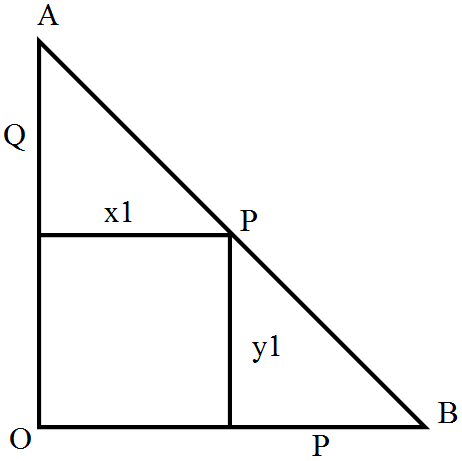
A rod of length 12cm moves with its ends always touching the coordinate axes. Determine the equation of the locus of a point P on the rod, which is 3 cm from the end in contact with x-axis.
Answer

Using similar triangle principle, we can write
$\frac{\text{Q}}{9}=\frac{\text{y}_1}{3}$
$\text{Q}=3\text{y}_1$
Similarly, $\text{p}=\frac{\text{x}}{3}$
Point $\text{P}(\text{x,y})$
So $\text{OB}=\text{x}+\frac{\text{x}}{3}$
$\text{OA}=\text{y}+3\text{y}=4\text{y}$
Using Pythageorus theorem, we get
$(\text{4y})^2+\Big(\frac{4\text{x}}{3}\Big)^2=12^2$
$\frac{\text{y}^2}{9}+\frac{\text{x}^2}{81}=1$ is the equation of ellipse.
View full question & answer
Question 84 Marks
Find the equation of an ellipse whose vertices are $(0,\pm10)$ and eccentricity $\text{e}=\frac{4}{5}.$
Answer
Let the equation of the ellipse be$\frac{\text{x}^2}{\text{b}^2}+\frac{\text{y}^2}{\text{b}^2}=1\ ,\dots(\text{i})$
The coordinates of vertices are $(0,\pm\text{b})$ i.e., $(0,\pm10).$
$\therefore\ \text{b}=10$
$\Rightarrow\text{b}^2=100$
Now, $\text{a}^2=\text{b}^2\big(1-\text{e}^2\big)$
$\Rightarrow\text{a}^2=100\Big[1-\Big(\frac{4}{5}\Big)^2\Big]$
$\Rightarrow\text{a}^2=100\Big[1-\frac{16}{25}\Big]$
$\Rightarrow\text{a}^2=100\Big[\frac{9}{25}\Big]$
$\Rightarrow\text{a}^2=4\times9=36$
Putting $a^2 = 36$ and $b^2 = 100$ in equation (i), we get$\frac{\text{x}^2}{36}+\frac{\text{y}^2}{100}=1$
$\Rightarrow\frac{100\text{x}^2+36\text{y}^2}{3600}=1$
$\Rightarrow100\text{x}^2+36\text{y}^2=3600$
this is the equation of the required ellipse.
View full question & answer
Question 94 Marks
Find the eccentricity, coordinates of foci, length of the latus-rectum of the following ellipes:
$4\text{x}^2+9\text{y}^2=1$
Answer
$\Rightarrow\frac{\text{x}^2}{\frac{1}{4}}+\frac{\text{y}^2}{\frac{1}{9}}=1$This is of the form $\frac{\text{x}^2}{\text{a}^2}+\frac{\text{y}^2}{\text{b}^2}=1,$ where $\text{a}^2=\frac{1}{4}$ and $\text{b}^2=\frac{1}{9},\text{ i}.\text{e}.\text{a}=\frac{1}{2}$and $\text{b}=\frac{1}{3}.$
Clearly a > b
Now, $\text{e}=\sqrt{1-\frac{\text{b}^2}{\text{a}^2}}$
$\Rightarrow\text{e}=\sqrt{1-\frac{\frac{1}{9}}{\frac{1}{4}}}$
$\Rightarrow\text{e}=\sqrt{1-\frac{4}{9}}$
$\Rightarrow\text{e}=\frac{\sqrt{5}}{3}$
Coordinates of the foci $=(\pm\text{ae, 0})=\Big(\pm\frac{\sqrt{5}}{6},0\Big)$
Length of the latus rectum $=\frac{2\text{b}^2}{\text{a}}$
$=\frac{2\times\frac{1}{9}}{\frac{1}{2}}$
$=\frac{4}{9}$
View full question & answer