Question 14 Marks
Let f and g be two real functions defined by $\text{f(x)}=\sqrt{\text{x}+1}$ and $\text{g(x)}=\sqrt{9-\text{x}^2}$ Then describe the following functions:
g - f
AnswerWe have,
$\text{f(x)}=\sqrt{\text{x}+1}$ and $\text{g(x)}=\sqrt{9-\text{x}^2}$
We observe that $\text{f(x)}=\sqrt{\text{x}+1}$ is defined for all $\text{x}\geq-1$
So, domain $\text{f}=[-1,\infty]$
Clearly, $\text{g(x)}=\sqrt{9-\text{x}^2}$ is defined for
$9-\text{x}^2\geq0$
$\Rightarrow\text{x}^2-9\leq0$
$\Rightarrow\text{x}^2-3^2\leq0$
$\Rightarrow\text{x}\in[-3,3]$
$\therefore\ \text{domain(g)}=[-3,3]$
Now,
$\text{domain(f)}\cap\text{domain(g)}$
$=[-1,\infty]\cap[-3,3]$
$=[-1,3]$
f - g : [-3] → R is given by (g - f)(x) = g(x) - g(x)
$=\sqrt{9-\text{x}^2}-\sqrt{\text{x}+1}$
View full question & answer→Question 24 Marks
Let f and g be two real functions defined by $\text{f(x)}=\sqrt{\text{x}+1}$ and $\text{g(x)}=\sqrt{9-\text{x}^2}$ Then describe the following functions:
$\text{f}^2+7\text{f}$
AnswerWe have,
$\text{f(x)}=\sqrt{\text{x}+1}$ and $\text{g(x)}=\sqrt{9-\text{x}^2}$
We observe that $\text{f(x)}=\sqrt{\text{x}+1}$ is defined for all $\text{x}\geq-1$
So, domain $\text{f}=[-1,\infty]$
Clearly, $\text{g(x)}=\sqrt{9-\text{x}^2}$ is defined for
$9-\text{x}^2\geq0$
$\Rightarrow\text{x}^2-9\leq0$
$\Rightarrow\text{x}^2-3^2\leq0$
$\Rightarrow\text{x}\in[-3,3]$
$\therefore\ \text{domain(g)}=[-3,3]$
Now,
$\text{domain(f)}\cap\text{domain(g)}$
$=[-1,\infty]\cap[-3,3]$
$=[-1,3]$
$\text{f}^2+7\text{f}:[-1,\infty]\rightarrow\text{R}$ defined by $(\text{f}^2+7\text{f})(\text{x})=\text{f}^2(\text{x})+7\text{f}(\text{x})$ $\big[\because\text{D(f)}=[-1,\infty]\big]$
$=\Big(\sqrt{\text{x}+1}\Big)^2+7\sqrt{\text{x}+1}$
$=\text{x}+1+7\sqrt{\text{x}+1}$
View full question & answer→Question 34 Marks
If $\text{f(x)}=\log_\text{e}(1-\text{x})$ and $\text{g(x)}=[\text{x}],$ then determine the following functions:
(f + g)(-1)
AnswerWe have,
$\text{f(x)}=\log_\text{e}(1-\text{x})$
and $\text{g(x)}=[\text{x}]$
$\text{f(x)}=\log_\text{e}(1-\text{x})$ is defined, if 1 - x > 0
$\Rightarrow1>\text{x}$
$\Rightarrow\text{x}<1$
$\Rightarrow\text{x}\in(-\infty,1)$
$\therefore\text{ Domain(f)}=(-\infty,1)$
$\text{g(x)}=[\text{x}]$ is defined for all $\text{x}\in\text{R}$
$\therefore\ \text{Domain(g)}=\text{R}$
$\therefore\ \text{Domain(f)}\cap\text{R}\text{ Domain(g)}=(-\infty,1)\cap\text{R}$
$=(-\infty,1)$
Now,
$(\text{f}+\text{g})(-1)=\text{f}(-1)+\text{g}(-1)$
$=\log_\text{e}(1-(-1))+[-1]$
$=\log_\text{e}2-1$
$(\text{f}+\text{g})(-1)=\log_\text{e}2-1$
View full question & answer→Question 44 Marks
Let $f(x) = x^2 $ and $g(x) = 2x + 1$ be two real functions. Find $(f + g)(x), (f - g)(x), (fg)(x)$ and $\Big(\frac{\text{f}}{\text{g}}\Big)\text{x}$
Answer$(\text{f}+\text{g}):\text{R}\rightarrow[0,\infty)$ defined by $(f + g)(x) = x^2 + 2x + 1 = (x + 1)^2$
$(\text{f}-\text{g}):\text{R}\rightarrow\text{R}$ defined by $(\text{f}-\text{g})(\text{x})=\text{x}^2-2\text{x}-1$
$(\text{fg}):\text{R}\rightarrow\text{R}$ defined by $(fg)(x) = 2x^3 + x^2$
$\Big(\frac{\text{f}}{\text{g}}\Big):\text{R}\rightarrow\text{R}$ defined by $\Big(\frac{\text{f}}{\text{g}}\Big)(\text{x})=\frac{\text{x}^2}{2\text{x}+1}$
View full question & answer→Question 54 Marks
Let f and g be two real functions defined by $\text{f(x)}=\sqrt{\text{x}+1}$ and $\text{g(x)}=\sqrt{9-\text{x}^2}$ Then describe the following functions:
$\frac{5}{\text{g}}$
AnswerWe have,
$\text{f(x)}=\sqrt{\text{x}+1}$ and $\text{g(x)}=\sqrt{9-\text{x}^2}$
We observe that $\text{f(x)}=\sqrt{\text{x}+1}$ is defined for all $\text{x}\geq-1$
So, domain $\text{f}=[-1,\infty]$
Clearly, $\text{g(x)}=\sqrt{9-\text{x}^2}$ is defined for
$9-\text{x}^2\geq0$
$\Rightarrow\text{x}^2-9\leq0$
$\Rightarrow\text{x}^2-3^2\leq0$
$\Rightarrow\text{x}\in[-3,3]$
$\therefore\ \text{domain(g)}=[-3,3]$
Now,
$\text{domain(f)}\cap\text{domain(g)}$
$=[-1,\infty]\cap[-3,3]$
$=[-1,3]$
We have,
$\text{g(x)}=\sqrt{9-\text{x}^2}$
$\therefore\ 9-\text{x}^2=0$
$\Rightarrow\text{x}^2-9=0$
$\Rightarrow(\text{x}-3)(\text{x}+3) =0$
$\Rightarrow\text{x}=\pm3$
So, domain $\Big(\frac{1}{\text{g}}\Big)=[-3,3]-\{-3,3\}=(-3,3)$
$\therefore\ \frac{5}{\text{g}}=(-3,3)\rightarrow\text{R}$ defined by $\Big(\frac{5}{\text{g}}\Big)(\text{x})=\frac{5}{\sqrt{9-\text{x}^2}}$
View full question & answer→Question 64 Marks
Let f and g be two real functions defined by $\text{f(x)}=\sqrt{\text{x}+1}$ and $\text{g(x)}=\sqrt{9-\text{x}^2}$ Then describe the following functions:
fg
AnswerWe have,
$\text{f(x)}=\sqrt{\text{x}+1}$ and $\text{g(x)}=\sqrt{9-\text{x}^2}$
We observe that $\text{f(x)}=\sqrt{\text{x}+1}$ is defined for all $\text{x}\geq-1$
So, domain $\text{f}=[-1,\infty]$
Clearly, $\text{g(x)}=\sqrt{9-\text{x}^2}$ is defined for
$9-\text{x}^2\geq0$
$\Rightarrow\text{x}^2-9\leq0$
$\Rightarrow\text{x}^2-3^2\leq0$
$\Rightarrow\text{x}\in[-3,3]$
$\therefore\ \text{domain(g)}=[-3,3]$
Now,
$\text{domain(f)}\cap\text{domain(g)}$
$=[-1,\infty]\cap[-3,3]$
$=[-1,3]$
fg : [-1, 3] → R is given by (fg)(x) = f(x) × g(x)
$=\sqrt{\text{x}+1}\times\sqrt{9-\text{x}^2}$
$=\sqrt{9+9\text{x}-\text{x}^2-\text{x}^3}$
View full question & answer→Question 74 Marks
If $\text{f(x)}=\log_\text{e}(1-\text{x})$ and $\text{g(x)}=[\text{x}],$ then determine the following functions:
$\frac{\text{g}}{\text{f}}$
AnswerWe have,
$\text{f(x)}=\log_\text{e}(1-\text{x})$
and $\text{g(x)}=[\text{x}]$
$\text{f(x)}=\log_\text{e}(1-\text{x})$ is defined, if 1 - x > 0
$\Rightarrow1>\text{x}$
$\Rightarrow\text{x}<1$
$\Rightarrow\text{x}\in(-\infty,1)$
$\therefore\text{ Domain(f)}=(-\infty,1)$
$\text{g(x)}=[\text{x}]$ is defined for all $\text{x}\in\text{R}$
$\therefore\ \text{Domain(g)}=\text{R}$
$\therefore\ \text{Domain(f)}\cap\text{R}\text{ Domain(g)}=(-\infty,1)\cap\text{R}$
$=(-\infty,1)$
we have,
$\text{f(x)}=\log_\text{e}(1-\text{x})$
$\Rightarrow\frac{1}{\text{f(x)}}=\frac{1}{\log_\text{e}(1-\text{x})}$
$\therefore\ \frac{1}{\text{f(x)}}$ is defined if $\log_\text{e}(1-\text{x})$ is defined and $\log_\text{e}(1-\text{x})\neq0$
$\Rightarrow1-\text{x}>0$ and $1-\text{x}\neq0$
$\Rightarrow\text{x}<1$ and $\text{x}\neq0$
$\Rightarrow\text{x}\in(-\infty,0)\cap(0,1)$
$\therefore\ \text{domain}\Big(\frac{\text{g}}{\text{f}}\Big)=(-\infty,0)\cup(0,1)$
$\frac{\text{g}}{\text{f}}:(-\infty,0)\cap(0,1)\rightarrow\text{R}$ defined by $\Big(\frac{\text{g}}{\text{f}}\Big)(\text{x})=\frac{[\text{x}]}{\log_\text{e}(1-\text{x})}$
View full question & answer→Question 84 Marks
Find $\text{f}+\text{g},\text{ f}-\text{g},\text{ cf}(\text{c}\in\text{R},\text{c}\neq0),\text{ fg},\frac{1}{\text{f}}$ and $\frac{\text{f}}{\text{g}}$ in the following:
$\text{f(x)}=\sqrt{\text{x}-1}\text{ and }\text{g(x)}=\sqrt{\text{x}+1}$
AnswerWe have,
$\text{f(x)}=\sqrt{\text{x}-1}$ and $\text{g(x)}=\sqrt{\text{x}+1}$
Now,
$\text{f}+\text{g}:(1,\infty)\rightarrow\text{R}$ is defined by (f + g)(x) $=\sqrt{\text{x}-1}+\sqrt{\text{x}+1}$
$\text{f}-\text{g}:(1,\infty)\rightarrow\text{R}$ is defined by (f - g)(x) = f(x) - g(x) $=\sqrt{\text{x}-1}-\sqrt{\text{x}+1}$
$\text{cf}:(1,\infty)\rightarrow\text{R}$ is defined by $(\text{cf)(x)}=\text{c}\sqrt{\text{x}-1}$
$(\text{fg}):(1,\infty)\rightarrow\text{R}$ is defined (fg)(x) $=\big(\sqrt{\text{x}-1}\big)\big(\sqrt{\text{x}+1}\big)=\sqrt{\text{x}^2-1}$
$\frac{1}{\text{f}}:(1,\infty)\rightarrow\text{R}$ is defined by $\Big(\frac{1}{\text{f}}\Big)(\text{x})=\frac{1}{\sqrt{\text{x}-1}}$
$\frac{\text{f}}{\text{g}}:\big(1,\infty)\rightarrow\text{R}$ is defined by $\Big(\frac{\text{f}}{\text{g}}\Big)(\text{x})=\sqrt{\frac{\text{x}+1}{\text{x}-1}}$
View full question & answer→Question 94 Marks
If $\text{f(x)}=\log_\text{e}(1-\text{x})$ and $\text{g(x)}=[\text{x}],$ then determine the following functions:
fg
AnswerWe have,
$\text{f(x)}=\log_\text{e}(1-\text{x})$
and $\text{g(x)}=[\text{x}]$
$\text{f(x)}=\log_\text{e}(1-\text{x})$ is defined, if 1 - x > 0
$\Rightarrow1>\text{x}$
$\Rightarrow\text{x}<1$
$\Rightarrow\text{x}\in-\infty,1)$
$\therefore\text{ Domain(f)}=(-\infty,1)$
$\text{g(x)}=[\text{x}]$ is defined for all $\text{x}\in\text{R}$
$\therefore\ \text{Domain(g)}=\text{R}$
$\therefore\ \text{Domain(f)}\cap\text{R}\text{ Domain(g)}=(-\infty,1)\cap\text{R}$
$=(-\infty,1)$
$\text{f}+\text{g}:(-\infty,1)\rightarrow\text{R}$ defined by $(\text{fg)(x)}=\text{f(x)}\times\text{g(x)}$
$=\log_\text{e}(1-\text{x})\times[\text{x}]$
$=[\text{x}]\log_\text{e}(1-\text{x})$
View full question & answer→Question 104 Marks
Let f and g be two real functions defined by $\text{f(x)}=\sqrt{\text{x}+1}$ and $\text{g(x)}=\sqrt{9-\text{x}^2}$ Then describe the following functions:
$\frac{\text{f}}{\text{g}}$
AnswerWe have,
$\text{f(x)}=\sqrt{\text{x}+1}$ and $\text{g(x)}=\sqrt{9-\text{x}^2}$
We observe that $\text{f(x)}=\sqrt{\text{x}+1}$ is defined for all $\text{x}\geq-1$
So, domain $\text{f}=[-1,\infty]$
Clearly, $\text{g(x)}=\sqrt{9-\text{x}^2}$ is defined for
$9-\text{x}^2\geq0$
$\Rightarrow\text{x}^2-9\leq0$
$\Rightarrow\text{x}^2-3^2\leq0$
$\Rightarrow\text{x}\in[-3,3]$
$\therefore\ \text{domain(g)}=[-3,3]$
Now,
$\text{domain(f)}\cap\text{domain(g)}$
$=[-1,\infty]\cap[-3,3]$
$=[-1,3]$
We have,
$\text{g(x)}=\sqrt{9-\text{x}^2}$
$\therefore\ 9-\text{x}^2=0$
$\Rightarrow\text{x}^2-9=0$
$\Rightarrow(\text{x}-3)(\text{x}+3)=0$
$\Rightarrow\text{x}=\pm3$
So, domain $\Big(\frac{\text{f}}{\text{g}}\Big)=[-1,3]-[-3,3]=[-1,3]$
$\therefore\ \frac{\text{f}}{\text{g}}:[-1,3]\rightarrow\text{R}$ is given by $\Big(\frac{\text{f}}{\text{g}}\Big)(\text{x})=\frac{\text{f(x)}}{\text{g(x)}}=\frac{\sqrt{\text{x}+1}}{\sqrt{9-\text{x}^2}}$
View full question & answer→Question 114 Marks
If $f(x) = x^2 - 3x + 4,$ then find the values of x satisfying the equation $f(x) = f(2x + 1).$
AnswerWe have,
$f(x) = x^2 - 3x + 4$
Now,
$f(2x + 1) = (2x + 1)^2- 3(2x + 1) + 4$
$= 4x^2 + 1 + 4x - 6x - 3 + 4$
$= 4x^2 - 2x + 2$
It is given that
$f(x) = f(2x + 1)$
$\Rightarrow x^2 - 3x + 4 = 4x^2 - 2x + 2$
$\Rightarrow 0 = 4x^2 - x^2 - 2x + 3x + 2 - 4$
$\Rightarrow 3x^2 + x - 2 = 0$
$\Rightarrow 3x^2 + 3x - 2x - 2 = 0$
$\Rightarrow 3x(x + 1) - 2(x + 1) = 0$
$\Rightarrow (x + 1)(3x - 2) = 0$
$\Rightarrow x + 1 = 0 $ or $3x - 2 = 0$
$\Rightarrow\ \text{x}=-1\text{ or }\text{x}=\frac{2}{3}$
View full question & answer→Question 124 Marks
The function f is defined by $\text{f(x)}=\begin{cases}1-\text{x},&\text{x}<0\\1,&\text{x}=0\\\text{x}+1,&\text{x>0}\end{cases}$ Draw the graph of f(x).
AnswerLet, $\text{f(x)}=\begin{cases}1-\text{x},&\text{x}<0\\1,&\text{x}=0\\\text{x}+1,&\text{x>0}\end{cases}$ The graph of f(x) for x < 0 is the part of the line y = 1 - x that lies to the left of origin. The graph of f(x) for x > 0 is the part of the line y = 1 + x that lies to the right of origin. For x = 0, the graph of f(x) represents the point (0, 1) The graph of f(x) is shown below.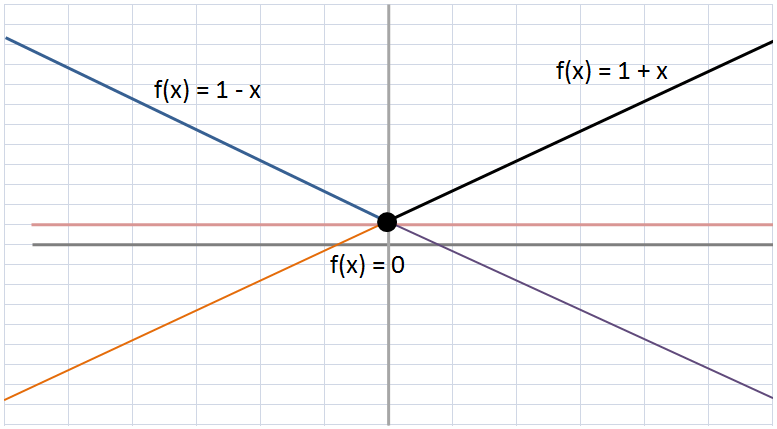
View full question & answer→Question 134 Marks
If $\text{f(x)}=\log_\text{e}(1-\text{x})$ and $\text{g(x)}=[\text{x}],$ then determine the following functions:
$\Big(\frac{\text{f}}{\text{g}}\Big)\Big(\frac{1}{2}\Big)$
AnswerWe have,
$\text{f(x)}=\log_\text{e}(1-\text{x})$
and $\text{g(x)}=[\text{x}]$
$\text{f(x)}=\log_\text{e}(1-\text{x})$ is defined, if 1 - x > 0
$\Rightarrow1>\text{x}$
$\Rightarrow\text{x}<1$
$\Rightarrow\text{x}\in(-\infty,1)$
$\therefore\text{ Domain(f)}=(-\infty,1)$
$\text{g(x)}=[\text{x}]$ is defined for all $\text{x}\in\text{R}$
$\therefore\ \text{Domain(g)}=\text{R}$
$\therefore\ \text{Domain(f)}\cap\text{R}\text{ Domain(g)}=(-\infty,1)\cap\text{R}$
$=(-\infty,1)$
$\Big(\frac{\text{f}}{\text{g}}\Big)\Big(\frac{1}{2}\Big)$= does not exist.
View full question & answer→Question 144 Marks
If $\text{f(x)}=\frac{1+\text{x}}{1-\text{x}},$ show that $\text{f}\big[\text{f}\text{(x)}\big]=\text{x}$
AnswerWe have,
$\text{f(x)}=\frac{1+\text{x}}{1-\text{x}}$
Now, $\text{f}\big[\text{f}\text{(x)}\big]=\text{f}\Big(\frac{\text{x}+1}{1-\text{x}}\Big)$
$=\frac{\big(\frac{\text{x}+1}{1-\text{x}}\big)+1}{\big(\frac{\text{x}+1}{1-\text{x}}\big)-1}$
$=\frac{\frac{\text{x}+1+{\text{x}}-1}{{\text{x}}-1}}{\frac{\text{x}+1-1(\text{x}-1)}{\text{x}-1}}$
$=\frac{\frac{2\text{x}}{\text{x}-1}}{\frac{\text{x}+1-\text{x}+1}{\text{x}-1}}$
$=\frac{2\text{x}}{2}$
$=\text{x}$
$\therefore\ \text{f}\big[\text{f}\text{(x)}\big]=\text{x}$ Hence, proved.
View full question & answer→Question 154 Marks
Let f, g : R → R be defined, respectively by f(x) = x + 1 and g(x) = 2x - 3. Find f + g, f - g and $\frac{\text{f}}{\text{g}}$
Answerf, g : R → R defined by (f + g)(x) = 3x - 2
f, g : R → R defined by (f - g)(x) = -x + 4
$\text{f}:\text{R}-\Big\{\frac{3}{2}\Big\}\rightarrow\text{R}$ defined by $\frac{\text{f}}{\text{g}}(\text{x})=\frac{\text{x}+1}{2\text{x}-3}$
View full question & answer→Question 164 Marks
If $\text{f(x)}=\log_\text{e}(1-\text{x})$ and $\text{g(x)}=[\text{x}],$ then determine the following functions:
$\Big(\frac{\text{g}}{\text{f}}\Big)\Big(\frac{1}{2}\Big)$
AnswerWe have,
$\text{f(x)}=\log_\text{e}(1-\text{x})$
and $\text{g(x)}=[\text{x}]$
$\text{f(x)}=\log_\text{e}(1-\text{x})$ is defined, if 1 - x > 0
$\Rightarrow1>\text{x}$
$\Rightarrow\text{x}<1$
$\Rightarrow\text{x}\in(-\infty,1)$
$\therefore\text{ Domain(f)}=(-\infty,1)$
$\text{g(x)}=[\text{x}]$ is defined for all $\text{x}\in\text{R}$
$\therefore\ \text{Domain(g)}=\text{R}$
$\therefore\ \text{Domain(f)}\cap\text{R}\text{ Domain(g)}=(-\infty,1)\cap\text{R}$
$=(-\infty,1)$
$\Big(\frac{\text{g}}{\text{f}}\Big)\Big(\frac{1}{2}\Big)=\frac{\big[\frac{1}{2}\big]}{\log_\text{e}\big(1-\frac{1}{2}\big)}=0$
View full question & answer→Question 174 Marks
If $\text{f(x)}=\frac{1}{1-\text{x}},$ show that $\text{f}\big[\text{f}\{\text{f(x)}\}\big]=\text{x}$
AnswerWe have,
$\text{f(x)}=\frac{1}{1-\text{x}}$
Now, $\text{f}\{\text{f}(\text{x})\}=\text{f}\Big\{\frac{1}{1-\text{x}}\Big\}$
$=\frac{1}{1-\frac{1}{1-\text{x}}}$
$=\frac{1}{\frac{1-\text{x}-1}{1-\text{x}}}$
$=\frac{1-\text{x}}{-\text{x}}$
$=\frac{\text{x}-1}{\text{x}}$
$\therefore\ \text{f}\big[\text{f}\{\text{f(x)}\}\big]=\text{f}\Big\{\frac{1}{1-\text{x}}\Big\}$
$=\frac{1}{1-\big(\frac{\text{x}-1}{\text{x}}\big)}$
$=\frac{1}{\frac{\text{x}-\text{x}+1}{\text{x}}}$
$=\frac{\text{x}}{1}$
$=\text{x}$
$\therefore\ \text{f}\big[\text{f}\{\text{f(x)}\}\big]=\text{x}$ Hence, proved.
View full question & answer→Question 184 Marks
If $f, g$ and h are real functions defined by $\text{f(x)}=\sqrt{\text{x}+1},\text{ g(x)}=\frac{1}{\text{x}}$ and $h(x) = 2x^2 - 3,$ find the values of $(2f + g - h)(1)$ and $(2f + g - h) (0).$
AnswerWe have, $\text{f(x)}=\sqrt{\text{x}+1},\text{ g(x)}=\frac{1}{\text{x}}$ and $h(x) = 2x^2 - 3$
Clearly, f(x) is defined for $\text{x}+1\geq0$
$\Rightarrow\text{x}\geq-1$
$\Rightarrow\text{x}\in[-1,\infty] g(x)$ is defined for
$\text{x}\neq0$
$\Rightarrow\text{x}\in\text{R}-\{0\}$ and,
h(x) is defined forll all $\text{x}\in\text{R}$
$\therefore\text{ Domain(f)}\cap\text{Domain(g)}\cap\text{Domain(h)}=[-1,\infty]-\{0\}$
Clearly, $2\text{f}+\text{g}-\text{h}:[-1,\infty]-\{0\}\rightarrow\text{R}$ is given by
$(2\text{f}+\text{g}-\text{h})(\text{x})=2\text{f(x)}+\text{g(x)}-\text{h(x)}$
$=2\sqrt{\text{x}+1}+\frac{1}{\text{x}}-2\text{x}^2+3$
$\therefore\ (2\text{f}+\text{g}-\text{h})(1)=2\sqrt{1+1}+\frac{1}{1}-2\times(1)^2+3$
$=2\sqrt{2}+1-2+3$
$=2\sqrt{2}+4-2$
$=2\sqrt{2}+2$and $(2\text{f}+\text{g}-\text{h})(0)$
does not exist, it is not list in the domain
$\text{x}\in[-1,\infty]-\{0\}$
View full question & answer→