MCQ 11 Mark
The line $2x - y + 4 = 0$ cuts the parabola $y^2 = 8x$ in $P$ and $Q$. The mid$-$point of $PQ$ is
- A
$(1, 2)$
- B
$(1, -2)$
- ✓
$(-1, 2)$
- D
$(-1, -2)$
AnswerCorrect option: C. $(-1, 2)$
Let the coordinates of $P$ and $Q$ be $( at_1^2, 2 at_1)$ and $(at_2^2, 2at_2),$ respectively.
$\text{Slope of PQ }=\frac{2\text{at}_2-2\text{at}_1}{\text{at}_2^2-\text{at}_1^2}...(1)$
But, the slope of $PQ$ is equal to the slope of $2x - y + 4 = 0.$
$\therefore\ \text{Slope of PQ}=\frac{-2}{-1}=2$
From $(1),$
$\frac{2\text{at}_2-2\text{at}_1}{\text{at}_2^2-\text{at}_1^2}=2\ ...(2)$
Putting $4a = 8,$
$a = 2$
$\therefore$ Focus of the given parabola $= (a, 0) = (2, 0)$
Using equation $(2):$
$\frac{4(\text{t}_2-\text{t}_1)}{2(\text{t}_2^2-\text{t}_1^2)}=2$
$\frac{(\text{t}_2-\text{t}_2)}{(\text{t}_2^2-\text{t}_1^2)}=1$
$\Rightarrow\ \text{t}_1+\text{t}_2=1$
As, points $P$ and $Q$ lie on $2x - y + 4 = 0$
$\Rightarrow P(at_1^2, 2at_1)$ or $P(2t_1^2, 4t_1)$ lie on line $2x - y + 4 = 0$
$\Rightarrow 2(2t_1^2) - (4t_1) + 4 = 0$
$\Rightarrow t_1^2 - t_1 + 1 = 0 ...(3)$
Also, $Q(at_2^2, 2at_2)$ or $P(2t_2^2, 4t_2)$ lie on line $2x - y + 4 = 0$
$\Rightarrow 2(2t_2^2) - (4t_2) + 4 = 0$
$\Rightarrow t_2^2 - t_2 + 1 = 0 ...(4)$
Adding $(3)$ and $(4),$ we get,
$\Rightarrow t_1^2 - t_1 + 1 + t_2^2 - t_2 + 1 = 0$
$\Rightarrow (t_1^2 + t_2^2) - (t_1 + t_2) + 2 = 0$
$\Rightarrow (t_1^2 + t_2^2) - 1 + 2 = 0 [t_1 + t_2 = 1,$ proved above$]$
$\Rightarrow (t_1^2 + t_2^2) = -1$
Let $(x_1, y_1)$ be the mid$-$point of $PQ.$
Then, we have:
$\text{y}_1=\frac{2\text{at}_2+2\text{at}_1}{2}=2(\text{t}_1+\text{t}_2)=2$
And, $\text{x}_1=\frac{\text{at}_1^2+\text{at}_2^2}{2}=\text{t}_1^2+\text{t}_2^2=-1$
$\Rightarrow\ (\text{x}_1, \text{y}_1)=(-1, 2)$
View full question & answer→MCQ 21 Mark
The equation of the parabola whose vertex is $(a, 0)$ and the directrix has the equation $x + y = 3a,$ is
- A
$x^2 + y^2 + 2xy + 6ax + 10ay + 7a^2 = 0$
- ✓
$x^2 - 2xy + y^2 + 6ax + 10ay - 7a^2 = 0$
- C
$x^2 - 2xy + y^2 - 6ax + 10ay - 7a^2 = 0$
- D
AnswerCorrect option: B. $x^2 - 2xy + y^2 + 6ax + 10ay - 7a^2 = 0$
Given: The vertex is at $(a, 0)$ and the directrix is the line $x + y = 3a.$
The slope of the line perpendicular to $x + y = 3a$ is $1.$
The axis of the parabola is perpendicular to the directrix and passes through the vertex.
$\therefore$ Equation of the axis of the parabola $= y − 0 = 1(x - a) ...(1)$
Intersection point of the directrix and the axis is the intersection point of $(1)$ and $x + y = 3a.$
Let the intersection point be $K.$
Therefore, the coordinates of $K$ are $(2a, a)$
The vertex is the mid$-$point of the segment joining $K$ and the focus $(h, k).$
$\therefore\ \text{a}=\frac{2\text{a+h}}{2},\ 0=\frac{\text{a+k}}{2}$
$h = 0, k = -a$
Let $P (x, y)$ be any point on the parabola whose focus is $S (h, k)$ and the directrix is $x + y= 3a.$
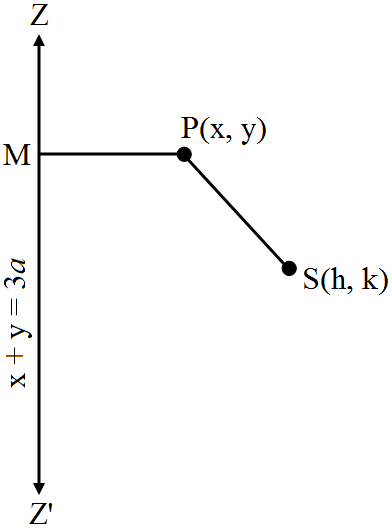
Draw $PM$ perpendicular to $x + y = 3a.$
Then, we have:
$SP = PM$
$\Rightarrow SP^2 = PM^2$
$\Rightarrow\ (\text{x}-0)^2+(\text{y+a})^2=\Big(\frac{\text{x+y}-3\text{a}}{\sqrt2}\Big)^2$
$\Rightarrow\ \text{x}^2+(\text{y+a})^2=\Big(\frac{\text{x+y}-3\text{a}}{\sqrt2}\Big)^2$
$\Rightarrow\ 2\text{x}^2+2\text{y}^2+2\text{a}^2+4\text{ay}=\text{x}^2+\text{y}^2+9\text{a}^2+2\text{xy}-6\text{ax}-6\text{ay}$
$\Rightarrow\ \text{x}^2+\text{y}^2-7\text{a}^2+10\text{ay}+6\text{ax}=0$ View full question & answer→MCQ 31 Mark
The vertex of the parabola $(y + a)^2 = 8a (x - a)$ is
- A
$(-a, -a)$
- ✓
$(a, -a)$
- C
$(-a, a)$
- D
AnswerCorrect option: B. $(a, -a)$
Given: The equation of the parabola is $(y + a)^2 = 8a (x - a).$
Putting $X = x - a, Y = y + a$
$Y^2 = 8aX$
Vertex $= (X = 0, Y = 0) = (x - a = 0, y + a = 0) = (x = a, y = -a)$
Hence, the vertex is at $(a, -a).$
View full question & answer→MCQ 41 Mark
If $V$ and $S$ are respectively the vertex and focus of the parabola $y^2 + 6y + 2x + 5 = 0$, then $SV =$
AnswerCorrect option: B. $\frac{1}{2}$
Given: The vertex and the focus of a parabola are $V$ and $S,$ respectively.
The given equation of parabola can be rewritten as follows:
$(y + 3)^2 - 9 + 5 + 2x = 0$
$\Rightarrow (y + 3)^2 + 2x = 4$
$\Rightarrow (y + 3)^2 = 4 - 2x$
$\Rightarrow (y + 3)^2 = -2(x - 2)$
Let $Y = y + 3, X = x - 2$
Then, the equation of parabola becomes $Y^2 = -2X.$
Vertex $= (X = 0, Y = 0) = (x - 2 = 0, y + 3 = 0) = (x = 2, y = -3)$
Comparing with $y^2 = 4ax:$
$4\text{a} = 2 \Rightarrow \text{a} =\frac{1}{2}$
Focus $=\ \Big(\text{X}=\frac{-1}{2}, \text{Y}=0\Big)=\Big(\text{x}-2=\frac{-1}{2},\text{y}+3=0\Big)=\Big(\text{x}=\frac{3}{2},\text{y}=-3\Big)$
$\Rightarrow\ \text{SV}=\sqrt{\Big(2-\frac{3}{2}\Big)^2+(-3+3)^2}=\frac{1}{2}$
View full question & answer→MCQ 51 Mark
The coordinates of the focus of the parabola $y^2 - x - 2y + 2 = 0$ are
- ✓
$\Big(\frac{5}{4}, 1\Big)$
- B
$\Big(\frac{1}{4}, 0\Big)$
- C
$(1, 1)$
- D
AnswerCorrect option: A. $\Big(\frac{5}{4}, 1\Big)$
Given: The equation of the parabola is $y^2 - x - 2y + 2 = 0.$
$\Rightarrow (y - 1) - 1 = (x - 2)$
$(y - 1) = x - 1$
Let $X = x - 1, Y = y - 1$
$Y = X$
Comparing with $Y = 4aX:$
$\text{a}=\frac{1}{4}$
Focus$=(\text{X} = \text{a}, \text{Y} = 0) = (\text{X} = \frac{1}{4}, \text{Y} = 0) = (\text{x} = \frac{1}{4}+ 1, \text{y} = 1) = (\text{x} = \frac{5}{4}, \text{y} = 1)$
Hence, the focus is at $\Big(\frac{5}{4}, 1\Big)$
View full question & answer→MCQ 61 Mark
The focus of the parabola $y = 2x^2 + x$ is
- A
$(0, 0)$
- B
$\Big(\frac{1}{2}, \frac{1}{4}\Big)$
- ✓
$\Big(-\frac{1}{4},0\Big)$
- D
$\Big(-\frac{1}{4}, \frac{1}{8}\Big)$
AnswerCorrect option: C. $\Big(-\frac{1}{4},0\Big)$
Given:
Equation of the parabola $= y = 2x^2 + x$
$\Rightarrow\ \text{x}^2+\frac{\text{x}}{2}=\frac{\text{y}}{2}$
$\Rightarrow\ \Big(\text{x}+\frac{1}{4}\Big)^2=\frac{\text{y}}{2}+\frac{1}{16}$
$\Rightarrow\ \Big(\text{x}+\frac{1}{4}\Big)^2=\frac{8\text{y}+1}{16}$
$\Rightarrow\ \Big(\text{x}+\frac{1}{4}\Big)^2=\frac{1}{2}(\text{y}+\frac{1}{8})$
$\text{Let }\text{X}=\text{x}+\frac{1}{4},\text{Y}=\text{y}+\frac{1}{8}$
$\therefore\ \text{X}^2=\frac{1}{2}\text{Y}$
Comparing with $X = 4aY$
$\text{a}=\frac{1}{8}$
Focus $=(\text{X}=0,\ \text{Y}=\text{a})=\Big(\text{x}=\frac{-1}{4},\text{y}=0\Big)$
Hence, the focus is at $\Big(-\frac{1}{4},0\Big).$
View full question & answer→MCQ 71 Mark
The vertex of the parabola $x^2 + 8x + 12y + 4 = 0$ is
- ✓
$(-4, 1)$
- B
$(4, -1)$
- C
$(-4, -1)$
- D
$(4, 1)$
AnswerCorrect option: A. $(-4, 1)$
Given:
$x^2 + 8x + 12y + 4 = 0$
$\Rightarrow (x+4)^2 - 16 + 12y + 4 = 0$
$\Rightarrow (x+4)^2 + 12y - 12 = 0$
$\Rightarrow (x+4)^2 = -12(y - 1)$
Let $X = x + 4, Y = y - 1$
$X^2 = -12Y$
Vertex $= (X = 0,Y = 0) = (x + 4 = 0,y - 1 = 0) = (x = -4,y = 1)$
Hence, the vertex is at $(-4, 1).$
View full question & answer→MCQ 81 Mark
If the focus of a parabola is $(-2, 1)$ and the directrix has the equation $x + y = 3,$ then its vertex is
AnswerCorrect option: C. $(−1, 2)$
Given :
The focus $S$ is at $(-2, 1)$ and the directrix is the line $x + y - 3 = 0.$
The slope of the line perpendicular to $x + y - 3 = 0$ is $1$.
The axis of the parabola is perpendicular to the directrix and passes through the focus.
$\therefore$ Equation of the axis of the parabola $= y - 1 = 1(x + 2) ...(1)$
Intersection point of the directrix and the axis is the intersection point of $(1)$ and $x + y - 3 = 0$.
Let the intersection point be $K$.
Therefore, the coordinates of $K$ will be $(0, 3).$
Let $(h, k)$ be the coordinates of the vertex, which is the mid-point of the segment joining $K$ and the focus.
$\therefore\ \text{h}=\frac{0-2}{2},\ \text{k}=\frac{3+1}{2}$
$h = -1, k = 2$
Hence, the coordinates of the vertex are $(−1, 2).$
View full question & answer→MCQ 91 Mark
The vertex of the parabola $(y - 2)^2 = 16 (x - 1)$ is
- ✓
$(1, 2)$
- B
$(-1, 2)$
- C
$(1, -2)$
- D
$(2, 1)$
AnswerCorrect option: A. $(1, 2)$
Given:
$(y - 2)^2 = 16 (x - 1)$
Let $X = x - 1, Y = y - 2$
$\therefore Y^2 = 16X$
Vertex $= (X = 0, Y = 0) = (x - 1 = 0, y - 2 = 0) = (x = 1, y = 2)$
Hence, the vertex is at $(1, 2).$
View full question & answer→MCQ 101 Mark
In the parabola $y^2 = 4ax,$ the length of the chord passing through the vertex and inclined to the axis at $\frac{\pi}{4}$ is
- ✓
$4\sqrt2\text{a}$
- B
$2\sqrt2\text{a}$
- C
$\sqrt2\text{a}$
- D
AnswerCorrect option: A. $4\sqrt2\text{a}$
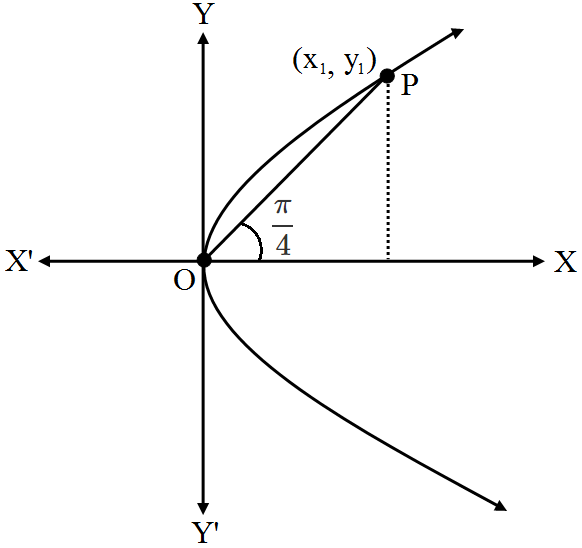
Let $OP$ be the chord.
Let the coordinates of $P$ be $(x_1, y_1).$
From the figure, we have:
$OP^2 = x_1^2 + y_1^2...(1)$
$\text{And },\tan\frac{\pi}{4}=\frac{\text{y}_1}{\text{x}_1}$
$\Rightarrow x_1 = y_{1 ...(2)}$
Also, $(x_1, y_1)$ lies on the parabola.
$\therefore y_1^2 = 4ax_1 ...(3)$
Using $(2)$ and $(3):$
$x_1^2 = 4ax_1 \Rightarrow x_1 = 4a ...(4)$
From $(4), (1)$ and $(2),$ we have:
$OP^2 = (4a)^2 + (4a)^2 = 32a^2$
$\Rightarrow\ \text{OP}=4\sqrt2\text{a}$
Therefore, the length of the chord is $4\sqrt2\text{a}$ a units.
View full question & answer→MCQ 111 Mark
If the coordinates of the vertex and the focus of a parabola are $(-1, 1)$ and $(2, 3) $respectively, then the equation of its directrix is
- ✓
$3x + 2y + 14 = 0$
- B
$3x + 2y - 25 = 0$
- C
$2x - 3y + 10 = 0$
- D
AnswerCorrect option: A. $3x + 2y + 14 = 0$
Given :
The vertex and the focus of a parabola are $(-1, 1)$ and $(2, 3),$ respectively.
$\therefore$ Slope of the axis of the parabola $=\frac{3-1}{2+1}=\frac{2}{3}$
Slope of the directrix $=\ \frac{-3}{2}$
Let the directrix intersect the axis at $K (r, s).$
$\therefore\ \frac{\text{r+2}}{2}=-1,\ \frac{\text{s}+3}{2}=1$
$\Rightarrow\ \text{r}=-4,\ \text{s}=-1$
Equation of the directrix :
$(\text{y}+1)=\frac{-3}{2}(\text{x}+4)$
$\Rightarrow\ 3\text{x}+2\text{y}+14=0$
View full question & answer→MCQ 121 Mark
Which of the following points lie on the parabola $x^2 = 4ay?$
- A
$x = at^2, y = 2at$
- B
$x = 2at, y = at^2$
- C
$x = 2at^2, y = at$
- ✓
$x = 2at, y = at^2$
AnswerCorrect option: D. $x = 2at, y = at^2$
Substituting $x = 2at, y = at^2$ in the given equation:
$(2at)^2 = 4a(at^2)$
$\Rightarrow 4a^2t^2 = 4a^2t^2$
Hence, $(2at, at^2)$ lies on the parabola $x^2 = 4ay.$
View full question & answer→MCQ 131 Mark
The parametric equations of a parabola are $x = t^2 + 1, y = 2t + 1.$ The cartesian equation of its directrix is
- ✓
$x = 0$
- B
$x + 1 = 0$
- C
$y = 0$
- D
AnswerCorrect option: A. $x = 0$
Given:
$x = t^2 + 1 ...(1)$
$y = 2t + 1 ...(2)$
From $(1)$ and $(2):$
$\text{x}=\Big(\frac{\text{y}-1}{2}\Big)^2+1$
On simplifying:
$(y - 1)^2 = 4(x - 1)$
Let $Y = y - 1$ and $X = x - 1$
$\therefore Y^2 = 4X$
Comparing it with $y^2 = 4ax:$
$a = 1$
Therefore, the equation of the directrix is $X = -a ,$
i.e. $x - 1= -1$
$\Rightarrow x = 0$
View full question & answer→MCQ 141 Mark
The equation of the directrix of the parabola whose vertex and focus are $(1, 4)$ and $(2, 6)$ respectively is
- ✓
$x + 2y = 4$
- B
$x - y = 3$
- C
$2x + y = 5$
- D
$x + 3y = 8$
AnswerCorrect option: A. $x + 2y = 4$
Given :
The vertex and the focus of a parabola are $(1, 4)$ and $(2, 6),$ respectively.
$\therefore$ Slope of the axis of the parabola $= \frac{6-4}{2-1}=2$
Slope of the directrix $=\ \frac{-1}{2}$
Let the directrix intersect the axis at $K (r, s).$
$\therefore\ \frac{\text{r}+2}{2}=1,\ \frac{\text{s}+6}{2}=4$
$\Rightarrow\ \text{r}=0,\ \text{s}=2$
Equation of the directrix:
$(\text{y}-2)=\frac{-1}{2}(\text{x}-0)$
$\Rightarrow x + 2y = 4$
View full question & answer→MCQ 151 Mark
The length of the latus$-$rectum of the parabola $y^2 + 8x − 2y + 17 = 0$ is
Answer$y^2 + 8x - 2y + 17 = 0$
$\Rightarrow (y - 1)^2 - 1 + 8x + 17 = 0$
$\Rightarrow (y - 1)^2 + 8x + 16 = 0$
$\Rightarrow (y - 1)^2 = -8(x + 2)$
Let $X = x + 2, Y = y - 1$
$\therefore Y^2 = -8X$
Comparing with $y^2= 4ax:$
$a = 2$
Length of the latus rectum $= 4a = 8$ units
View full question & answer→MCQ 161 Mark
The length of the latus$-$rectum of the parabola $x^2 - 4x - 8y + 12 = 0$ is
AnswerGiven:
$x^2 - 4x - 8y + 12 = 0$
$(x - 2)^2 - 8y + 8 = 0$
$(x - 2)^2 = 8y - 8 = 8(y - 1)$
Let $X = x - 2, Y = y - 1$
$\therefore X^2 = 8Y$
$\therefore$ Length of the latus rectum $= 4a = 8$ units
View full question & answer→MCQ 171 Mark
The equation $16x^2 + y^2 + 8xy - 74x - 78y + 212 = 0$ represents
AnswerComparing the given equation with $ax^2 + by^2 + 2hxy + 2gx + 2fy + c = 0$, we get:
$a = 16, b = 1, h = 4$
We have : $h^2 = 16 = ab$
Thus, the given equation represents a parabola.
View full question & answer→MCQ 181 Mark
The locus of the points of trisection of the double ordinates of a parabola is a
Answer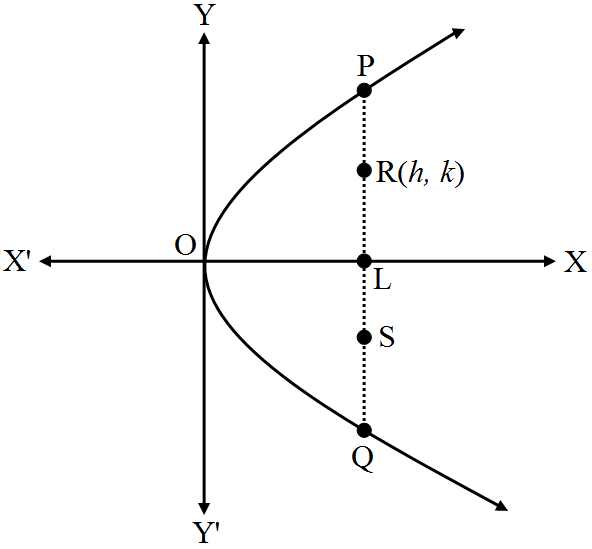
Suppose $\ce{PQ}$ is a double ordinate of the parabola $y^2 = 4ax.$
Let $R$ and $S$ be the points of trisection of the double ordinates.
Let $(h, k)$ be the coordinates of $R.$
Then, we have:
$\ce{OL = h}$ and $\ce{RL = k}$
$\therefore \ce{RS = RL + LS = k + k = 2k}$
$\Rightarrow \ce{PR = RS = SQ = 2K}$
$\Rightarrow \ce{LP = LR + RP = k + 2k = 3k}$
Thus, the coordinates of $P$ are $(h, 3k)$ which lie on $y^2 = 4ax$.
$\therefore$ $9k^2 = 4ah$
Hence, the locus of the point $(h, k)$ is $9\text{y} = 4\text{ax}$
i.e. $\text{y}^2=\Big(\frac{4\text{a}}{9}\Big)\text{x}$
which represents a parabola. View full question & answer→MCQ 191 Mark
The directrix of the parabola $x^2 - 4x - 8y + 12 = 0$ is
- A
$y = 0$
- B
$x = 1$
- ✓
$y = -1$
- D
$x = -1$
AnswerCorrect option: C. $y = -1$
Given:
$x^2 - 4x - 8y + 12 = 0$
$\Rightarrow (x - 2)^2 - 4 - 8y + 12 = 0$
$\Rightarrow (x - 2)^2 = 8y - 8$
$\Rightarrow (x - 2)^2 = 8(y - 1)$
Putting $X = x - 2, Y = y - 1:$
$X^2 = 8Y$
Comparing with $X^2 = 4aY$:
$a = 2$
Equation of the directrix:
$Y = -a$
$\Rightarrow Y = -2$
$\Rightarrow y - 1 = -2$
$\Rightarrow y = -2 + 1$
$\Rightarrow y = -1$
View full question & answer→MCQ 201 Mark
The equation of the parabola whose focus is $(1, -1)$ and the directrix is $x + y + 7 = 0$ is
- A
$x^2 + y^2 - 2xy - 18x - 10y = 0$
- B
$x^2 - 18x - 10y - 45 = 0$
- C
$x^2 + y^2 - 18x - 10y - 45 = 0$
- ✓
$x^2 + y^2 - 2xy - 18x - 10y - 45 = 0$
AnswerCorrect option: D. $x^2 + y^2 - 2xy - 18x - 10y - 45 = 0$
Let $P (x, y)$ be any point on the parabola whose focus is $S (1, -1)$ and the directrix is $x + y+ 7 = 0$.
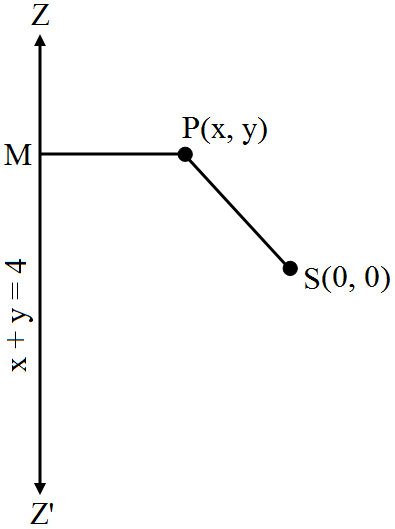
Draw $PM$ perpendicular to $x + y + 7 = 0$.
Then, we have:
$SP = PM$
$\Rightarrow SP^2 = PM^2$
$\Rightarrow\ (\text{x} - 1)^2+ (\text{y} + 1)^2= \Big(\frac{\text{x+y+7}}{\sqrt{1+1}}\Big)^2$
$\Rightarrow\ (\text{x} - 1)^2+ (\text{y} + 1)^2= \Big(\frac{\text{x+y+7}}{\sqrt{2}}\Big)^2$
$\Rightarrow\ 2(\text{x}^2+1-2\text{x}+\text{y}^2+1+2\text{y})\\ \ \ =\text{x}^2+\text{y}^2+49+2\text{xy}+14\text{y}+14\text{x}$
$\Rightarrow\ (2\text{x}^2+2-4\text{x}+2\text{y}^2+2+4\text{y})\\ \ \ =\text{x}^2+\text{y}^2+49+2\text{xy}+14\text{y}+14\text{x}$
$\Rightarrow\ \text{x}^2+\text{y}^2-45-10\text{y}-2\text{xy}-18\text{x}=0$
Hence, the required equation is $x^2 + y^2 - 2xy - 18x - 10y - 45 = 0.$ View full question & answer→MCQ 211 Mark
The equation of the parabola with focus $(0, 0)$ and directrix $x + y = 4$ is
- ✓
$x^2 + y^2 - 2xy + 8x + 8y - 16 = 0$
- B
$x^2 + y^2 - 2xy + 8x + 8y = 0$
- C
$x^2 + y^2 + 8x + 8y - 16 = 0$
- D
$x^2 - y^2 + 8x + 8y - 16 = 0$
AnswerCorrect option: A. $x^2 + y^2 - 2xy + 8x + 8y - 16 = 0$
Let $P (x, y)$ be any point on the parabola whose focus is $S (0, 0)$ and the directrix is$ x + y = 4.$
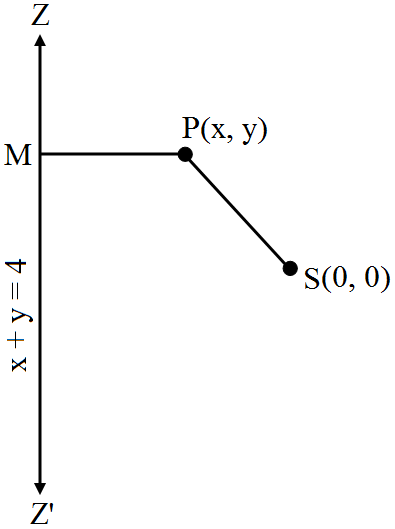
Draw $PM$ perpendicular to $x + y = 4.$
Then, we have:
$SP = PM$
$\Rightarrow SP^2 = PM^2$
$\Rightarrow\ (\text{x}-0)^2+(\text{y}-0)^2=\Big(\frac{\text{x+y}-4}{\sqrt2}\Big)^2$
$\Rightarrow\ \text{x}^2+\text{y}^2=\Big(\frac{\text{x+y}-4}{\sqrt2}\Big)^2$
$\Rightarrow 2x^2 + 2y^2 = x^2 + y^2 + 16 + 2xy - 8x - 8y$
$\Rightarrow x^2 + y^2 - 2xy + 8x + 8y - 16 = 0$ View full question & answer→MCQ 221 Mark
The length of the latus$-$rectum of the parabola $4y^2 + 2x - 20y + 17 = 0$ is
- A
$3$
- B
$6$
- ✓
$\frac{1}{2}$
- D
$9$
AnswerCorrect option: C. $\frac{1}{2}$
Given: $4y^2 + 2x - 20y + 17 = 0$
$\Rightarrow\ \text{y}^2+\frac{\text{x}}{2}-5\text{y}+\frac{17}{4}=0$
$\Rightarrow\ \Big(\text{y}-\frac{5}{2}\Big)^2+\frac{\text{x}}{2}-2=0$
$\Rightarrow\ \Big(\text{y}-\frac{5}{2}\Big)^2=-1\Big(\frac{\text{x}}{2}-2\Big)$
$\Rightarrow\ \Big(\text{y}-\frac{5}{2}\Big)^2=\frac{-1}{2}(\text{x}-4)$
Let $\text{X}=\text{x}-4,\ \text{Y}=\text{y}-\frac{5}{2}$
$\therefore\ \text{Y}^2=\frac{-\text{X}}{2}$
$\therefore$ Length of the latus rectum $=\ 4\text{a}=\frac{1}{2}$ units
View full question & answer→