Questions

Solve the Following Question.(4 Marks)

Take a timed test

17 questions · self-marked practice — reveal the answer and mark yourself.

Question 14 Marks
Find the vertex, focus, axis, directrix and latus-rectum of the following parabolas:
$y^2 = 5x - 4y - 9.$
Answer
The given equation is
$\text{y}^2=\text{5x}-\text{4y}-9$
$\Rightarrow\text{y}^2+\text{4y}=\text{5x}-9$
$\Rightarrow\text{y}^2+\text{4y}+4=\text{5x}-9+4$
$\Rightarrow\text{(y}+2)^2=\text{5x}-5$
$\Rightarrow\text{(y}+2)^2=5\text{(x}-1)....\text{(i)}$
Shifting the origin to the point $(1, -2)$ without rotating the axes and denoting the new coordinates w.r.t these axes by $X$ and $Y,$ we have,
$\text{x}=\text{X}+1,\ \text{y}=\text{Y}-2....\text{(ii)}$
Using these relation equation (i), redus to
$\text{Y}^2=5\text{X}......\text{(iii)}$
This is of the form $\text{Y}=\text{4aX},$ on comparing, we get
$\text{4a}=5$
$\Rightarrow\text{a}=\frac{5}{4}$
Now,
Vertex: The coordinates of the vertex w.r.t new axes are $(\text{X}=0,\ \text{Y}=0)$
$\therefore \text{ x}=0+1,\ \text{y}=0-2$ [Using equation (iii)]
$\Rightarrow\text{x}=1,\ \text{y}=-2$
$\therefore$ coordinate of the vertex w.r.t new axes are (1, -2).
Focus: The coordinate of the focus w.r.t new axes are $\Big(\text{x}=\frac{5}{4},\text{y}=0\Big)$
$\therefore\text{x}=\frac{9}{4}+1,\ \text{y}=0-2$
$\Rightarrow\text{x}=\frac{9}{4},\ \text{y}=-2$
Axis: Equation of the axes of the parabola w.r.t new axes is
$\text{y}=0$
$\therefore\ \text{y}=0-2$
$\Rightarrow\text{y}=-2$
$\therefore$ equation of axis w.r.t old axes is $\text{y}=-2.$
Directrix: Equation of the directrix of the parabola w.r.t new axes is
$\text{x}=\frac{-5}{4}$
$\therefore\ \text{x}=\frac{-5}{4}+1$
$\Rightarrow\text{x}=\frac{-1}{4}$
$\Rightarrow\text{4x}+1=0$
$\therefore $ Equation of the directrix of the parabola w.r.t oid axes is $\text{4x}+1=0$
Latus-rectum: The length of the latus-rectum $= 4a$
$=4\times\frac{5}{4}$
$=5.$
View full question & answer
Question 24 Marks
Find the equation of the parabola whose:
Focus is (0, 0) and the directrix 2 x - y + 1 = 0
Answer
Let P(X, Y) be any point on the parabola whose focus is S (0, 0) and the directrix 2x - y -1 = 0. Draw PM perpendicular from P(X, Y) on the directrix 2x - y - 1 = 0.
Then by definition
$\text{SP}=\text{PM}$
$\Rightarrow\text{SP}^2=\text{PM}^2$
$\Rightarrow\text{(x}-0)^2+\text{(y}-0)^2=\Bigg(\frac{\text{2x}-\text{y}-1}{\sqrt{(2)^2+(-1)^2}}\Bigg)^2$
$\Rightarrow\text{x}^2+\text{y}^2=\frac{\text{(2x}-\text{y}-1)^2}{(\sqrt5)^2}$
$\Rightarrow5(\text{x}^2+\text{y}^2)=(\text{2x}-\text{y}-1)^2$
$\Rightarrow5\text{x}^2+5\text{y}^2=\text{}\text{2x}^2+(-\text{y)}^2+(-1)^2+2\times\text{2x}\times\$-\text{y)}\times2\times(-\text{y)}\times(-1)+2\times(-1)\times\text{2x}$
$\Rightarrow5\text{x}^2+\text{5y}^2=\text{4x}^2+\text{y}^2+1-\text{4xy}+\text{2y}-\text{4y}$
$\Rightarrow5\text{x}^2+\text{5y}^2-\text{4x}^2-\text{y}^2-1+\text{4xy}-\text{2y}+\text{4y}=0$
$\Rightarrow\text{x}^2+\text{4y}^2+\text{4xy}+\text{4x}-\text{2y}-1=0$
This is the equetion of the required parabola.
View full question & answer
Question 34 Marks
Find the vertex, focus, axis, directrix and latus-rectum of the following parabolas:
$y^2 + 4x + 4y - 3 = 0$
Answer
The given equation is
$\text{y}^2+\text{4x}+\text{4y}-3=0$
$\Rightarrow\text{y}^2+\text{4y}=-\text{4x}+3$
$\Rightarrow\text{y}^2+2\times\text{y}\times2+2^2=-\text{4x}+3+2^2$
$\Rightarrow\text{(y}+\text{2})^2=-\text{4x}+3+4$
$\Rightarrow\text{(y}+\text{2})^2=-\text{4x}+7$
$\Rightarrow\text{(y}+\text{2})^2=-4\Big(\text{x}-\frac{7}{4}\Big).....\text{(i)}$
Shifting the origin to the point $\Big(\frac{7}{4},-2\Big)$ without rotating the axes and denoting the new coordinates with respect to these axes by $X$ and $Y,$ we have
$\text{x}=\text{X}+\frac{7}{4},\ \text{y}=\text{Y}-2.....\text{(ii)}$
Using these relation (i), reduces to $\text{Y}^2=-\text{4X}.....\text{(iii)}$
This is of the form $\text{Y}^2=-4\text{X}$ on comparing, we get $\text{a} = 1$
Now,
Vertex: The coordinates of the vertex w.r.t new axes are $(\text{X}=0,\ \text{Y}=0)$
$\therefore\ \text{x}=0+\frac{7}{4},\ \text{y}=0-2$ [Using equation (ii)]
$\Rightarrow\text{x}=\frac{7}{4},\ \text{y}=-2$
$\therefore$ coordinates of the vertex w.r.t old axes are $\Big(\frac{7}{4},-2\Big).$
Focus: The coordinate of the focus w.r.t new axes are $(\text{X}=-1,\ \text{y}=0)$
$\therefore\text{ x}=-1+\frac{7}{4}$ and $\text{y}=0-2$ [Using equation (ii)]
$\Rightarrow\text{x}=\frac{3}{4},$ and $\text{y}=-2$
$\therefore$ coordinate of the focus w.r.t old axes are $\Big(\frac{3}{4},-2\Big).$
Axis: Equation of the axis of the parabola w.r.t new axes is
$\text{y}=0$
$\therefore\text{ y}=0-2$
$\Rightarrow\text{ y}=-2$
$\therefore$ equation of the w.r.t old axes is $\text{y}+2=0.$
View full question & answer
Question 44 Marks
Find the vertex, focus, axis, directrix and latus-rectum of the following parabolas:
$x^2 + y = 6x - 14.$
Answer
The given equation is
$\text{x}^2 +\text{y} = \text{6x}-14$
$\Rightarrow\text{x}^2-\text{6x} =-\text{y} -14$
$\Rightarrow\text{x}^2-2\times\text{x}\times3+9 =-\text{y} -14+9$
$\Rightarrow\text{(x}-\text{3})^2 =-\text{y} -5$
$\Rightarrow\text{(x}-\text{3})^2 =-1\text{(y} +5).....\text{(i)}$
Shifting the origin to the point (3, -5) without rotating the axes and denoting the new coordinates w.r.t these axes by X and Y, we have,
$\text{x}=\text{X}+3,\ \text{y}=\text{Y}-5....\text{(ii)}$
Using these relation equation (i), redus to
$\text{X}^2=-\text{y}......\text{(iii)}$
This is of the form $\text{Y}=-\text{4aX},$ on comparing, we get
$\text{4a}=1$
$\Rightarrow\text{a}=\frac{1}{4}$
Now,
Vertex: The coordinates of the vertex w.r.t new axes are $(\text{X}=0,\ \text{Y}=0)$
$\therefore \text{ x}=0+3,\ \text{y}=0-5$
$\Rightarrow\text{x}=3,\ \text{y}=-5$
$\therefore$ coordinate of the vertex w.r.t new axes are (3, -5).
Focus: The coordinate of the focus w.r.t new axes are $\Big(\text{x}=0,\ \text{y}=\frac{-1}{4}\Big)$
$\therefore\text{x}=0+3,\ \text{y}=\frac{-1}{4}-5$
$\Rightarrow\text{x}=3,\ \text{y}=\frac{-21}{4}$
$\therefore$ Coordinates of the focus w.r.t old axes are $\Big(3,\frac{-21}{4}\Big)$
Axis: Equation of the axes of the parabola w.r.t new axes is
$\text{x}=0$
$\therefore\ \text{x}=0+3$
$\Rightarrow\text{x}=3$
$\therefore$ equation of axis w.r.t old axes is $\text{x}=3.$
Directrix: Equation of the directrix of the parabola w.r.t new axes is
$\text{y}=\frac{1}{4}$
$\therefore\ \text{y}=\frac{1}{4}-5$
$\Rightarrow\text{y}=\frac{-19}{4}$
$\Rightarrow\text{4y}+19=0$
$\therefore $ Equation of the directrix of the parabola w.r.t oid axes is $\text{4y}+19=0$
Latus-rectum: The length of the latus-rectum = 4a
$=4\times\frac{1}{4}$
$=1.$
View full question & answer
Question 54 Marks
If the points (O, 4) and(O, 2) are respectively the vertex and focus of a parabola, then find the equation of the parabola.
Answer
The vertex and focus of the parabola are A(0, 4) and F(0, 2) respectively.
$\text{AF} = 2$
As point A and F lie on y-axis, so y-axis is the axis of the parabola.
If the diretrix meets the axis of parabola at point Z, then $\text{AZ = AF} = 2.$
$\therefore\ \text{OZ = OF + FA + AZ}=2+2+2=6$
Let P(x, y) be any point in the plane of focus and diretrix, and MP be the perpendicular distance from P to the diretrix, then P lies on parabola iff
$\text{ FP = MP}$
$\Leftrightarrow\sqrt{\text{(x}-0)^2+\text{(y}-2)^2}=\frac{\big|\text{y}-6\big|}{1}$
$\Leftrightarrow\ \text{x}^2+\text{(y}-2)^2=\text{(y}-6)^2$
$\Leftrightarrow\ \text{x}^2+\text{y}^2-\text{4y}+4=\text{y}^2-\text{12y}+36$
$\Leftrightarrow\text{x}^2+\text{8y}=32$
$\text{x}^2+\text{8y}=32$ is the required equation of the parabola.
View full question & answer
Question 64 Marks
Find the vertex, focus, axis, directrix and latus-rectum of the following parabolas:
$y^2 - 4y + 4x = 0.$
Answer
The given equation is
$\text{y}^2-\text{4y}+\text{4x}=0$
$\Rightarrow\text{y}^2-\text{4y}=-\text{4x}$
$\Rightarrow\text{y}^2-2\times\text{x}\times2+(2)^2=-\text{4x}+(2)^2$
$\Rightarrow\text{(y}-\text{2})^2=-\text{4x}+4$
$\Rightarrow\text{(y}-\text{2})^2=-\text{4(x}-1).....\text{(i)}$
Shifting the origin to the point $(1, 2)$ without ratating the axes and denoting the new coordinates with respect to these axes by $X$ and $Y,$ we have
$\text{x}=\text{X}+1,\text{y}=\text{Y}+2.....\text{(ii)}$ 
Using these relations equation (i), reduces to
$\text{Y}^2=-\text{4X}....\text{(iii)}$
This is of the form $\text{Y}^2=-4\text{aX}.$
On comparing, we get, $a = 1.$
Now,
Vertex: The coordinates of the vertexw.r.t to new axes are $(\text{X}=0,\ \text{y=0}).$
$\therefore\text{ x}=0+1,\text{y}=0+2$  [using equation (ii)]
$\Rightarrow \text{x}=1,\text{y}=2$ 
$\therefore$ coordinates of the vertex w.r.t old axes are, $(1, 2)$
Focus: the coordinates of the focus with respect to new axes are $(\text{X}=0,\ \text{Y}=0).$
Putting $\text{X}=-1$ and $\text{Y}=0$ in equation (ii),we get
$\text{x}=-1+1,\ \text{y}=0+2$
$\Rightarrow\text{x}=0,\ \text{y}=2$
$\therefore$ coordinates of the focus w.r.t old axes are, $(0, 2)$
Axis: Equation of the axis of the parabola w.r.t new axes is $\text{Y}=0$
$\therefore \text{y}=0+2 [$Using equation $(ii)]$
$\Rightarrow\text{y}=2$
$\therefore$ equation of axis w.r.t old axes is $\text{y}=2$
Directrix: Equation of the directrix of the parabola w.r.t new axes is $\text{x}=1$
$\therefore\text{x}=1+1 [$Using equation $(ii)]$
$\Rightarrow\text{x}=2$
$\therefore$ equation of the directrix of the parabola w.r.t old axes is $\text{x}=2$
Latus-rectum: The length of the latus-rectum $= 4a$
$=4\times1$
$=4.$
View full question & answer
Question 74 Marks
The cable of a uniformly loaded suspension bridge hangs in the form of a parabola. The roadway which is horizontal and 100m long is supported by vertical wires attached to the cable, the longest wire being 30m and the shortest wire being 6m. Find the length of a supporting wire attached to the roadway 18m from the middle.
Answer
Let CAB be the bridge and LOX be the road way. Let A be the centre of the bridge. We find that the coordinates of A are (o, 6).
Clearly, the bridge is in the shope of a parabola having its vertex at A (D,6).
Let its equation be $\text{x}^2=\text{4a}\text{(y}-6)$
It posses through $\text{B}(50, 30).$ Therefore, $(50)^2=\text{4a}(30-6)$
$\Rightarrow\ 2500=\text{4a}\times24$
$\Rightarrow\frac{2500}{4\times24}=\text{a}$
$\Rightarrow\ \text{a}=\frac{625}{24}$
Putting the value of in (i), we get
$\text{x}^2=4\times\frac{625}{24}(\text{y}-6)$
$\Rightarrow\ \text{x}^2=\frac{625}{6}\text{(y}-6)$
Let l metres be the length of the vertical supporting cable 18 metres from the centre. Then, P(18, l) lies on (ii). Therefore
$(18)^2=\frac{625}{6}\text{(l}-6)$
$\Rightarrow\ 324\times6=625\text{(l}-6)$
$\Rightarrow\ \frac{1944}{625}=\text{(l}-6)$
$\Rightarrow\ \frac{1944}{625}+6=\text{l}$
$\Rightarrow\ \frac{1944+3750}{625}=\text{l}$
$\Rightarrow\ \text{l}=\frac{1944}{625}=9.11\text{m}\text{ (approx)}$
Hence, the required length of a supporting wire is 9.11m.
View full question & answer
Question 84 Marks
Find the equation of the parabola, if
The focus is at (-6, - 6) and the vertex is at (-2, 2).
Answer
Given Focus (-6, -6)
Vertex (-2, 2)
Slope of lone connecting vertext and focuse is $\frac{2+6}{-2+6}=2$
Slope is the midpoint of focus and point on directrix which passes through axis
$-2=\frac{-6+\text{x}}{2};2=\frac{-6+\text{y}}{2}$
$(\text{x, y})=(2, 10)$
Equation of directrix is given by
$\text{y}-10=\frac{-1}{2}(\text{x}-2)$
$\text{2y}-20=-\text{x}=2$
$\text{x}+\text{2y}=22$
Equation of parabola is $\text{(x + 6})^2+(\text{y}+6)^2=\frac{\text{(x}+\text{2y}-22)^2}{5}$
$5\Big[\text{x}^2+\text{y}^2+36+36+\text{12x}+\text{12y}\Big]=\Big[\text{x}^2+\text{4y}^2+484+4\text{xy}-88\text{y}-\text{44x}\Big]$
$\text{4x}^2+\text{y}^2-124-\text{4xy}+\text{10x}+\text{148y}=0$
$\text{(2x}-\text{y})^2+4\text{(26x}+\text{37y}-31)=0.$
View full question & answer
Question 94 Marks
Find the equation of the parabola, if
The focus is at $(0, -3)$ and the vertex is at $(0, 0).$
Answer
In a parabola, vertex is the mid-point of the focus and the point of the intersection of the axis and directrix.
So, let $(x_1, y_1)$ be the co-ordinate of the point of intersection of the axis and directrix.
Then $(0, 0) $ is the mid-point of the line segment joining $(0, 3)$ and $(x_1, y_1).$
$\therefore\frac{\text{x}_1+0}{2}=0$ and $\frac{\text{y}_1+0}{2}=0$
$\Rightarrow\text{x}_1=0$ and $\text{y}_1=3$
Thus, the directrix meets the axis at $(0, 3)$
$\therefore$ The equation of the directrix is $\text{y} = 3$
Clearly, the required parabola is not the form $\text{x}^2 = -\text{4ay},$ where $\text{a} = 3$
$\therefore$ equation of parabola is $\text{x}^2 = -4\times3\times\text{y}$
$\Rightarrow\text{x}^2=-\text{12y.}$
View full question & answer
Question 104 Marks
Find the coordinates of points on the parabola $y^2 = Bx$ whose focal distance is $4.$
Answer
We have $\text{y}^2=\text{8x}$
$\Rightarrow\ \text{y}^2=\text{4(2)x}$
Comparing it with the genaral equation of parabola $\text{y}^2=\text{4ax},$ we will get $\text{a}=2$
Let the required point be $(x_1, y_1)$
Now, Focal distance $= 4$
$\Rightarrow\ \text{x}_1+\text{a}=4$
$\Rightarrow\ \text{x}_1+2=4$
$\Rightarrow\ \text{x}_1=4$
Now, the point will satisfy the equation of parabota
$\therefore(\text{y}_1)^2=8(2)=16$
$\Rightarrow\ \text{y}_1=\pm4$
Hence, the coordinate of the point are $(2, 4)$ and $(2, -4).$
View full question & answer
Question 114 Marks
Find the equation of the parabola whose:
Focus is (1, 1) and the directrix is x + y + 1 = 0
Answer
Let P(X, Y) be any point on the parabola whose focus is S (1, 1) and the directrix x + y = 0. Draw PM perpendicular from P(X, Y) on the directrix x + y + 1 = 0.
Then by definition
$\text{SP}=\text{PM}$
$\Rightarrow\text{SP}^2=\text{PM}^2$
$\Rightarrow\text{(x}-1)^2+\text{(y}-1)^2=\Big(\frac{\text{x}+\text{y}+1}{\sqrt{1^2+1^2}}\Big)^2$
$\Rightarrow\text{x}^2+1-\text{2x}+\text{y}^2+1-\text{2y}=\Big(\frac{\text{x}+\text{y}+1}{\sqrt2}\Big)^2$
$\Rightarrow\text{x}^2+\text{y}^2-\text{2x}-\text{2y}+2=\frac{\text{(x}+\text{y}+1)^2}{2}$
$\Rightarrow\text{2(x}^2+\text{y}^2-\text{2x}-\text{2y}+2)=\text{x}^2+\text{y}^2+1+\text{2xy}+\text{2x}+\text{2y}$
$\Rightarrow\text{2x}^2+\text{2y}^2-\text{4x}-\text{4y}+4=\text{x}^2+\text{y}^2+1+\text{2xy}+\text{2x}+\text{2y}$
$\Rightarrow\text{2x}^2-\text{x}^2+\text{2y}^2-\text{y}^2-\text{2xy}-\text{4x}-\text{2x}-\text{4y}-\text{2y}+4-1=0$
$\Rightarrow\text{x}^2+\text{y}^2-\text{2xy}-\text{6x}-\text{6y}+3=0$
This is the equetion of the required parabola.
View full question & answer
Question 124 Marks
Find the area of the triartgle formed by the lines joining the vertex of the parabola $x^2 = 12y$ to the ends of its latus-rectum.
Answer
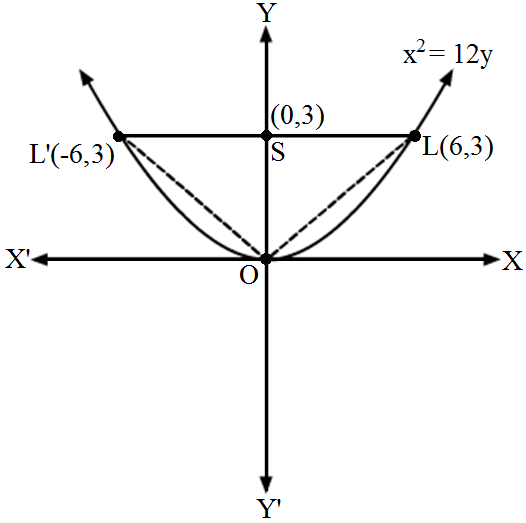
The given equation of the parabola is $x^2 = 12y.$
On comparing the given equation with $x^2 = 4ay:$
$a = 3$

Required area $=\frac{1}{2}(\text{LL}'\times\text{OS}) =\frac{1}{2}\times12\times3=18 $ square units
View full question & answer
Question 134 Marks
For the parabola $y^2 = 4px$ find the extremitiJs of a double ordinate of length $8p.$ Prove that the lines from the vertex to its extremities are at right angles.
Answer
Let $PQ$ be the double ordinate of length $8p$ of the parabola $\text{y}^2==\text{4px}.$
Then, $PR = QR = 4p.$
Let $\text{AR} = \text{x}_1.$ Then the coordinate of $P$ and $Q$ are $(\text{x}_1,\ 4\text{p})$ and $(\text{x}_1,\ -4\text{p})$ respectively.
Since P line on $\text{y}^2=\text{4px}$
$\therefore\ \text{(4p)}^2=\text{4px}_1$
$\Rightarrow\ \text{x}_1=4\text{p}$
So, coordinates of $p$ and $Q$ are $\text{(4p,}\text{ 4p})$ and $\text{(4p,}\ -\text{4p})$ respectively.
$\therefore$ The extremities of a double ordinate are $\text{(4p,}\text{ 4p})$ and $\text{(4p,}\ -\text{4p}).$
Also, the coordinates of the vertex $A$ are $(o, o).$
$\therefore m_1 =$ slope of $AP$
$=\frac{4\text{p}-0}{4\text{p}-0}$
$=1$
and, $m_2 =$ slope of $\text{AQ}=\frac{-\text{4p}-0}{\text{4p}-0}$
$=-1$
Clear $\text{y, m}_1\text{m}_2=-1.$
Hence, $\text{AP}\bot\text{AQ}$
$\therefore$ The lines from the vertex to its extremities are at right angles.
View full question & answer
Question 144 Marks
Find the equation of the parabola whose:
Focus is (3, 0) and the directrix is 3 x + 4y = 1
Answer
Let P(X, Y) be any point on the parabola whose focus is S(3, 0) and the directrix 3x + 4y = 1. Draw PM perpendicular from P(X, Y) on the diretrix 3x + 4y = 1.
Then by definition
$\text{SP = PM}$
$\Rightarrow\text{SP}^2=\text{PM}^2$
$\Rightarrow\text{(x}-3)^2+\text{(y}-0)^2=\Big(\frac{\text{3x+4y}-1}{\sqrt{(3)^2+(4)^2}}\Big)^2$
$\Rightarrow\text{x}^2+9-6\text{x}+\text{y}^2=\Big(\frac{\text{3x+4y}-1}{\sqrt{9+16}}\Big)^2$
$\Rightarrow\text{x}^2+9-\text{6x}+\text{y}^2=\frac{\text{(3x+4y}-1)^2}{\big(\sqrt{25}\big)^2}$
$\Rightarrow\text{x}^2+9+\text{6x}+\text{y}^2=\frac{\text{(3x}+\text{4y}-1)^2}{25}$
$\Rightarrow25(\text{x}^2-\text{6x}+\text{y}^2+9)=(\text{3x}+\text{4y}-1)^2$
$\Rightarrow25\text{x}^2-\text{150x}+\text{25y}^2+225=\text{(3x)}^2+\text{(4y)}^2+(-1)^2\\+2\times\text{3x}\times\text{4y}+2\times\text{4y}\times(-1)+2\times(-1)\times\text{3x}$
$\Rightarrow\text{25x}^2-\text{150x}+\text{25y}^2+225=\text{9x}^2+\text{16y}^2+1+\text{24xy}-\text{8y}-\text{6x}$
$\Rightarrow\text{25x}^2-\text{9x}^2+\text{25y}^2-\text{16y}^2-\text{150x}+\text{6x}+\text{8y}-\text{24xy}+225=0$
$\Rightarrow\text{16x}^2+\text{9x}^2-\text{144x}+\text{8y}-\text{24xy}+224=0$
$\Rightarrow\text{16x}^2+\text{9x}^2-\text{24xy}-\text{144x}+\text{8y}+224=0$
This is the questions of the required parabola.
View full question & answer
Question 154 Marks
Find the equations of the lines joining the vertex of the parabola $y^2 = 6x$ to the point on it which have abscissa $24.$
Answer
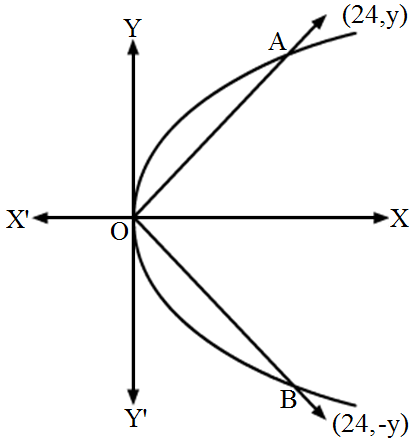
Let $A$ and $B$ be points on the parabola $y^2 = 6x$ and $OA, OB$ be the lines joining the vertex $O$ to the points $A$ and $B$ whose abscissa are $24.$

Now, $y^2 = 6 \times 24 = 144 y^2 = \pm 12$
 Therefore the coordinates of the points $A$ and $B$ are $(24, 12)$ and $(24, -12)$ respectively.
​​​​​​​ Hence the lines are given by $\text{y}-0=\pm\ \frac{12-0}{24-0}(\text{x}-0)$
$\Rightarrow\pm\ 2\text{y}=\text{x}$
View full question & answer
Question 164 Marks
If the line $y = mx + 1$ is tangent to the parabola $y^2 = 4x,$ then find the value of $m.$
Answer
The line $y = mx + 1$ is tangent to the parabola $y^2 = 4x.$
$\therefore\text{(mx}=1)^2=4\text{x}$
$\text{m}^2\text{x}^2+\text{(4mx}+1)=\text{4x}$
$\text{m}^2\text{x}^2+\text{(2m}-1)\text{x}+1=0$
As we know tangent touches the parabola, so the roots of the above quadratic wi II be equal.
$\Rightarrow\text{D}=\text{b}^2-\text{4ac}=0$
$\Rightarrow\ (2\text{m}-4)^2-4\text{(m}^2)(1)=0$
$\Rightarrow\text{4m}^2-16+\text{16m}-\text{4m}^2=0$
$\Rightarrow\text{m}=1.$
View full question & answer
Question 174 Marks
Find the equation of the parabola whose:
Focus is (2, 3) and the directrix x - 4 y + 3 = 0
Answer
Let P(X, Y) be any point on the parabola whose focus is S (2, 3) and the directrix x - 4y + 3 = 0. Draw PM perpendicular from P(X, Y) on the directrix x - 4y + 3 = 0.
Then by definition
$\text{SP}=\text{PM}$
$\Rightarrow\text{SP}^2=\text{PM}^2$
$\Rightarrow\text{(x}-2)^2+\text{(y}-3)^2=\Bigg(\frac{\text{x}-\text{4y}+3}{\sqrt{1^2+(-4)^2}}\Bigg)^2$
$\Rightarrow\text{x}^2+4-\text{4x}+\text{y}^2+9-\text{6y}=\frac{\text{(x}-\text{4y}+3)^2}{(\sqrt{17})^2}$
$\Rightarrow\text{x}^2+\text{y}^2-\text{4x}-\text{6y}+4+9=\frac{(\text{x}-\text{4y}+3)^2}{17}$
$\Rightarrow\text{17(x}^2+\text{y}^2-\text{4x}-\text{6y}+13)=\text{(x}-\text{4y}+3)^2$
$\Rightarrow\text{17x}^2+\text{17y}^2-\text{68x}-\text{102y}+122=\text{x}^2+(-\text{4y})^2\\+3^2+2\times\text{x}\times(-\text{4y)}+2\times(-\text{4y)}\times3+2\times3\times\text{x}$
$\Rightarrow\text{17x}^2+\text{17y}^2-\text{68x}-\text{102y}+221=\text{x}^2+\text{16y}^2+9-\text{8xy}-\text{24y}+\text{6x}$
$\Rightarrow\text{17x}^2-\text{x}^2+\text{17y}^2-\text{16}^2+\text{8xy}-\text{68x}-\text{6x}-\text{102y}+\text{24y}+221-9=0$
$\Rightarrow\text{16x}^2+\text{y}^2+\text{8xy}-\text{74x}-\text{78y}+212=0$
This is the questions of the required parabola.
View full question & answer