Questions

Solve the following Question.(1 Marks)

Take a timed test

58 questions · self-marked practice — reveal the answer and mark yourself.

Question 11 Mark
Four parallel lines intersect another set of five parallel lines. Find the number of distinct parallelograms formed.
Answer
The first set has 4 parallel lines and another set has 5 parallel lines. To form a parallelogram, we need 2 lines from each set.$\therefore$ Required number of distinct parallelograms formed $={ }^4 C _2 \times{ }^5 C _2$

= 6 × 10

= 60
View full question & answer
Question 21 Mark
Find the number of ways of dividing $20$ objects into three groups of sizes $8, 7,$ and $5.$
Answer
First we can select $8$ objects our of $20$ for the first group in ${ }^{20} C _8$ ways.Now there are $12$ objects left out of which we can select $7$ objects for the second group in ${ }^{12} C_7$ ways.
Remaining $5$ objects can be selected for the third group in ${ }^5 C _5$ ways.
$\therefore$ Required number of ways $={ }^{20} C _8 \times{ }^{12} C _7 \times{ }^5 C _5$
$=\frac{20 !}{8 ! 12 !} \times \frac{12 !}{7 ! 5 !} \times 1$
$=\frac{20 !}{8 ! 7 ! 5 !}$
View full question & answer
Question 31 Mark
A question paper has 6 questions. How many ways does a student have to answer if he wants to solve at least one question?
Answer
Every question is ‘SOLVED’ or ‘NOT SOLVED’. There are 6 questions.

Number of outcomes $=2^6$

This number includes one case when the student solves NONE of the questions.

$\therefore$ Required number of ways $=2^6-1=64-1=63$

View full question & answer
Question 41 Mark
A hall has 12 lamps and every lamp can be switched on independently. Find the number of ways of illuminating the hall.
Answer
Every lamp is either ON or OFF. There are 12 lamps

Number of instances $=2^{12}$

This number includes one case in when all 12 lamps are OFF.

$\therefore$ Required Number of ways $=2^{12}-1=4095$

View full question & answer
Question 51 Mark
A student passes an examination if he secures a minimum in each of the 7 subjects. Find the number of ways a student can fail.
Answer
Every subject a student may pass or fail.$\therefore$ Total number of outcomes $=2^7=128$

This number includes one case when the student passes in all subjects. Required number of ways = 128 – 1 = 127

View full question & answer
Question 61 Mark
$30$ objects are to be divided into three groups containing $7, 10, 13$ objects. Find the number of distinct ways of doing so.
Answer
First we can select $7$ objects out of $30$ for the first group in ${ }^{30} C _7$ ways.
Now there are $23$ objects left out of which we can select $10$ objects for the second group
in ${ }^{23} C _{10}$ ways.
Remaining $13$ objects can be selected for the third group in ${ }^5 C _5$ ways.
$\therefore$ Required number of ways $={ }^{30} C _7 \times{ }^{23} C _{10} \times{ }^{13} C _{13}$
$=\frac{30 !}{23 ! 7 !} \times \frac{23 !}{10 ! 13 !} \times 1$
$=\frac{30 !}{7 ! 10 ! 13 !}$
View full question & answer
Question 71 Mark
The Capital English alphabet has 11 symmetric letters that appear the same when looked at in a mirror. These letters are A, H, I, M, O, T, U, V, W, X, and Y. How many symmetric three letters passwords can be formed using these letters?
Answer
There are 11 symmetric letters.$\therefore$ Number of 3 Letter passwords $={ }^{11} P _3$

= 11 × 10 × 9 = 990

View full question & answer
Question 81 Mark
How many words can be formed by writing letters in the word CROWN in a different order?
Answer
Five Letters of the word CROWN are to be permuted. ∴ Number of different words = 5! = 120
View full question & answer
Question 101 Mark
Find $x$ if ${ }^n P_r=x^n C_r$.
Answer
$\begin{aligned}{ }^n P_r & =x\left({ }^n C_r\right) \\ x & =\frac{{ }^n P_r}{{ }^n C_r} \\ & =\frac{\frac{n !}{(n-r) !}}{n !} \\ & =r !\end{aligned}$
View full question & answer
Question 111 Mark
There are $20$ straight lines in a plane so that no two lines are parallel and no three lines are concurrent. Determine the number of points of intersection.
Answer
There are 20 lines such that no two of them are parallel and no three of them are concurrent. Since no two lines are parallel, they intersect at a point. ∴ Number of points of intersection if no two lines are parallel and no three lines areconcurrent $={ }^{20} C _2$
$=\frac{20 !}{2 ! 18 !}$
$=\frac{20 \times 19 \times 18 !}{2 \times 1 \times 18 !}$
$=190$
View full question & answer
Question 121 Mark
If 20 points are marked on a circle, how many chords can be drawn?
Answer
To draw a chord we need to join two points on the circle.
There are $20$ points on a circle.
$\threfore$ Total number of chords possible from these points
$={ }^{20} C _2$
$=\frac{20 !}{2 ! 18 !}$
$=\frac{20 \times 19 \times 18 !}{2 \times 1 \times 18 !}$
$=190$
View full question & answer
Question 131 Mark
Find the value of

${ }^{20} C _{16}-{ }^{19} C _{16}$

Answer
$\begin{aligned}{ }^{20} C _{16}-{ }^{19} C _{16} & =\frac{20 !}{16 ! 4 !}-\frac{19 !}{16 ! 3 !} \\ & =\frac{20 \times 19 !}{16 ! \times 4 \times 3 !}-\frac{19 !}{16 ! 3 !} \\ & =\frac{19 !}{3 ! 16 !}\left[\frac{20}{4}-1\right] \\ & =\frac{19 !}{3 ! 16 !}(4) \\ & =\frac{19 !}{3 !(16)(15 !)} 4 \\ & =\frac{19 !}{4(3 !)(15 !)} \\ & =\frac{19 !}{4 ! 15 !}={ }^{19} C _{15} \text { or }{ }^{19} C _4\end{aligned}$
View full question & answer
Question 141 Mark
Find the value of

${ }^{15} C_4+{ }^{15} C_5$

Answer
$\begin{aligned}{ }^{15} C _4+{ }^{15} C _5 & ={ }^{15} C _5+{ }^{15} C _4={ }^{15} C _5+{ }^{15} C _{5-1} \\ & ={ }^{16} C _5 \quad \ldots\left[\because{ }^n C _{ r }+{ }^n C _{ r -1}={ }^{ n +1} C _{ r }\right]\end{aligned}$
View full question & answer
Question 151 Mark
Find the value of

${ }^{80} C_2$

Answer
$\begin{aligned}{ }^{80} C _2=\frac{80 !}{2 !(80-2) !} & =\frac{80 !}{2 ! 78 !} \\ & =\frac{80 \times 79 \times 78 !}{2 \times 78 !}\end{aligned}$

$=40 \times 79=3160$

View full question & answer
Question 161 Mark
Find the value of

${ }^{15} C _4$

Answer
$\begin{aligned}{ }^{15} C _4 & =\frac{15 !}{4 !(15-4) !}=\frac{15 !}{4 ! 11 !} \\ & =\frac{15 \times 14 \times 13 \times 12 \times 11 !}{4 \times 3 \times 2 \times 1 \times 11 !} \\ & =\frac{15 \times 14 \times 13 \times 12}{4 \times 3 \times 2 \times 1}=1365\end{aligned}$
View full question & answer
Question 171 Mark
Fifteen persons sit around a table. Find the number of arrangements that have two specified persons not sitting side by side.
Answer
Since 2 particular persons can’t be sitting side by side, the other 13 persons can be arranged around the table in (13 – 1)! = 12! ways. The two persons who are not sitting side by side may take 13 positions created by 3persons in ${ }^{13} P _2$ ways.

$\therefore$ Required number of arrangements $=12 ! \times{ }^{13} P _2$

= 12! × 13 × 12

= 13 × 12! × 12

= 12 × 13!

View full question & answer
Question 181 Mark
Four objects in a set of ten objects are alike. Find the number of ways of arranging them in a circular order.
Answer
Ten things can be arranged in a circular order of which 4 are alike in $\frac{9 !}{4 !}$ ways.

$\therefore$ Required number of arrangements $=\frac{9 !}{4 !}$

View full question & answer
Question 191 Mark
Eight men and six women sit around a table. How many sitting arrangements will have no two women together?
Answer
8 men can be seated around a table in (8 – 1)! = 7! ways.

No two women should sit together.

There are 8 gaps created by 8 men’s seats.

$\therefore$ Women can be seated in 8 gaps in ${ }^8 P _6$ ways.

$\therefore$ Required number of arrangements $=7 ! \times{ }^8 P _6$

View full question & answer
Question 201 Mark
Find the number of ways for 15 people to sit around the table so that no two arrangements have the same neighbours.
Answer
There are 15 people to sit around a table.

∴ They can be arranged in(15 – 1)! = 14! ways.

But, they should not have the same neighbour in any two arrangements.

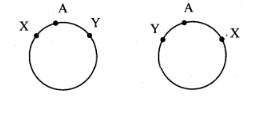
Around the table, arrangements (i.e., clockwise and anticlockwise) coincide.

Image

$\therefore$ Required number of arrangements $=\frac{14 !}{2}$

View full question & answer
Question 211 Mark
In how many different ways can 8 friends sit around a table?
Answer
We know that ‘n’ persons can sit around a table in (n – 1)! ways.

∴ 8 friends can sit around a table in 7!

= 7 × 6 × 5 × 4 × 3 × 2 × 1

= 5040 ways.

View full question & answer
Question 221 Mark
Find the number of distinct numbers formed using the digits 3, 4, 5, 6, 7, 8, 9, so that odd positions are occupied by odd digits.
Answer
A number is to be formed with digits 3, 4, 5, 6, 7, 8, 9 such that odd digits always occupy the odd places. There are 4 odd digits, i.e. 3, 5, 7, 9. ∴ They can be arranged at 4 odd places among themselves in 4! = 24 ways. There are 3 even digits, i.e. 4, 6, 8. ∴ They can be arranged at 3 even places among themselves in 3! = 6 ways. ∴ Required number of numbers formed = 24 × 6 = 144
View full question & answer
Question 231 Mark
How many distinct 5 digit numbers can be formed using the digits 3, 2, 3, 2, 4, 5.
Answer
5 digit numbers are to be formed from 2, 3, 2, 3, 4, 5. Case I: Numbers formed from 2, 2, 3, 4, 5 OR 2, 3, 3, 4, 5

Number of such numbers $=\frac{5 !}{2 !}+\frac{5 !}{2 !}=5 !=120$

Case II: Numbers are formed from 2, 2, 3, 3 and any one of 4 or 5

Number of such numbers $=\frac{5 !}{2 ! 2 !}+\frac{5 !}{2 ! 2 !}=60$

Required number of numbers = 120 + 60 = 180

View full question & answer
Question 241 Mark
Find the number of different ways of arranging letters in the word ARRANGE. How many of these arrangements do not have the two R’s and two A’s together?
Answer
There are 7 letters in the word ARRANGE in which ‘A’ and ‘R’ repeat 2 times each.

$\therefore$ Number of ways to arrange the letters of word ARRANGE $=\frac{7 !}{2 ! 2 !}=1260$

Consider the words in which 2A are together and 2R are together. Let us consider 2A as one unit and 2R as one unit.

These two units with remaining 3 letters can be arranged in $=\frac{5 !}{2 ! 2 !}=30$ ways.

Number of arrangements in which neither 2A together nor 2R are together = 1260 – 30 = 1230

View full question & answer
Question 251 Mark
Find the number of arrangements of letters in the word CONSTITUTION that begin and end with N.
Answer
There are 12 letters in the word CONSTITUTION, in which ‘O’, ‘N’, ‘I’ repeat two times each, ‘T’ repeats 3 times. When the arrangement starts and ends with ‘N’, other 10 letters can be arranged between two N, in which ‘O’ and ‘I’ repeat twice each and ‘T’ repeats 3 times.

$\therefore$ Required number of arrangements $=\frac{10 !}{2 ! 2 ! 3 !}$

View full question & answer
Question 261 Mark
Find the number of arrangements of letters in the word MUMBAI so that the letter B is always next to A.
Answer
There are $6$ letters in the word MUMBAI. These letters are to be arranged in such a way that ‘B’ is always next to ‘A’. Let us consider AB as one unit. This unit with the other 4 letters in which ‘M’ repeats twice is to be arranged.$\therefore$ Required number of arrangements $=\frac{5 !}{2 !}$
$=\frac{5 \times 4 \times 3 \times 2 !}{2 !}$
$=60$
View full question & answer
Question 271 Mark
A bag has 5 red, 4 blue, and 4 green marbles. If all are drawn one by one and their colours are recorded, how many different arrangements can be found?
Answer
There is a total of 13 marbles in a bag. Out of these 5 are Red, 4 Blue, and 4 are Green marbles. All balls of the same colour are taken to be identical.$\therefore$ Required number of arrangements $=\frac{13 !}{5 ! 444 !}$
View full question & answer
Question 281 Mark
You have $2$ identical books on English, $3$ identical books on Hindi, and $4$ identical books on Mathematics. Find the number of distinct ways of arranging them on a shelf.
Answer
There are total $9$ books to be arranged on a shelf. Out of these $9$ books, $2$ books on English, $3$ books on Hindi and $4$ books on mathematics are identical.$\therefore$ Total number of arrangements possible $=\frac{9 !}{2 ! 3 ! 4 !}$
$=\frac{9 \times 8 \times 7 \times 6 \times 5 \times 4 !}{2 \times 3 \times 2 \times 4 !}$
$=9 \times 4 \times 7 \times 5$
$=1260$
View full question & answer
Question 291 Mark
Find the number of ways in which 5 letters can be posted in 3 post boxes if any number of letters can be posted in a post box.
Answer
There are 5 letters and 3 post boxes and any number of letters can be posted in all three post boxes. ∴ Each letter can be posted in 3 ways. ∴ Total number of ways 5 letters can be posted = 3 × 3 × 3 × 3 × 3 = 243
View full question & answer
Question 391 Mark
Evaluate: $\frac{n !}{r !(n-r) !}$ for

$n =12, r =12$

Answer
$n =12, r =12$

$\begin{aligned} \therefore \quad \frac{ n !}{ r !( n - r ) !} & =\frac{12 !}{12 !(12-12) !}=\frac{12 !}{12 ! 0 !} \\ & =1 \quad \ldots[\because 0 !=1]\end{aligned}$

View full question & answer
Question 401 Mark
Evaluate: $\frac{n !}{r !(n-r) !}$ for

n = 8, r = 6

Answer
$n =8, r =6$

$\begin{aligned} \therefore \quad \frac{n !}{r !(n-r) !} & =\frac{8 !}{6 !(8-6) !}=\frac{8 \times 7 \times 6 !}{6 ! 2 !} \\ & =\frac{8 \times 7}{2 !}=\frac{8 \times 7}{1 \times 2}=28\end{aligned}$

View full question & answer
Question 411 Mark
Write in terms of factorials
$5 \times 10 \times 15 \times 20$
Answer
$5 \times 10 \times 15 \times 20$
$=(5 \times 1) \times(5 \times 2) \times(5 \times 3) \times(5 \times 4)$
$=\left(5^4\right)(4 \times 3 \times 2 \times 1)$
$=\left(5^4\right)(4 !)$
View full question & answer
Question 421 Mark
Write in terms of factorials $: 6 \times 7 \times 8 \times 9$
Answer
$6 \times 7 \times 8 \times 9 = 9 \times 8 \times 7 \times 6$ Multiplying and dividing by $5!,$ we get
$=\frac{9 \times 8 \times 7 \times 6 \times 5 !}{5 !}$
$=\frac{9 \times 8 \times 7 \times 6 \times 5 \times 4 \times 3 \times 2 \times 1}{5 !}$
$=\frac{9 !}{5 !}$
View full question & answer
Question 431 Mark
Write in terms of factorials
$3 \times 6 \times 9 \times 12 \times 15$
Answer
$3 \times 6 \times 9 \times 12 \times 15$
$=3 \times(3 \times 2) \times(3 \times 3) \times(3 \times 4) \times(3 \times 5)$
$=\left(3^5\right)(5 \times 4 \times 3 \times 2 \times 1)$
$=3^5(5 !)$
View full question & answer
Question 441 Mark
Write in terms of factorials
$5 \times 6 \times 7 \times 8 \times 9 \times 10$
Answer
$5 \times 6 \times 7 \times 8 \times 9 \times 10 = 10 \times 9 \times 8 \times 7 \times 6 \times 5$ Multiplying and dividing by 4!, we get
$=\frac{10 \times 9 \times 8 \times 7 \times 6 \times 5 \times 4 !}{4 !}$
$=\frac{10 \times 9 \times 8 \times 7 \times 6 \times 5 \times 4 \times 3 \times 2 \times 1}{4 !}$
$=\frac{10 !}{4 !}$
View full question & answer
Question 451 Mark
Compute:
$\frac{8 !}{(6-4) !}$
Answer
$\frac{8 !}{(6-4) !}=\frac{8 !}{2 !}$
$=\frac{8 \times 7 \times 6 \times 5 \times 4 \times 3 \times 2 !}{2 !}$
$=20160$
View full question & answer
Question 461 Mark
Compute:
$\frac{8 !}{6 !-4 !}$
Answer
$\frac{8 !}{6 !-4 !}=\frac{8 \times 7 \times 6 \times 5 \times 4 !}{6 \times 5 \times 4 !-4 !}$
$=\frac{8 \times 7 \times 6 \times 5 \times 4 !}{4 !(6 \times 5-1)}$
$=\frac{1680}{29}$
$=57.93$
View full question & answer
Question 471 Mark
Compute:

$\frac{6 !-4 !}{4 !}$

Answer
$\frac{6 !-4 !}{4 !}=\frac{6 \times 5 \times 4 !-4 !}{4 !}=\frac{4 !(6 \times 5-1)}{4 !}=29$
View full question & answer
Question 481 Mark
Compute:

$\frac{9 !}{3 ! 6 !}$

Answer
$\frac{9 !}{3 ! 6 !}=\frac{9 \times 8 \times 7 \times 6 !}{(3 \times 2 \times 1) \times 6 !}=84$
View full question & answer
Question 521 Mark
Compute:
$\frac{12 !}{6 !}$
Answer
$\frac{12 !}{6 !}=\frac{12 \times 11 \times 10 \times 9 \times 8 \times 7 \times 6 !}{6 !}$
$=12 \times 11 \times 10 \times 9 \times 8 \times 7$
$=665280$
View full question & answer
Question 541 Mark
Evaluate :

10! – 6!

Answer
10! – 6! = 10 × 9 × 8 × 7 × 6! – 6! = 6! (10 × 9 × 8 × 7 – 1) = 6! (5040 – 1) = 6 × 5 × 4 × 3 × 2 × 1 × 5039 = 3628080
View full question & answer
Question 571 Mark
In a test, 5 questions are of the form ‘state, true or false. No student has got all answers correct. Also, the answer of every student is different. Find the number of students who appeared for the test.
Answer
Every question can be answered in 2 ways. (True or False) ∴ By using the fundamental principle of multiplication, the total number of set of answers possible = 2 × 2 × 2 × 2 × 2 = 32. Since One of them is the case where all questions are answered correctly, The number of wrong answers = 32 – 1 = 31. Since no student has answered all the questions correctly, the number of students who appeared for the test are 31.
View full question & answer
Question 581 Mark
A letter lock contains 3 rings and each ring contains 5 letters. Determine the maximum number of false trails that can be made before the lock is opened.
Answer
A letter lock has 3 rings, each ring containing 5 different letters. ∴ A letter from each ring can be selected in 5 ways. ∴ By using the fundamental principle of multiplication, a total number of trials that can be made = 5 × 5 × 5 = 125. Out of these 124 wrong attempts are made and in the 125th attempt, the lock gets opened. ∴ A maximum number of false trials = 124.
View full question & answer