Questions

Solve the Following Question.(3 Marks)

Take a timed test

35 questions · self-marked practice — reveal the answer and mark yourself.

Question 13 Marks
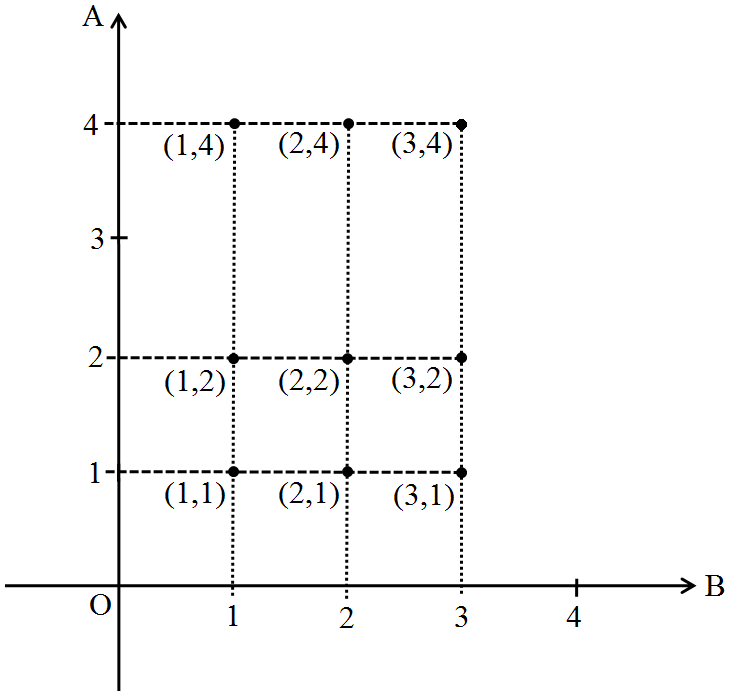
If A = {1, 2, 4} and B = {1, 2, 3}, represent following sets graphically:
B × A
Answer
We have, A = {1, 2, 4} and B = {1, 2, 3} $\therefore$ B × A = {1, 2, 3} × {1, 2, 4} = {(1, 1), (1, 2), (1, 4), (2, 1), (2, 2), (2, 4), (3, 1), (3, 2), (3, 4)} Hence, we represent B on the horizontal line and A on vertical line. Graphical representation of B × A is as shown below:
View full question & answer
Question 23 Marks
Determine the domain and range of the relation $R$ defined by:
$R=\left\{\left(x, x^3\right): x\right.$ is a prime number less than 10$\}$
Answer
We have,
$R=\left\{\left(x, x^3\right): x\right.$ is a prime number less than 10$\}$
For the elements of the given sets, we find that
$x=2,3,5,7$
$\therefore(2,8) \in R,(3,27) \in R,(5,127) \in R \text { and }(7,343) \in R$
$\Rightarrow R=\{(2,8),(3,27),(5,125),(7,343)\}$
Clearly, Domain $(R)=\{2,3,5,7\}$ and Range $(R)=\{8,27,125,343\}$
View full question & answer
Question 33 Marks
If A = {1, 2, 3} and B = {2, 4}, what are A × B, B × A, A × A, B × B and $(\text{A}\times\text{B})\cap(\text{B}\times\text{A})?$
Answer
We have,
A = {1, 2, 3} and B = {2, 4}
$\therefore$ A × B = {1, 2, 3} × {2, 4}
= {(1, 2), (1, 4), (2, 2), (2, 4), (3, 2), (3, 4)}
B × A = {2, 4} × {1, 2, 3}
= {(2, 1), (2, 2), (2, 3), (4, 1), (4, 2), (4, 3)}
A × A = {1, 2, 3} × {1, 2, 3}
= {(1, 1), (1, 2), (1, 3), (2, 1), (2, 2), (2, 3), (3, 1), (3, 2), (3, 3)}
B × B = {2, 4} × {2, 4}
= {(2, 2), (2, 4), (4, 2), (4, 4)}
$(\text{A}\times\text{B})\cap(\text{B}\times\text{A})$
$=\{ {(1, 2), (1, 4), (2, 2), (2, 4), (3, 2), (3, 4)} \}\\\ \ \ \cap\{(2, 1),(2,2),(2,3),(4,1),(4,2),(4,3)\}$
$=\{(2,2)\}$
$(\text{A}\times\text{B})\cap(\text{B}\times\text{A})=\{(2,2)\}$
View full question & answer
Question 43 Marks
Let R be a relation from N to N defined by $\text{R}=\{(\text{a, b}):\text{a, b}\in\text{N and a}=\text{b}^2\}.$ Are the following statement true?
$(\text{a, b})\in\text{R and (b, c)}\in\text{R}\Rightarrow \text{(a, c)}\in\text{R}$
Answer
We have,
$\text{R}=\{(\text{a, b}):\text{a, b}\in\text{N and a}=\text{b}^2\}$
This statement is not true because $(36,6)\notin\text{R and (25, 5)}\in\text{R}\text{ but }(36,5)\notin\text{R}$
View full question & answer
Question 53 Marks
Write the following relation as the sets of ordered pairs:
A relation R on the set {1, 2, 3, 4, 5, 6, 7}defined by $(\text{x, y})\in \text{R}\Leftrightarrow\text{x}$ is relatively prime to y.
Answer
We have,
It is given that relation R on the set {1, 2, 3, 4, 5, 6, 7} defined by $(\text{x, y})\in \text{R}\Leftrightarrow\text{x}$ is relatively.
$\therefore\ (2,3)\in\text{R},(2,5)\in\text{R},(2,7)\in\text{(3,2)}\in\text{R},(3,4)\in\text{R},(3,5)\in\text{R},(3,7)\in\text{R},\\\ \ \ \ \ (4,3)\in\text{R},(4,5)\in\text{R},(4,7)\in\text{R},(5,2)\in\text{R},(5,3)\in\text{R},(5,4)\in\text{R},(5,6)\in\text{R},\\\ \ \ \ (5,7)\in\text{R},(6,5)\in\text{R},(6,7)\in\text{R},(7,2)\in\text{R},(7,3\in\text{R},(7,4))\in\text{R},(7,5)\in\text{R and }(7,6)\in\text{R}$
Thus,
$\text{R}=\big\{(2,3),(2,5),(2,7),(3,2),(3,4),(3,5),(3,7),(4,3),(4,5),(4,7),(5,2),\\\ \ \ \ \ \ \ \ \ (5,3),(5,4),(5,6),(5,7),(6,5),(6,7),(7,2),(7,3),(7,4),(7,5),(7,6)\big\}$
View full question & answer
Question 63 Marks
Let A and B be two sets. Show that the sets A × B and B × A have elements in common iff the sets A and B have an elements in common.
Answer
Let (a, b) be an arbitrary element of $(\text{A}\times\text{B})\cap(\text{B}\times\text{A}).$ Then,
$(\text{a},\text{b})\in(\text{A}\times\text{B})\cap(\text{B}\times\text{A})$
$\Leftrightarrow(\text{a},\text{b})\in\text{A}\times\text{B}$ and $(\text{a},\text{b})\in\text{B}\times\text{A}$
$\Leftrightarrow(\text{a}\in\text{A}\text{ and b}\in\text{B})$ and $(\text{a}\in\text{B and b}\in\text{A})$
$\Leftrightarrow(\text{a}\in\text{A and a}\in\text{B})$ and $(\text{b}\in\text{A and b}\in\text{B})$
$\Leftrightarrow\text{a}\in\text{A}\cap\text{B}$ and $\text{b}\in\text{A}\cap\text{B}$
Hence, the sets A × B and B × A have an element in comon iff the sets A and B have an element in common.
View full question & answer
Question 73 Marks
If A = {1, 2, 3}, B = {4}, C = {5}, then verify that:
$\text{A}\times(\text{B}\cap\text{C})=(\text{A}\times\text{B})\cap(\text{A}\times\text{C})$
Answer
We have,
$\text{A}=\{1,2,3\},\text{ B}=\{4\}$ and $\text{C}=\{5\}$
$\therefore\ \text{B}\cap\text{C}=\{4\}\cap\{5\}=\phi$
$\therefore\ \text{A}\times(\text{B}\cap\text{C})=\{1,2,3\}\times\phi$
$\Rightarrow\text{A}\times(\text{B}\cap\text{C})=\phi\ ...(\text{i})$
Now,
$\text{A}\times\text{B}=\{1, 2, 3\}\times\{4\}$
$=\{(1, 4), (2, 4), (3, 4)\}$
and, $\text{A}\times\text{C}=\{1,2,3\}\times\{5\}$
$=\{(1, 5) , (2, 5), (3, 5)\}$
$\therefore\ (\text{A}\times\text{B})\cap(\text{A}\times\text{C})=\{(1, 4), (2, 4), (3, 4)\} \cup\{(1, 5), (2, 5), (3, 5)\}$
$\Rightarrow(\text{A}\times\text{B})\cup(\text{A}\times\text{C})=\phi\ ...(\text{ii})$
From equation (i) and (ii), we get
$\text{A}\times (\text{B}\cap\text{C})=(\text{A}\times\text{B})\cap(\text{A}\times\text{C})$
Hence verified.
View full question & answer
Question 83 Marks
If A = {1, 2, 3}, B = {3, 4} and C = {4, 5, 6}, find
$(\text{A}\times\text{B})\cup(\text{A}\cup\text{C})$
Answer
$(\text{A}\times\text{B})\cup(\text{A}\cup\text{C})$
Now,
$(\text{A}\times\text{B})=\{(1,3),(1,4),(2,3),(2,4),(3,3),(3,4)\}$
And,
$(\text{A}\times\text{C})=\{(1, 4), (1, 5), (1, 6), (2, 4), (2, 5), (2, 6), (3, 4), (3, 5), (3, 6)\}$
$\therefore\ (\text{A}\times\text{B})\cup(\text{A}\cup\text{C})$ $= {(1, 3), (1, 4), (1, 5), (1, 6), (2, 3), (2, 4), (2, 5), (2, 6), (3, 3), (3, 4), (3, 5), (3, 6)}$
View full question & answer
Question 93 Marks
Let R be a relation on N × N defined by:
$(\text{a, b})\text{ R }(\text{c, d})\Leftrightarrow\text{a}+\text{d}=\text{b}+\text{c}$ for all $(\text{a, b}),(\text{c, d})\in\text{N}\times\text{N}$
Show that:
$(\text{a},\text{b})\text{ R }(\text{c, d})\text{ and (c, d) R (e, f)}$
$\Rightarrow(\text{a, b})\text{ R (e, f)}$ for all $(\text{a, b}),(\text{c, d}),(\text{e, f})\in\text{N}\times\text{N}$
Answer
We have,
$(\text{a, b})\text{ R }(\text{c, d})\Leftrightarrow\text{a}+\text{d}=\text{b}+\text{c}$ for all $(\text{a, b}),(\text{c, d})\in\text{N}\times\text{N}$
Now,
(a, b) R (c, d) and (c, d) R (e, f)
⇒ a + d = b + c and c + f = d + e
⇒ a + d + c + f = b + c + d + e [Adding]
⇒ a + f = b + e
⇒ (a, b) R (e, f)
View full question & answer
Question 103 Marks
Write the relation $R=\left\{\left(x, x^3\right): x\right.$ is a prime number less than 10$\}$ in roster form.
Answer
We have,
$R=\left\{\left(x, x^3\right): x\right.$ is a prime number less than 10$\}$
For the elements of the given sets, we find that
$x=2,3,5,7$
$\therefore(2,8) \in R,(3,27) \in R,(5,125) \in R \text { and }(7,343) \in R$
$\therefore \text { Relation } R \text { in roster form is }=\{(2,8),(3,27),(5,125),(7,343)\}$
View full question & answer
Question 113 Marks
Write the following relation as the sets of ordered pairs:
A relation R on the set {0, 1, 2, ....., 10} defined by 2x + 3y = 12.
Answer
We have,
$2\text{x}+3\text{y}=12$
$\Rightarrow2\text{x}=12-3\text{y}$
$\Rightarrow\text{x}=\frac{12-3\text{y}}{2}$
Putting y = 0, 2, 4 we get x = 6, 3, 0 respectively.
For y = 1, 3, 5, 6, 7, 8, 9, 10, $\text{x}\notin$ given set
$\therefore\ \text{R}=\{(6,0),(3,2),(0,4)\}$
$=\{(0,4),(3,2),(6,0)\}$
View full question & answer
Question 123 Marks
Find the inverse relation $R^{-1}$​​​​​​​ in the following case:
$R = {(1, 2), (1, 3), (2, 3), (3, 2), (5, 6)}$
Answer
We have,
$R = {(1, 2), (1, 3), (2, 3), (3, 2), (5, 6)}$
$\Rightarrow R^{-1} = {(2, 1), (3, 1), (3, 2), (2, 3), (6, 5)}$
View full question & answer
Question 133 Marks
Write the following relation as the sets of ordered pairs:
A relation R from a set A = {5, 6, 7, 8} to the set B = {10, 12, 15, 16, 18} defined by $\text{x, y}\in\text{R}\Leftrightarrow\text{x}$ divides y.
Answer
We have,
A = {5, 6, 7, 8} and B = {10, 12, 15, 16, 18}
Now,
$\frac{\text{a}}{\text{b}}$ stands for 'a divides b'. For the elements of the given set A and B.
We find that $\frac{5}{10},\frac{5}{15},\frac{6}{12},\frac{6}{18}$ and $\frac{6}{16}$
$\therefore\ (5,10)\in\text{R},(5,15)\in\text{R},(6,12)\in\text{R},(6,18)\in\text{R},$ and $(8,16)\in\text{R}$
Thus,
$\text{R}=\{(5,10),(5,15),(6,12),(6,18),(8,16)\}$
View full question & answer
Question 143 Marks
If the ordered pairs (x, -1) and (5, y) belong to the set {(a, b): b = 2a - 3}, find the values of x and y.
Answer
We have,
$(\text{x}-1)\in\{(\text{a},\text{b}):\text{b}=2\text{a}-3\}$
and, $(5,\text{y})\in\{(\text{a,b}):\text{b}=2\text{a}-3\}$
⇒ -1 = 2 × x - 3 and y = 2 × 5 - 3
⇒ -1 = 2x - 3 and y = 10 - 3
⇒ 3 - 1 = 2x and y = 7
⇒ 2 = 2x and y = 7
⇒ x = 1 and y = 7
View full question & answer
Question 153 Marks
Find the sum of the following series to n terms:
$2^2 + 4^2 + 6^2 + 8^2 + ....$
Answer
Let Tn be the nth term of this series. Then,
$T_n = (2n)^3$
$T_n = 8n^3$
Let $S^n$ be the sum to n terms of the given series, Then,
$\text{S}_\text{n}=\sum\limits^{\text{n}}_{\text{k}=1}8\text{k}^3$
$=8\sum\limits^{\text{n}}_{\text{k}=1}\text{k}^3$
$=8\bigg[\frac{\text{n}(\text{n}+1)^2}{2}\bigg]^2$
$=8\times\frac{\text{n}^2(\text{n}+1)^2}{4}$
$=2\text{n}^2(\text{n}+1)^2$
Hence, $\text{S}_\text{n}=2\text{n}^2(\text{n}+1)^2$
View full question & answer
Question 163 Marks
A = {1, 2, 3, 5} and B = {4, 6, 9}. Define a relation R from A to B by R = $\{$(x, y): the difference between x and y is odd, $\text{x}\in\text{A},\text{y}\in\text{B}\}$ Write R in Roster form.
Answer
We have,
S = {1, 2, 3, 5} and B = {4, 6, 9}
It is given that,
R = $\{$(x, y): the difference between x and y is odd, $\text{x}\in\text{A}, \text{y}\in\text{B}\}$
For the elements of the given sets A and B, we find that
$(1,4)\in\text{R},(1,6)\in\text{R},(2,9)\in\text{R},(3,4)\in\text{R},(3,6)\in\text{R},(5,4)\in\text{R and (5,6)}\in\text{R}$
$\therefore\ \text{R}=\{(1,4),(1,6),(2,9),(3,4),(3,6),(5,4),(5,6)\}$
Hence, relation R in roster form is {(1, 4), (1, 6), (2, 9), (3, 4), (3, 6), (5, 4), (5, 6)}
View full question & answer
Question 173 Marks
If A = {1, 2} and B = {1, 3}, find A × B and B × A.
Answer
We have,
A = {1, 2} and B = {1, 3}
Now, A × B = {1, 2} × {1, 3}
= {(1, 1), (1, 3), (2, 1), (2, 3)}
and, B × A = {1, 3} × {1, 2}
= {(1, 1), (1, 2), (3, 1), (3, 2)}
View full question & answer
Question 183 Marks
Let A = {1, 2}, B = {1, 2, 3, 4}, C = {5, 6} and D = {5, 6, 7, 8}. Verify that:
$\text{A}\times(\text{B}\cap\text{C})=(\text{A}\times\text{B})\cap(\text{A}\times\text{C})$
Answer
We have,
A = {1, 2}, B = {1, 2, 3, 4}, C = {5, 6} and D = {5, 6, 7, 8}
$\therefore\text{ B}\cap\text{C}=\{1,2,3,4\}\cap\{5,6\}=\phi$
$\text{A}\times(\text{B}\cap\text{C})=\{1,2\}\times\phi=\phi\ ...(\text{i})$
Now,
A × B = {1, 2} × {1, 2, 3, 4}
= {(1,1), (1, 2), (1,3), (1, 4), (2, 1), (2, 2), (2, 3), (2, 4)}
and, A × C = {1, 2} × {5, 6} = {(1, 5), (1, 6), (2, 5), (2, 6)}
$\therefore\ (\text{A}\times\text{B})\cap(\text{A}\times\text{C})=\phi\ ...(\text{ii})$
From equation (i) and equation (ii), we get
$\text{A}\times(\text{B}\cap\text{C})=(\text{A}\times\text{B})\cap(\text{A}\times\text{C})$
Hence verified.
View full question & answer
Question 193 Marks
If A = {1, 2}, from the set A × A × A.
Answer
We have,
A = {1, 2 }
$\therefore$ A × A = {1, 2} × {1, 2}
= {(1, 1), (1, 2), (2, 1), (2, 2)}
$\therefore$ A × A × A = {1, 2} × {(1, 1), (1, 2), (2, 1), (2, 2)}
= {(1, 1, 1), (1, 1, 2), (1, 2, 1), (1, 2, 2), (2, 1, 1), (2, 1, 2), (2, 2, 1), (2, 2, 2)}
View full question & answer
Question 203 Marks
Given A = {1, 2, 3}, B = {3, 4}, C ={4, 5, 6}, find $(\text{A}\times\text{B})\cap(\text{B}\times\text{C})$
Answer
We have,
A = {1, 2, 3}, B = {3, 4} and C = {4, 5, 6}
$\therefore$ A × B = {1, 2, 3} × {3, 4}
= {(1, 3), (1, 4), (2, 3), (2, 4), (3, 3), (3, 4)}
and B × C = {3, 4} × {4, 5, 6}
= {(3, 4), (3, 5), (3, 6), (4, 4), (4, 5), (4, 6)}
$\therefore\ (\text{A}\times\text{B})\cap(\text{B}\times\text{C})=\{(3,4)\}$
View full question & answer
Question 213 Marks
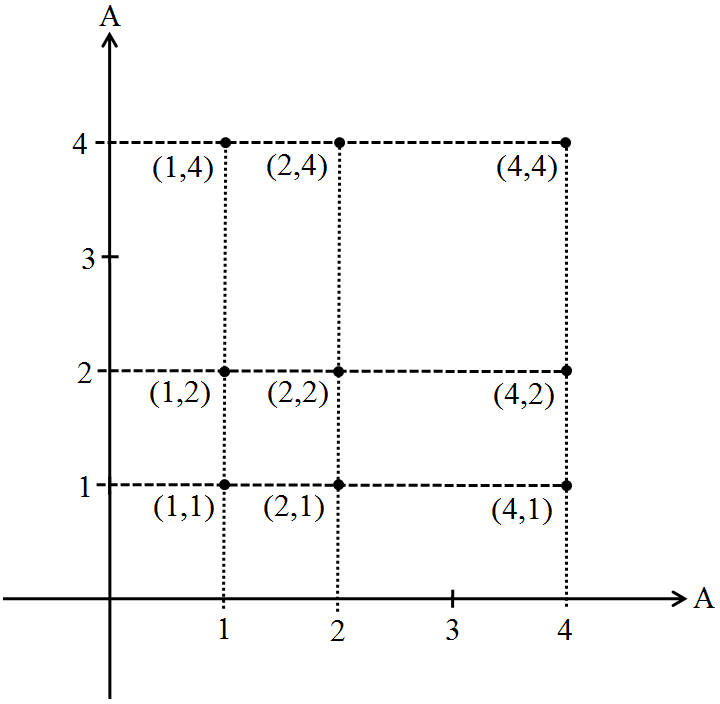
If A = {1, 2, 4} and B = {1, 2, 3}, represent following sets graphically:
A × A
Answer
We have, A = {1, 2, 4} $\therefore$ A × A = {1, 2, 4} × {1, 2, 4} = {(1, 1), (1, 2), (1, 4), (2, 1), (2, 2), (2, 4), (4, 1), (4, 2), (4, 4)} Graphical representation of A × A is as shown below:
View full question & answer
Question 223 Marks
Write the following relation as the sets of ordered pairs:
A relation R from the set {2, 3, 4, 5, 6} to the set {1, 2, 3} defined by x = 2y.
Answer
We have,
x = 2y
Putting y = 1, 2, 3 we get x = 2, 4, 6 respectively.
$\therefore$ R = {(2, 1), (4, 2), (6, 3)}
View full question & answer
Question 233 Marks
Let A = {1, 2} and B = {3, 4}. Find the total number of relation from A into B.
Answer
We have,
A = {1, 2} and B = {3, 4}
$\therefore$ n(A) = 2 and n(B) = 2
⇒ n(A) × n(B) = 2 × 2 = 4
⇒ n(A × B) = 4 $\big[\because\text{ n}(\text{A}\times\text{B})=\text{n(A)}\times\text{n(B)}\big]$
So, there are 24 = 16 relations from A to b. $\begin{bmatrix}\because\ \text{n(x)}=\text{a},\text{ n(y)}=\text{b}\\\Rightarrow\text{ total number of relations}=2^{\text{ab}}\end{bmatrix}$
View full question & answer
Question 243 Marks
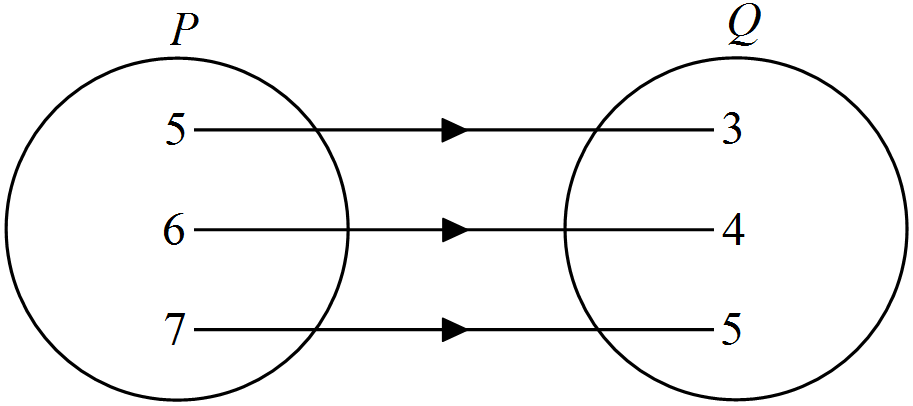
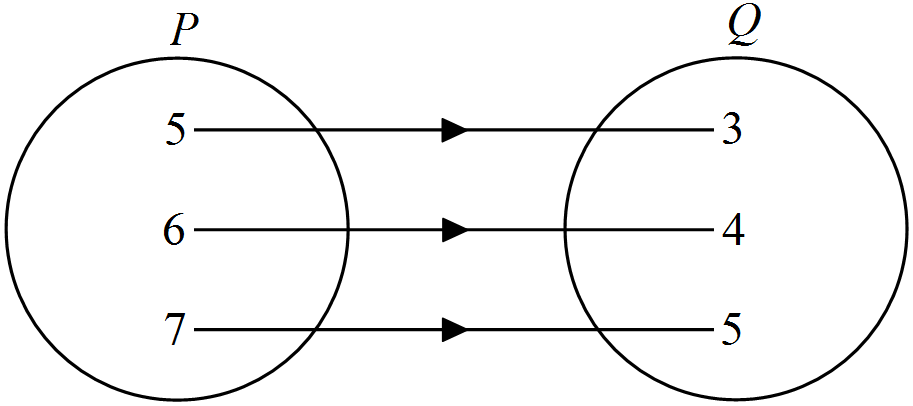
The adjacent figure shows a relationship between the sets P and Q. Write this relation in:
  1. Set builder form.
  2. Roster form. What is its domain and range?
Answer
  1. Set builder form of the relation from P to Q is,
$\text{R}=\{(\text{x, y}):\text{y}=\text{x}-2,\text{x}\in\text{P},\text{y}\in\text{Q}\}$
  1. Roster form of the relation from P to Q is,
R = {(5, 3), (6, 4), (7, 5)}

Domain(R) = {5, 6, 7}

Range(R) = {3, 4, 5}
View full question & answer
Question 253 Marks
Let A = {1, 2, 3, 4} and $\text{R}=\{(\text{a},\text{b}):\text{a}\in\text{A},\text{b}\in\text{A},\text{ a divides b}\}.$ Write R explicitly.
Answer
We have,
A = {1, 2, 3, 4}
and, $\text{R}=\{(\text{a},\text{b})=\text{a}\in\text{A},\text{ b}\in\text{A},\text{ a}\text{ divides b}\}$
Now, $\frac{\text{a}}{\text{b}}$ stands for 'a divides b'. For the elements of the given sets, we find that $\frac{1}{1},\frac{1}{2},\frac{1}{3},\frac{1}{4},\frac{2}{2},\frac{3}{3}\text{ and }\frac{4}{4}$
$\therefore\ \text{R}=\{(1,1),(1,2),(1,3),(1,4),(2,2),(2,4),(3,3),(4,4)\}$
View full question & answer
Question 263 Marks
If $\text{a}\in[-1,2,3,4]$ and $\text{b}\in [0, 3, 6],$ write the set of all ordered pairs (a, b) such that a + b= 5.
Answer
We have,
a + b = 5
⇒ a = 5 - b
$\therefore$ b = 0 ⇒ a = 5 - 0 = 5,
b = 3 ⇒ a = 5 - 3 = 2,
b = 6 ⇒ a = 5 - 6 = -1
Hence, the required set of ordered pairs (a, b) is {(-1, 6), (2, 3), (5, 0)}
View full question & answer
Question 273 Marks
Let A = {x, y, z} and B = {a, b}. Find the total number of relations from A into B.
Answer
We have,
A = {x, y, z} and B = {a, b}
⇒ n(A) = 3 and n(B) = 2
⇒ n(A) × n(B) = 3 × 2 = 6
⇒ n(A × B) = 6 $\big[\because\text{ n}(\text{A}\times\text{B})=\text{n(A)}\times\text{n(B)}\big]$
So, there are 26 = 64 relations from A to B. $\begin{bmatrix}\because\ \text{n(x)}=\text{a},\text{ n(y)}=\text{b}\\\Rightarrow\text{ total number of relations}=2^{\text{ab}}\end{bmatrix}$
View full question & answer
Question 283 Marks
  1. If $\Big(\frac{\text{a}}{3}+1,\text{b}-\frac{2}{3}\Big)=\Big(\frac{5}{3},\frac{1}{3}\Big),$ find the values of a and b.
  2. f(x + 1, 1) = (3, y - 2), find the values of x and y.
Answer
  1. By the definition of equality of ordered pairs,
$\Big(\frac{\text{a}}{3}+1,\text{b}-\frac{2}{3}\Big)=\Big(\frac{5}{3},\frac{1}{3}\Big)$
$\Rightarrow\frac{\text{a}}{3}+1=\frac{5}{3}$ and $\text{b}-\frac{2}{3}=\frac{1}{3}$
$\Rightarrow\frac{\text{a}}{3}=\frac{5}{3}=-1$ and $\text{b}=\frac{1}{3}+\frac{2}{3}$
$\Rightarrow\frac{\text{a}}{3}=\frac{5-3}{3}$ and $\text{b}=\frac{1+2}{3}$
$\Rightarrow\frac{\text{a}}{3}=\frac{2}{3}$ and $\text{b}=\frac{3}{3}$
$\Rightarrow\text{a}=2$ and $\text{b}=1$
  1. By the definition of equality of ordered pairs,
(x + 1, 1) = (3, y - 2)
⇒ x + 1 = 3 and 1 = y - 2
⇒ x = 3 - 1 and x + 2 = y
⇒ x = 2 and 3 = y
⇒ x = 2 and y = 3
View full question & answer
Question 293 Marks
Let $A = {a, b}$. List all relations on $A$ and find their number.
Answer
Here, $A = {a, b}$
We know that,
Number of relations $= 2^{m\times n}$
$= 2^{2\times 2}$
$= 24$
$= 16$
Number of relations on $A = 16$
Relations on $A$ are given by,
$R = {a, a}, {a, b}, {b, a}, {b, b},$
${(a, a), (a, b)}, {(a, a), (b, a)}, {(a, a), (b, b)},$
${(a, b), (b, a)}, {(a, b), (b, b)} {(b, a), (b, b)},$
${(a, a), (a, b), (b, a)}, {(a, b), (b, a), (b, b)},$
${(b, a), (b, b), (a, a)}, {(b, b), (a, a), (a, b)},$
${(a, a), (b, a), (b, b)}, {(a, a), (b, a), (b, b)}$
View full question & answer
Question 303 Marks
Let R be a relation from N to N defined by $\text{R}=\{(\text{a, b}):\text{a, b}\in\text{N and a}=\text{b}^2\}.$ Are the following statement true?
$(\text{a, b})\in\text{R }\Rightarrow \text{(b, a)}\in\text{R}$
Answer
We have,
$\text{R}=\{(\text{a, b}):\text{a, b}\in\text{N and a}=\text{b}^2\}$
This statement is not true because $(25,5)\notin\text{R}\text{ but }(5,25)\notin\text{R}$
View full question & answer
Question 313 Marks
If A and B are two set having 3 elements in common. If n(A) = 5, n(B) = 4, find n(A × B) and $\text{n}\big[(\text{A}\times\text{B})\cap(\text{B}\times\text{A})\big]$
Answer
We have,
n(A) = 5 and n(B) = 4
We know that, if A and B are two finite sets n(A × B) = n(A) × n(B)
$\therefore$ n(A × B) = 5 × 4 = 20
Now,
$\text{n}\big[(\text{A}\times\text{B})\cap(\text{B}\times\text{A})\big]=3\times3=9$ $\big[\because$ A and B have 3 elements in common$\big]$
View full question & answer
Question 323 Marks
Let A = {1, 2, 3, 4, 5, 6}. Let R be a relation on A defined by
{(a, b) : a, b ∈ A, b is exactly divisible by a}
  1. Writer R in roster form.
  2. Find the domain of R.
  3. Find the range of R.
Answer
We have,
A = {1, 2, 3, 4, 5, 6}
and, {(a, b): a, b ∈ A, b is exactly divisible by a}
  1. Now, $\frac{\text{a}}{\text{b}}$ stands for 'a divides b'. For the elements of the given sets A and A, we find that,
$\frac{1}{1},\frac{1}{2},\frac{1}{3},\frac{1}{4},\frac{1}{5},\frac{1}{6},\frac{2}{2},\frac{2}{4},\frac{2}{6},\frac{3}{3},\frac{3}{6},\frac{4}{4},\frac{5}{5},\frac{6}{6}$

$\therefore$ Relation R in roster form is

R = {(1, 1), (1, 2), (1, 3), (1, 4), (1, 5), (1, 6), (2, 2), (2, 4), (2, 6), (3, 3), (3, 6), (4, 4), (5, 5), (6, 6)}
  1. Domain(R) = {1, 2, 3, 4, 5, 6}
  2. Range(R) = {1, 2, 3, 4, 5, 6}
View full question & answer
Question 333 Marks
If A = {1, 2, 3}, B = {3, 4} and C = {4, 5, 6}, find
$\text{A}\times(\text{B}\cap\text{C})$
Answer
We have,
$\text{A}=\{1,2,3\},\text{ B}=\{3,4\}$ and $\text{C}=\{4,5,6\}$
$\therefore\ \text{B}\cap\text{C}=\{3,4\}\cap\{4,5,6\}=\{4\}$
$\therefore\ \text{A}\times(\text{B}\cap\text{C})=\{1,2,3\}\times\{4\}$
$=\{(1,4),(2,4),(3,4)\}$
$\Rightarrow\text{A}\times(\text{B}\cap\text{C})=\{(1, 4), (2, 4), (3, 4)\}$
View full question & answer
Question 343 Marks
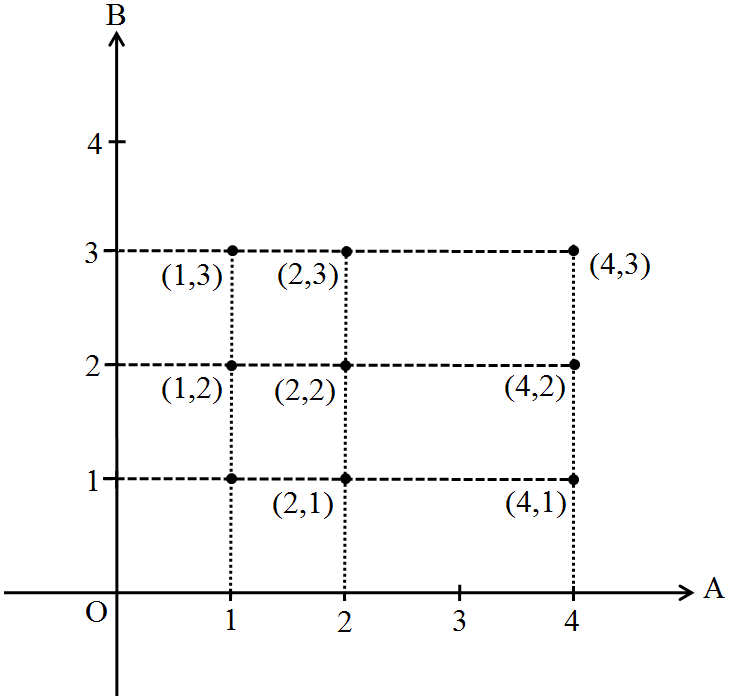
If A = {1, 2, 4} and B = {1, 2, 3}, represent following sets graphically:
A × B
Answer
We have, A = {1, 2, 4} and B = {1, 2, 3} $\therefore$ A × B = {1, 2, 4} × {1, 2, 3} = {(1, 1), (1, 2), (1, 3), (2, 1), (2, 2), (2, 3), (4, 1), (4, 2), (4, 3)} Hence, we represent A on the horizontal line and B on vertical line. Graphical representation of A × B is as shown below:
View full question & answer
Question 353 Marks
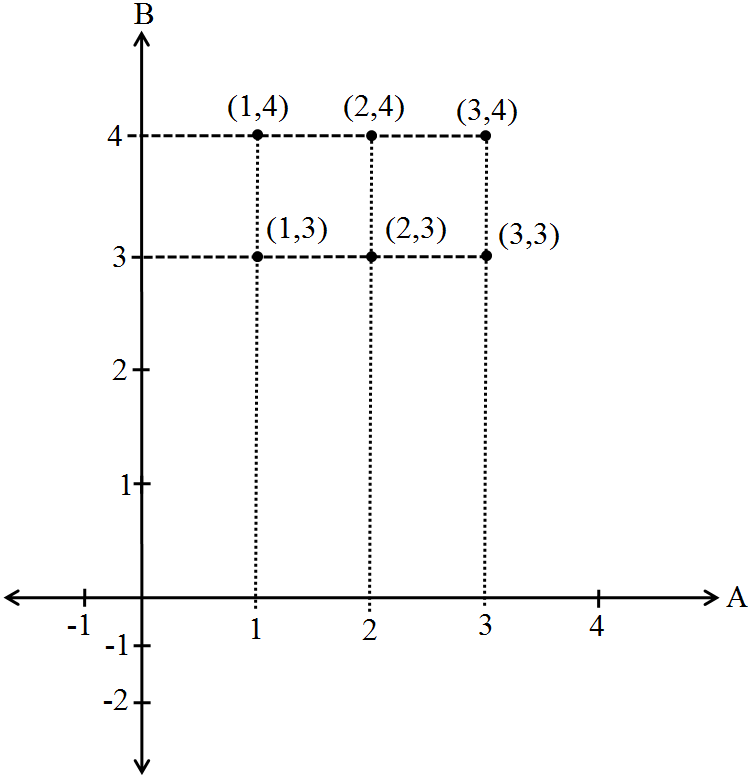
Let A = {1, 2, 3} and B = {3, 4}. Find A × B and show it graphically.
Answer
We have, A = {1, 2, 3} and B = {3, 4} $\therefore$ A × B = {1, 2, 3} × {3, 4} = {(1, 3), (1, 4), (2, 3), (2, 4), (3, 3), (3, 4)} To represent A × B graphically, follow the given steps: Draw two mutually perpendicular lines-one horizontal and one vertical. On the horizontal line, represent the elements of set A and on the vertical line, represent the elements of set B. Draw vertical dotted lines through points representing elements of set A on the horizontal line and horizontal lines through points representing elements of set B on the vertical line. The points of intersection of these lines will represent A × B graphically.
View full question & answer