Questions

Solve the Following Question.(2 Marks)

Take a timed test

23 questions · self-marked practice — reveal the answer and mark yourself.

Question 12 Marks
Find R : A → A when A = {1, 2, 3, 4} such that
R = {(a, b) / |a – b| ≥ 0}
Answer
R = {(a, b) / |a – b| ≥ 0} = {(1, 1), (1, 2), (1, 3), (1, 4), (2, 1), (2, 2), (2, 3), (2, 4), (3, 1), (3, 2), (3, 3), (3, 4), (4, 1), (4, 2), (4, 3), (4, 4)} A × A = {(1, 1), (1, 2), (1, 3), (1, 4), (2, 1), (2, 2), (2, 3), (2, 4), (3, 1), (3, 2), (3, 3), (3, 4), (4, 1), (4, 2), (4, 3), (4, 4)} ∴ R = A × A
View full question & answer
Question 22 Marks
Find R : A → A when A = {1, 2, 3, 4} such that

(i) R = {(a, b) / a – b = 10}

Answer
R : A → A, A = {1, 2, 3,4} (i) R = {(a, b)/a – b = 10} = { }
View full question & answer
Question 32 Marks
Determine the domain and range of the following relations.

R = {(a, b) / b = |a – 1|, a ∈ Z, |a| < 3}

Answer
R = {(a, b) / b = |a – 1|, a ∈ Z, |a| < 3} Since a ∈ Z and |a| < 3, a < 3 and a > -3 ∴ -3 < a < 3 ∴ a = -2, -1, 0, 1, 2 b = |a – 1| When a = -2, b = 3 When a = -1, b = 2 When a = 0, b = 1 When a = 1, b = 0 When a = 2, b = 1 Domain (R) = {-2, -1, 0, 1, 2} Range (R) = {0, 1, 2, 3}
View full question & answer
Question 42 Marks
If A = {-1, 1}, find A × A × A.
Answer
A = {-1, 1} ∴ A × A × A = {(-1, -1, -1), (-1, -1, 1), (-1, 1, -1), (-1, 1, 1), (1, -1, -1), (1, -1, 1), (1, 1, -1), (1, 1, 1)}
View full question & answer
Question 52 Marks
If A = {1, 2, 3} and B = {2, 4}, state the elements of A × A, A × B, B × A, B × B, (A × B) ∩ (B × A).
Answer
A = {1, 2, 3} and B = {2, 4} A × A = {(1, 1), (1, 2), (1, 3), (2, 1), (2, 2), (2, 3), (3, 1), (3, 2), (3, 3)} A × B = {(1, 2), (1, 4), (2, 2), (2, 4), (3, 2), (3, 4)} B × A = {(2, 1), (2, 2), (2, 3), (4, 1), (4, 2), (4, 3)} B × B = {(2, 2), (2, 4), (4, 2), (4, 4)} ∴ (A × B) ∩ (B × A) = {(2, 2)}
View full question & answer
Question 62 Marks
Write the relation in the Roster form. State its domain and range.

$R_8=\{(a, b) / b=a+2, a \in Z, 0<a<5\}$

View full question & answer
Question 82 Marks
Write the relation in the Roster form. State its domain and range.

$R_6=\{(a, b) / a \in N, a<6$ and $b=4\}$

View full question & answer
Question 92 Marks
Write the relation in the Roster form. State its domain and range.

$R_5=\{(x, y) / x+y=3, x, y \in\{0,1,2,3\}\}$

View full question & answer
Question 102 Marks
Write the relation in the Roster form. State its domain and range.

$R_4=\{(x, y) / y>x+1, x=1,2$ and $y=2,4,6\}$

View full question & answer
Question 112 Marks
Write the relation in the Roster form. State its domain and range.

$R_3=\{(x, y / y=3 x, y \in\{3,6,9,12\}, x \in\{1,2,3\}\}$

View full question & answer
Question 122 Marks
Write the relation in the Roster form. State its domain and range.

$R_2=\left\{\left(a, \frac{1}{a}\right) / 0<a \leq 5, a \in N\right\}$

View full question & answer
Question 132 Marks
Write the relation in the Roster form. State its domain and range.

$R_1=\left\{\left(a, a^2\right) / a\right.$ is a prime number less than 15$\}$

View full question & answer
Question 142 Marks
Express $\left\{(x, y) / x^2+y^2=100\right.$, where $\left.x, y \in W\right\}$ as a set of ordered pairs.
View full question & answer
Question 152 Marks
Let A = {1, 2, 3, 4}, B = {4, 5, 6}, C = {5, 6}. Verify,
A × (B ∪ C) = (A × B) ∪ (A × C)
Answer
B ∪ C = {4, 5, 6}

A × (B ∪ C) = {(1, 4), (1, 5), (1, 6), (2, 4), (2, 5), (2, 6), (3,4), (3, 5), (3, 6), (4, 4), (4, 5), (4, 6)}

A × B = {(1, 4), (1, 5), (1, 6), (2, 4), (2, 5), (2, 6), (3, 4), (3, 5), (3, 6), (4, 4), (4, 5), (4, 6)}

A × C = {(1, 5), (1, 6), (2, 5), (2, 6), (3, 5), (3, 6), (4, 5), (4, 6)}

∴ (A × B) ∪ (A × C) = {(1, 4), (1, 5), (1, 6), (2, 4), (2, 5), (2, 6), (3, 4), (3, 5), (3, 6), (4, 4), (4, 5), (4, 6)}

∴ A × (B ∪ C) = (A × B) ∪ (A × C)

View full question & answer
Question 162 Marks
Let A = {1, 2, 3, 4}, B = {4, 5, 6}, C = {5, 6}. Verify,

A × (B ∩ C) = (A × B) ∩ (A × C)

Answer
A = {1, 2, 3, 4}, B = {4, 5, 6}, C = {5, 6}

(i) B ∩ C = {5, 6} A × (B ∩ C) = = {(1, 5), (1, 6), (2, 5), (2, 6), (3, 5), (3, 6), (4, 5), (4, 6)}

A × B = {(1, 4), (1, 5), (1, 6), (2, 4), (2, 5), (2, 6), (3, 4), (3, 5), (3, 6), (4, 4), (4, 5), (4, 6)}

A × C = {(1, 5), (1, 6), (2, 5), (2, 6), (3, 5), (3, 6), (4, 5), (4, 6)}

∴ (A × B) ∩ (A × C) = {(1, 5), (1, 6), (2, 5), (2, 6), (3, 5), (3, 6), (4, 5), (4, 6)}

∴ A × (B ∩ C) = (A × B) ∩ (A × C)

View full question & answer
Question 172 Marks
If A = {a, b, c}, B = {x, y}, find A × B, B × A, A × A, B × B.
Answer
A = (a, b, c}, B = {x, y} A × B = {(a, x), (a, y), (b, x), (b, y), (c, x), (c, y)} B × A = {(x, a), (x, b), (x, c), (y, a), (y, b), (y, c)} A × A = {(a, a), (a, b), (a, c), (b, a), (b, b), (b, c), (c, a), (c, b), (c, c)} B × B = {(x, x), (x, y), (y, x), (y, y)}
View full question & answer
Question 182 Marks
If $\left(x+\frac{1}{3}, \frac{y}{3}-1\right)=\left(\frac{1}{2}, \frac{3}{2}\right)$, find $x$ and $y$.
Answer
$\left(x+\frac{1}{3}, \frac{y}{3}-1\right)=\left(\frac{1}{2}, \frac{3}{2}\right)$
By the definition of equality of ordered pairs, we have
$ x +\frac{1}{3}=\frac{1}{2} \text { and } \frac{y}{3}-1=\frac{3}{2}$
$\therefore x =\frac{1}{2}-\frac{1}{3} \text { and } \frac{y}{3}=\frac{3}{2}+1$
$\therefore x =\frac{1}{6} \text { and } y =\frac{15}{2}$
View full question & answer
Question 192 Marks
Solve the following inequalities and write the solution set using interval notation.$6 x^2+1 \leq 5 x$
Answer
$6 x^2+1 \leq 5 x$
$6 x^2-5 x+1 \leq 0$
$6 x^2-3 x-2 x+1 \leq 0$
$(3 x-1)(2 x-1) \leq 0$ either 3x – 1 ≤ 0 and 2x – 1 ≥ 0 or 3x – 1 ≥ 0 and 2x – 1 ≤ 0 Case I: 3x – 1 ≤ 0 and 2x – 1 ≥ 0
$\therefore x \leq \frac{1}{3}$ and $x \geq \frac{1}{2}$, which is not possible.
Case II:
$3 x-1 \geq 0 \text { and } 2 x-1 \leq 0$
$\therefore x \geq \frac{1}{3} \text { and } x \leq \frac{1}{2}$
$\therefore x \in\left[\frac{1}{3}, \frac{1}{2}\right]$
View full question & answer
Question 202 Marks
Solve the following inequalities and write the solution set using interval notation.$\frac{2 x}{x-4} \leq 5$
Answer
$\frac{2 x}{x-4} \leq 5$
$\therefore \frac{2 x}{x-4}-5 \leq 0$
$\therefore \frac{2 x-5 x+20}{x-4} \leq 0$
$\therefore \frac{20-3 x}{x-4} \leq 0$
$\text { When } \frac{a}{b} \leq 0,$
$a \geq 0$ and $b < 0$ or $a \leq 0$ and $b > 0$
$\therefore $ either $20 – 3x \geq 0$ and $x – 4 < 0$ or $20 – 3x \leq 0$ and $x – 4 > 0$
Case I:$ 20 – 3x \geq 0$ and $x – 4 < 0$
Case I:$20-3 x \geq 0 \text { and } x-4<0$
$\therefore x \leq \frac{20}{3} \text { and } x<4$
$\therefore x<4 \ldots \ldots . \text { (l) }$
Case II: $20-3 x \leq 0$ and $x-4>0$
$\therefore x \geq \frac{20}{3} \text { and } x>4$
$\therefore x \geq \frac{20}{3} \ldots \ldots \text { (ii) }$
From (i) and (ii), we get
$x \in(-\infty, 4) \cup\left[\frac{20}{3}, \infty\right)$
View full question & answer
Question 212 Marks
Solve the following inequalities and write the solution set using interval notation.$x^2-x>20$
Answer
$x^2-x>20$
$\therefore x^2-x-20>0$
$\therefore x^2-5 x+4 x-20>0$
$\therefore(x-5)(x+4)>0$
$\therefore \text { either } x-5>0 \text { and } x+4>0 \text { or } x-5<0 \text { and } x+4<0$
Case I: $x – 5 > 0$ and $x + 4 > 0 \therefore x > 5$ and $x > -4 \therefore x > 5$ ….(i)
Case II: $x – 5 < 0$ and $x + 4 < 0 \therefore x < 5$ and $x < -4 \therefore x < -4$ …..(ii)
From (i) and (ii), we get $x \in (-\propto, – 4) \cup (5, \propto)$
View full question & answer
Question 222 Marks
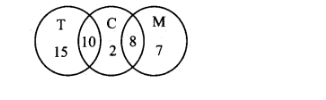
In a hostel, 25 students take tea, 20 students take coffee, 15 students take milk, 10 students take both tea and coffee, 8 students take both milk and coffee. None of them take tea and milk both and everyone takes atleast one beverage, find the total number of students in the hostel.
Answer
Let T = set of students who take tea C = set of students who take coffee M = set of students who take milk ∴ n(T) = 25, n(C) = 20, n(M) = 15, n(T ∩ C) = 10, n(M ∩ C) = 8, n(T ∩ M) = 0, n(T ∩ M ∩ C) = 0

Image

∴ Total number of students in the hostel = n(T ∪ C ∪ M) = n(T) + n(C) + n(M) – n(T ∩ C) – n(M ∩ C) – n(T ∩ M) + n(T ∩ M ∩ C) = 25 + 20 + 15 – 10 – 8 – 0 + 0 = 42

View full question & answer
Question 232 Marks
If A, B, C are the sets for the letters in the words ‘college’, ‘marriage’ and ‘luggage’ respectively, then verify that [A – (B ∪ C)] = [(A – B) ∩ (A – C)].
Answer
A = {c, o, l, g, e} B = {m, a, r, i, g, e} C = {l, u, g, a, e} B ∪ C = {m, a, r, i, g, e, l, u} A – (B ∪ C) = {c, o} A – B = {c, o, l} A – C = {c, o} ∴ [(A – B) ∩ (A – C)] = {c, o} = A – (B ∪ C) ∴ [A -( B ∪ C)] = [(A – B) ∩ (A – C)]
View full question & answer