Questions

Solve the Following Question.(3 Marks)

Take a timed test

12 questions · self-marked practice — reveal the answer and mark yourself.

Question 13 Marks
Show that the following are equivalence relations:

R in A = (x ∈ N/x ≤ 10} given by R = {(a, b) | a = b}

Answer
(iii) a. Since a = a ∴ (a, a) ∈ R ∴ R is reflexive. b. Let (a, b) ∈ R Then a = b ∴ b = a ∴ (b, a) ∈ R ∴ R is symmetric. c. Let (a, b), (b, c) ∈ R Then, a = b, b = c ∴ a = c ∴ (a, c) ∈ R ∴ R is transitive. Thus, R is an equivalence relation.
View full question & answer
Question 23 Marks
Show that the following are equivalence relations:

R in A = {x ∈ Z | 0 ≤ x ≤ 12} given by R = {(a, b) / |a – b| is a multiple of 4}

Answer
a. Since |a – a| is a multiple of 4,

(a, a) ∈ R

∴ R is reflexive.

b. Let (a, b) ∈ R Then a – b = ±4m,

∴ b – a = ±4m, where m is an integer

∴ (b, a) ∈ R ∴ R is symmetric.

c. Let (a, b), (b, c) ∈ R a – b = ± 4m, b – c = ± 4n,

∴ a – c = ±4(m + n), where m, n are integers

∴ (a, c) ∈ R

∴ R is transitive Thus, R is an equivalence relation.

View full question & answer
Question 33 Marks
Show that the following are equivalence relations:

R in A is set of all books given by R = {(x, y) / x and y have same number of pages}

Answer
a. Clearly (x, x) ∈ R

∴ R is reflexive.

b. If (x, y) ∈ R then (y, x) ∈ R.

∴ R is symmetric.

c. Let (x, y) ∈ R, (y, x) ∈ R.

Then x, y, and z are 3 books having the same number of pages.

∴ (x, z) ∈ R as x, z has the same number of pages.

∴ R is transitive. Thus, R is an equivalence relation.
View full question & answer
Question 43 Marks
Show that the relation R in the set A = {1, 2, 3, 4, 5} Given by R = {(a, b) / |a – b| is even} is an equivalence relation.
Answer
(i) Since |a – a| is even,

∴ (a, a) ∈ R

∴ R is reflexive.

(ii) Let (a, b) ∈ R Then |a – b| is even

∴ |b – a| is even

∴ (b, a) ∈ R

∴ R is symmetric.

(iii) Let (a, b), (b, c) ∈ R Then a – b = ±2m, b – c = ±2n

∴ a – c = ±2(m + n), where m, n are integers.

∴ (a, c) ∈ R ∴ R is transitive Thus, R is an equivalence relation.

View full question & answer
Question 53 Marks
Check if R : Z → Z, R = {(a, b) | 2 divides a – b} is an equivalence relation.
Answer
(i) Since 2 divides a – a, (a, a) ∈ R ∴ R is reflexive. .

(ii) Let (a, b) ∈ R Then 2 divides a – b ∴ 2 divides b – a ∴ (b, a) ∈ R ∴ R is symmetric.

(iii) Let (a, b) ∈ R, (b, c) ∈ R Then a – b = 2m, b – c = 2n, ∴ a – c = 2(m + n), where m, n are integers. ∴ 2 divides a – c ∴ (a, c) ∈ R ∴ R is transitive. Thus, R is an equivalence relation.
View full question & answer
Question 63 Marks
In a school, there are 20 teachers who teach Mathematics or Physics. Of these, 12 teach Mathematics and 4 teach both Physics and Mathematics. How many teachers teach Physics?
View full question & answer
Question 73 Marks
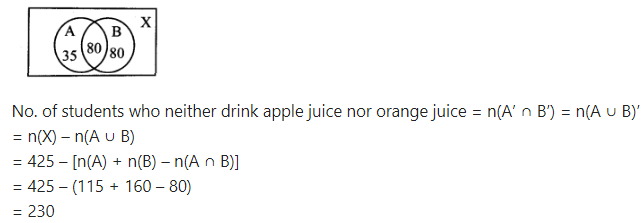
In a survey of 425 students in a school, it was found that 115 drink apple juice, 160 drink orange juice, and 80 drink both apple as well as orange juice. How many drinks neither apple juice nor orange juice?
Answer
Let A = set of students who drink apple juice

B = set of students who drink orange juice

X = set of all students

∴ n(X) = 425, n(A) = 115, n(B) = 160, n(A ∩ B) = 80

Image

View full question & answer
Question 83 Marks
Let A = {6, 8} and B = {1, 3, 5}. Show that R1 = {(a, b) / a ∈ A, b ∈ B, a – b is an even number} is a null relation, R2 = {(a, b) / a ∈ A, b ∈ B, a + b is an odd number} is a universal
View full question & answer
Question 93 Marks
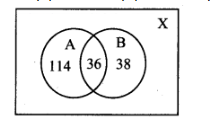
There are 260 persons with skin disorders. If 150 had been exposed to the chemical A, 74 to the chemical B, and 36 to both chemicals A and B, find the number of persons exposed to (i) Chemical A but not Chemical B. 2. Chemical B but not Chemical A. 3. Chemical A or Chemical B
Answer
Let A = set of persons exposed to chemical A B = set of persons exposed to chemical B X = set of all persons ∴ n(X) = 260, n(A) = 150, n(B) = 74, n(A ∩ B) = 36

Image

(i) No. of persons exposed to chemical A but not to chemical B = n(A ∩ B’)

= n(A) – n(A ∩ B)

= 150 – 36

= 114

2. No. of persons exposed to chemical B but not to chemical A = n(A’ ∩ B) = n(B) – n(A ∩ B) = 74 – 36 = 38

3. No. of persons exposed to chemical A or chemical B = n(A ∪ B)

= n(A) + n(B) – n(A ∩ B)

= 150 + 74 – 36

= 188

View full question & answer
Question 103 Marks
From amongst 2000 Uterate individuals of a town, 70% read Marathi newspapers, 50% read English newspapers and 32.5% read both Marathi and English newspapers. Find the number of individuals who read (i) at least one of the newspapers. 2. neither Marathi nor English newspaper. 3. only one of the newspapers.
Answer
Let M = set of individuals who read Marathi newspapers E = set of individuals who read English newspapers X = set of all literate individuals ∴ n(X) = 2000,
$\therefore n ( X )=2000$
$n ( M )=\frac{70}{100} \times 2000=1400$
$n ( E )=\frac{50}{100} \times 2000=1000$
$n ( M \cap E )=\frac{32.5}{100} \times 2000=650$
$\text { (i) } n ( M \cup E )= n ( M )+ n ( E )- n ( M \cap E )$
$=1400+1000-650$
$=1750$
Image
No. of individuals who read at least one of the newspapers = n(M ∪ E) = 1750.
2. No. of individuals who read neither Marathi nor English newspaper = n(M’ ∩ E’) = n(M ∪ E)’ = n(X) – n(M ∪ E) = 2000 – 1750 = 250
3. No. of individuals who read only one of the newspapers = n(M ∩ E’) + n(M’ ∩ E) = n(M ∪ E) – n(M ∩ E) = 1750 – 650 = 1100
View full question & answer
Question 113 Marks
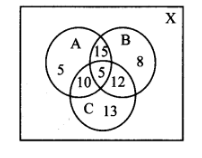
In a class of 200 students who appeared in certain examinations, 35 students faded in CET, 40 in NEET and 40 in JEE, 20 faded in CET and NEET, 17 in NEET and JEE, 15 in CET and JEE and 5 faded in ad three examinations. Find how many students (i) did not fail in any examination. 2. faded in NEET or JEE entrance.
Answer
Let A = set of students who failed in CET B = set of students who failed in NEET C = set of students who failed in JEE X = set of all students ∴ n(X) = 200, n(A) = 35, n(B) = 40, n(C) = 40, n(A ∩ B) = 20, n(B ∩ C) = 17, n(A ∩ C) = 15, n(A ∩ B ∩ C) = 5

Image

n(A ∪ B ∪ C) = n(A) + n(B) + n(C) – n(A ∩ B) – n(B ∩ C) – n(A ∩ C) + n(A ∩ B ∩ C) = 35 + 40 + 40 – 20 – 17 – 15 + 5 = 68 ∴ No. of students who did not fail in any exam = n(X) – n(A ∪ B ∪ C) = 200 – 68 = 132

2. No. of students who failed in NEET or JEE entrance = n(B ∪ C)
= n(B) + n(C) – n(B ∩ C)
= 40 + 40 – 17
= 63

View full question & answer
Question 123 Marks
If $A=\left\{x / 6 x^2+x-15=0\right\}, B=\left\{x / 2 x^2-5 x-3=0\right\}, C=\left\{x / 2 x^2-x-3=0\right\}$, then find

(i)(A ∪ B ∪ C) (ii) (A ∩ B ∩ C)

View full question & answer