Questions

Solve the Following Question.(4 Marks)

🎯

Test yourself on this topic

8 questions · timed · auto-graded

Question 14 Marks
Show that there are two lines which pass through A(3, 4) and the sum of whose intercepts is zero.
Answer
Case I: Line not passing through origin.
Let the equation of the line be $\frac{x}{a}+\frac{y}{b}=1$
This line passes through $(3,4)$
$\frac{3}{a}+\frac{4}{b}=1$
Since the sum of the intercepts of the line is zero,
$ a+b=0$
$a=-b . \ldots . \text { (iii) } $
Substituting the value of $a$ in (ii), we get
$ \frac{3}{b}+\frac{4}{b}=1$
$\frac{1}{b}=1$
$b=1$
$a=-1 \ldots . .[\text { From (iii)] } $
Substituting the values of $a$ and $b$ in (i), the equation of the required line is
$ \frac{x}{-1}+\frac{y}{1}=1$
$x-y=-1$
$\therefore x-y+1=0 $
Case II: Line passing through origin.
Slope of line passing through origin and $A(3,4)$ is
$m=\frac{4-0}{3-0}=\frac{4}{3}$
Equation of the line having slope $m$ and passing through origin $(0,0)$ is $y=m x$.
The equation of the required line is
$ y=\frac{4}{3} x$
$\therefore 4 x-3 y=0 $
$\therefore$ There are two lines which pass through $A (3,4)$ and the sum of whose intercepts is zero.
View full question & answer
Question 24 Marks
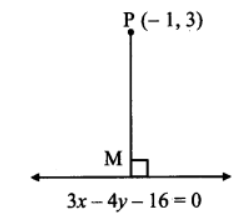
Find the co-ordinates of the foot of the perpendicular drawn from the point $P(-1, 3)$ to the line $3x – 4y – 16 = 0.$
Answer
Image
Let $M$ be the foot of perpendicular drawn from $P(-1,3)$ to the line $3 x-4 y-16=0$ Slope of the line $3 x-4 y-16=0$ is $\frac{-3}{-4}=\frac{3}{4}$
Since $P M \perp$ to line (i),
slope of $PM =\frac{-4}{3}$
Equation of $PM$ is
$ y-3=\frac{-4}{3}(x+1)$
$\Rightarrow 3(y-3)=-4(x+1)$
$\Rightarrow 3 y-9=-4 x-4$
$\therefore 4 x+3 y-5=0 $
The foot of perpendicular i.e., point $M$, is the point of intersection of equation (i) and (ii).
By (i) $\times 3+$ (ii) $\times 4$, we get
$ 25 x=68$
$x=\frac{68}{25} $
Substituting $x=\frac{68}{25}$ in (ii), we get
$ 4\left(\frac{68}{25}\right)+3 y-5=0$
$3 y=5-4\left(\frac{68}{25}\right)=\frac{125-272}{25}=\frac{-147}{25}$
$y=\frac{-49}{25} $
The co-ordinates of the foot of perpendicular $M$ are $\left(\frac{68}{25}, \frac{-49}{25}\right)$
View full question & answer
Question 34 Marks
Find the equation of the line which contains the point A(3, 5) and makes equal intercepts on the co-ordinates axes.
Answer
Case I: Line not passing through origin.

Let the equation of the line be $\frac{x}{a}+\frac{y}{b}=1 \ldots \ldots$ (i)

This line passes through A(3, 5).

$\therefore \frac{3}{a}+\frac{5}{b}=1$

......(ii)

Since the required line makes equal intercepts on the co-ordinates axes,

a = b …….(iii)

Substituting the value of b in (ii), we get

$\begin{aligned} & \frac{3}{a}+\frac{5}{a}=1 \\ & \therefore a=8 \\ & \therefore b=8 \ldots \ldots[\text { From (iii)] }\end{aligned}$

Substituting the values of a and b in equation (i), the equation of the required line is

$\begin{aligned} & \frac{x}{8}+\frac{y}{8}=1 \\ & \therefore x+y=8\end{aligned}$

Case II: Line passing through origin. Slope of line passing through origin and A(3, 5) is

$m=\frac{5-0}{3-0}=\frac{5}{3}$

∴ Equation of the line having slope m and passing through origin (0, 0) is y = mx. ∴ The equation of the required line is

$\begin{aligned} & y=\frac{5}{3} x \\ & \therefore 5 x-3 y=0\end{aligned}$

View full question & answer
Question 44 Marks
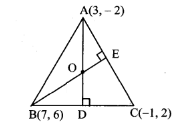
Find the co-ordinates of the orthocentre of the triangle whose vertices are A(3, – 2), B(7,6), C (-1,2).
Answer
Let O be the orthocentre of ∆ABC. Let AD and BE be the altitudes on the sides BC and AC respectively.

Image

Slope of side $B C=\frac{2-6}{-1-7}=\frac{-4}{-8}=\frac{1}{2}$

∴ Slope of AD = – 2 [∵ AD ⊥ BC]

∴ Equation of line AD is y – (-2) = (- 2) (x – 3)

∴ y + 2 = -2x + 6

∴ 2x + y -4 = 0 …(i)

Slope of side $A C=\frac{-2-2}{3-(-1)}=\frac{-4}{4}=-1$

∴ Slope of BE = 1 …[ ∵ BE ⊥ AC]

∴ Equation of line BE is

y – 6 = 1(x – 7)

∴ y – 6 = x – 1

∴ x = y + 1 …(ii)

Substituting x = y + 1 in (i), we get

2(y + 1) + y – 4 = 0

∴ 2y + 2 + y – 4 = 0

∴ 3y – 2 = 0

$\therefore y=\frac{2}{3}$ in $($ ii $)$, wegetSubstitutingy $=[$ latex $] \frac{2}{3}$ in (ii), we get

$x=\frac{2}{3}+1=\frac{5}{3}$

$\therefore$ Co-ordinates of orthocentre, $O=\left(\frac{5}{3}, \frac{2}{3}\right)$

View full question & answer
Question 54 Marks
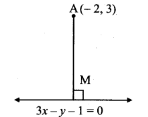
Find the co-ordinates of the foot of the perpendicular drawn from the point A(- 2,3) to the line 3x-y -1 = 0.
Answer
Let M be the foot of perpendicular drawn from

point A(- 2,3) to the line

3x-y- 1 = 0 …(i)

Slope of the line $3 x-y-1=0$ is $\frac{-3}{-1}=3$.

∴ Equation of AM is

$y-3=\frac{-1}{3}(x+2)$

Image

∴ 3(y – 3) = – 1(x + 2) ∴ 3y – 9 = -x – 2

∴ x + 3y – 7 = 0 …………(ii)

The foot of perpendicular i.e., point M, is the point of intersection of equations (i) and (ii).

By (i) x 3 + (ii), we get 10x -10 = 0

∴ x = 1

Substituting x = 1 in (ii), we get

1 + 3y – 7 = 0

∴ 3y = 6

∴ y = 2

∴ The co-ordinates of the foot of the perpendicular Mare (1,2).

View full question & answer
Question 64 Marks
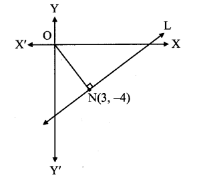
N(3, – 4) is the foot of the perpendicular drawn from the origin to line L. Find the equation of line L.
Answer

Image

Slope of $O N=\frac{-4-0}{3-0}=\frac{-4}{3}$

Since line L ⊥ ON,

slope of the line $L$ is $\frac{3}{4}$ and it passes through point $N(3,-4)$.

Equation of the line in slope point form is $y-y_1=m\left(x-x_1\right)$

Equation of line L is

$y-(-4)=\frac{3}{4}(x-3)$

∴ 4(y + 4) = 3(x – 3)

∴ 4y + 16 = 3x – 9

∴ 3x – 4y – 25 = 0

View full question & answer
Question 74 Marks
Find equations of the line containing the point A(3, 4) and making equal intercepts on the co-ordinate axes.
Answer
Case I: Line not passing through origin.

Let the equation of the line be $\frac{x}{a}+\frac{y}{b}=1$

This line passes through A(3, 4).

$\therefore \frac{3}{a}+\frac{4}{b}=1$……………..(ii)

Since, the required line make equal intercepts on the co-ordinate axes.

∴ a = b …(iii)

Substituting the value of b in (ii), we get

$\begin{aligned} & \frac{3}{a}+\frac{4}{a}=1 \\ & \therefore \frac{7}{a}=1 \\ & \therefore a=7 \\ & \therefore b=7 \ldots[\text { From (iii)] }\end{aligned}$

Substituting the values of a and b in (i), equation of the required line is

$\frac{x}{7}+\frac{y}{7}=1=1$

∴ x + y = 7

Case II: Line passing through origin.

Slope of line passing through origin and $A(3,4)$ is $m==\frac{4-0}{3-0}=\frac{4}{3}$

∴ Equation of the line having slope m and passing through origin (0, 0) is y = mx.

∴ The equation of the required line is 4

$y=\frac{4}{3} x$

∴ 4x – 3y = 0

View full question & answer
Question 84 Marks
Find equations of the line which contains the point A(l, 3) and the sum of whose intercepts on the co-ordinate axes is zero.
Answer
Case I: Line not passing through origin.

Let the equation of the line be

$\frac{x}{a}+\frac{y}{b}=1 \ldots \ldots \ldots$ (i)

Since, the sum of the intercepts of the line is zero.

∴ a + b = 0

∴ b = – a Substituting b = – a in (i), we get

$\frac{x}{a}+\frac{y}{(-a)}=1$

x – y = a .. .(ii)

Since, the line passes through A(1, 3).

∴ 1 – 3 = a

∴ a = – 2 Substituting the value of a in (ii), equation of the required line is

∴ x – y = – 2,

∴ x – y + 2 = 0

Case II: Line passing through origin.

Slope of line passing through origin and

$A(1,3)$ is $m=\frac{3-0}{1-0}=3$

∴ Equation of the line having slope m and passing through origin (0, 0) is / = mx.

∴ The equation of the required line is y = 3x

∴ 3x – y = 0

View full question & answer
Solve the Following Question.(4 Marks) - Maths STD 11 Questions - Vidyadip