Questions

Solve the Following Question.(5 Marks)

Take a timed test

8 questions · self-marked practice — reveal the answer and mark yourself.

Question 15 Marks
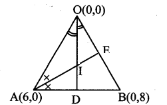
0(0, 0), A(6, 0) and B(0, 8) are vertices of a triangle. Find the co-ordinates of the incentre of ∆OAB.
Answer
Let bisector of ∠O meet AB at point D and bisector of ∠A meet BO at point E ∴ Point D divides seg AB in the ratio l(OA): l(OB) and point E divides seg BO in the ratio l(AB): l(AO) Let I be the incentre of ∠OAB.

Image

By distance formula.

$\begin{aligned} & l(\mathrm{OA})=\sqrt{(0-6)^2+(0-0)^2}=6 \\ & l(\mathrm{OB})=\sqrt{(0-0)^2+(0-8)^2}=8\end{aligned}$

∴ Point D divides AB internally in 6 : 8 i.e. 3 :4

$\therefore \quad D \equiv\left(\frac{3(0)+4(6)}{3+4}, \frac{3(8)+4(0)}{3+4}\right) \equiv\left(\frac{24}{7}, \frac{24}{7}\right)$

$\therefore \quad$ Equation of $\mathrm{OD}$ is $\frac{y-0}{\frac{24}{7}-0}=\frac{x-0}{\frac{24}{7}-0}$

∴ y = x …(i) Now, by distance formula,

$\begin{aligned} I(A B)= & =\sqrt{(6-0)^2+(0-8)^2} \\ & =\sqrt{36+64}=10\end{aligned}$

$I(A O)=\sqrt{(6-0)^2+(0-0)^2}=6$

∴ Point E divides BO internally in 10 : 6 i.e. 5:3

$\therefore \quad \mathrm{E}=\left(\frac{5(0)+3(0)}{5+3}, \frac{5(0)+3(8)}{5+3}\right)=(0,3)$

$\therefore \quad$ Equation of AE is $\frac{y-0}{3-0}=\frac{x-6}{0-6}$

$\therefore \quad \frac{y}{3}=\frac{x-6}{-6}$

∴ -2y = x – 6 ∴ x + 2y = 6 …(ii) To find co-ordinates of incentre, we have to solve equations (i) and (ii). Substituting y = x in (ii), we get x + 2x = 6 ∴ x = 2 Substituting the value of x in (i), we get y = 2 ∴ Co-ordinates of incentre I ≡ (2, 2).

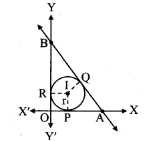
Alternate Method: Let I be the incentre. I lies in the 1st quadrant. OPIR is a square having side length r. Since OA = 6, OP = r, PA = 6 – r Since PA = AQ, AQ = 6 – r …(i) Since OB = 8, OR = r, BR = 8 – r ∴ BR = BQ ∴ BQ = 8 – r …(ii)
Image

AB = BQ + AQ

$\begin{aligned} & =\sqrt{\mathrm{OA}^2+\mathrm{OB}^2} \\ \text { Also, } \mathrm{AB}= & =\sqrt{6^2+8^2} \\ & =\sqrt{100}=10\end{aligned}$

∴ BQ + AQ= 10

∴ (8 – r) + (6 – r) = 10

∴ 2r = 14- 10 = 4

∴ r = 2

∴ I = (2,2)
View full question & answer
Question 25 Marks
D(- 1, 8), E(4, – 2), F(- 5, – 3) are midpoints of sides BC, CA and AB of AABC. Find co-ordinates of the circumcentre of ΔABC.
Answer
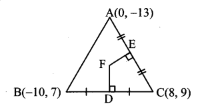
Here, A(0, – 13), B(- 10, 7), C(8, 9) are the vertices of ΔABC. Let F be the circumcentre of AABC. Let FD and FE be perpendicular bisectors of the sides BC and AC respectively. D and E are the midpoints of side BC and AC.

$\therefore \quad D=\left(\frac{-10+8}{2}, \frac{7+9}{2}\right)$

$\begin{array}{ll}\therefore \quad D=(-1,8) \\ & \text { and } E=\left(\frac{0+8}{2}, \frac{-13+9}{2}\right)\end{array}$

$\therefore \quad E=(4,-2)$

Image

Now, slope of BC $=\frac{7-9}{-10-8}=\frac{1}{9}$

∴ Slope of FD = -9 … [ ∵ FD ⊥ BC] Since FD passes through (-1, 8) and has slope -9,

equation of FD is y – 8 = -9 (x +1)

∴ y – 8 = -9x – 9

∴ y = -9x – 1

Also, slope of $A C=\frac{-13-9}{0-8}=\frac{11}{4}$

$\therefore$ Slope of $F E=\frac{-4}{11}[\because F E \perp A C]$

Since FE passes through (4, -2) and has slope -4

$\frac{-4}{11}$, equation of $\mathrm{FE}$ is

$(y+2)=\frac{-4}{11}(x-4)$

∴ 11(y + 2) = -4(x – 4)

∴ 11y + 22 = – 4x + 16

∴ 4x + 11y = -6 …………(ii)

To find co-ordinates of circumcentre, we have to solve equations (i) and (ii).

Substituting the value ofy in (ii), we get

4x + 11(-9x- 1) = – 6

∴ 4x – 99x -11 = – 6

∴ -95x = 5

$\therefore x=\frac{-1}{19}$

Substituting the value of x in (i), we get

$y=-9\left(\frac{-1}{19}\right)-1=\frac{-10}{19}$

$\therefore$ Co-ordinates of circumcentre $F \equiv\left(\frac{-1}{19}, \frac{-10}{19}\right)$

View full question & answer
Question 35 Marks
D(- 1, 8), E(4, – 2), F(- 5, – 3) are midpoints of sides BC, CA and AB of AABC. Find equations of sides of ΔABC.
Answer
Let $A\left(x_1, y_1\right), B\left(x_2, y_2\right)$ and $C\left(x_3, y_3\right)$ be the vertices of $\triangle A B C$.

Given, points D, E and F are midpoints of sides BC, CA and AB respectively of ΔABC.

$\mathrm{D}=\left(\frac{x_2+x_3}{2}, \frac{y_2+y_3}{2}\right)$

$\therefore \quad(-1,8)=\left(\frac{x_2+x_3}{2}, \frac{y_2+y_3}{2}\right)$

$\begin{array}{ll}\therefore \quad & x_2+x_3=-2 \\ & \text { and } y_2+y_3=16\end{array}$

Also, $\mathrm{E}=\left(\frac{x_1+x_3}{2}, \frac{y_1+y_3}{2}\right)$

$\therefore \quad(4,-2)=\left(\frac{x_1+x_3}{2}, \frac{y_1+y_3}{2}\right)$

$\therefore \quad x_1+x_3=8$

$\ldots$ (iii)

and $y_1+y_3=-4$

$\ldots(i v)$

Similarly, $\mathrm{F}=\left(\frac{x_1+x_2}{2}, \frac{y_1+\dot{y}_2}{2}\right)$

$\therefore \quad(-5,-3)=\left(\frac{x_1+x_2}{2}, \frac{y_1+y_2}{2}\right)$

$\therefore x_1+x_2=-10$

and $y_1+y_2=-6$

…………(vi)

For x-coordinates: Adding (i), (iii) and (v), we get 2x1 + 2x2 + 2x3 = – 4 ∴ x1 + x2 + x3 = -2 …………..(vii) Solving (i) and (vii), we get x1 = 0 Solving (iii) and (vii), we get x2 = – 10 Solving (v) and (vii), we get x3 = 8

For y-coordinates: Adding (ii), (iv) and (vi), we get 2y1 + 2y2 + 2y3 = 6 y1 + y2 + y3 = 3 …….(viii) Solving (ii) and (viii), we get y1 = -13 Solving (iv) and (viii), we get y2 = 7 Solving (vi) and (viii), we get y3 = 9 ∴ Vertices of AABC are A(0, – 13), B(- 10, 7), C(8, 9)

a. Equation of side $\mathrm{AB}$ is

$\begin{array}{ll} & \frac{y+13}{7+13}=\frac{x-0}{-10-0} \\ \therefore \quad & \frac{y+13}{20}=\frac{x}{-10} \\ \therefore \quad & \frac{y+13}{2}=-x \\ \therefore \quad & 2 x+y+13=0\end{array}$

b. Equation of side $\mathrm{BC}$ is

$\begin{array}{r}\quad \frac{y-7}{9-7}=\frac{x+10}{8+10} \\ \therefore \quad \frac{y-7}{2}=\frac{x+10}{18} \\ \therefore \quad y-7=\frac{x+10}{9} \\ \therefore \quad x-9 y+73=0\end{array}$

c. Equation of side $\mathrm{AC}$ is

$\begin{aligned} & \frac{y+13}{9+13}=\frac{x-0}{8-0} \\ & \therefore \quad \frac{y+13}{22}=\frac{x}{8} \text { } \\ & \end{aligned}$

∴ 8(y + 13) = 22x ∴ 4(y + 13) = 11x ∴ 11x – 4y – 52 = 0

View full question & answer
Question 45 Marks
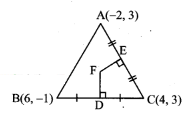
Find the co-ordinates of the circumcentre of the triangle whose vertices are A(- 2, 3), B(6, -1), C(4,3),e
Answer
Here, A(-2, 3), B(6, -1), C(4, 3) are the vertices of ∆ABC.

Let F be the circumcentre of AABC.

Let FD and FE be the perpendicular bisectors of the sides BC and AC respectively.

∴ D and E are the midpoints of side BC and AC respectively.

$\therefore \quad \mathrm{D} \equiv\left(\frac{6+4}{2}, \frac{-1+3}{2}\right)$

$\begin{array}{ll}\therefore \quad & \mathrm{D}=(5,1) \\ & \text { and } \mathbf{E} \equiv\left(\frac{-2+4}{2}, \frac{3+3}{2}\right) \\ \therefore \quad & \mathrm{E}=(1,3)\end{array}$

Image

Now, slope of $B C=\frac{3-(-1)}{4-6}=\frac{4}{-2}=-2$

$\therefore \quad$ Slope of $\mathrm{FD}=\frac{1}{2} \quad \ldots[\because \mathrm{FD} \perp \mathrm{BC}]$

Since FD passes through (5, 1) and has slope 1/2 equation of FD is

$y-1=\frac{1}{2}(x-5)$

∴ 2 (y – 1) = x – 5

∴ 2y – 2 = x – 5

∴ x – 2y – 3 = 0 …(i)

Since both the points A and C have same y co-ordinates i.e. 3, the given points lie on the line y = 3. Since the equation FE passes through E(1, 3), the equation of FE is x = 1. .. .(ii) To find co-ordinates of circumcentre, we have to solve equations (i) and (ii). Substituting the value of x in (i), we get

1 – 2y -3 = 0

∴ y = -1

∴ Co-ordinates of circumcentre F ≡ (1, – 1).

View full question & answer
Question 55 Marks
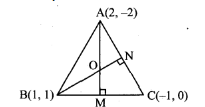
Find the co-ordinates of the orthocentre of the triangle whose vertices are A(2, – 2), B(l, 1) and C(-1,0).
Answer
Let O be the orthocentre of AABC. Let AM and BN be the altitudes of sides BC and AC respectively.

Now, slope of $B C=\frac{0-1}{-1-1}=\frac{-1}{-2}=\frac{1}{2}$

Slope of AM = -2 ,..[∵ AM ⊥ BC] Since AM passes through (2, – 2) and has slope -2, equation of the altitude AM is y – (- 2) = – 2 (x – 2)

∴ y + 2 = -2x + 4

∴ 2x + y – 2 = 0 …(i)

Image

Also, slope of $A C=\frac{0-(-2)}{-1-2}=\frac{2}{-3}$

$\therefore$ Slope of $B N=\frac{3}{2} \ldots[\because B N \perp A C]$

Since BN passes through $(1,1)$ and has slope $\frac{3}{2}$, equation of the altitude $B N$ is

$y-1=\frac{3}{2}(x-1)$

∴ 2y – 2 = 3x – 3

∴ 3x – 2y – 1 = 0 …(ii) To find co-ordinates of orthocentre,

we have to solve equations (i) and (ii). By (i) x 2 + (ii), we get

7x – 5 = 0

$\therefore x=\frac{5}{7}$

substituting $x=\frac{5}{7}$ in eq $(\mathrm{i})$, we get

$2\left(\frac{5}{7}\right)+y-2=0$

$\begin{aligned} & \therefore y=-2\left(\frac{5}{7}\right)+2 \\ & \therefore y=\frac{-10+14}{7}=\frac{4}{7}\end{aligned}$

$\therefore$ Coordinates of orthocentre $O=\left(\frac{5}{7}, \frac{4}{7}\right)$

View full question & answer
Question 65 Marks
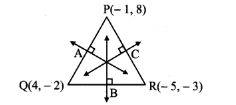
Find the equations of perpendicular bisectors of sides of the triangle whose vertices are P(-1, 8), Q(4, – 2) and R(- 5, – 3).
Answer

Image

Let A, B and C be the midpoints of sides PQ, QR and PR respectively of APQR. A is the midpoint of side PQ.

$\therefore \quad \mathrm{A} \equiv\left(\frac{-1+4}{2}, \frac{8-2}{2}\right)=\left(\frac{3}{2}, 3\right)$

Slope of side $\mathrm{PQ}=\frac{-2-8}{4-(-1)}=\frac{-10}{5}=-2$

Slope of perpendicular bisector of $P Q$ is $\frac{1}{2}$ and it passes through $\left.\left(\frac{3}{2}\right), 3\right)$.

Equation of the perpendicular bisector of side PQ is

$\begin{aligned} & y-3=\frac{1}{2}\left(x-\frac{3}{2}\right) \\ & y-3=\left(\frac{1}{2}\left(\frac{2 x-3}{2}\right)\right) \\ & \therefore 4(y-3)=2 x-3 \\ & \therefore 4 y-12=2 x-3 \\ & \therefore 2 x-4 y+9=0\end{aligned}$

B is the midpoint of side QR

$\therefore B=\left(\frac{4-5}{2}, \frac{-2-3}{2}\right)=\left(\frac{-1}{2}, \frac{-5}{2}\right)$

Slope of side $Q R=\frac{-3-(-2)}{-5-4}=\frac{-1}{-9}=\frac{1}{9}$

$\therefore$ Slope of perpendicular bisector of $Q R$ is -9 and it passes through $\left(-\frac{1}{2},-\frac{5}{2}\right)$

∴ Equation of the perpendicular bisector of side QR is

$y-\left(-\frac{5}{2}\right)=-9\left[x-\left(-\frac{1}{2}\right)\right]$

$\therefore \quad \frac{2 y+5}{2}=-9\left(\frac{2 x+1}{2}\right)$

∴ 2y + 5 = -18x – 9

∴ 18x + 2y + 14 = 0

∴ 9x + y + 7 = 0

C is the midpoint of side PR

$\therefore \quad \mathrm{C} \equiv\left(\frac{-1-5}{2}, \frac{8-3}{2}\right)=\left(-3, \frac{5}{2}\right)$

Slope of side PR $=\frac{-3-8}{-5-(-1)}=\frac{-11}{-4}=\frac{11}{4}$

$\therefore \quad$ Slope of perpendicular bisector of $\mathrm{PR}$ is $-\frac{4}{11}$

and it passes through $\left(-3, \frac{5}{2}\right)$

Equation of the perpendicular bisector of PR is $y-\frac{5}{2}=-\frac{4}{11}(x+3)$

$\begin{aligned} & \therefore 11\left(\frac{2 y-5}{2}\right)=-4(x+3) \\ & \therefore 11(2 y-5)=-8(x+3) \\ & \therefore 22 y-55=-8 x-24 \\ & \therefore 8 x+22 y-31=0\end{aligned}$

View full question & answer
Question 75 Marks
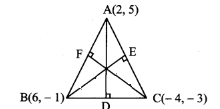
Find the equations of the altitudes of the triangle whose vertices are A(2, 5), B(6, – 1 ) and C(- 4, – 3).
Answer

Image

A(2, 5), B(6, – 1), C(- 4, – 3) are the vertices of ∆ABC.

Let AD, BE and CF be the altitudes through the vertices A, B and C respectively of ∆ABC.

∴ Slope of AD = -5 …[∵AD ⊥ BC] Since altitude AD passes through (2, 5) and has slope – 5, equation of the altitude AD is y – 5 = -5 (x – 2)

∴ y – 5 = – 5x + 10

∴ 5x +y -15 = 0

Now, slope of $A C=\frac{-3-5}{-4-2}=\frac{-8}{-6}=\frac{4}{3}$

Slope of BE $=\frac{-3}{4}$

$\ldots[\because B E \perp A C]$

Since altitude BE passes through $(6,-1)$ and has slope $\frac{-3}{4}$,

equation of the altitude BE is

$y-(-1)=\frac{-3}{4}(x-6)$

∴ 4 (y + 1) = – 3 (x – 6)

∴ 4y + 4 =-3x+ 18

∴ 3x + 4y – 14 = 0

Also, slope of $A B=\frac{-1-5}{6-2}=\frac{-6}{4}=\frac{-3}{2}$

$\therefore$ Slope of $C F=23 \ldots[\because C F \perp A B]$

Since altitude CF passes through $(-4,-3)$ and has slope, $\frac{2}{3}$

equation of the altitude CF is

$y-(-3)=\frac{2}{3}[x-(-4)]$

∴ 3 (y + 3) = 2 (x + 4)

∴ 3y + 9 = 2x + 8

∴ 2x – 3y – 1 = 0

View full question & answer
Question 85 Marks
Obtain the new equations of the following loci if the origin is shifted to the point $0′(2,2),$ the direction of axes remaining the same:
$1. 3x-y + 2 = 0$
$2. x^2+y^2-3x = 7$
$3. xy – 2x – 2y + 4 = 0$
$4. y^2 – 4x – 4y + 12 = 0$
Answer
Given, $(h,k) = (2,2)$ Let $(X, Y)$ be the new co-ordinates of the point $(x,y).$
$∴ x = X + h$ and $y = Y + k$
$ ∴ x = X + 2$ and $y = Y + 2 i.$
Substituting the values of x and y in the equation $3x -y + 2 = 0,$
we get $3(X + 2) – (Y + 2) + 2 = 0 $
$∴ 3X + 6-Y-2 + 2 = 0 $
$∴ 3 X – Y + 6 = 0,$ which is the new equation of locus.
Substituting the values of $x$ and $y$ in the equation
$\begin{aligned} & x^2+y^2-3 x=7 \text {, we get } \\ & (X+2)^2+(Y+2)^2-3(X+2)=7 \\ & \therefore X^2+4 X+4+Y^2+4 Y+4-3 X-6=7\end{aligned}$
$\therefore X^2+Y^2+X+4 Y-5=0$,
which is the new equation of locus.
Substituting the values of $x$ and $y$ in the equation $xy – 2x – 2y + 4 = 0,$ we get
$(X + 2) (Y + 2) – 2(X + 2) – 2(Y + 2) + 4 = 0$
$∴ XY + 2X + 2Y + 4 – 2X – 4-2Y- 4 + 4 = 0$
$∴ XY = 0,$ which is the new equation of locus.
Substituting the values of $x$ and $y$ in the equation $y^2-4 x-4 y+12=0$, we get
$(X+2)(Y+2)-2(X+2)-2(Y+2)+4=0$
$\therefore Y^2+4 Y+4-4 X-8-4 Y-8+12=0$
$\therefore Y^2-4 X=0$, which is the new equation of locus.
View full question & answer
Solve the Following Question.(5 Marks) - Maths STD 11 Questions - Vidyadip