MCQ 11 Mark
Three vertices of a parallelogram taken in order are $(-1, -6), (2, -5)$ and $(7, 2$). The fourth vertex is :
- A
$(1, 4)$
- ✓
$(4, 1)$
- C
$(1, 1)$
- D
$(4, 4)$
AnswerCorrect option: B. $(4, 1)$
$(4, 1)$
View full question & answer→MCQ 21 Mark
The point which divides the join of $(1, 2)$ and $(3, 4)$ externally in the ratio $1 : 1$ :
- A
Lies in the $III$ quadrant.
- B
Lies in the $II$ quadrant.
- C
Lies in the $I$ quadrant.
- ✓
AnswerThe point which divides the join of $(1, 2)$ and $(3, 4)$ externally in the ratio $1 : 1$ is
$\Big(\frac{1\times3-1\times1}{1-1},\frac{1\times4-1\times2}{1-1}\Big)$
which is not defined.
Therefore, it is not possible to externally divide the line joining two points in the ratio $1 : 1$
View full question & answer→MCQ 31 Mark
$L$ is a variable line such that the algebraic sum of the distances of the points $(1, 1), (2, 0)$ and $(0, 2)$ from the line is equal to zero. The line $L$ will always pass through:
- ✓
$(1, 1)$
- B
$(2, 1)$
- C
$(1, 2)$
- D
AnswerCorrect option: A. $(1, 1)$
Let $ax + by + c = 0$ be the variable line. It is given that the algebraic sum of the distances of the points $(1, 1), (2, 0)$ and $(0, 2)$ from the line is equal to zero
$\therefore \ \frac{\text{a}+\text{b}+\text{c}}{\sqrt{\text{a}^2+\text{b}^2}}+\frac{2\text{a}+0+\text{c}}{\sqrt{\text{a}^2+\text{b}^2}}+\frac{0+2\text{b}+\text{c}}{\sqrt{\text{a}^2+\text{b}^2}}=0$
$\Rightarrow3\text{a}+3\text{b}+3\text{c}=0$
$\Rightarrow\text{a}+\text{b}+\text{c}=0$
Substituting $c = -a - b$ in $ax + by + c = 0,$ we get:
$\text{ax}+\text{by}-\text{a}-\text{b}=0$
$\Rightarrow\text{a}(\text{x}-1)+\text{b}(\text{y}-1)=0$
$\Rightarrow(\text{x}-1)+\frac{\text{a}}{\text{b}}(\text{y}-1)=0$
This line is of the form $\text{L}_1+\lambda\text{L}_2=0$ which passes through the intersection of $L_1 =0$ and $L_2 =0$,
i.e. $x - 1 = 0$ and $y - 1 = 0.$
$\Rightarrow x = 1, y = 1$
View full question & answer→MCQ 41 Mark
The acute angle between the medians drawn from the acute angles of $a$ right angled isosceles triangle is:
- A
$\cos^{-1}\big(\frac{2}{3}\big)$
- ✓
$\cos^{-1}\big(\frac{3}{4}\big)$
- C
$\cos^{-1}\big(\frac{4}{5}\big)$
- D
$\cos^{-1}\big(\frac{5}{6}\big)$
AnswerCorrect option: B. $\cos^{-1}\big(\frac{3}{4}\big)$
Let the coordinates of the right$-$angled isosceles triangle be $O(0, 0), A(a, 0)$ and $B(0, a).$
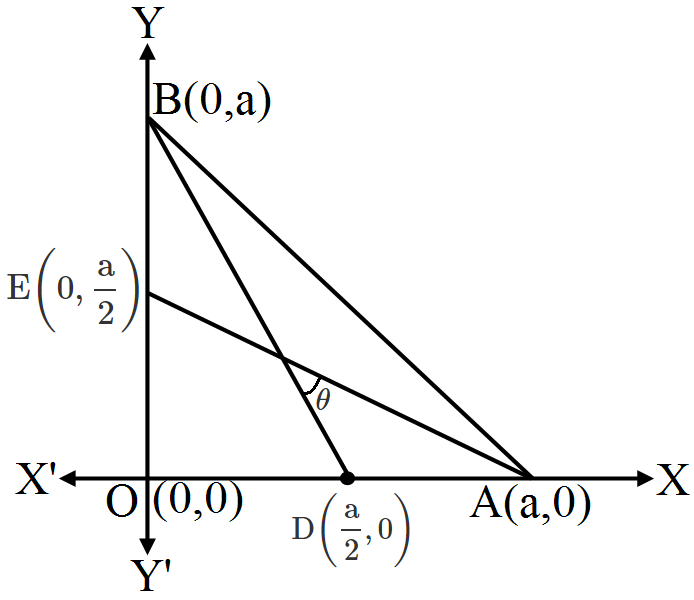
Here, $BD$ and $AE$ are the medians drawn from the acute angles $B$ and $A,$ respectively.
$\therefore$ Slope of $BD = m_1$
$=\frac{0-\text{a}}{\frac{\text{a}}{2}-0}$
$=-\frac{1}{2}$
Let $\theta$ be the angle between $BD$ and $AE.$
$\tan\theta=\Big|\frac{-2+\frac{1}{2}}{1+1}\Big|$
$=\frac{3}{4}$
$\Rightarrow\cos\theta=\frac{4}{\sqrt{3^2+4^2}}$
$\Rightarrow\cos\theta=\frac{4}{5}$
$\Rightarrow\theta=\cos^{-1}\Big(\frac{4}{5}\Big)$
Hence, the acute angle between the medians is $\cos^{-1}\Big(\frac{4}{5}\Big).$
View full question & answer→MCQ 51 Mark
The medians $AD$ and $BE$ of a triangle with vertices $A(0, b), B(0, 0)$ and $C(a, 0)$ are perpendicular to each other, if
- A
$\text{a}=\frac{\text{b}}{2}$
- B
$\text{b}=\frac{\text{a}}{2}$
- C
$\text{ab}=1$
- ✓
$\text{a}=\pm\sqrt{2}\text{b}$
AnswerCorrect option: D. $\text{a}=\pm\sqrt{2}\text{b}$
The midpoints of $BC$ and $AC$ are $\text{D}\Big(\frac{\text{a}}{2},0\Big)$ and $\text{E}\Big(\frac{\text{a}}{2},\frac{\text{b}}{2}\Big)$
Slope of $\text{AD}=\frac{0-\text{b}}{\frac{\text{a}}{2}-0}$
Slope of $\text{BE}=\frac{-\frac{\text{b}}{2}}{\frac{\text{-a}}{2}}$
It is given that the medians are perpendicular to each other.
$\frac{0-\text{b}}{\frac{\text{a}}{2}-0}\times\frac{-\frac{\text{b}}{2}}{-\frac{\text{a}}{2}}=-1$
$\Rightarrow\text{a}=\pm\sqrt{2}\text{b}$
View full question & answer→MCQ 61 Mark
The line segment joining the points $(-3, -4)$ and $(1, -2)$ is divided by $y-$ axis in the ratio :
- A
$1 : 3$
- B
$2 : 3$
- ✓
$3 : 1$
- D
$3 : 2$
AnswerCorrect option: C. $3 : 1$
Let the points $(-3, -4)$ and $(1, -2)$ be divided by $y-$ axis at $(0, t)$ in the ratio $m : n.$
$\therefore\Big(\frac{\text{m}-3\text{n}}{\text{m}+\text{n}},\frac{-2\text{m}-4\text{n}}{\text{m}+\text{n}}\Big)=(0,\text{t})$
$\Rightarrow0=\frac{\text{m}-3\text{n}}{\text{m}+\text{n}}$
$\Rightarrow\text{m}:\text{n}=3:1$
View full question & answer→MCQ 71 Mark
The number of real values of $\lambda$ for which the lines $\text{x} - 2\text{y} + 3 = 0, \lambda\text{x} + 3\text{y} + 1 = 0$ and $4\text{x} - \lambda\text{y} + 2 = 0$ are concurrent is :
Answer$\text{x} - 2\text{y} + 3 = 0 \ ...(\text{i})$
$\lambda\text{x} + 3\text{y} + 1 = 0 \ ...(\text{ii})$
$4\text{x} - \lambda\text{y} + 2 = 0 \ ...(\text{iii})$
It is given that $(1), (2) $ and $(3)$ are concurrent.
$\therefore\begin{vmatrix} 1&-2&3\\\lambda&3&1\\4&-\lambda&2\end{vmatrix}=0$
$\Rightarrow(6+\lambda)+2(2\lambda-4)+3(-\lambda^2-12)=0$
$\Rightarrow6+\lambda+4\lambda-8-3\lambda^2-36=0$
$\Rightarrow5\lambda-3\lambda^2-38=0$
$\Rightarrow3\lambda^2-5\lambda+38=0$
The discriminant of this equation is $25 - 4 \times 3 \times 38 = -431$
Hence, there is no real value of $\lambda$ for which the lines $\text{x} - 2\text{y} + 3 = 0, \lambda\text{x} + 3\text{y} + 1 = 0$ and $4\text{x} - \lambda\text{y} + 2 = 0$ are concurrent.
View full question & answer→MCQ 81 Mark
If the point $(5, 2)$ bisects the intercept of a line between the axes, then its equation is :
- A
$5x + 2y = 20$
- ✓
$2x + 5y = 20$
- C
$5x - 2y = 20$
- D
$2x - 5y = 20$
AnswerCorrect option: B. $2x + 5y = 20$
Let the equation of the line be $\frac{\text{x}}{\text{a}}+\frac{\text{y}}{\text{b}}=1$
The coordinates of the intersection of this line with the coordinate axes are $(a, 0) $ and $(0, b).$
The midpoint of $(a, 0)$ and $(0, b)$ is $\Big(\frac{\text{a}}{2},\frac{\text{b}}{2}\Big)$
According to the question:
$\Big(\frac{\text{a}}{2},\frac{\text{b}}{2}\Big)=(5,2)$
$\Rightarrow\frac{\text{a}}{2}=5,\frac{\text{b}}{2}=2$
$\Rightarrow\text{a}=10,\text{b}=4$
The equation of the required line is given below:
$\frac{\text{x}}{10}+\frac{\text{y}}{4}=1$
$\Rightarrow2\text{x}+5\text{y}=20$
View full question & answer→MCQ 91 Mark
Distance between the lines $5x + 3y - 7 = 0$ and $15x + 9y + 14 = 0$ is :
- A
$\frac{35}{\sqrt{34}}$
- B
$\frac{1}{3\sqrt{34}}$
- ✓
$\frac{35}{3\sqrt{34}}$
- D
$\frac{35}{2\sqrt{34}}$
AnswerCorrect option: C. $\frac{35}{3\sqrt{34}}$
The given lines can be written as
$5\text{x}+3\text{y}-7=0 \ ...(1)$
$5\text{x}+3\text{y}+\frac{14}{3}=0 \ ...(2)$
Let $d$ be the distance between the lines $5x + 3y - 7 = 0$ and $15x + 9y + 14 = 0$
Then, $\text{d}=\Bigg|\frac{-7-\frac{14}{3}}{\sqrt{5^2+3^2}}\Bigg|$
$\Rightarrow\text{d}=\frac{35}{3\sqrt{34}}$
View full question & answer→MCQ 101 Mark
The area of a triangle with vertices at $(-4, -1), (1, 2)$ and $(4, -3)$ is :
AnswerLet $A$ be the area of the triangle formed by the points $(-4, -1), (1, 2)$ and $(4, -3).$
$\therefore\text{A}=\frac{1}{2}\big|\{\text{x}_1(\text{y}_2-\text{y}_3)+\text{x}_2(\text{y}_3-\text{y}_1)+\text{x}_3(\text{y}_1-\text{y}_2)\}\big|$
$\Rightarrow\text{A}=\frac{1}{2}\big|\{-4(2+3)+1(-3+1)+4(-1-2)\}\big|$
$\Rightarrow\text{A}=17$
View full question & answer→MCQ 111 Mark
The equation of the straight line which passes through the point $(-4, 3)$ such that the portion of the line between the axes is divided internally by the point in the ratio $5 : 3$ is :
- ✓
$9x - 20y + 96 = 0$
- B
$9x + 20y = 24$
- C
$20x + 9y + 53 = 0$
- D
AnswerCorrect option: A. $9x - 20y + 96 = 0$
Let the required line intersects the coordinate axis at $(a, 0)$ and $(0, b)$.
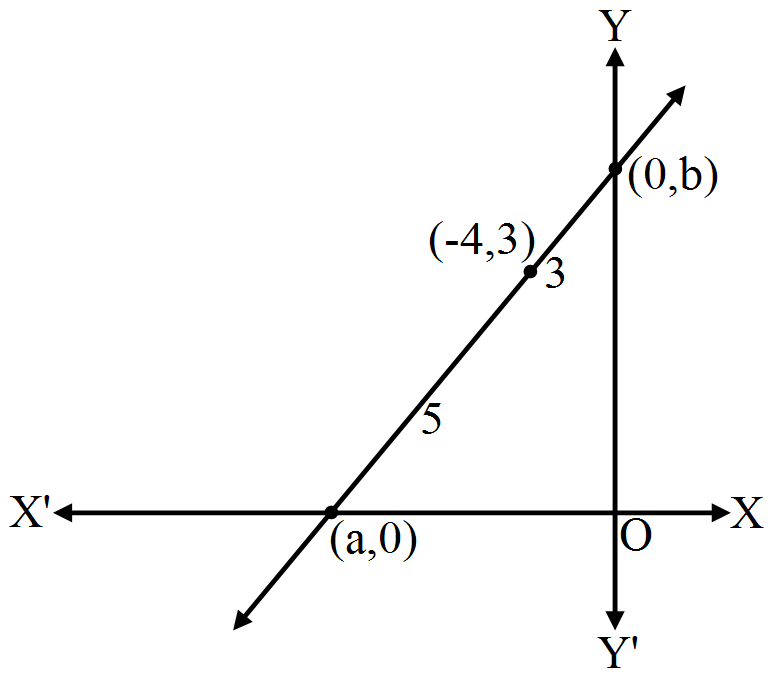
The point $(−4, 3)$ divides the required line in the ratio $5 : 3$
$\therefore \ -4=\frac{5\times0+3\times\text{a}}{5+3}$ and $3=\frac{5\times\text{b}+3\times0}{5+3}$
$\Rightarrow\text{a}=\frac{ -32}{3}$ and $\text{b}=\frac{ 24}{5}$
Hence, The equation of the required line is given below :
$\frac{\text{x}}{\frac{-32}{3}}+\frac{\text{y}}{\frac{24}{5}}=1$
$\Rightarrow\frac{-3\text{x}}{32}+\frac{5\text{y}}{24}=1$
$\Rightarrow-9\text{x}+20\text{y}=96$
$\Rightarrow9\text{x}-20\text{y}+96=0$ View full question & answer→MCQ 121 Mark
Two vertices of a triangle are $(-2, -1)$ and $(3, 2)$ and third vertex lies on the line $x + y = 5$. If the area of the triangle is $4$ square units, then the third vertex is :
- A
$(0, 5)$ or, $(4, 1)$
- ✓
$(5, 0)$ or, $(1, 4)$
- C
$(5, 0)$ or, $(4, 1)$
- D
$(0, 5)$ or, $(1, 4)$
AnswerCorrect option: B. $(5, 0)$ or, $(1, 4)$
Let $(h, k)$ be the third vertex of the triangle.
It is given that the area of the triangle with vertices $(h, k), (-2, -1)$ and $(3, 2)$ is $4$ square units.
$\frac{1}{2}\big|\text{h}(-1-2)-3(-1-\text{K})-2(2-\text{K})\big|=4$
$\Rightarrow3\text{h}-5\text{k}+1=\pm 8$
Taking positive sign, we get,
$3h - 5k + 1 = 8$
$3h - 5k - 7 = 0 ...(1)$
Taking negative sign, we get,
$3h - 5k + 9 = 0 ...(2)$
The vertex $(h, k)$ lies on the line $x + y = 5.$
$h + k - 5 = 0 ...(3)$
On solving $(1)$ and $(3),$ we find $(4, 1)$ to be the coordinates of the third vertex.
Similarly, on solving $(2)$ and $(3),$ we find $(2, 3)$ to be the coordinates of the third vertex.
View full question & answer→MCQ 131 Mark
If $p$ be the length of the perpendicular from the origin on the line $\frac{\text{x}}{\text{a}}+\frac{\text{y}}{\text{b}}=1,$ then :
- A
$\text{p}^2=\text{a}^2+\text{b}^2$
- B
$\text{p}^2=\frac{1}{\text{a}^2}+\frac{1}{\text{b}^2}$
- ✓
$\frac{1}{\text{p}^2}=\frac{1}{\text{a}^2}+\frac{1}{\text{b}^2}$
- D
AnswerCorrect option: C. $\frac{1}{\text{p}^2}=\frac{1}{\text{a}^2}+\frac{1}{\text{b}^2}$
It is given that $p$ is the length of the perpendicular from the origin on the line
$\frac{\text{x}}{\text{a}}+\frac{\text{y}}{\text{b}}=1$
$\frac{1}{\text{a}}\text{x}+\frac{1}{\text{b}}\text{y}-1=0$
$\therefore\text{p}=\begin{vmatrix}\frac{0+0+1}{\sqrt{\frac{1}{\text{a}^2}+\frac{1}{\text{b}^2}}} \end{vmatrix}$
Squaring both sides,
$\Rightarrow\frac{1}{\text{p}^2}=\frac{1}{\text{a}^2}+\frac{1}{\text{b}^2}$
View full question & answer→MCQ 141 Mark
The ratio in which the line $3x + 4y + 2 = 0$ divides the distance between the line $3x + 4y + 5 = 0$ and $3x + 4y - 5 = 0$ is :
- A
$1 : 2$
- ✓
$3 : 7$
- C
$2 : 3$
- D
$2 : 5$
AnswerCorrect option: B. $3 : 7$
Here, in all equations the coefficient of $x$ is same.
It means all the lines have same slope
So, all the lines are parallel.
Now, the distance between the line $3x + 4y + 2 = 0 $ and $3x + 4y + 5 = 0$ is given by
$\frac{|2-5|}{\sqrt{3^2+4^2}}$
$=\frac{3}{\sqrt{25}}=\frac{3}{5}$
Hence, the ratio is given by
$\frac{3}{5}:\frac{7}{5}$
$=3:7$
View full question & answer→MCQ 151 Mark
The inclination of the straight line passing through the point $(-3, 6)$ and the mid-point of the line joining the point $(4, -5)$ and $(-2, 9)$ is :
- A
$\frac{\pi}{4}$
- B
$\frac{\pi}{6}$
- C
$\frac{\pi}{3}$
- ✓
$\frac{3\pi}{4}$
AnswerCorrect option: D. $\frac{3\pi}{4}$
The midpoint of the line joining the points $(4, -5)$ and $(-2, 9)$ is $(1, 2)$.
Let $\theta$ be the inclination of the straight line passing through the points $(-3, 6) $ and $(1, 2)$.
Then, $\tan\theta=\frac{ 2-6}{1+3}=-1$
$\Rightarrow\theta=\frac{3\pi}{4}$
View full question & answer→MCQ 161 Mark
The angle between the lines $2x - y + 3 = 0$ and $x + 2y + 3 = 0$ is:
- ✓
$90^\circ$
- B
$60^\circ$
- C
$45^\circ$
- D
$30^\circ$
AnswerCorrect option: A. $90^\circ$
Let $m_1$ and $m_2$ be the slope of the lines $2x - y + 3 = 0$ and $x + 2y + 3 = 0$, respectively.
Let $\theta$ be the angle between them.
Here, $m_1 = 2$ and $\text{m}_2=-\frac{1}{2}$
$\because\text{m}_1\text{m}_2=-1$
Therefore, the angle between the given lines is $90^\circ .$
View full question & answer→MCQ 171 Mark
$A(6, 3), B(-3, 5), C(4, -2)$ and $D(x, 3x)$ are four points. If $\triangle\text{DBC} : \triangle\text{ABC}= 1 : 2,$ then $x$ is equal to :
- ✓
$\frac{11}{8}$
- B
$\frac{8}{11}$
- C
$3$
- D
AnswerCorrect option: A. $\frac{11}{8}$
The area of a triangle with vertices $D(x, 3x), B(-3, 5)$ and $C(4, -2)$ is given below :
Area of $\triangle\text{DBC}=\frac{1}{2}\{\text{x}(5+2)-3(-2-3\text{x})+4(3\text{x}-5)\}$
$\Rightarrow$ Area of $\triangle\text{DBC}=(14\text{x}-7)\text{sq units}$
Similarly, the area of a triangle with vertices $A(6, 3), B(-3, 5)$ and $C(4, -2)$ is given below :
$\triangle\text{ABC}=\frac{1}{2}\{6(5+2)-3(-2-3)+4(3-5)\}$
$\triangle\text{ABC}=\frac{49}{2}\text{sq units}$
Given:
$\triangle\text{DBC}:\triangle\text{ABC}=1:2$
$\frac{2(14\text{x}-7)}{49}=\frac{1}{2}$
$\Rightarrow8\text{x}-4=7$
$\Rightarrow\text{x}=\frac{11}{8}$
View full question & answer→MCQ 181 Mark
The equations of the sides $AB, BC$ and $CA$ of $\triangle \text{ABC}$ are $y - x = 2, x + 2y = 1$ and $3x + y + 5 = 0$ respectively. The equation of the altitude through $B$ is :
- A
$x - 3y + 1 = 0$
- ✓
$x - 3y + 4 = 0$
- C
$3x - y + 2 = 0$
- D
AnswerCorrect option: B. $x - 3y + 4 = 0$
The equation of the sides $AB, BC$ and $CA$ of $\triangle \text{ABC}$ are $y - x = 2, x + 2y = 1$ and $3x + y + 5 = 0,$ respectively.
Solving the equations of $AB$ and $BC,$
i.e. $y - x = 2 $ and $x + 2y = 1,$ we get:
$x = -1, y = 1$
So, the coordinates of $B$ are $(-1, 1)$.
The altitude through $B$ is perpendicular to $AC$.
$\therefore$ Slope of $AC = -3$
Thus, slope of the altitude through $B$ is $13$.
Thus, slope of the altitude through $B$ is $\frac{1}{3}.$
Equation of the required altitude is given below:
$\text{y}-1+\frac{1}{3}(\text{x}+1)$
$\Rightarrow\text{x}-3\text{y}+4=0$
View full question & answer→MCQ 191 Mark
If $a + b + c = 0, $ then the family of lines $3ax + by + 2c = 0$ pass through fixed point:
- A
$\Big(2,\frac{2}{3}\Big)$
- ✓
$\Big(\frac{2}{3},2\Big).$
- C
$\Big(-2,\frac{2}{3}\Big)$
- D
AnswerCorrect option: B. $\Big(\frac{2}{3},2\Big).$
Given:
$a + b + c = 0$
Substituting $c = -a - b$ in $3ax + by + 2c = 0, $ we get:
$3\text{ax}+\text{by}-2\text{a}-2\text{b}=0$
$\Rightarrow\text{a}(3\text{x}-2)+\text{b}(\text{y}-2)=0$
$\Rightarrow(3\text{x}-2)+\frac{\text{b}}{\text{a}}(\text{y}-2)=0$
This line is of the form $\text{L}_1+\lambda\text{L}_2=0,$ which passes through the intersection of the lines $L_1$ and $L_2$
i.e. $3x - 2 = 0$ and $y - 2 = 0.$
Solving $3x - 2 = 0$ and $y - 2 = 0,$ we get
$\text{x}=\frac{2}{3},\text{y}=2$
Hence, the required fixed point is $\Big(\frac{2}{3},2\Big).$
View full question & answer→MCQ 201 Mark
If the lines $x + q = 0, y - 2 = 0$ and $3x + 2y + 5 = 0$ are concurrent, then the value of $q$ will be :
AnswerThe lines $x + q = 0, y - 2 = 0$ and $3x + 2y + 5 = 0$ are concurrent.
$\therefore\begin{vmatrix}1&0&\text{q}\\0&1&-2\\3&2&5 \end{vmatrix}=0$
$\Rightarrow1(5+4)-0+\text{q}(0-3)=0$
$\Rightarrow3\text{q}=9$
$\Rightarrow\text{q}=3$
View full question & answer→MCQ 211 Mark
A point equidistant from the line $4x + 3y + 10 = 0, 5x - 12y + 26 = 0$ and $7x + 24y - 50 = 0$ is :
- A
$(1, -1)$
- B
$(1, 1)$
- ✓
$(0, 0)$
- D
$(0, 1)$
AnswerCorrect option: C. $(0, 0)$
Let the coordiantes of the point be $(a, b)$
Now, the distance of the point $(a, b)$ from $4x + 3y + 10 = 0$ is given by
$\Bigg|\frac{4\text{a}+3\text{b}+10}{\sqrt{4^2+3^2}}\Bigg|$
$=\Bigg|\frac{4\text{a}+3\text{b}+10}{5}\Bigg|$
Again, the distance of the point $(a, b)$ from $5x - 12y + 26 = 0$ is given by
$\Bigg|\frac{5\text{a}-12\text{b}+26}{\sqrt{5^2+(-12)^2}}\Bigg|$
$=\Bigg|\frac{5\text{a}-12\text{b}+26}{13}\Bigg|$
Again, the distance of the point $(a, b)$ from $7x + 24y - 50 = 0$ is is given by
$\Bigg|\frac{7\text{a}+24\text{b}-50}{\sqrt{7^2+(24)^2}}\Bigg|$
$=\Bigg|\frac{7\text{a}+24\text{b}-50}{25}\Bigg|$
Now,
$\Bigg|\frac{4\text{a}+3\text{b}+10}{5}\Bigg|=\Bigg|\frac{5\text{a}-12\text{b}+26}{13}\Bigg|=\Bigg|\frac{7\text{a}+24\text{b}-50}{25}\Bigg|$
Only $a = 0$ and $b = 0$ is satisfying the above equation
Hence, the correct answer is option $(c)$.
View full question & answer→MCQ 221 Mark
Area of the triangle formed by the points $((a + 3)(a + 4), a + 3), ((a + 2)(a + 3), (a + 2))$ and $((a + 1)(a + 2), (a + 1))$ is:
AnswerThe given points are $\{(a + 3)(a + 4), a + 3), ((a + 2)(a + 3), (a + 2))$ and $((a + 1)(a + 2), (a + 1)\}$
Let $A$ be the area of the triangle formed by these points.
Then, $\text{A}=\frac{1}{2}[\text{x}_1(\text{y}_2-\text{y}_3)+\text{x}_2(\text{y}_3-\text{y}_1)+\text{x}_3(\text{y}_1-\text{y}_2)]$
$\Rightarrow\text{A}=\frac{1}{2}[(\text{a}+3)(\text{a}+4)(\text{a}+2-\text{a}-1)+(\text{a}+2)(\text{a}+3)\text{a}+1-\text{a}-3)+(\text{a}+1)(\text{a}+2)(\text{a}+3-\text{a}-2)]$
$\Rightarrow\text{A}=\frac{1}{2}[(\text{a}+3)(\text{a}+4)-2(\text{a}+2)(\text{a}+3)+(\text{a}+1)(\text{a}+2)]$
$\Rightarrow\text{A}=\frac{1}{2}[\text{a}^2+7\text{a}+12-2\text{a}^2-10\text{a}-12+\text{a}^2+3\text{a}+2]$
$\Rightarrow\text{A}=1$
View full question & answer→MCQ 231 Mark
The equation of the line with slope $-\frac{3}{2}$ and which is concurrent with the lines $4x + 3y - 7 = 0$ and $8x + 5y - 1 = 0$ is :
- A
$3x + 2y - 63 = 0$
- ✓
$3x + 2y - 2 = 0$
- C
$2y - 3x - 2 = 0$
- D
AnswerCorrect option: B. $3x + 2y - 2 = 0$
Given :
$4x + 3y - 7 = 0 ...(1)$
$8x + 5y - 1 = 0 ...(2)$
The equation of the line with slope $-\frac{3}{2}$ is given below:
$\text{y}=-\frac{3}{2}\text{x}+\text{c}$
$\Rightarrow\frac{3}{2}\text{x}+\text{y}-\text{C}=0 \ ...(3)$
The lines $(1), (2) $ and $(3)$ are concurrent.
$\therefore\begin{vmatrix}4&3&-7\\8&5&-1\\\frac{3}{2}&1&\text{-c} \end{vmatrix}=0$
$\Rightarrow4(-5\text{c}+1)-3\Big(-8\text{c}+\frac{3}{2}\Big)-7\Big(8-\frac{15}{2}\Big)=0$
$\Rightarrow-20\text{c}+4+24\text{c}-\frac{9}{2}-56+\frac{105}{2}=0$
$\Rightarrow\frac{-40\text{c}+8+48\text{c}-9-112+105}{2}=0$
$\Rightarrow8\text{c}=8$
$\Rightarrow\text{c}=1$
On substituting $c = 1$ in $\text{y}=-\frac{3}{2}\text{x}+\text{c},$ we get:
$\text{y}=-\frac{3}{2}\text{x}+1,$
$\Rightarrow3\text{x}+2\text{y}-2=0$
View full question & answer→MCQ 241 Mark
If $p_1$ and $p_2$ are the lengths of the perpendiculars from the origin upon the lines $\text{x} \sec \theta + \text{y} \text{cosec}\theta = \text{a}$ and $\text{x} \cos \theta - \text{y} \sin \theta = \text{a} \cos 2 \theta$ respectively, then:
- ✓
$4\text{p}_1^2 + \text{p}_2^2 = \text{a}^2$
- B
$\text{p}_1^2 + 4\text{p}_2^2 = \text{a}^2$
- C
$\text{p}_1^2 + 4\text{p}_2^2 = \text{a}^2$
- D
AnswerCorrect option: A. $4\text{p}_1^2 + \text{p}_2^2 = \text{a}^2$
The given lines are
$\text{x} \sec \theta + \text{y} \text{cosec}\theta = \text{a} \ ...(1)$
$\text{x} \cos \theta - \text{y} \sin \theta = \text{a} \cos 2 \theta \ ...(2)$
$p_1$ and $p_2$ are the perpendiculars from the origin upon the lines $(1)$ and $(2),$ respectively.
$\text{p}_1=\Big|\frac{-\text{a}}{\sqrt{\sec^2\theta+\text{cosec}^2}\theta}\Big|$ and $\text{p}_2=\Big|\frac{-\text{a}\cos2\theta}{\sqrt{\cos^2\theta+\sin^2}\theta}\Big|$
$\Rightarrow\text{p}_1=\Big|\frac{-\text{a}\sin\theta\cos\theta}{\sqrt{\sin^2\theta+\cos^2}\theta}\Big|$ and $\text{p}_2=\big|-\text{a}\cos2\theta\big|$
$\Rightarrow\text{p}_1=\frac{1}{2}\big|-\text{a}\times2\sin\theta\cos\theta\big|$ and $\text{p}_2=\big|-\text{a}\cos2\theta\big|$
$\Rightarrow\text{p}_1=\frac{1}{2}\big|-\text{a}\times\sin2\theta\big|$ and $\text{p}_2=\big|-\text{a}\cos2\theta\big|$
$\Rightarrow4\text{p}_1^2+\text{p}_2^2=\text{a}^2(\sin^22\theta+\cos^22\theta)$
$=\text{a}^2$
View full question & answer→MCQ 251 Mark
The figure formed by the lines $\text{ax} \pm \text{by} \pm \text{c} = 0 $ is :
AnswerThe given lines can be written separately in the following manner :
$ax + by + c = 0 ...(1)$
$ax + by - c = 0 ...(2)$
$ax - by - c = 0 ...(3)$
$ax - by - c = 0 ...(4)$
Graph of the given lines is given below :
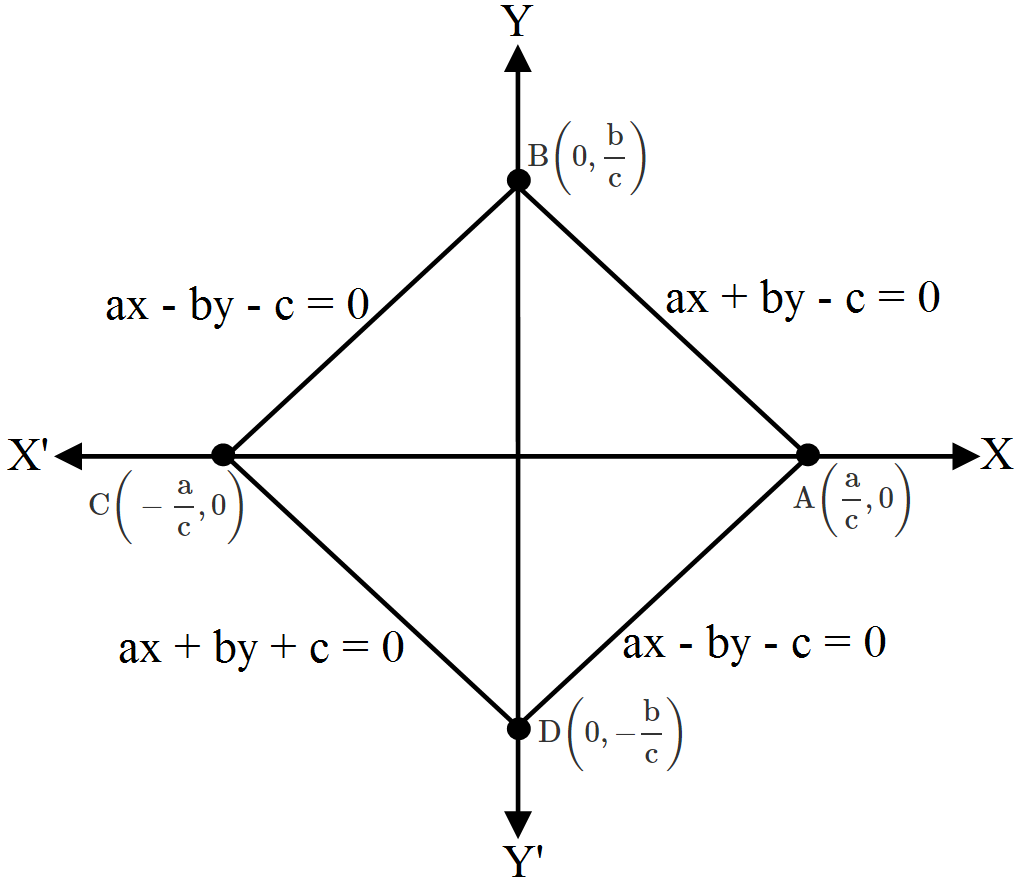
Clearly, $\text{AB}=\text{BC}=\text{CD}=\text{DA}$
$=\sqrt{\frac{\text{a}^2}{\text{c}^2}+\frac{\text{b}^2}{\text{c}^2}}=\frac{\sqrt{\text{a}^2+\text{b}^2}}{|\text{c}|}$
Thus, the region formed by the given lines is $\text{ABCD},$ which is a rhombus. View full question & answer→MCQ 261 Mark
The line segment joining the points $(1, 2) $ and $(-2, 1)$ is divided by the line $3x + 4y = 7$ in the ratio:
- A
$3 : 4$
- B
$4 : 3$
- C
$9 : 4$
- ✓
$4 : 9$
AnswerCorrect option: D. $4 : 9$
Let the line segment joining the points $(1, 2)$ and $(−2, 1)$ be divided by the line $3x + 4y = 7$ in the ratio $m : n.$
Then, the coordinates of this point will be $\Big(\frac{-2\text{m}+\text{n}}{\text{m}+\text{n}},\frac{\text{m}+2\text{n}}{\text{m}+\text{n}}\Big)$ that lie on the line.
$3\text{x}+4\text{y}=7$
$3\times\frac{-2\text{m}+\text{n}}{\text{m}+\text{n}}+4\times\frac{\text{m}+2\text{n}}{\text{m}+\text{n}}=7$
$\Rightarrow-2\text{m}+11\text{n}=7\text{m}+7\text{n}$
$\Rightarrow-9\text{m}=-4\text{n}$
$\Rightarrow\text{m}:\text{n}=4:9$
View full question & answer→MCQ 271 Mark
A line passes through the point $(2, 2)$ and is perpendicular to the line $3x + y = 3.$ Its $y-$ intercept is :
- A
$\frac{1}{3}$
- B
$\frac{2}{3}$
- C
$1$
- ✓
$\frac{4}{3}$
AnswerCorrect option: D. $\frac{4}{3}$
The equation of the line perpendicular to $3x + y = 3$ is given below :
$\text{x}-3\text{y}+\lambda=0$
This line passes through $(2, 2)$.
$2-6+\lambda=0$
$\Rightarrow\lambda=4$
So, the equation of the line will be
$x - 3y + 4 = 0$
$\Rightarrow\text{y}=\frac{1}{3}\text{x}+\frac{4}{3}$
Hence, the $y-$ intercept is $\frac{4}{3}.$
View full question & answer→MCQ 281 Mark
If the lines $ax + 12y + 1 = 0, bx + 13y + 1 = 0$ and $ax + 14y + 1 = 0$ are concurrent, then $a, b, c$ are in :
AnswerCorrect option: C. $A.P.$
The given lines are
$ax + 12y + 1 = 0 ...(1)$
$bx + 13y + 1 = 0 ...(2)$
$cx + 14y + 1 = 0 ...(3)$
It is given that $(1), (2)$ and $(3)$ are concurrent.
$\begin{vmatrix} \text{a}&12&1\\\text{b}&13&1\\\text{c}&14&1\end{vmatrix}=0$
$\Rightarrow\text{a}(13-14)-12(\text{b}-\text{c})+14\text{b}-13\text{c}=0$
$\Rightarrow-\text{a}-12\text{b}+12\text{c}+14\text{b}-13\text{c}=0$
$\Rightarrow-\text{a}+2\text{b}-\text{c}=0$
$\Rightarrow2\text{b}=\text{a}+\text{c}$
Hence $, a, b$ and $c$ are in $A.P$.
View full question & answer→MCQ 291 Mark
The vertices of a triangle are $(6, 0), (0, 6)$ and $(6, 6)$. The distance between its circumcentre and centroid is :
- A
$2\sqrt{2}$
- B
$2$
- ✓
$\sqrt{2}$
- D
$1$
AnswerCorrect option: C. $\sqrt{2}$
Let $A(0, 6), B(6, 0)$ and $C(6, 6)$ be the vertices of the given triangle.
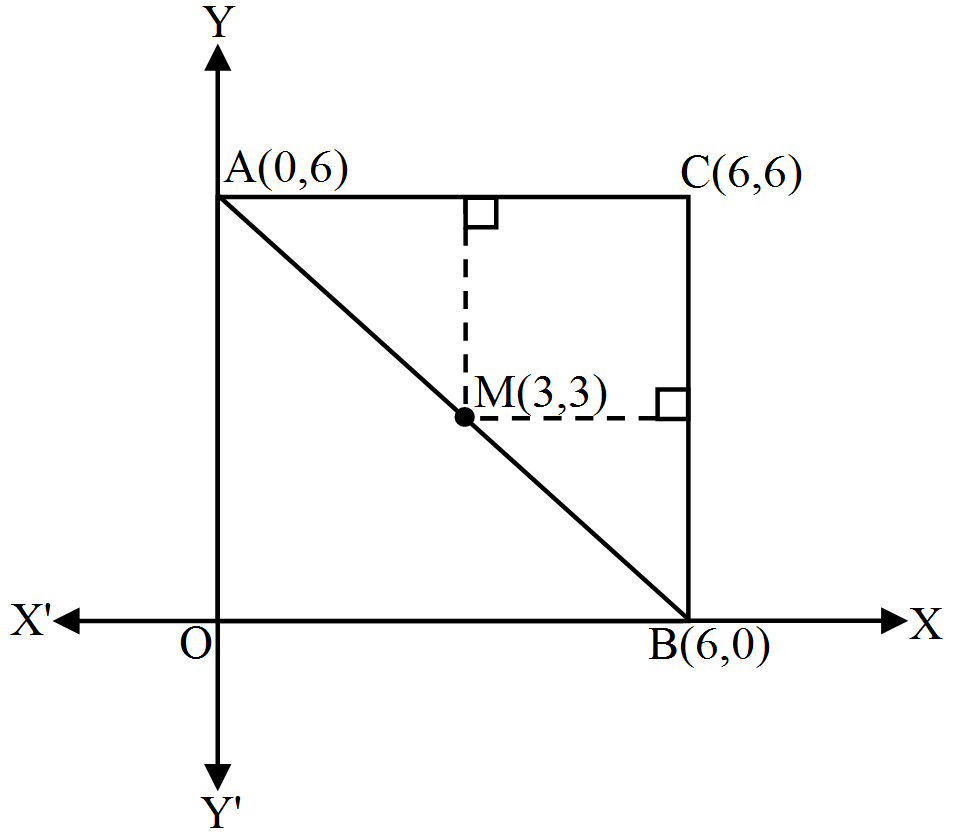
Centroid of $\triangle\text{ABC}=\Big(\frac{0+6+6}{3},\frac{6+0+6}{3}\Big)$
$=(4,4)$
Coordinates of $\text{N}=\Big(\frac{6+6}{2},\frac{6+0}{2}\Big)$
$=(6,3)$
Coordinates of $\text{P}=\Big(\frac{0+6}{2},\frac{6+6}{2}\Big)$
$=(3,6)$
Equation of $MN$ is $y = 3$
Equation of $MP$ is $x = 3$
As, we know that circumcentre of a triangle is the intersection of the perpendicular bisectors of any two sides.
Therefore, coordinates of circumcentre is $(3, 3)$
Thus, the coordinates of the circumcentre are $(3, 3)$ and the centroid of the triangle is $(4, 4).$
Let $d$ be the distance between the circumcentre and the centroid.
$\therefore\text{d}\sqrt{(4-3)^2+(4-3)^2}=\sqrt{2}$ View full question & answer→MCQ 301 Mark
The equation of the line passing through $(1, 5)$ and perpendicular to the line $3x - 5y + 7 = 0$ is :
- ✓
$5x + 3y - 20 = 0$
- B
$3x - 5y + 7 = 0$
- C
$3x - 5y + 6 = 0$
- D
$5x + 3y + 7 = 0$
AnswerCorrect option: A. $5x + 3y - 20 = 0$
A line perpendicular to $3x - 5y + 7 = 0$ is given by
$5\text{x}+3\text{y}+\lambda=0$
This line passes through $(1, 5)$
$5+15+\lambda=0$
$\Rightarrow\lambda=-20$
Therefore, the equation of the required line is $5x + 3y - 20 = 0.$
View full question & answer→MCQ 311 Mark
The reflection of the point $(4, -13) $ about the line $5x + y + 6 = 0$ is :
- ✓
$(-1, -14)$
- B
$(3, 4)$
- C
$(0, 0)$
- D
$(1, 2)$
AnswerCorrect option: A. $(-1, -14)$
Let the reflection point be $A(h, k)$
Now, the mid point of line joining $(h, k)$ and $(4, -13)$ will lie on the line $5x + y + 6 = 0$
$\therefore5\Big(\frac{\text{h}+4}{2}\Big)+\frac{\text{k}-13}{2}+6=0$
$\Rightarrow5\text{h}+20+\text{k}-13+12=0$
$\Rightarrow5\text{h}+\text{k}+19=0 \ ...(1)$
Now, the slope of the line joining points $(h, k)$ and $(4, -13)$ are perpendicular to the line $5x + y + 6 = 0.$
slope of the line $= -5$
slope of line joining by points $(h, k)$ and $(4, -13)$
$\frac{\text{k}+13}{\text{h}-4}$
$\therefore\frac{\text{k}+13}{\text{h}-4}(-5)=-1$
$\Rightarrow5\text{k}-\text{h}+60=0 \ ...(2)$
Solving $(1)$ and $(2),$ we get
$h = -1$ and $k = -14$
View full question & answer→MCQ 321 Mark
The value of $\lambda$ for which the lines $3\text{x} + 4\text{y} = 5, 5\text{x} + 4\text{y} =4$ and $\lambda\text{x} + 4\text{y} = 6$ meet at a point is :
AnswerIt is given that the lines $3\text{x} + 4\text{y} = 5, 5\text{x} + 4\text{y} =4$ and $\lambda\text{x} + 4\text{y} = 6$ meet at a point.
In other words, the given lines are concurrent.
$\begin{vmatrix}3&4&-5\\5&4&-4\\\lambda&4&-6 \end{vmatrix}=0$
$\Rightarrow3(-24+16)-4(-30+4\lambda)-5(20-4\lambda)=0$
$\Rightarrow-24+120-16\lambda-100+20\lambda=0$
$\Rightarrow4\lambda=4$
$\Rightarrow\lambda=1$
View full question & answer→MCQ 331 Mark
The centroid of a triangle is $(2, 7)$ and two of its vertices are $(4, 8)$ and $(-2, 6)$. The third vertex is :
- A
$(0, 0)$
- ✓
$(4, 7)$
- C
$(7, 4)$
- D
$(7, 7)$
AnswerCorrect option: B. $(4, 7)$
Let $A(4, 8)$ and $B(-2, 6)$ be the given vertex.
Let $C(h, k)$ be the third vertex.
The centroid of $\triangle\text{ABC}$ is $\Big(\frac{4-2+\text{h}}{3},\frac{8+6+\text{k}}{3}\Big)$
It is given that the centroid of triangle $\text{ABC}$ is $(2, 7)$.
$\therefore\frac{4-2+\text{h}}{3}=2,\frac{8+6+\text{k}}{3}=7$
$\Rightarrow\text{h}=4,\text{h}=7$
Thus, the third vertex is $(4, 7)$.
View full question & answer→MCQ 341 Mark
The distance between the orthocentre and circumcentre of the triangle with vertices $(1, 2), (2, 1)$ and $\Big(\frac{3+\sqrt{3}}{2},\frac{3+\sqrt{3}}{2}\Big)$ is :
AnswerLet $A(1, 2), B(2, 1)$ and $C \Big(\frac{3+\sqrt{3}}{2},\frac{3+\sqrt{3}}{2}\Big)$ be the given points.
$\therefore \ \text{AB}=\sqrt{(2-1)^2+(1-2)^2}$
$=\sqrt{2}$
$\text{BC}=\sqrt{\Big(\frac{3+\sqrt{3}}{2}-2\Big)^2,\Big(\frac{3+\sqrt{3}}{2}-1\Big)^2}$
$=\sqrt{2}$
$\text{AC}=\sqrt{\Big(\frac{3+\sqrt{3}}{2}-1\Big)^2,\Big(\frac{3+\sqrt{3}}{2}-2\Big)^2}$
$=\sqrt{2}$
Thus, $\text{ABC}$ is an equilateral triangle.
We know that the orthocentre and the circumcentre of an equilateral triangle are same.
So, the distance between the the orthocentre and the circumcentre of the triangle with vertices $(1, 2), (2, 1)$ and $\Big(\frac{3+\sqrt{3}}{2},\frac{3+\sqrt{3}}{2}\Big)$ is $0.$
View full question & answer→MCQ 351 Mark
The coordinates of the foot of the perpendicular from the point $(2, 3)$ on the line $x + y - 11 = 0$ are :
- A
$(-6, 5)$
- ✓
$(5, 6)$
- C
$(-5, 6)$
- D
$(6, 5)$
AnswerCorrect option: B. $(5, 6)$
Let the coordinates of the foot of the perpendicular from the point $(2, 3)$ on the line $x + y - 11 = 0$ be $(x, y)$
Now, the slope of the line $x + y - 11 = 0$ is $-1$
So, the slope of the perpendicular $= 1$
The equation of the perpendicular is given by
$y - 3 = 1(x - 2)$
$\Rightarrow x - y + 1 = 0$
Solving $x + y - 11 = 0$ and $x - y + 1 = 0,$ we get
$x = 5 $ and $y = 6$
View full question & answer→