Questions

M.C.Q (1 Marks)

Take a timed test

35 questions · auto-graded multiple-choice test.

MCQ 11 Mark
Two point charges of A = +5.0 µC and B = -5.0 µC are separated by 5.0 cm. A point charge C = 1.0 µC is placed at 3.0 cm away from the centre on the perpendicular bisector of the line joining the two point charges. The charge at C will experience a force directed towards
  • A
    point A
  • B
    point B
  • a direction parallel to line AB
  • D
    a direction along the perpendicular bisector
Answer
Correct option: C.
a direction parallel to line AB
View full question & answer
MCQ 21 Mark
Which of the following produces uniform electric field?
  • A
    point charge
  • B
    linear charge
  • two parallel plates
  • D
    charge distributed an circular any
Answer
Correct option: C.
two parallel plates
View full question & answer
MCQ 31 Mark
A metallic sphere A isolated from ground is charged to +50 µC. This sphere is brought in contact with other isolated metallic sphere B of half the radius of sphere A. The charge on the two sphere will be now in the ratio
  • A
    1:2
  • B
    2:1
  • C
    4:1
  • 1:1
Answer
Correct option: D.
1:1
1:1
View full question & answer
MCQ 41 Mark
Two point charges of $+5 \mu C$ are so placed that they experience a force of $80 \times 10^{-3} N$. They are then moved apart, so that the force is now $2.0 \times 10^{-3} N$. The distance between them is now
  • A
    $\frac{1}{4}$ the previous distance
  • double the previous distance
  • C
    four times the previous distance
  • D
    half the previous distance
Answer
Correct option: B.
double the previous distance
View full question & answer
MCQ 51 Mark
Two charges of 1.0 C each are placed one meter apart in free space. The force between them will be
  • A
    $1.0 N$
  • $9 \times 10^9 N$
  • C
    $9 \times 10^{-9} N$
  • D
    $10 N$
Answer
Correct option: B.
$9 \times 10^9 N$
$9 \times 10^9 N$
View full question & answer
MCQ 61 Mark
A charge of + 7 µC is placed at the centre of two concentric spheres with radius 2.0 cm and 4.0 cm respectively. The ratio of the flux through them will be
  • A
    1:4
  • B
    1:2
  • 1:1
  • D
    1:16
Answer
Correct option: C.
1:1
1:1
View full question & answer
MCQ 71 Mark
An electron is placed between two parallel plates connected to a battery. If the battery is switched on, the electron will
  • be attracted to the +ve plate
  • B
    be attracted to the -ve plate
  • C
    remain stationary
  • D
    will move parallel to the plates
Answer
Correct option: A.
be attracted to the +ve plate
View full question & answer
MCQ 81 Mark
A positively charged glass rod is brought close to a metallic rod isolated from the ground. The charge on the side of the metallic rod away from the glass rod will be
  • same as that on the glass rod and equal in quantity
  • B
    opposite to that on the glass of and equal in quantity
  • C
    same as that on the glass rod but lesser in quantity
  • D
    same as that on the glass rod but more in quantity
Answer
Correct option: A.
same as that on the glass rod and equal in quantity
View full question & answer
MCQ 91 Mark
If $E_a$ and $E_q$ represent the electric field intensity due to a short dipole at a point on its axial line and on the equatorial line at the same distance $' r\ '$ from the centre of the dipole, then
  • A
    $E_a=E_q$
  • B
    $E_a=\frac{1}{2} E_q$
  • C
    $E_a=\frac{1}{\sqrt{2}} E_q$
  • $E_a=2 E_Q$
Answer
Correct option: D.
$E_a=2 E_Q$
On axial line, $E_a=\frac{2 k p}{r^3}$ On equatorial line $E_q=\frac{k p}{r^3} ;$
So, $E_a=2 E_q$
View full question & answer
MCQ 101 Mark
An electron of mass ' $m_e$ ' and a proton of mass ' $m_p$ ' are kept in a uniform electric field. The ratio of the acceleration of electron $\left(a_e\right)$ to the acceleration of proton $\left(a_p\right)$ is
  • A
    infinity
  • $\frac{m_p}{m_e}$
  • C
    one
  • D
    $\frac{m_e}{m_p}$
Answer
Correct option: B.
$\frac{m_p}{m_e}$
(b) : Mass of electron $=m_e$
Mass of proton $=m_p$
Acceleration of electron $=a_e$
Acceleration of proton $=a_p$
$
\Rightarrow \quad \frac{a_e}{a_p}=\frac{F_e / m_e}{F_p / m_p}=\frac{m_p(e E)}{m_e(e E)}=\frac{m_p}{m_e}
$
View full question & answer
MCQ 111 Mark
Identify the WRONG statement in the case of electric field lines.
  • They do not pass through an insulator.
  • B
    They do not pass through a conductor.
  • C
    They start from a positive charge and end on a negative charge.
  • D
    They do not intersect each other.
Answer
Correct option: A.
They do not pass through an insulator.
(a) : Electric field lines passes only through insulator. Insulators are the materials that obstruct free flow of electrons from one particle of the element to another.
View full question & answer
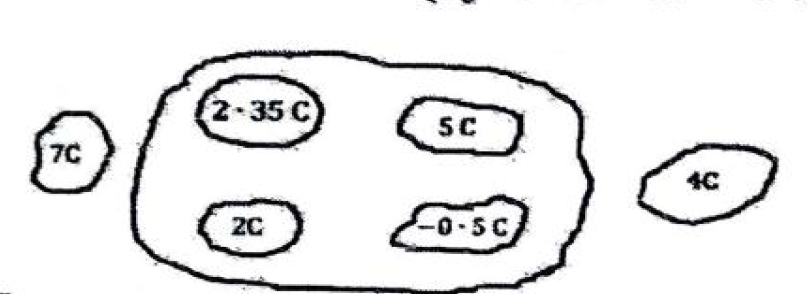
MCQ 121 Mark
The electric flux linked with the closed surface in $Nm ^2 C ^{-1}$ is $\left(\epsilon_0=8.85 \times 10^{-12} C ^2 N ^{-1} m ^{-2}\right)$Image
  • A
    $10^{10}$
  • B
    $8.85 \times 10^{-13}$
  • $10^{12}$
  • D
    $10^{11}$
Answer
Correct option: C.
$10^{12}$
(c): From Gauss law, Electric flux $=\frac{q_{\text {inclosed }}}{\varepsilon_0}$
$
\begin{aligned}
& =\frac{2.35 C +5 C +2 C +(-0.5 C )}{8.85 \times 10^{-12} C ^2 N ^{-1} m ^{-2}} \\
& =10^{12} Nm ^2 C ^{-1}
\end{aligned}
$
View full question & answer
MCQ 131 Mark
An electron of mass ' $m$ ' and charge ' $q$ ' is accelerated from rest in a uniform electric field of strength ${ }^4 E$. The velocity acquired by it as it travels a distance $l$ is
  • $\left[\frac{2 E q l}{m}\right]^{1 / 2}$
  • B
    $\left[\frac{2 E q}{m l}\right]^{1 / 2}$
  • C
    $\left[\frac{2 E m}{q l}\right]^{1 / 2}$
  • D
    $\left[\frac{E q}{m l}\right]^{1 / 2}$
Answer
Correct option: A.
$\left[\frac{2 E q l}{m}\right]^{1 / 2}$
(a): Mass of electron $=m$, charge $=q$
Electric field $=E$ (Uniform)
Electric force, $F=q E$
Acceleration, $a=\frac{F}{m}=\frac{q E}{m}$
Also, $u=0, s=l, v=$ ?
Using kinematics eqn, $v^2=u^2+2 a s$
$
v^2=0+2 \times \frac{q E}{m} \times l
$
$\therefore \quad v=\left[\frac{2 E q l}{m}\right]^{\frac{1}{2}}$
View full question & answer
MCQ 141 Mark
Four coulomb charge is uniformly distributed on $2 \ km$ long wire. Its linear charge density is
  • A
    $2 \ C/m$
  • B
    $4 \ C/m$
  • C
    $4 \times 10^3 \ C/m$
  • $2 \times 10^{-3} \ C/m$
Answer
Correct option: D.
$2 \times 10^{-3} \ C/m$
View full question & answer
MCQ 151 Mark
An electric dipole of moment p is placed in the position of stable equilibrium in a uniform electric field of intensity E. The torque required to rotate, when the dipole makes an angle 0 with the initial position is
  • A
    pE cosθ
  • pE sinθ
  • C
    pE tanθ
  • D
    pE cotθ
Answer
Correct option: B.
pE sinθ
pE sinθ
View full question & answer
MCQ 161 Mark
Number of lines of induction starting from a conductor holding + q charge surrounded by a medium of permittivity ε is
  • A
    q and they leave the surface in normal direction.
  • B
    q and they leave the surface in any direction.
  • q/ε and they leave the surface normally at every point.
  • D
    q/ε and they leave the surface in any direction.
Answer
Correct option: C.
q/ε and they leave the surface normally at every point.
View full question & answer
MCQ 171 Mark
Gauss’ theorem states that total normal electric induction over a closed surface in an electric field is equal to
  • A
    $\frac{1}{\varepsilon} \sum q _{ n }$
  • B
    ${ }^{\varepsilon} \Sigma q_n$
  • $\Sigma q_n$
  • D
    $q_1 \times q_2 \times q_3 \times ……… q_n$
Answer
Correct option: C.
$\Sigma q_n$
$\Sigma q_n$
View full question & answer
MCQ 181 Mark
The electric flux over a sphere of radius 1.0 m is ø. If the radius of the sphere is doubled without changing the charge, the flux will be
  • A
  • B
  • ø
  • D
Answer
Correct option: C.
ø
ø
View full question & answer
MCQ 191 Mark
Gauss’ law helps in
  • determination of electric field due to symmetric charge distribution.
  • B
    determination of electric potential due to symmetric charge distribution.
  • C
    determination of electric flux.
  • D
    situations where Coulomb’s law fails.
Answer
Correct option: A.
determination of electric field due to symmetric charge distribution.
View full question & answer
MCQ 201 Mark
In a uniform electric field, a charge of 3 C experiences a force of 3000 N. The potential difference between two points 1 cm apart along the electric lines of force will be
  • 10 V
  • B
    3 V
  • C
    0.1 V
  • D
    20 V
Answer
Correct option: A.
10 V
 10 V
View full question & answer
MCQ 211 Mark
Which of the following is NOT the property of equipotential surfaces?
  • A
    They do not intersect each other.
  • They are concentric spheres for uniform electric field.
  • C
    Potential at all points on the surface has constant value.
  • D
    Separation of equipotential surfaces increases with decrease in electric field.
Answer
Correct option: B.
They are concentric spheres for uniform electric field.
View full question & answer
MCQ 221 Mark
Electric lines of force about a positive point charge and negative point charge are respectively .
  • A
    circular, clockwise
  • radially outward, radially inward
  • C
    radially inward, radially outward
  • D
    circular, anticlockwise
Answer
Correct option: B.
radially outward, radially inward
View full question & answer
MCQ 231 Mark
The charge on the electron is $1.6 \times 10^{-19} C.$ The number of electrons need to be removed from a metal sphere of $0.05 m$ radius so as to acquire a charge of $4 \times 10^{-15} C$ is
  • A
    $1.25 \times 10^4$
  • B
    $1.25 \times 10^3$
  • C
    $2.5 \times 10^3$
  • $2.5 \times 10^4$
Answer
Correct option: D.
$2.5 \times 10^4$
$2.5 \times 10^4$
View full question & answer
MCQ 241 Mark
The electric intensity in air at a point $20 \ cm$ from a point charge $Q$ coulombs is $4.5 \times 10^5 N/ C.$ The magnitude of $Q$ is
  • A
    $20 µc$
  • B
    $200 µC$
  • C
    $10 µC$
  • $2 µC$
Answer
Correct option: D.
$2 µC$
$2 µC$
View full question & answer
MCQ 251 Mark
A point charge $q$ produces an electric field of magnitude $2 N C^{-1}$ at a point distant $0.25 m$ from it. What is the value of charge?
  • $1.39 \times 10^{-11} C$
  • B
    $1.39 \times 10^{11} C$
  • C
    $13.9 \times 10^{-11} C$
  • D
    $13.9 \times 10^{11} C$
Answer
Correct option: A.
$1.39 \times 10^{-11} C$
View full question & answer
MCQ 261 Mark
A force of $2.25 N$ acts on a charge of $15 \times 10^{-4}C.$ Calculate the intensity of electric field at that point.
  • $1500 NC^{-1}$
  • B
    $150 NC^{-1}$
  • C
    $15000NC^{-1}$
  • D
    $2500 NC^{-1}$
Answer
Correct option: A.
$1500 NC^{-1}$
$1500 NC^{-1}$
View full question & answer
MCQ 271 Mark
The dimensional formula of electric field intensity is
  • A
    $[M^1E^1T^{-2}A^{-1}]$
  • $[M^1L^1T^{-3}A^{-1}]$
  • C
    $[M^{-1}L^2T^{-3}A^{-1}]$
  • D
    $[M^1L^2T^{-3}A^{-2}]$
Answer
Correct option: B.
$[M^1L^1T^{-3}A^{-1}]$
View full question & answer
MCQ 281 Mark
The electric field intensity at a point 2 m from an isolated point charge is 500 N/C. The electric potential at the point is
  • A
    0 V
  • B
    2.5 V
  • C
    250 V
  • 1000 V
Answer
Correct option: D.
1000 V
1000 V
View full question & answer
MCQ 291 Mark
Two point charges +4 µC and +2 µC repel each other with a force of 8 N. If a charge of -4 µC is added to each of these charges, the force would be
  • zero
  • B
    8 N
  • C
    4 N
  • D
    12 N
Answer
Correct option: A.
zero
zero
View full question & answer
MCQ 301 Mark
If a charge is moved against the Coulomb force of an electric field,
  • A
    work is done by the electric field
  • energy is used from some outside source
  • C
    the strength of the field is decreased
  • D
    the energy of the system is decreased
Answer
Correct option: B.
energy is used from some outside source
View full question & answer
MCQ 311 Mark
Choose the correct answer.
  • Total charge present in the universe is constant.
  • B
    Total positive charge present in the universe is constant.
  • C
    Total negative charge present in the universe is constant.
  • D
    Total number of charged particles present in the universe is
Answer
Correct option: A.
Total charge present in the universe is constant.
View full question & answer
MCQ 321 Mark
A glass rod when rubbed with a piece of fur acquires a charge of magnitude $3.2 µC$. The number of electrons transferred is
  • $2 \times 10^{-13}$ from fur to glass
  • B
    $5 \times 10^{12}$ from glass to fur
  • C
    $2 \times 10^{13} $ from glass to fur
  • D
    $5 \times 10^{12} $ from fur to glass
Answer
Correct option: A.
$2 \times 10^{-13}$ from fur to glass
$2 \times 10^{-13} $ from fur to glass
View full question & answer
MCQ 331 Mark
The permittivity of medium is $26.55 \times 10^{-12} C^2/Nm^2.$ The dielectric constant of the medium will be
  • A
    $2$
  • $3$
  • C
    $4$
  • D
    $5$
Answer
Correct option: B.
$3$
$3$
View full question & answer
MCQ 341 Mark
For what order of distance is Coulomb $7 s$ law true?
  • A
    For all distances.
  • Distances greater than $10^{-13} m.$
  • C
    Distances less than $10^{-13} m.$
  • D
    Distance equal to $10^{-13} m.$
Answer
Correct option: B.
Distances greater than $10^{-13} m.$
View full question & answer
MCQ 351 Mark
Force between two charges separated by a certain distance in air is F. If each charge is doubled and the distance between them is also doubled, force would be
  • F
  • B
    2 F
  • C
    O’ 4 F
  • D
    O’ 4 F
Answer
Correct option: A.
F
F
View full question & answer