Question types

Mathematical Methods question types

116 questions across 4 question groups — pick any mix to generate a Physics paper with step-by-step answer keys.

116
Questions
4
Question groups
5
Question types
Sample Questions

Mathematical Methods questions

One sample from each question group in this chapter. Select any group above to see the full set with answer keys.

If $\vec{A}, \vec{B}$, and $\vec{C}$ are three vectors, then which of the following is not correct?
  • A
    $\vec{A} \cdot(\vec{B}+\vec{C})=\vec{A} \cdot \vec{B}+\vec{A} \cdot \vec{C}$
  • B
    $\overrightarrow{ A } \cdot \overrightarrow{ B }=\overrightarrow{ B } \cdot \overrightarrow{ A }$
  • $\vec{A} \times \vec{B}=\vec{B} \times \vec{A}$
  • D
    $\vec{A} \times(\vec{B} \times \vec{C})=\vec{A} \times \vec{B}+\vec{B} \times \vec{C}$

Answer: C.

View full solution
The magnitude of vector product of two unit vectors making an angle of 60° with each other is
  • A
    1
  • B
    2
  • C
    $\frac{3}{2}$
  • $\frac{\sqrt{3}}{2}$

Answer: D.

View full solution
For two vectors to be equal, they should have the
  • A
    same magnitude
  • B
    same direction
  • same magnitude and direction
  • D
    same magnitude but opposite direction

Answer: C.

View full solution
The resultant of two forces 10 N and 15 N acting along + x and – x-axes respectively, is
  • A
    25 N along + x-axis
  • B
    25 N along – x-axis
  • C
    5 N along + x-axis
  • 5 N along – x-axis

Answer: D.

View full solution
If $\overrightarrow{ P }$ is moving away from a point and $\overrightarrow{ Q }$ is moving towards a point then, can their resultant be found using parallelogram law of vector addition?
View full solution
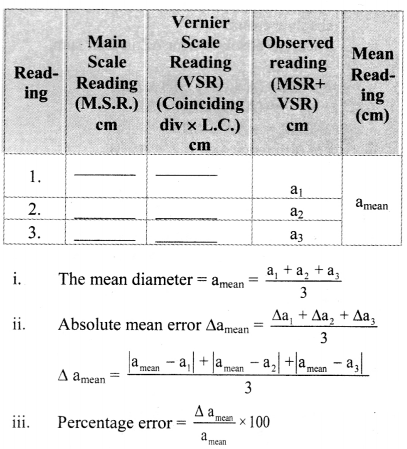
Given: L.C. = 0.01 cm
To measure external diameter of hollow cylinder readings are taken as follows:

Image

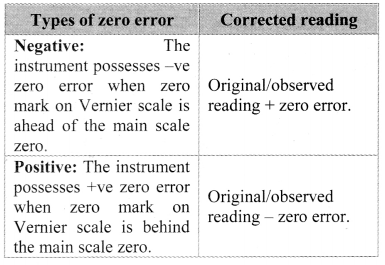
[Note: The above table is made assuming zero error in Vernier callipers. If calliper has positive or negative zero error, the zero error correction needs to be introduced into observed reading.]

Image

View full solution
Determine the vector product of $\overrightarrow{ v _1}=2 \hat{i}+3 \hat{j}-\hat{k}$ and $\overrightarrow{ v _2}=\hat{i}+2 \hat{j}-3 \hat{k}$ are perpendicular to each other, determine the value of $a$.
View full solution
Show that vectors $\overrightarrow{ a }=2 \hat{ i }+3 \hat{ j }+6 \hat{ k }, \overrightarrow{ b }=3 \hat{ i }-6 \hat{ j }+2 \hat{ k }$ and $\overrightarrow{ c }=6 \hat{ i }+2 \hat{ j }-3 \hat{ k }$ are mutually perpendicular.
View full solution
On an open ground, a biker follows a track that turns to his left by an angle of $60^\circ$ after every $600 m.$ Starting from a given turn, specify the displacement of the biker at the third and sixth turn. Compare the magnitude of the displacement with the total path length covered by the motorist in each case.
View full solution
$\overrightarrow{ P }=\hat{ i }+ 2 \hat{ k }$ and $\overrightarrow{ Q }=2 \hat{ i }+\hat{ j }-2 \hat{ k }$ are two vectors, find the unit vector parallel to $\overrightarrow{ P } \times \overrightarrow{ Q }$ Also find the vector perpendicular to $P$ and $Q$ of magnitude 6 units.
View full solution

Generate a Mathematical Methods paper free

Pick question groups from the list above, set marks and difficulty, and export a branded PDF with step-by-step answer keys. First 3 chapters free — no signup.

Download App