Questions

Distinguish between

Take a timed test

13 questions · self-marked practice — reveal the answer and mark yourself.

Question 12 Marks
Demand and Supply.
Answer
Demand:

  1. Demand is a desire backed by ability and willingness to pay.
  2. Demand is inversely related to price.
  3. Demand curve has negative slope.

Supply:

  1. Supply means the various quantities offered for sale by a producer at a given price and at a given period of time.
  2. Supply is directly related to price.
  3. Supply curve has positive slope.
View full question & answer
Question 22 Marks
Increase in Supply and Decrease in Supply.
Answer
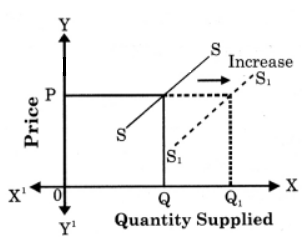
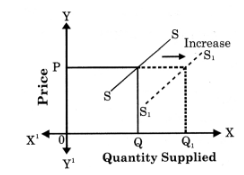
Increase in Supply :

  1. The supply is said to increase if at the same price more is supplied.
  2. Increase in supply is a case of changes in supply.
  3. Supply increases due to
    (1) fall in cost of production
    (2) improvement in transport facility
    (3) introduction of modern technology
    (4) government subsidies
    (5) more imports etc.
  4. When there is an increase in supply, the supply curve shifts to the right of original supply curve.

Image

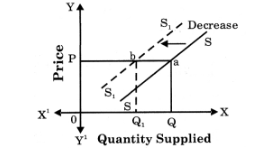
Decrease in Supply

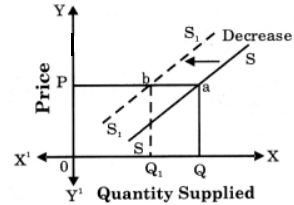
  1. Decrease in supply occurs when less quantity is supplied at the same price.
  2. It is a case of changes in supply.
  3. Supply decreases due to –
    (1) increase in cost of production
    (2) transport strike
    (3) outdated technique
    (4) heavy taxes imposed by government.
    (5) more exports etc.
  4. When there is curve shifts to curve.

Image

View full question & answer
Question 32 Marks
Demand Curve and Supply Curve.
Answer
Demand Curve:

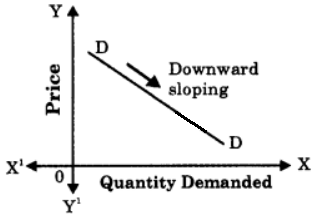
  1. Demand curve is the graphical representation of a given demand schedule.
  2. The demand curve slopes downward from left to right.
  3. The demand curve has a negative slope as price and demand are inversely related.
  4. The demand curve indicates the consumer’s behaviour in response to change in its price.

Image

Supply Curve:

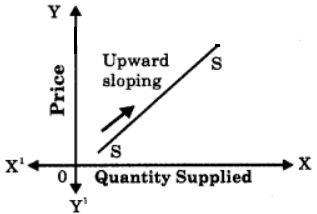
  1. Supply curve is a graphical representation of a given supply schedule.
  2. The supply curve slopes upward from left to right.
  3. The supply curve has a positive slope as price and supply are directly related.
  4. The supply curve indicates the seller’s behaviour in response to change in its price.

Image

View full question & answer
Question 42 Marks
Total Cost (TC) and Total Revenue (TR).
Answer
Total Cost (TC) :

  1. TC is the total expenditure incurred by a firm on the factors of production required for production of goods and services.
  2. TC is sum total of Total Fixed Cost (TFC) and Total Variable Cost (TVC). TC=TFC+TVC
  3. TC increases with the increase in output.
  4. TC depends on factors like cost of raw material, cost of factors like labour, land, capital, technology, cost of advertisement, management, etc.
  5. When TC > TR firm faces loss.

Total Revenue (TR) :

  1. TR refers to the amount received (income earned) by a firm from the sale of given quantity of a commodity at different price.
  2. TR is calculated by multiplying price with the quantity sold. TR = Price X Total Quantity
  3. TR increases with increase in sale.
  4. Total Revenue (TR) depends on the price of product, demand for the product, etc.
  5. When TR > TC firm earns profit.
View full question & answer
Question 52 Marks
Variation in supply and Changes in Supply.
Answer
Variation in Supply:

  1. Variation in supply refers to expansion and contraction of supply which takes place due to change in price.
  2. Expansion means more quantity is supplied at a high price while contraction means less quantity is supplied at a lower price.
  3. Variation in supply is caused by change in price.
  4. Variation is shown by a upward or downward movement on the same supply curve.

Image

Changes in Supply:

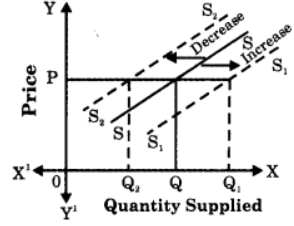
  1. Changes in supply refers to increase and decrease in supply which takes place due to changes in factors other than price.
  2. Increase in supply means more quantity is supplied at same price and decrease means less quantity supplied at the same price.
  3. Changes in supply occurs due to change in factors like.
    (1) change in cost of production
    (2) change in techniques of production
    (3) change in government policy.
    (4) change in goal of producer.
    (5) change in climatic condition etc.
  4. Changes in supply is shown by a shift in supply curve to the right or left of the original supply curve.

Image

View full question & answer
Question 62 Marks
Extension of Supply and Contraction of Supply.
Answer
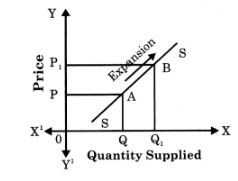
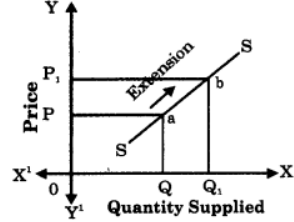
Extension of Supply:
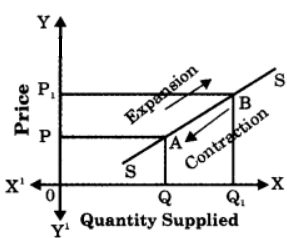
  1. When the supply of a commodity rises only due to increase in the price of that commodity, then it is said to be extension of supply.
  2. Extension in supply is shown by an upward movement to right on the same supply curve.
     
Image
  1. When price rises from OP to 0P1, Supply extends from $0Q$ to $0Q_1$.
Contraction of Supply :
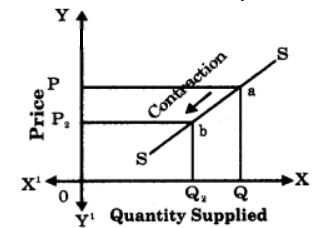
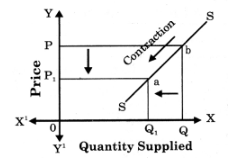
  1. When supply of a commodity falls only due to fall in the price of that commodity, then it is said to be contraction of supply.
  2. Contraction is shown by the downward movement to left on the same supply curve.
     
Image
  1. When prices falls from $0P$ to $0P_2$, Supply contracts from $0Q$ to $0Q_2$.
View full question & answer
Question 72 Marks
Individual Supply Curve and Market Supply Curve
Answer
Individual Supply Curve:

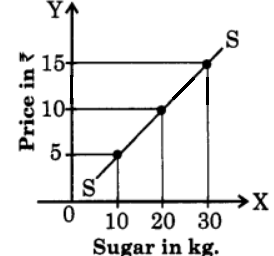
  1. Individual Supply Curve An individual supply curve is a graphical representation of various quantities of a commodity offered for sale by an individual seller at different prices during a given period of time.
  2. It is a narrow concept, as it is a part of market supply.

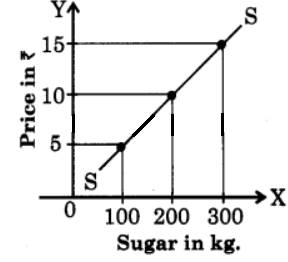
Image

  1. The above supply curve shows that as price rises quantity supplied increases to 10, 20, 30 kg.

Market Supply Curve:

  1. Market supply curve is the graphical representation of the various quantities of a commodity offered for sale by all the sellers at different prices during a given period of time.
  2. It is a broader concept, as it sum total of individual supply.

Image

  1. The above supply curve shows that as price rises, total supply in the market rises to a greater extent to 100, 200, 300 kg.
View full question & answer
Question 82 Marks
Individual Supply and Market Supply
Answer
Individual Supply:
(a) Individual Supply schedule refers to various quantities of a commodity that an individual seller is willing to sell in the market at different prices during given period of time.
(b) Individual Supply is a narrow concept. It is a part of market_supply.
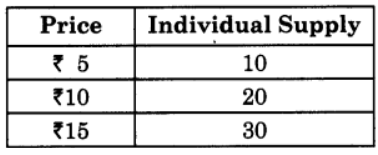
(c) Schedule:

Image

(d) As price rises, a seller likes to sell more.

Market Supply:
(a) Market Supply schedule refers to various quantities of a commodity that all sellers are willing to sell in the market at different prices during given period of time.
(b) Market Supply is a broader concept. It is sum total of individual supply.
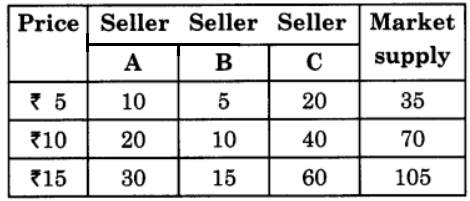
(c) Schedule:

Image

(d) As price rises total quantity supplied in the market increases.

View full question & answer
Question 92 Marks
Output and Supply
Answer
OutputSupply
1. Output refers to the total quantity of a commodity that a producer produces with the help of factors of production using a particular technology during a given period of time.(a) Supply refers to the quantity of a commodity which producers are willing to offer for sale at a given price during a given period of time.
2. Output is a function of input. So, O = f (Inputs)(b) Supply is a function of stock. So, S =f (Stock)
3. Output depends upon the level of investment, technique of production, cost of production, availability of factors and natural resources, etc.(c) Supply depends on the stock and price.
4. Output forms the basis of stock.(d) Stock forms the basis of supply.
View full question & answer
Question 102 Marks
Average Revenue and Average Cost.
Answer
Average Revenue (AR)Average Cost (AC)
(a) Average revenue refers to average income earned per unit of a sold commodity.(a)Average cost refers per unit of cost of production of a commodity produced.
(b) It is calculated by dividing total revenue (TR) earned by number of unit sold.(b) It is calculated by dividing total cost (TC)by number of units of that commodity produced.
(c) Symbolically it in expressed as$[$ latex $] \frac{\text { TotalRevenue }}{\text { TotalQuantitysold }}[/$ latex $]$(c) Symbolically it is expressed as TotalCost $\overline{\text { TotalQuantityproduced }}$
E.g. If TR from sale of 10 units of a commodity is Rs. 1000 then, AP = 1000/10 = Rs. 100E.g. If TC of 100 units a commodity is Rs. 1000 then, $\mathrm{AC}=\frac{1000}{100}=$ Rs. 10
View full question & answer
Question 112 Marks
Contraction of Supply and Decrease in Supply.
Answer
Contraction of Supply

  1. Contraction of supply occurs when quantity supplied of a commodity falls due to a fall in price alone.
  2. It is a case of variation in supply.
  3. Supply contracts due to fall in price alone.
  4. When there is a downward n curve.

Image

Decrease in Supply

  1. Decrease in supply occurs when less quantity is supplied at the same price.
  2. It is a case of changes in supply.
  3. Supply decreases due to –
    (1) increase in cost of production
    (2) transport strike
    (3) outdated technique
    (4) heavy taxes imposed by government.
    (5) more exports etc.
  4. When there is curve shifts to curve.

Image

View full question & answer
Question 122 Marks
Expansion of Supply and Increase in Supply.
Answer
Expansion / Extension of Supply

  1. When the supply of a commodity rises only due to the rise in the price of the commodity, then it is said to be extension in supply.
  2. Extension of supply is a case of variation in supply.
  3. Rise in price is the only factor due to which supply expands / extends.
  4. When there is extension in supply, there is an upward movement on the same supply curve.

Image

Increase in Supply :

  1. The supply is said to increase if at the same price more is supplied.
  2. Increase in supply is a case of changes in supply.
  3. Supply increases due to
    (1) fall in cost of production
    (2) improvement in transport facility
    (3) introduction of modern technology
    (4) government subsidies
    (5) more imports etc.
  4. When there is an increase in supply, the supply curve shifts to the right of original supply curve.

Image

View full question & answer
Question 132 Marks
Stock and Supply.
Answer
StockSupply
(a) Stock refers to the total quantity of commodity available with producer for sale.(a)Supply is that part of stock which the seller is willing to offer for sale at a given price.
(b) It is outcome of production. If production increases, stock will also increase.(b) It is outcome of stock. Stock is the basis of supply.
(c) It is a fund or reservoir and a static concept (inelastic).(c) It is a flow concept. It changes according to change in price (elastic).
(d) It can exceed supply.(d) It cannot exceed stock.
View full question & answer