Questions

Solve the Following Question.(5 Marks)

Take a timed test

4 questions · self-marked practice — reveal the answer and mark yourself.

Question 15 Marks
Find the area of the ellipse $\frac{x^2}{16}+\frac{y^2}{9}=1$.
Answer
By the symmetry of the ellipse, the required area of the ellipse is 4 times the area of the region OPQO.
For the region OPQO, the limits of integration are x = 0 and x = 4.
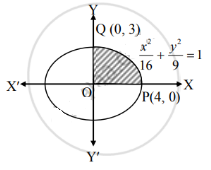
Image
Given equation of the ellipse is $\frac{x^2}{16}+\frac{y^2}{9}=1$
$
\begin{aligned}
& \therefore \frac{y^2}{9}=1-\frac{x^2}{16} \\
& \therefore y ^2=9\left(1-\frac{x^2}{16}\right) \\
& =\frac{9}{16}\left(16-x^2\right) \\
& \therefore y = \pm \frac{3}{4} \sqrt{16-x^2} \\
& \therefore y =\frac{3}{4} \sqrt{16-x^2} \ldots[\because \text { In first quadrant, } y >0] \\
& \therefore \text { Required area }=4(\text { area of the region OPQO) } \\
& =4 \int_0^4 y \cdot d x \\
& =4 \int_0^4 \frac{3}{4} \sqrt{16-x^2} \cdot d x \\
& =3 \int_0^4 \sqrt{(4)^2-x^2} \cdot d x \\
& =3\left[\frac{x}{2} \sqrt{(4)^2-x^2}+\frac{(4)^2}{2} \sin ^{-1}\left(\frac{x}{4}\right)\right]_0^4 \\
& =3\left\{\left[\frac{4}{2} \sqrt{(4)^2-(4)^2}+\frac{(4)^2}{2} \sin ^{-1}\left(\frac{4}{4}\right)\right]-\left[\frac{0}{2} \sqrt{(4)^2-(0)^2}+\frac{(4)^2}{2} \sin ^{-1}\left(\frac{0}{4}\right)\right]\right\} \\
& =3\{[0+8 \sin -1(1)]-[0+0]\} \\
& =3\left(8 \times \frac{\pi}{2}\right) \\
& =12 \pi \text { sq. units. }
\end{aligned}
$
View full question & answer
Question 25 Marks
Find the area between the parabolas $y^2=7 x$ and $x^2=7 y$.
Answer
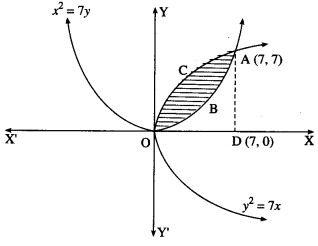
Image
For finding the points of intersection of the two parabolas,
we equate the values of $y^2$ from their equations.
From the equation $x ^2=7 y , y ^2=\frac{x^4}{49}$
$
\begin{aligned}
& \therefore \frac{x^4}{49}=7 x \\
& \therefore x ^4=343 x \\
& \therefore x ^4-343 x =0 \\
& \therefore x \left( x ^3-343\right)=0
\end{aligned}
$
$\therefore x =0$ or $x ^3=343$, i.e. $x =7$
When $x =0, y =0$
When $x=7,7 y=49$
$
\therefore y =7
$
$\therefore$ the points of intersection are $O (0,0)$ and $A (7,7)$
Required area $=$ area of the region $OBACO$
$=($ area of the region $O D A C O)-($ area of the region $O D A B O$ )
Now, area of the region ODACO $=$ area under the parabola $y^2=7 x$
i.e. $y=\sqrt{ } 7 \sqrt{ } x$
$
\begin{aligned}
& =\int_0^7 \sqrt{7} \sqrt{x} d x=\sqrt{7}\left[\frac{x^{\frac{3}{2}}}{3 / 2}\right]_0^7 \\
& =\sqrt{7} \times \frac{2}{3}\left[7^{\frac{3}{2}}-0\right]=\frac{2 \sqrt{7}}{3}[7 \sqrt{7}-0] \\
& =\frac{98}{3}
\end{aligned}
$
Area of the region $ODABO =$ Area under the parabola
$
x^2=7 y
$
i.e. $y =\frac{x^2}{7}$
$
=\int_0^7 \frac{x^2}{7} d x=\frac{1}{7}\left[\frac{x^3}{3}\right]_0^7=\frac{1}{7}\left[\frac{7^3}{3}-0\right]
$
$=\frac{7^2}{3}=\frac{49}{3}$
$\therefore$ required area $=\frac{98}{3}-\frac{49}{3}=\frac{49}{3}$ sq units.
View full question & answer
Question 35 Marks
Find the area of the ellipse $\frac{x^2}{4}+\frac{y^2}{25}=1$
Answer
Image
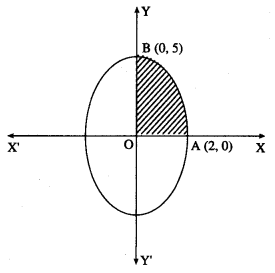
By the symmetry of the ellipse, its area is equal to 4 times the area of the region OABO.
Clearly, for this region, the limits of integration are 0 and From the equation of the ellipse,
$
\begin{aligned}
\frac{y^2}{25} & =1-\frac{x^2}{4}=\frac{4-x^2}{4} \\
\therefore y^2 & =\frac{25}{4}\left(4-x^2\right)
\end{aligned}
$
In the first quadrant, $y>0$
$
\therefore y=\frac{5}{2} \sqrt{4-x^2}
$
$\therefore$ area of ellipse $=4$ (area of the region $OABO )$
$
\begin{aligned}
& =4 \int_0^2 y d x \\
& =4 \int_0^2 \frac{5}{2} \sqrt{4-x^2} d x \\
& =10 \int_0^2 \sqrt{4-x^2} d x \\
& =10\left[\frac{x}{2} \sqrt{4-x^2}+\frac{4}{2} \sin ^{-1}\left(\frac{x}{2}\right)\right]_0^2 \\
& \quad \ldots\left[\because \int \sqrt{a^2-x^2} d x=\frac{x}{2} \sqrt{a^2-x^2}+\frac{a^2}{2} \sin ^{-1}\left(\frac{x}{a}\right)\right] \\
& =10\left[\left\{\frac{2}{2} \sqrt{4-4}+2 \sin ^{-1}(1)\right\}-\left\{\frac{0}{2} \sqrt{4-0}+2 \sin ^{-1}(0)\right\}\right] \\
& =10 \times 2 \times \frac{\pi}{2}=10 \pi \text { sq units. } \\
& \quad \ldots\left[\because \sin ^{-1}(1)=\frac{\pi}{2}, \sin ^{-1}(0)=0 .\right]
\end{aligned}
$
View full question & answer
Question 45 Marks
Find the area of the circle $x^2 + y^2 = 25.$
Answer
Image
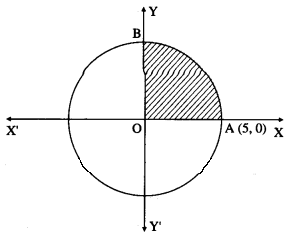
By the symmetry of the circle, its area is equal to $4$ times the area of the region $OABO$.
Clearly, for this region, the limits of integration are $0$ and $5$ .
From the equation of the circle, $y^2=25-x^2$.
In the first quadrant $y>0$
$
\therefore y =\sqrt{25-x^2}
$
$\therefore$ area of the circle $=4($ area of region $OABO )$
$
\begin{aligned}
=4 & \int_0^5 y d x=4 \int_0^5 \sqrt{25-x^2} d x \\
=4 & {\left[\frac{x}{2} \sqrt{25-x^2}+\frac{25}{2} \sin ^{-1}\left(\frac{x}{5}\right)\right]_0^5 } \\
& \ldots\left[\because \int \sqrt{a^2-x^2} d x=\frac{x}{2} \sqrt{a^2-x^2}+\frac{a^2}{2} \sin ^{-1}\left(\frac{x}{a}\right)\right]
\end{aligned}
$
$
\begin{array}{r}
=4\left[\left\{\frac{5}{2} \sqrt{25-25}+\frac{25}{2} \sin ^{-1}(1)\right\}-\right. \\
\left.\left\{\frac{0}{2} \sqrt{25-0}+\frac{25}{2} \sin ^{-1}(0)\right\}\right]
\end{array}
$
$=4 \cdot \frac{25}{2} \cdot \frac{\pi}{2}=25 \pi$ sq units.
$
\cdots\left[\because \sin ^{-1}(1)=\frac{\pi}{2}, \sin ^{-1}(0)=0 .\right]
$
View full question & answer