Questions

Solve the Following Question.(4 Marks)

🎯

Test yourself on this topic

11 questions · timed · auto-graded

Question 14 Marks
If p : Proof is lengthy.
q : It is interesting.
Express the following statements in symbolic form:
(i) Proof is lengthy and it is not interesting.
(ii) If the proof is lengthy, then it is interesting.
(iii) It is not true that the proof is lengthy but it is interesting.
(iv) It is interesting iff the proof is lengthy.
Answer
The symbolic form of the given statements are:
(i) p ∧ ~q
(ii) p → q
(iii) ~(p ∧ q)
(iv) q ↔ p
View full question & answer
Question 24 Marks
What is a tautology? What is a contradiction? Show that the negation of a tautology is a contradiction and the negation of a contradiction is a tautology.
Answer
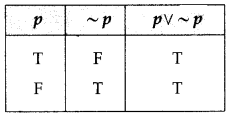
Tautology: A statement pattern that has all the entries in the last column of its truth table as T is called a tautology.
For example:
Image
In the above truth table for the statement p ∨ ~p,
we observe that all the entries in the last column are T.
Hence, the statement p ∨ ~p is a tautology.

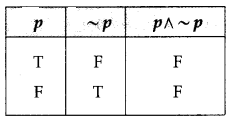
Contradiction: A statement pattern that has all the entries in the last column of its truth table as F is called a contradiction.
For example:
Image
In the above truth table for the statement p ∧ ~p,
we observe that all the entries in the last column are F.
Hence, the statement p ∧ ~p is a contradiction.

To show that the negation of a tautology is a contradiction and vice versa:
A tautology is true on every row of its truth table.
Since, ~T = F and ~F = T, when we negate a tautology, the resulting statement is false on every row of its table.
i.e. the negation of tautology is a contradiction.
Similarly, the negation of a contradiction is a tautology.
View full question & answer
Question 34 Marks
Write the converse, inverse, and contrapositive of the following statements:
(i) If it snows, then they do not drive the car.
(ii) If he studies, then he will go to college.
Answer
(i) Let p : It snows.
q : They do not drive the car.
Then the symbolic form of the given statement is p → q.
Converse: q → p is the converse of p → q.
i.e. If they do not drive the car, then it snows.
Inverse: ~p → ~q is the inverse of p → q.
i.e. If it does not snow, then they drive the car.
Contrapositive: ~q → ~p is the contrapositive of p → q.
i.e. If they drive the car, then it does not snow.
(ii) Let p : He studies.
q : He will go to college.
Then two symbolic form of the given statement is p → q.
Converse: q → p is the converse of p → q.
i.e. If he will go to college, then he studies.
Inverse: ~p → ~q is the inverse of p → q.
i.e. If he does not study, then he will not go to college.
Contrapositive: ~q → ~p is the contrapositive of p → q.
i.e. If he will not go to college, then he does not study.
View full question & answer
Question 44 Marks
Write the negation of each of the following statements:
(i) All the stars are shining if it is night.
(ii) $∀ n \in N, n + 1 > 0$.
(iii) $∃ n \in N$, such that $(n^2 + 2)$ is odd number.
(iv) Some continuous functions are differentiable.
Answer
(i) $\exists x \in N$, such that $x^2+3 x-10=0$ is a true statement.
( $x=2 \in N$ satisfy $x^2+3 x-10=0$ )
(ii) $\exists x \in N$, such that $3 x-4<9$ is a true statement.
( $x=1,2,3,4 \in N$ satisfy $3 x-4<9$ )
(iii) $\forall n \in N, n^2 \geq 1$ is a true statement.
(All $n \in N$ satisfy $n ^2 \geq 1$ )
(iv) $\exists x \in N$, such that $2 n-1=5$ is a true statement.
( $n=3 \in N$ satisfy $2 n-1=5$ )
(v) $\exists y \in N$, such that $y+4>6$ is a true statement.
( $y=3,4,5, \ldots \in N$ satisfy $y+4>6$
(vi) $\exists y \in N$, such that $2 y \leq 9$ is a true statement.
$(y=1,2,3 \in N$ satisfy $3 y-2 \leq 9)$.
View full question & answer
Question 54 Marks
Write the dual statement of each of the following compound statements:
(i) 13 is prime number and India is a democratic country.
(ii) Karina is very good or everybody likes her.
(iii) Radha and Sushmita can not read Urdu.
(iv) A number is real number and the square of the number is non-negative.
Answer
1. 13 is prime number or India is a democratic country.
2. Karina is very good and everybody likes her.
3. Radha or Sushmita can not read Urdu.
4. A number is real number or the square of the number is non-negative.
View full question & answer
Question 64 Marks
Prove that the following pairs of statement patterns are equivalent:
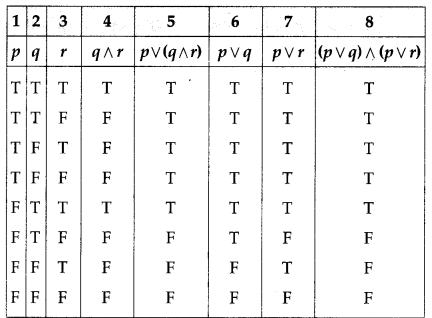
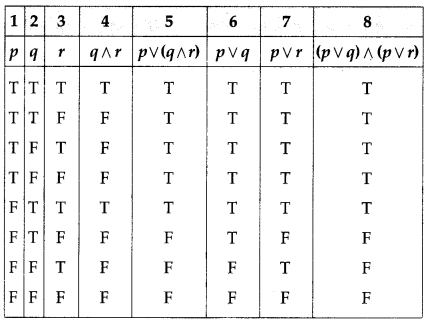
(i) p ∨ (q ∧ r) and (p ∨ q) ∧ (p ∨ r)
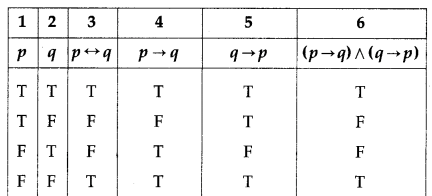
(ii) p ↔ q and (p → q) ∧ (q → p)
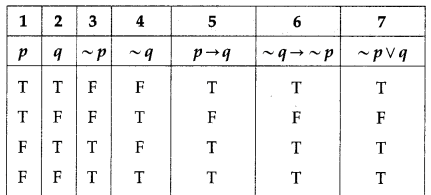
(iii) p → q and ~q → ~p and ~p ∨ q
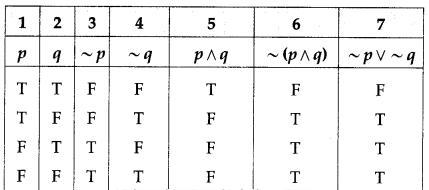
(iv) ~(p ∧ q) and ~p ∨ ~q
Answer
1.Image
The entries in columns 5 and 8 are identical.
∴ p ∨ (q ∧ r) ≡ (p ∨ q) ∧ (p ∨ r)
2.Image
The entries in columns 3 and 6 are identical.
∴ p ↔ q ≡ (p → q) ∧ (q → p)
3.Image
The entries in columns 5, 6 and 7 are identical.
∴ p → q ≡ ~q → ~p ≡ ~p ∨ q.
4.Image
The entries in columns 6 and 7 are identical.
∴ ~(p ∧ q) ≡ ~p ∨ ~q.
View full question & answer
Question 74 Marks
Using the truth table, verify:
(i) p ∨ (q ∧ r) = (p ∨ q) ∧ (p ∨ r)
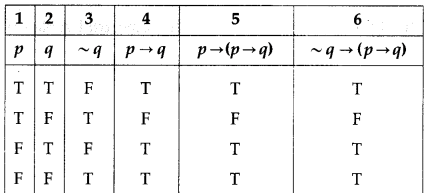
(ii) p → (p → q) ≡ ~q → (p → q)
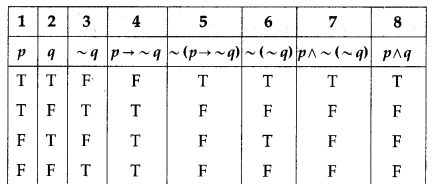
(iii) ~(p → ~q) ≡ p ∧ ~(~q) ≡ p ∧ q
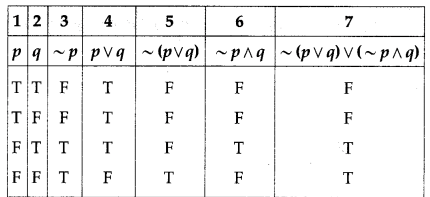
(iv) ~(p ∨ q) ∨ (~p ∧ q) ≡ ~p
Answer
1.Image
The entries in columns 5 and 8 are identical.
∴ p ∨ (q ∧ r) ≡ (p ∨ q) ∧ (p ∨ r).
2.Image
The entries in columns 5 and 6 are identical.
∴ p → (p → q) ≡ ~q → (p → q)
3.Image
The entries in columns 5, 7 and 8 are identical.
∴ ~(p → ~q) ≡ p ∧ ~(~q) ≡ p ∧ q.
4.Image
The entries in columns 3 and 7 are identical.
∴ ~(p ∨ q) ∨ (~p ∧ q) ≡ ~p.
View full question & answer
Question 84 Marks
Show that each of the following statement pattern is a contingency:
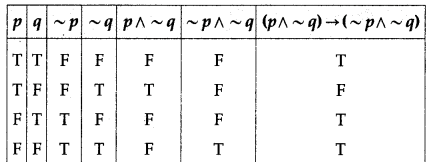
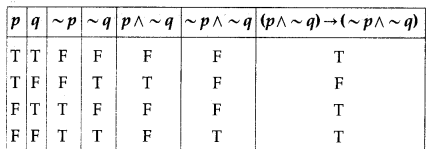
(i) (p ∧ ~q) → (~p ∧ ~q)
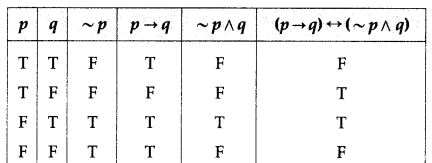
(ii) (p → q) ↔ (~p ∧ q)
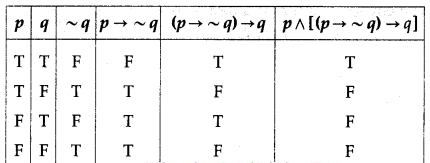
(iii) p ∧ [(p → ~q) → q]
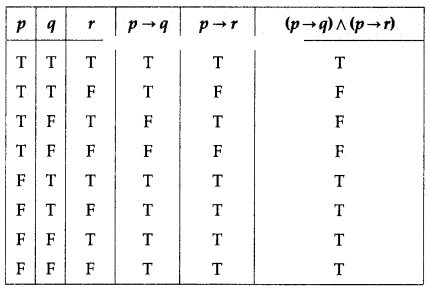
(iv) (p → q) ∧ (p → r)
Answer
1.Image
The entries in the last column of the above truth table are neither all T nor all F.
∴ (p ∧ ~q) → (~p ∧ ~q) is a contingency.
2.Image
The entries in the last column of the above truth table are neither all T nor all F.
∴ (p → q) ↔ (~p ∧ q) is a contingency.
3.Image
The entries in the last column of the above truth table are neither all T nor all F.
∴ p ∧ [(p → ~q) → q] is a contingency.
4.Image
The entries in the last column of the above truth table are neither all T nor all F.
∴ (p → q) ∧ (p → r) is a contingency.
View full question & answer
Question 94 Marks
Prove that each of the following statement pattern is a contradiction:
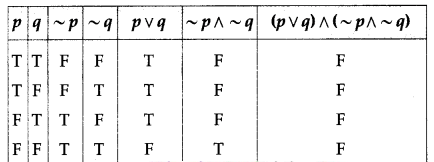
(i) (p ∨ q) ∧ (~p ∧ ~q)
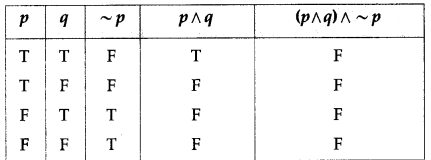
(ii) (p ∧ q) ∧ ~p
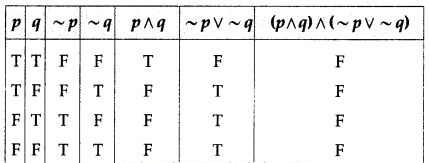
(iii) (p ∧ q) ∧ (~p ∨ ~q)
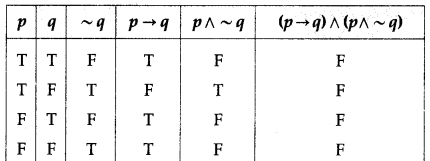
(iv) (p → q) ∧ (p ∧ ~q)
Answer
1.Image
All the entries in the last column of the above truth table are F.
∴ (p ∨ q) ∧ (~p ∧ ~q) is a contradiction.
2.Image
All the entries in the last column of the above truth table are T.
∴ (p ∧ q) ∧ ~p is a contradiction.
3.Image
All the entries in the last column of the above truth table are F.
∴ (p ∧ q) ∧ (~p ∨ ~q) is a contradiction.
4.Image
All the entries in the last column of the above truth table are F.
∴ (p → q) ∧ (p ∧ ~q) is a contradiction.
View full question & answer
Question 104 Marks
Prove that each of the following statement pattern is a tautology :
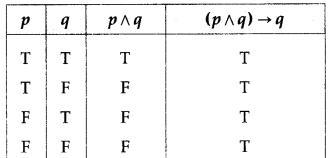
(i) (p ∧ q) → q
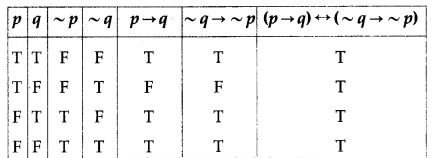
(ii) (p → q) ↔ (~q → ~p)
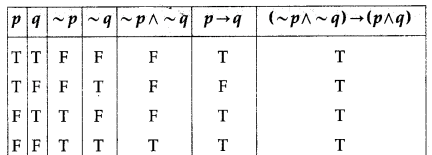
(iii) (~p ∧ ~q) → (p → q)
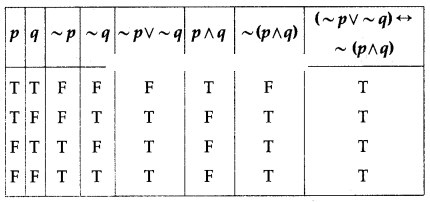
(iv) (~p ∨ ~q) ↔ ~(p ∧ q)
Answer
1.Image
All the entries in the last column of the above truth table are T.
∴ (p ∧ q) → q is a tautology.
2.Image
All the entries in the last column of the above truth table are T.
∴ (p → q) ↔ (~q → ~p) is a tautology.
3.Image
All the entries in the last column of the above truth table are T.
∴ (~p ∧ ~q) → (p → q) is a tautology.
4.Image
All the entries in the last column of the above truth table are T.
∴ (~p ∨ ~q) ↔ ~(p ∧ q) is a tautology.
View full question & answer
Question 114 Marks
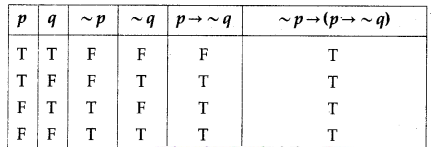
Examine, whether each of the following statement patterns is a tautology or a contradiction or a contingency :
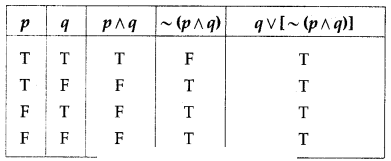
(i) q ∨ [~(p ∧ q)]
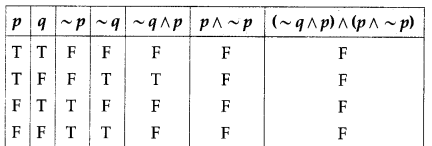
(ii) (~q ∧ p) ∧ (p ∧ ~p)
(iii) (p ∧ ~q) → (~p ∧ ~q)
(iv) ~p → (p → ~q)
Answer
1.Image
All the entries in the last column of the above truth table are T.
∴ q ∨ [~(p ∧ q)] is a tautology.
2.Image
All the entries in the last column of the above truth table are F.
∴ (~q ∧ p) ∧ (p ∧ ~p) is a contradiction.
3.Image
The entries in the last column are neither all T nor all F.
∴ (p ∧ ~q) → (~p ∧ ~q) is a contingency.
4.Image
All the entries in the last column of the truth table are T.
∴ p → (p → ~q) is a tautology.
View full question & answer
Solve the Following Question.(4 Marks) - Maths (commerce) STD 12 Commerce / Arts Questions - Vidyadip