MCQ 11 Mark
Identify the correct decreasing order of bond dissociation enthalpy from following .
- ✓
$Cl - Cl > Br - Br > F - F > I - I$
- B
$Cl - Cl > F - F > Br - Br > I - I$
- C
$I - I > Br - Br > Cl - Cl > F - F$
- D
$F - F > Cl - Cl > Br - Br > I - I$
AnswerCorrect option: A. $Cl - Cl > Br - Br > F - F > I - I$
View full question & answer→MCQ 21 Mark
Identify the element having smallest atomic radius from following
MCQ 31 Mark
Which among the following hydrogen halides is thermally least stable?
MCQ 41 Mark
What is the bond angle $O - S - O$ in $SO _2$ molecule?
- A
$104 \cdot 5^{\circ}$
- B
$107^{\circ}$
- C
$180^{\circ}$
- ✓
$119.5$
AnswerCorrect option: D. $119.5$
View full question & answer→MCQ 51 Mark
Which among the following compounds contains highest number of chlorine atoms in their single molecule ?
MCQ 61 Mark
Which of the following molecules possesses highest dipole$-$dipole interactions?
View full question & answer→MCQ 71 Mark
Identify the products obtained when chlorine reacts with hot and conc. $NaOH$.
AnswerCorrect option: B. $NaClO _3, NaCl$ and $H _2 O$
View full question & answer→MCQ 81 Mark
Identify the product obtained when excess chlorine reacts with ammonia.
- A
Dinitrogen and hydrochloric acid
- B
Ammonium chloride and dinitrogen
- C
Nitrogen dioxide and hydrochloric acid
- ✓
Nitrogen trichloride and hydrochloric acid
AnswerCorrect option: D. Nitrogen trichloride and hydrochloric acid
View full question & answer→MCQ 91 Mark
Which of the following conversions is carried out by using charcoal catalyst $3$
- ✓
$SO _{2( g )}+ Cl _{2( g )} \longrightarrow SO _2 Cl _{2( l )}$
- B
$2 SO _{2_{( g )}}+ O _{2( g )} \longrightarrow 2 SO _{3_{( g )}}$
- C
$4 HCl + O _2 \longrightarrow 2 Cl _2+2 H _2 O$
- D
$2 ZnS _{( s )}+3 O _{2( g )} \longrightarrow 2 ZnO _{( s )}+2 SO _{2( g )}$
AnswerCorrect option: A. $SO _{2( g )}+ Cl _{2( g )} \longrightarrow SO _2 Cl _{2( l )}$
View full question & answer→MCQ 101 Mark
Which of following interhalogen compounds is NOT obtained by action of fluorine with bromine? $\left(X=B r, X^{\prime}=F\right)$
- ✓
$X X_7^{\prime}$
- B
$X X^{\prime}$
- C
$X X_3^{\prime}$
- D
$X X_5^{\prime}$
AnswerCorrect option: A. $X X_7^{\prime}$
View full question & answer→MCQ 111 Mark
Identify the gases used to fill in electric bulbs?
- A
$He$ and $N _2$
- B
$Ne$ and $He$
- ✓
$Ar$ and $N _2$
- D
$He$ and $O _2$
AnswerCorrect option: C. $Ar$ and $N _2$
View full question & answer→MCQ 121 Mark
Which among the following molecules has lowest bond dissociation enthalpy?
- A
$F _2$
- B
$Br _2$
- C
$Cl _2$
- ✓
$I _2$
AnswerCorrect option: D. $I _2$
View full question & answer→MCQ 131 Mark
Which among the following is group 16 element?
MCQ 141 Mark
Which from following activities results in to the formation of oleum in manufacture of sulphuric acid by contact process ?
- ✓
By absorbing $SO _3$ gas in conc. $H _2 SO _4$.
- B
Passing $SO _2$ gas through $NaOH$ solution.
- C
By passing $SO _2$ gas in to the dil. $H _2 SO _4$.
- D
By adding sodium sulphite and $SO$, in water
AnswerCorrect option: A. By absorbing $SO _3$ gas in conc. $H _2 SO _4$.
View full question & answer→MCQ 151 Mark
What is action of chlorine on excess ammonia?
- A
Formation of nitrogen trichloride.
- B
Formation of dinitrogen and hydrochloric acid.
- ✓
Formation of ammonium chloride and dinitrogen.
- D
Formation of nitric oxide and hydrochloric acid.
AnswerCorrect option: C. Formation of ammonium chloride and dinitrogen.
View full question & answer→MCQ 161 Mark
Identify the molecular geometry of $XeF _4$ is
View full question & answer→MCQ 171 Mark
Which from following molecules has highest bond dissociation enthalpy
- A
$F _2$
- B
$I _2$
- C
$Br _2$
- ✓
$Cl _2$
AnswerCorrect option: D. $Cl _2$
View full question & answer→MCQ 181 Mark
What are the different elements present in mineral baryte?
MCQ 191 Mark
Among the known interhalogen compounds, the maximum number of atoms is
MCQ 201 Mark
In which of the following pairs, molecules are paired with their correct shapes?
- ✓
$\left[I_3\right]$ : bent
- B
$BrF_5$ : trigonal bipyramid
- C
$ClF _3$ : trigonal planar $BrF _5$
- D
$[BrF_4]$ : square planar
AnswerCorrect option: A. $\left[I_3\right]$ : bent
View full question & answer→MCQ 211 Mark
Which of the following has one lone pair of electrons?
- A
$IF _3$
- B
- ✓
$IF _5z$
- D
$ClF _3$
AnswerCorrect option: C. $IF _5z$
$IF _5$
View full question & answer→MCQ 221 Mark
In interhalogen compounds, which of the following halogens is never the central atom.
MCQ 231 Mark
Chlorine reacts with excess of fluorine to form.
- A
$ClF$
- ✓
$ClF _3$
- C
$ClF _2$
- D
$Cl _2 F _3$
AnswerCorrect option: B. $ClF _3$
View full question & answer→MCQ 241 Mark
BrCl reacts with water to form
MCQ 251 Mark
Stability of interhalogen compounds follows the order
- A
BrF > IBr > ICl > ClF > BrCl
- B
IBr > BeF > ICl > ClF > BrCl
- ✓
ClF > ICl > IBr > BrCl > BrF
- D
ICl > ClF > BrCl > IBr > BrF
AnswerCorrect option: C. ClF > ICl > IBr > BrCl > BrF
ClF > ICl > IBr > BrCl > BrF
View full question & answer→MCQ 261 Mark
In pyrosulfurous acid oxidation state of sulfur is
MCQ 271 Mark
Which of the following occurs in liquid state at room temperature?
MCQ 281 Mark
Ozone layer is depleted by
- ✓
$NO$
- B
$NO _2$
- C
$NO _3$
- D
$N_2 O _5$
View full question & answer→MCQ 291 Mark
HI acid when heated with conc. $H _2 SO _4$ forms
- A
$HIO _3$
- B
$KIO _3$
- ✓
$I _2$
- D
$Kl$
AnswerCorrect option: C. $I _2$
View full question & answer→MCQ 301 Mark
Which of the following element does not show oxidation state of +4 ?
MCQ 311 Mark
Hydrides of group $16$ are weakly acidic. The correct order of acidity is
- A
$H _2 O > H _2 S > H _2 Se > H _2 Te$
- B
$H _2 Te > H _2 O > H _2 S > H _2 Se$
- ✓
$H _2 Te > H _2 Se > H _2 S > H _2 O$
- D
$H _2 Te > H _2 Se > H _2 O > H _2 S$
AnswerCorrect option: C. $H _2 Te > H _2 Se > H _2 S > H _2 O$
View full question & answer→MCQ 321 Mark
Which of the following has the highest electron gain enthalpy?
MCQ 331 Mark
What is the number of electrons around sulphur in $H _2 SO _4$ molecule?
View full question & answer→MCQ 341 Mark
Which group elements from following are called as chalcogens?
Answer(c): Chalcogens are group 16 elements.
View full question & answer→MCQ 351 Mark
Which from following molecules exhibits highest acidic nature?
- A
$H _2 O$
- B
$H _2 S$
- C
$H _2 Se$
- ✓
$H _2 Te$
AnswerCorrect option: D. $H _2 Te$
(d) : $H _2 Te$ is most acidic in nature as acidic nature increases down the group in the hydrides of group 16.
View full question & answer→MCQ 361 Mark
Which of the following metals is used as catalyst in manufacture of sulphuric acid by Contact process?
Answer(b) : Platinum is used as catalyst in manufacturing process of sulphuric acid by Contact process.
View full question & answer→MCQ 371 Mark
Identify the element having general electronic configuration $n s^2 n p^4$ from following.
Answer(a): The general electronic configuration, $n s^2 n p^4$ is for group 16 (chalcogens) which includes oxygen (O), sulphur (S), selenium ( $Se )$, tellurium ( $Te )$, polonium ( $Po )$ and livermorium (Lv).
View full question & answer→MCQ 381 Mark
Identify the element having positive electron gain enthalpy.
Answer(a) : Ne is a noble gas, it has positive electron gain enthalpy because of its stable inert gas configuration.
View full question & answer→MCQ 391 Mark
Which from following elements is in liquid state at room temperature?
Answer(b) : Bromine exists in liquid state at room temperature.
View full question & answer→MCQ 401 Mark
What is the value of $\angle \mathrm{S}-\mathrm{S}-\mathrm{S}$ in puckered $\mathrm{S}_8$ rhombic sulphur?
Answer(a) : Angle S-S-S in puckered rhombic sulphur is $107^{\circ}$,
View full question & answer→MCQ 411 Mark
Which element from following exhibits highest number of allotropes?
Answer(b) : After carbon, sulphur has the most number of allotropes.
View full question & answer→MCQ 421 Mark
Identify the correct decreasing order af bond dissociation enthalpy.
Answer(d): The decreasing order for the bond dissociation enthalpy of halogen molecules is
$
\begin{aligned}
Cl _2(57 kcal / mol ) & > Br _2(45.5 kcal / mol )> \\
F _2(38 kcal / mol ) & > I _2(35.6 kcal / mol )
\end{aligned}
$
View full question & answer→MCQ 431 Mark
Which halogen has the highest value of negative electron gain enthalapy?
Answer(b): On moving down the group in halogens, the electron gain enthalpy becomes less negative. This is due to the fact that the atoms of these elements have only one electron less than stable noble gas configurations. However, the negative electron gain enthalpy of fluorine is less than that of chlorine. Because of small size, interelectronic repulsions are stronger in relatively small $2 p$ orbitals of fluorine and there is not much attraction of the nucleus on the incoming electron, due to higher electron density. So, chlorine has highest value of electron gain enthalpy.
View full question & answer→MCQ 441 Mark
Which element among the following does not form diatomic molocules?
Answer(a): Argon is a monoatomic gas and does not form diatomic molecules because of inertness. Whereas all others are elements having a tendency to form diatomic molecules.
View full question & answer→MCQ 451 Mark
Which among the following compound does not act as a reducing agent?
- ✓
$H _2 O$
- B
$H_2 S$
- C
$H _2 Se$
- D
$H _2 Te$
AnswerCorrect option: A. $H _2 O$
(a) : All the hydrides of group 16 are reducing in nature except $H _2 O$.
View full question & answer→MCQ 461 Mark
Brown ring test is used for detection of which radical?
Answer(c): On treating aqueous solution of nitrate salt with freshly prepared solution of ferrous sulphate and concentrated sulphuric acid, a brown ring at the junction of two liquids is formed.
$
NaNO _3+ H _2 SO _4 \rightarrow NaHSO _4+ HNO _3
$
Salt
$6 \mathrm{FeSO}_4+2 \mathrm{HNO}_3+3 \mathrm{H}_2 \mathrm{SO}_4 \rightarrow 3 \mathrm{Fe}_2\left(\mathrm{SO}_4\right)_3+4 \mathrm{H}_2 \mathrm{O}+2 \mathrm{NO}$
$\left[\mathrm{Fe}\left(\mathrm{H}_2 \mathrm{O}\right)_6\right] \mathrm{SO}_4+\mathrm{NO} \rightarrow\left[\mathrm{Fe}\left(\mathrm{H}_2 \mathrm{O}\right)_5 \mathrm{NO}_3 \mathrm{SO}_4+2 \mathrm{H}_2 \mathrm{O}\right.$
$\quad$
Ferrous sulphate $\quad$$\quad$$\quad$$\quad$$\quad$ Brown ring
View full question & answer→MCQ 471 Mark
The most abundant noble gas in atmosphere is
MCQ 481 Mark
What is the highest oxidation state exhibited by group 17 elements?
Answer(d) : All the halogens exhibit -1 oxidation state. However, chlorine, bromine and iodine exhibit $+1,+3,+5$ and +7 oxidation states.
View full question & answer→MCQ 491 Mark
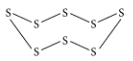
Which is the most stable allotrope of sulphur?
Answer(a): Octahedral sulphur or rhombic sulphur is the most stable allotrope of sulphur which exists as staggered $S_8$ rings.
View full question & answer→MCQ 501 Mark
What oxoacid of sulphur contains $\mathrm{S}-\mathrm{S}$ bond in its structure?
View full question & answer→MCQ 511 Mark
Which halogen forms an oxyacid that contains the halogen atom in tripositive oxidation state?
Answer(b) : Only chlorine forms $HOClO$ or $HClO _2$ where oxidation state of $Cl$ is +3 .
View full question & answer→MCQ 521 Mark
Identify a metalloid from the following list of elements.
MCQ 531 Mark
What is the most abundant element on earth?
Answer(c): Oxygen occurs in the free state as dioxygen $\left( O _2\right)$ and makes up $20.46 \%$ by volume and $23 \%$ by mass of the atmosphere and $46.6 \%$ by weight of the earth's crust where it mainly occurs as silicate minerals.
View full question & answer→MCQ 541 Mark
Electronic configuration of only one $p$-block element is exceptional. One molecule of that element consists of how many atoms of it?
View full question & answer→MCQ 551 Mark
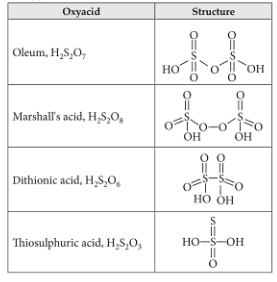
Which oxyacid of sulphur contains $S-S$ simple bond?
Answer(c) :
View full question & answer→MCQ 561 Mark
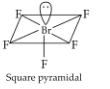
What is the geometry of molecule of bromine pentaflaceride?
Answer(c):
View full question & answer→MCQ 571 Mark
Which among the following group 16 elements exists in more than two allotropic states?
Answer(c):| Element | Allotropic forms |
| Pollonium | $\alpha$ - and $\beta$-forms |
| Tellurium | Crystalline and amorphous |
| Oxygen | Dinuclear oxygen, $\mathrm{O}_2$ and trinuclear oxygen, $\mathrm{O}_3$ (ozone) |
| Selenium | Red monoclinic, grey hexagonal metallic, amorphous black |
View full question & answer→MCQ 581 Mark
In $XeF _2$, $XeF _4$ and $XeF _6$ the number of lone pairs on $Xe$ is respectively
- A
$2, 3, 1$
- B
$1, 2, 3$
- C
$4, 1, 2$
- ✓
$3, 2, 1$
AnswerCorrect option: D. $3, 2, 1$
View full question & answer→MCQ 591 Mark
Shape of $XeO _4$ is
View full question & answer→MCQ 601 Mark
$XeF _4$ on partial hydrolysis produces
- A
$XeF _2$
- B
$XeOF _2$
- ✓
$XeOF _4$
- D
$XeO _3$
AnswerCorrect option: C. $XeOF _4$
View full question & answer→MCQ 611 Mark
The oxidation number of $Xe$ in $XeOF _2$ is :
View full question & answer→MCQ 621 Mark
The bond angle $F - Cl - F$ in $ClF _3$ is
- ✓
$89^{\circ}$
- B
$109^{\circ} 29$
- C
$95^{\circ}$
- D
$120^{\circ}$
AnswerCorrect option: A. $89^{\circ}$
View full question & answer→MCQ 631 Mark
The increasing order of thermal stability of hydrides of sixteenth group elements is
- A
$H _2 O < H _2 S < H _2 Se < H _2 Te$
- B
$H _2 S < H _2 O < H _2 Se < H _2 Te$
- C
$H _2 Te < H _2 S < H _2 Se < H _2 O$
- ✓
$H _2 Te < H _2 Se < H _2 S < H _2 O$
AnswerCorrect option: D. $H _2 Te < H _2 Se < H _2 S < H _2 O$
View full question & answer→MCQ 641 Mark
$S-O-O-S$ bonds are present in
- A
$H _2 S _2 O _6$
- B
$H _2 SO _5$
- C
$H _2 S _2 O _5$
- ✓
$H _2 S _2 O _8$
AnswerCorrect option: D. $H _2 S _2 O _8$
View full question & answer→MCQ 651 Mark
The increasing order of oxidising power of oxyacids of chlorine is
- A
$HClO _2> HClO _3> HClO _4$
- B
$HOCl > HClO _2> HClO _4$
- ✓
$HClO _2< HClO _3< HClO _4$
- D
$HClO _4< HOCl < HCO _2$
AnswerCorrect option: C. $HClO _2< HClO _3< HClO _4$
View full question & answer→MCQ 661 Mark
Which of the following compounds of chlorine is used as refrigerant?
- A
$CCl _3 NO _2$
- ✓
$CCl _2 F _2$
- C
$COCl _2$
- D
$CCl _4$
AnswerCorrect option: B. $CCl _2 F _2$
View full question & answer→MCQ 671 Mark
Noble gas which finds the use as a cryogenic agent is
MCQ 681 Mark
Hybridisation in $H _2 S$ is
- A
- ✓
$s p^3$
- C
$s p^3 d^2$
- D
$s p^2$
AnswerCorrect option: B. $s p^3$
View full question & answer→MCQ 691 Mark
Iodine exists as$-$
View full question & answer→MCQ 701 Mark
A mixture used for respiration by the sea divers is $OR$ Which mixture is used for respiration by deep sea divers?
- ✓
$He + O _2$
- B
$Ne + O _2$
- C
$Ar + O _2$
- D
$Kr + O _2$
AnswerCorrect option: A. $He + O _2$
View full question & answer→MCQ 711 Mark
Which is the most abundant noble gas?
MCQ 721 Mark
Name the noble gas not present in the air.
MCQ 731 Mark
Which one of the following does not exist?
- ✓
$HeF _4$
- B
$XeF _4$
- C
$CF _4$
- D
$SF _6$
AnswerCorrect option: A. $HeF _4$
$HeF _4$
View full question & answer→MCQ 741 Mark
The electronic configuration of krypton is
AnswerCorrect option: A. $[ Ar ] 3 d^{10} A s^2 A p^6$
$[ Ar ] 3 d^{10} A s^2 A p^6$
View full question & answer→MCQ 751 Mark
Which of the following halogen is radioactive in nature?
MCQ 761 Mark
Fluorine can exist in the oxidation state :
MCQ 771 Mark
Which one is the strongest reducing agent?
MCQ 781 Mark
The most powerful oxidising agent is :
MCQ 791 Mark
Fluorine does not show positive oxidation state due to absence of:
MCQ 801 Mark
Iodine can exist in the oxidation states
- A
$+1,+3,+5$
- B
$-1,+1,+3$
- C
$+3,+5,+7$
- ✓
$-1,+1,+3,+5,+7$
AnswerCorrect option: D. $-1,+1,+3,+5,+7$
$-1,+1,+3,+5,+7$
View full question & answer→MCQ 811 Mark
The strongest oxidizing agent is :
- A
$HOCl$
- ✓
$HClO _4$
- C
$HClO _3$
- D
$HClO _2$
AnswerCorrect option: B. $HClO _4$
$HClO _4$
View full question & answer→MCQ 821 Mark
The shape of $IF _7$ molecules is :
View full question & answer→MCQ 831 Mark
The increasing order of thermal stability of oxoacids of halogens is
- ✓
$HClO _2< HClO _3< HClO _4$
- B
$HClO _4< HClO 3< HClO _2$
- C
$HClO _4< HClO _2< HClO 3$
- D
$HClO 3< HClO _2< HClO _4$
AnswerCorrect option: A. $HClO _2< HClO _3< HClO _4$
$HClO _2< HClO _3< HClO _4$
View full question & answer→MCQ 841 Mark
Interhalogen compound used as a fluorinating agent is
- A
$IF _7$
- B
$BrF _5$
- C
$IF _5$
- ✓
$ClF _3$
AnswerCorrect option: D. $ClF _3$
$ClF _3$
View full question & answer→MCQ 851 Mark
The structure of interhalogen compound $XX _5^{\prime}$ is
View full question & answer→MCQ 861 Mark
The geometry of $ClF _3$ is
View full question & answer→MCQ 871 Mark
Hybridisation in $ClF _3$ is
- A
$s p^3$
- ✓
$s p^3 d$
- C
$dsp ^3$
- D
$s p^3 d^2$
AnswerCorrect option: B. $s p^3 d$
$s p^3 d$
View full question & answer→MCQ 881 Mark
When chlorine is passed over dry slaked lime the product obtained is
- A
$CaCl _2$
- B
$HCl$
- ✓
$CaOCl _2$
- D
$HOCl$
AnswerCorrect option: C. $CaOCl _2$
$CaOCl _2$
View full question & answer→MCQ 891 Mark
Chlorine on reaction with carbon disulphide forms
- A
$CCl _4$
- B
$SO _2 Cl _2$
- ✓
$S _2 Cl _2$
- D
$CSCl _2$
AnswerCorrect option: C. $S _2 Cl _2$
$S _2 Cl _2$
View full question & answer→MCQ 901 Mark
In Deacon’s process the catalyst used is
- A
$V _2 O _5$
- ✓
$CuCl _2$
- C
$PtCl _4$
- D
$FeCl _3$
AnswerCorrect option: B. $CuCl _2$
$CuCl _2$
View full question & answer→MCQ 911 Mark
Camalite is a natural source of
MCQ 921 Mark
The halogen which does not form polyhalide ion is
MCQ 931 Mark
The bleaching action of chlorine is due to
MCQ 941 Mark
Haloacid with the maximum thermal stability is
MCQ 951 Mark
Amongst haloacids, the strongest reducing agent is
MCQ 961 Mark
The increasing order of acidic strength of haloacids is
- A
$HF > HCl > HBr > HI$
- B
$HCl > HF > HBr > HI$
- C
$HCl < HF < HBr < HI$
- ✓
$HF < HCl < HBr < HI$
AnswerCorrect option: D. $HF < HCl < HBr < HI$
$HF < HCl < HBr < HI$
View full question & answer→MCQ 971 Mark
The decreasing order of electronegativity is
- A
$Cl > I > Br$
- B
$Br > I > F$
- ✓
$F > Br >1$
- D
$Cl > F > Br$
AnswerCorrect option: C. $F > Br >1$
$F > Br >1$
View full question & answer→MCQ 981 Mark
General electronic configuration of group 16 elements is
- A
$n s^2 n p^3$
- ✓
$n s^2 n p^4$
- C
$n s^2 n p^2$
- D
$n s^2 n p^5$
AnswerCorrect option: B. $n s^2 n p^4$
$n s^2 n p^4$
View full question & answer→MCQ 991 Mark
The molecular formula $H _2 S _2 O _2$ represents which oxoacid among the following?
View full question & answer→MCQ 1001 Mark
The decreasing order for negative values for electron gain enthalpies is
- A
$F > Cl > Br$
- ✓
$Cl > F > Br$
- C
$Br > Cl > F$
- D
$F > Br > Cl$
AnswerCorrect option: B. $Cl > F > Br$
$Cl > F > Br$
View full question & answer→MCQ 1011 Mark
The electronic configuration of bromine is
- A
$[ Ne ] 3 s^2 3 p^5$
- B
$[K r] 4 d^{10} 5 s^2 5 p^s$
- ✓
$[ Ar ] 3 d^{10} 4 s^2 4 p^5$
- D
$[A r] 4 d^{10} 5 s^2 5 p^5$
AnswerCorrect option: C. $[ Ar ] 3 d^{10} 4 s^2 4 p^5$
$[ Ar ] 3 d^{10} 4 s^2 4 p^5$
View full question & answer→MCQ 1021 Mark
What is the molecular formula of the oleum?
- A
$H _2 SO _3$
- B
$H _2 SO _4$
- ✓
$H _2 S _2 O _7$
- D
$H _2 S _2 O _8$
AnswerCorrect option: C. $H _2 S _2 O _7$
$H _2 S _2 O _7$
View full question & answer→MCQ 1031 Mark
In the contact process, the catalyst used is
- A
$TiO _2$
- B
$Pt$
- ✓
$V _2 O _5$
- D
$Fe _2 O _3$
AnswerCorrect option: C. $V _2 O _5$
$V _2 O _5$
View full question & answer→MCQ 1041 Mark
The oxidation state of sulphur in peroxy disul- phuric acid is
MCQ 1051 Mark
The atomicity of sulphur in orthorhombic sulphur is –
MCQ 1061 Mark
The most stable allotropic form of sulphur is :
MCQ 1071 Mark
Which of the following is a basic oxide?
- A
$SiO _2$
- B
$P _4 O _{10}$
- ✓
$MgO$
- D
$Al _2 O _3$
View full question & answer→MCQ 1081 Mark
$Al _2 O _3$ is
View full question & answer→MCQ 1091 Mark
In $SF _6$, sulphur atom undergoes hybridisation
- A
$sp ^3$
- B
$sp ^3 d$
- ✓
$sp ^3 d ^2$
- D
$s p^3 d^3$
AnswerCorrect option: C. $sp ^3 d ^2$
$sp ^3 d ^2$
View full question & answer→MCQ 1101 Mark
In the hydrides of group 16 elements, the minimum bond angle is in
- A
$H _2 O$
- B
$H _2 S$
- C
$H _2 Se$
- ✓
$H _2 Te$
AnswerCorrect option: D. $H _2 Te$
$H _2 Te$
View full question & answer→MCQ 1111 Mark
The oxidation state of oxygen in $OF _2$ is
View full question & answer→MCQ 1121 Mark
Oxygen exhibits-1 oxidation state in :
- A
$OF _2$
- ✓
$H _2 O _2$
- C
$HClO$
- D
$H _2 O$
AnswerCorrect option: B. $H _2 O _2$
$H _2 O _2$
View full question & answer→MCQ 1131 Mark
Maximum covalency of sulphur is :
MCQ 1141 Mark
Which one has lowest boiling point?
- A
$H _2 O$
- ✓
$H _2 S$
- C
$H _2 Se$
- D
$H _2 Te$
AnswerCorrect option: B. $H _2 S$
$H _2 S$
View full question & answer→MCQ 1151 Mark
View full question & answer→MCQ 1161 Mark
Which of the following compounds contains $S=O$ as well as $S=S$ bonds?
View full question & answer→MCQ 1171 Mark
Which one has the highest bond energy?
- A
$0-0$
- ✓
$s-s$
- C
$Se-Se$
- D
$Te-Te$
View full question & answer→MCQ 1181 Mark
The structure of $SF _4$ is
View full question & answer→MCQ 1191 Mark
Hybridization involved in $H _2 O$ is
- A
- ✓
$sp ^3$
- C
$sp ^3 d ^2$
- D
$s p^2$
AnswerCorrect option: B. $sp ^3$
$sp ^3$
View full question & answer→MCQ 1201 Mark
Among group 16 elements, the radioactive element is
MCQ 1211 Mark
View full question & answer→