Questions

Answer the following in brief.

Take a timed test

11 questions · self-marked practice — reveal the answer and mark yourself.

Question 23 Marks
Observe the following and answer the questions given below.
$CH _2= CH -\ddot{ X }: \longleftrightarrow \stackrel{\ominus}{ CH _2- CH =\stackrel{\oplus}{ X }:}$
$a.$ Name the type of halogen derivative
$b.$ Comment on the bond length of $C-X$ bond in it
$c.$ Can react by $SN1$ mechanism? Justify your answer.
Answer
$a.$  Vinyl halide
$b. \ C – X$ bond length shorter in vinyl halide than alkyl halide. Vinyl halide has partial double bond character due to resonance. In vinyl halide, carbon is $sp$ hybridised. The bond is shorter and stronger and the molecule is more stable.
$c.$ Yes, It reacts by $S_N1$ mechanism. $S_N1$ mechanism involves formation of carbocation intermediate. The vinylic carbocation intermediate formed is resonance stabilized, hence $S_N1$ mechanism is favoured.
View full question & answer
Question 33 Marks
Complete the following reaction sequences by writing the structural formulae of the organic compounds ‘A’, ‘B’ and ‘C’.
a. 2-Bromobutane $\xrightarrow{\text { alc. } KOH } A \xrightarrow[ Br _2]{\longrightarrow} B \xrightarrow[ NaNH _2]{ } C$
b. Isopropyl alcohol $\xrightarrow[ PBr _3]{\Delta} A \xrightarrow[ NH _3 \text { excess }]{ } B$
View full question & answer
Question 43 Marks
$HCl$ is added to a hydrocarbon ' $A$ ' $\left( C _4 H _8\right)$ to give a compound ' $B$ ' which on hydrolysis with aqueous alkali forms tertiary alcohol ' $C$ ' $\left(C_4 H 100\right)$. Identify ' $A$ ', ' $B$ ' and ' $C$ '.
View full question & answer
Question 53 Marks
Alkyl halides are generally not prepared by free radical halogenation of alkanes.
Answer
(1) Direct fluorination of alkanes is highly exothermic, explosive and invariably leads to polyfluorination and decomposition of the alkanes. It is difficult to control the reaction.
(2) Direct iodination of alkanes is highly reversible and difficult to carry out.
(3) In direct chlorination and bromination, the reaction is not selective. It can lead to different isomeric monohalogenated alkanes (alkyl halides) as well as polyhalogenated alkanes. Hence, halogenation of alkanes is not a good method of preparation of alkyl halides.
View full question & answer
Question 63 Marks
Write a note on Friedel Craft’s reaction.
Answer
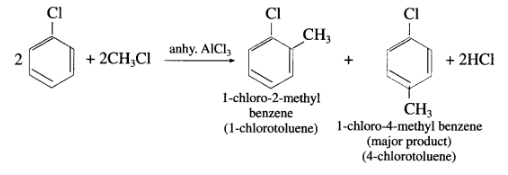
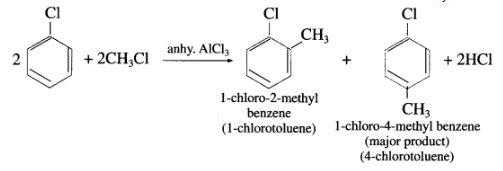
(1) Methyl chloride in the presence of anhydrous $AICl _3$ : When chlorobenzene is treated with methyl chloride in the presence of anhydrous $AlCl _3$, a mixture of I-chloro-4-methyl benzene (major product) and I-chloro-2-methyl benzene is formed. Since, the alkyl group is introduced in the benzene ring, the reaction is termed as Friedel Craft's alkylation.
Image
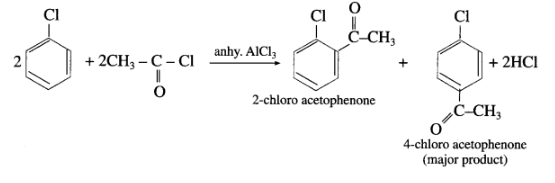
(2) Acetyl chloride in the presence of anhydrous $AlCl _3$ : When chlorobenzene is reacted with acetyl chloride in the presence of anhydrous $AlCl _3$, a mixture of 2-chloro acetophenone and 4-chloro acetophenone (major product) is formed. Since, the acetyl group is introduced in the benzene ring, the reaction is termed as Friedel Craft's acylation.
Image
View full question & answer
Question 73 Marks
Describe the action of the following on chlorobenzene :
(1) Methyl chloride in the presence of anhydrous $AlCl _3$
(2) Acetyl chloride in the presence of anhydrous $AlCl _3$.
Answer
(1) Methyl chloride in the presence of anhydrous $AICl _3$ : When chlorobenzene is treated with methyl chloride in the presence of anhydrous $AlCl _3$, a mixture of I-chloro-4-methyl benzene (major product) and I-chloro-2-methyl benzene is formed. Since, the alkyl group is introduced in the benzene ring, the reaction is termed as Friedel Craft's alkylation.
Image
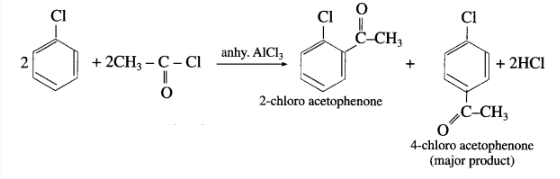
(2) Acetyl chloride in the presence of anhydrous $AICl _3$ : When chlorobenzene is reacted with acetyl chloride in the presence of anhydrous $AlCl _3$, a mixture of 2 -chloro acetophenone and 4-chloro acetophenone (major product) is formed. Since, the acetyl group is introduced in the benzene ring, the reaction is termed as Friedel Craft's acylation.
Image
View full question & answer
Question 83 Marks
Explain the following substitution reactions of chlorobenzene :
(1) Halogenation
(2) Nitration
(3) Sulphonation.
Answer
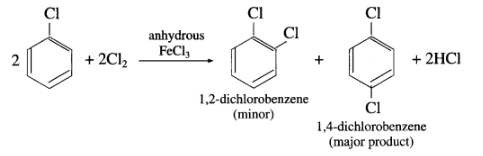
(1) Halogenation : When chlorobenzene is reacted with chlorine in presence of anhydrous ferric chloride, a mixture of ortho and para-dichlorobenzene (major product) is formed.
Image
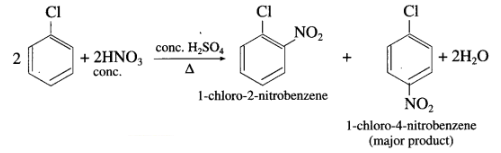
(2) Nitration : When chlorobenzene is heated with nitrating mixture (cone, nitric acid -1 - cone, sulphuric acid) a mixture of I-chloro-4-nitro benzene (major product) and I-chloro-2-nitrobenzene is formed.
Image
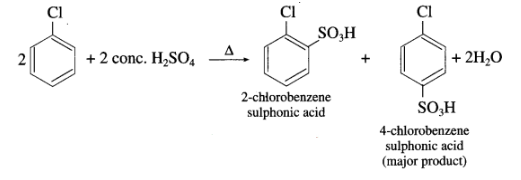
(3) Sulphonation : When chlorobenzene is heated with concentrated sulphuric acid, a mixture of 4chlorobenzene sulphonic acid (major product) and 2-chlorobenzene sulphonic acid is formed.
Image
View full question & answer
Question 93 Marks
How is Grignard reagent prepared ?
Answer
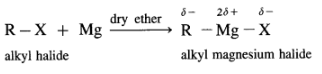
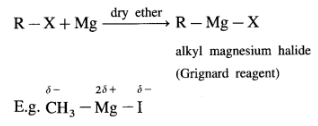
Grignard reagent is an alkyl magnesium halide, $R - Mg - X$ obtained by the reaction of alkyl halide $R - X$ with magnesium $( Mg )$ in dry ether.
Image
When an alkyl halide like $CH _3$ l is added from a dropping funnel to a flask containing pieces of pure $Mg$ in pure and dry ether (diethyl ether) and a trace of iodine, Grignard reagent, $CH _3- Mg - I$ is formed.
Image

Ethyl iodide when treated with magnesium in presence of dry ether forms ethyl magnesium iodide.
Image
View full question & answer
Question 103 Marks
What is a Grignard reagent ?
Answer
Grignard reagent: An organometallic compound in which the divalent magnesium is directly linked to an alkyl group (R -) and a halogen atom (X), and has general formula $R- Mg - X$ is called Grignard reagent. OR When alkyl halide is treated with magnesium in dry ether as solvent, it gives alkyl magnesium halide. It is known as Grignard reagent.
Image
The carbon-magnesium bond is highly polar and magnesium-halogen bond is in ionic in nature. Grignard reagent is highly reactive. It is an important reagent and used in the preparation of a large number of organic compounds.
View full question & answer
Question 113 Marks
Explain Saytzelf’s rule with suitable example.
Answer
Saytzcff's rule: In dehydrohalogenation reaction the preferred product is that alkene which has the greater number of alkyl groups attached to the doubly bonded carbon atoms.
Hence the number of alkyl substituents on doubly bonded Carbon atoms increases, the stability of the alkene giving its major products.

Hence the increasing stability of alkenes is.
Image
There are two types of fi hydrogens $\left(\beta_1\right.$ and $\left.\beta_2\right)$ therefore two alkenes are expected.
Image
View full question & answer