Questions

Answer the following in brief.

Take a timed test

12 questions · self-marked practice — reveal the answer and mark yourself.

Question 13 Marks
Write the preparation of potassium dichromate from chromite ore.
Answer
Reactions involved in the preparation of potassium dichromate from chrome iron ore (chromite ore):
Conversion of chrome iron ore into sodium chromate (Roasting):
$\underset{\substack{\text { Chrome iron } \\ \text { ore }}}{4 FeO \cdot Cr _2 O _3}+\underset{\substack{\text { Sodium } \\ \text { Carbonate }}}{8 Na _2 CO _3}+\underset{\text { Oxygen }}{7 O _2} \longrightarrow \underset{\substack{\text { Ferric } \\ \text { Oxide }}}{2 Fe _2 O _3}+\underset{\substack{\text { Sodium } \\ \text { Chromate }}}{8 Na _2 CrO _4}+\underset{\substack{\text { Carbon } \\ \text { dioxide }}}{8 CO _2}$
Conversion of sodium chromate into sodium dichromate:
$\underset{\substack{\text { Sodium } \\ \text { Chromate }}}{2 Na _2 CrO _4}+\underset{\text { (conc } \cdot \text { ) }}{ H _2 SO _4} \longrightarrow \underset{\substack{\text { Sodium } \\ \text { dichromate }}}{ Na _2 Cr _2 O _7}+\underset{\substack{\text { sodium } \\ \text { sulphate }}}{ Na _2 SO _4}+ H _2 O$
Conversion of sodium dichromate into potassium dichromate:
$\underset{\begin{array}{c}\text { Sodium } \\ \text { dichromate }\end{array}}{ Na _2 Cr _2 O _7}+\underset{\begin{array}{c}\text { Potassium } \\ \text { chloride }\end{array}}{2 KCl } \longrightarrow \underset{\begin{array}{c}\text { Potassium } \\ \text { dichromate }\end{array}}{ K _2 Cr _2 O _7}+2 NaCl$
View full question & answer
Question 23 Marks
Define acids and bases according to Bronsted$-$Lowry theory. Derive relationship between $pH$ and $pOH.$
Answer
$\text{J. N.}$ Bronsted and $\text{T. M.}$ Lowry $(1923)$ proposed a more general theory known as the Bronsted$-$Lowry proton transfer theory. According to this theory acids and bases are defined as follows:
Acid: Acid is a substance that donates a proton $\left( H ^{\oplus}\right)$ to another substance.
Base: Base is a substance that accepts a proton $\left( H ^{\oplus}\right)$ from another substance.
We know that the ionic product of water is given as:
$K_W = [H_3O^+][OH^–]$
Now, $K_W = [H_3O^+][OH^–] = 1 \times 10^{–14}$
Taking $\log$ on both sides, we write
$log_{10} [H_3O^+] + log_{10} [OH^–]$
$= log_{10} (1 \times 10^{–14})$
$= – 14$
Multiply by $(– 1),$ we get,
$log_{10} [H_3O^+] + {log_{10} [OH^–]} = - 14$
$- log_{10} [H_3O^+] + {- log_{10} [OH^–]} = 14$
Now $pH = - log_{10} [H_3O^+]$ and $pOH = - log_{10} [OH^–]$
$\therefore pH + pOH = 14$
View full question & answer
Question 33 Marks
Identify 'A', 'B' and 'C' in following chain reaction and rewrite the chemical reactions:
$CH _3 CH _2 OH \xrightarrow[B r_2]{ red \cdot P ^{\prime}} A \xrightarrow[\text { alc }]{ KCN } B \xrightarrow[\text { Ether }]{ LiAlH _4} C$
Answer
$CH _3 CH _2 OH \xrightarrow[ Br _2]{ red ^{\prime} P ^{\prime}} CH _3- CH _2- Br \xrightarrow[\text { alc }]{ KCN } CH _3- CH _2- CN \xrightarrow[\text { Ether }]{ LiAlH _4} CH _3- CH _2- CH_2 -NH_2$
View full question & answer
Question 43 Marks
Define electrochemical series and write its two applications.
Answer
EMF series is defined as the arrangement of the electrode with the electrode half$-$reaction in order of decreasing standard potentials.
$1.$ Oxidizing and Reducing Strengths: The electrochemical series helps to identify the substances that are good oxidizing agents and reducing agents. All the substances appearing on the top of the series behave as good reducing agents. All the substances appearing at the bottom of the table are good oxidizing agents.
$2.$ Displacement reactions: A metal higher in the series will displace the metal from its solution which is lower in the series. A metal higher in the series has a greater tendency to provide electrons to the cations of the metal to be precipitated. The metal having low standard reduction potential will displace the metal from its salt's solution which has a higher value of standard reduction potential.
$3.$ Predicting the Liberation of Hydrogen Gas from Acids by Metals: All metals having negative electrode potentials $(- E^\circ )$ show a greater tendency of losing electrons as compared to hydrogen. So, when such a metal is placed in an acid solution, the metal gets oxidized, and $H^+$ ions get reduced to form hydrogen gas. Thus, the metals having $- E^\circ$ values liberate hydrogen from acids.
$4.$ Predicting the Feasibility of a Redox Reaction: Depending on the $E^\circ$ values of the two electrodes feasibility of the given redox reaction can be found out. A redox reaction is feasible only if the species which has higher potential is reduced i.e., accepts the electrons and the species which has lower reduction potential is oxidized i.e., loses electrons.
$5.$ Calculation of the EMF of the Cell: If the $\text{EMF}$ of the cell is positive, the reaction is feasible in the given direction and the cell is correctly represented. If it is negative, the cell reaction is not feasible in the given direction and the cell is wrongly represented.
$6.$ Comparison of Reactivities of Metals: The relative ease with which the various species of metals and ions may be oxidized or reduced is indicated by the reduction of potential values. The metals with lower reduction potential are not reduced easily but are easily oxidized to their ions losing electrons.
View full question & answer
Question 53 Marks
Write postulates of Werner theory of co$-$ordination complexes. Write the name of a hexadentate ligand.
Answer
The first attempt to explain nature of bonding in coordination compounds was put forth by Werner. The postulates of Werner theory are as follows.
$1.$ Unlike metal salts, the metal in a complex possesses two types of valencies : primary $($ionizable$)$ valency and secondary $($nonionizable$)$ valency.
$2.$ The ionizable sphere consists of entities which satisfy the primary valency of the metal. Primary valencies are generally satisfied by anions.
$3.$ The secondary coordination sphere consists of entities which satisfy the secondary valencies and are non ionizable. The secondary valencies for a metal ion are fixed and satisfied by either anions or neutral ligands. Number of secondary valencies is equal to the coordination number.
$4.$The secondary valencies have a fixed spatial arrangement around the metal ion.
The name of a hexadentate ligand is $EDTA^{-4}$
View full question & answer
Question 63 Marks
Explain Wolf$-$Kishner reduction reaction. Write preparation of propanone by using ethanoyl chloride and dimethyl cadmium.
Answer
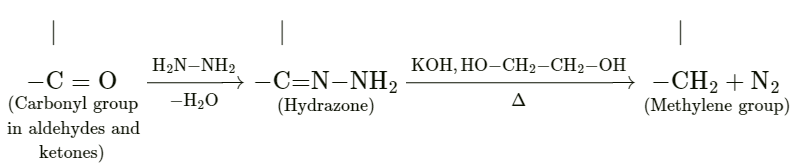
The Wolf$-$Kishner reduction is a reaction that reduces the carbonyl group of aldehydes and ketones to a methylene group $(CH_2)$ on treatment with zinc$–$amalgam and hydrazine followed by heating with sodium or potassium hydroxide in high boiling solvent like ethylene glycol $($Wolf$-$Kishner reduction$).$
Image
Wolf$-$Kishner reduction is used to synthesize straight chain alkyl substituted benzenes which is not possible by FriedelCrafts alkylation reaction.
The preparation of propanone $($acetone$)$ from ethanoyl chloride and dimethyl cadmium is a process that involves the reaction of ethanoyl chloride with dimethyl cadmium. In this reaction, two molecules of ethanoyl chloride react with one molecule of dimethyl cadmium to yield propanone and cadmium chloride as products. The reaction proceeds as follows:
$\underset{\text { (Ethanoyl chloride) }}{2 CH _3- COCl }+\underset{\text { (Dimethyl cadmium) }}{\left( CH _3\right)_2 Cd } \longrightarrow 2 CH _3-\underset{\text { Propanone(Acetone) }}{ CO - CH _3+ CdCl _2}$
This process allows for the formation of propanone, a ketone, through the acylation of the methyl group from dimethyl cadmium with ethanoyl chloride, followed by the elimination of cadmium chloride​​.
View full question & answer
Question 73 Marks
Arrange the following in the increasing order of the property mentioned:
$(i) \ HOCI, HCIO_2, HCIO_3, HCIO_4($ acidic strength $)$
$(ii) \ MF, MCI, MBr, MI ($ ionic character $)$
$(iii) \ HF, HCl, HBr, HI ($ thermal stability $)$
Answer
$HOCl  <  HClO_2 < HCIO_3 < HCIO_4$
$MF < MCI < MBr < MI$
$HF > HCl > HBr > HI$
View full question & answer
Question 83 Marks
For the reaction $A+B \rightarrow P.$
If $[B]$ is doubled at constant $[A],$ the rate of reaction doubled. If $[A]$ is triple and $[B]$ is doubled, the rate of reaction increases by a factor of $6.$ Calculate the rate law equation.
Answer
When $[B]$ is doubled $($and $[A]$ is held constant$)$, the rate doubles.
When $[A]$ is tripled and $[B]$ is doubled, the rate increases by a factor of $6.$
Let the rate law for the reaction be:
Rate $= k[A]^x[B]^y ...(1)$
From $(1),$ we can infer that:
Rate $∝ [B]^y$
So when $[B]$ is doubled, the rate doubles, which means:
$k[A]^x(2[B])^y= 2k[A]^x[B]^y ...(2)$
$2^y= 2$
$y = 1$
From $(2),$ given that $[A]$ is tripled and $[B]$ is doubled, and the rate increases by a factor of $6:$
$k(3[A])^x(2[B])^y= 6k[A]^x[B]^y$
$3^x\times 2^y= 6$
We already know that $y = 1,$ so:
$3^x\times 2 = 6$
$3^x= 3$
$x = 1$
Therefore, the rate law is:
Rate $= k[A][B]$
View full question & answer
Question 93 Marks
What is the action of following on ethyl bromide ?
$(a)$ silver nitrite
$(b) \ Mg$ in dry ether
$(c)$ alcoholic sodium hydroxide
Answer
$R - Br + AgONO \longrightarrow R - NO _2+ AgBr \downarrow$
Ethyl bromide $(C_2H_5Br)$ reacts with silver nitrite $(AgONO),$ resulting in the formation of nitroethane $(C_2H_5NO_2​)$ and silver bromide precipitate $(AgBr).$
$\underset{\text { Ethyl bromide }}{ C _2 H _5- Br + Mg } \xrightarrow{\text { Dry ether }} \underset{\text { Ethylmagnesium bromide }}{ C _2 H _5- Mg - B}$
The action of alcoholic sodium hydroxide on ethyl bromide leads to the formation of ethene via a bimolecular nucleophilic substitution $(SN2)$ elimination reaction, known as dehydrohalogenation. Under basic conditions and with heat, the reaction typically follows this equation:
$C _2 H _5 Br + NaOH \longrightarrow C _2 H _4+ NaBr + H _2 O$
Here, ethyl bromide $(C2H5Br)$ reacts with alcoholic sodium hydroxide $(NaOH)$ to produce ethene $(C2H4),$ sodium bromide $(NaBr),$ and water $(H2O)​​.$
View full question & answer
Question 103 Marks
Calculate the standard enthalpy of combustion of methane if the standard enthalpy of formation of methane, carbon dioxide and water are $−74.8, −393.5$ and $−285.8 \ kJ \ mol^{−1}$ respectively.
Answer
To calculate the standard enthalpy of combustion of methane $\left(\Delta H _c^{\circ}\right)$, we need to use the standard enthalpies of formation $\left(\Delta H _f^{\circ}\right)$ of the reactants and products involved in the combustion reaction. The combustion of methane $\left( CH _4\right)$ can be represented by the following balanced chemical equation:
$CH_4(g)+2 O_2(g) \longrightarrow CO_2(g)+2 H_2 O(l)$
Given the standard enthalpy of formation values:
$-$ Standard enthalpy of formation of methane $(\Delta H _f^{\circ}$ for $\left.CH _4\right)=-74.8 \ kJ / mol$
$-$ Standard enthalpy of formation of carbon dioxide $\left(\Delta H _f^{\circ}\right.$ for $\left.CO _2\right)=-393.5 \ kJ / mol$
$-$ Standard enthalpy of formation of water $\left(\Delta H _f^{\circ}\right.$ for $\left.H _2 O \right)=-285.8 \ kJ / mol$
The standard enthalpy of combustion $\left(\Delta H _c^{\circ}\right)$ can be calculated using the enthalpies of formation of the products and reactants according to the formula:
$\Delta H_c^{\circ}=\sum\left(\Delta H_f^{\circ} \text { of products }\right)-\sum\left(\Delta H_f^{\circ} \text { reactants }\right)
$For the combustion of methane:
$\Delta H_c^{\circ}=\left[(\Delta H_f^{\circ} \text { for } CO_2)+2\left(\Delta H_f^{\circ} \text { for } H_2 O\right)-\left(\Delta H_f^{\circ} \text { or } CH_4\right)+2\left(\Delta H_f^{\circ} \text { for } O_2\right)\right]$
Note that the standard enthalpy of formation for elemental oxygen $\left( O _2\right)$ is zero because it is in its standard state. Let's calculate $\Delta H _c^{\circ}$ for the combustion of methane.
The standard enthalpy of combustion of methane is $-890.3 kJ / mol -890.3 \ kJ / mol$.
View full question & answer
Question 113 Marks
Write chemical reactions involved in:
(a) Rosenmund reduction.
(b) Gatterman Koch formylation.
(c) Cannizzaro reaction of methanal.
View full question & answer
Question 123 Marks
What is osmotic pressure? How will you determine molar mass of solute from osmotic pressure?
Answer
The excess of pressure on the side of the solution that stops the net flow of solvent into the solution through a semipermeable membrane is called osmotic pressure. Consider equation $\pi=\frac{n_2 R T}{V}$...(1)
If the mass of solute in V litres of solution is $W_2$ and its molar mass is $M _2$ then $n_2=\frac{W_2}{M_2}$.
With this value of $n _2$, equation (1) becomes
$n_2=\pi=\frac{W_2 R T}{M_2 V} \text { or } M_2=\frac{W_2 R T}{\pi V}$
View full question & answer